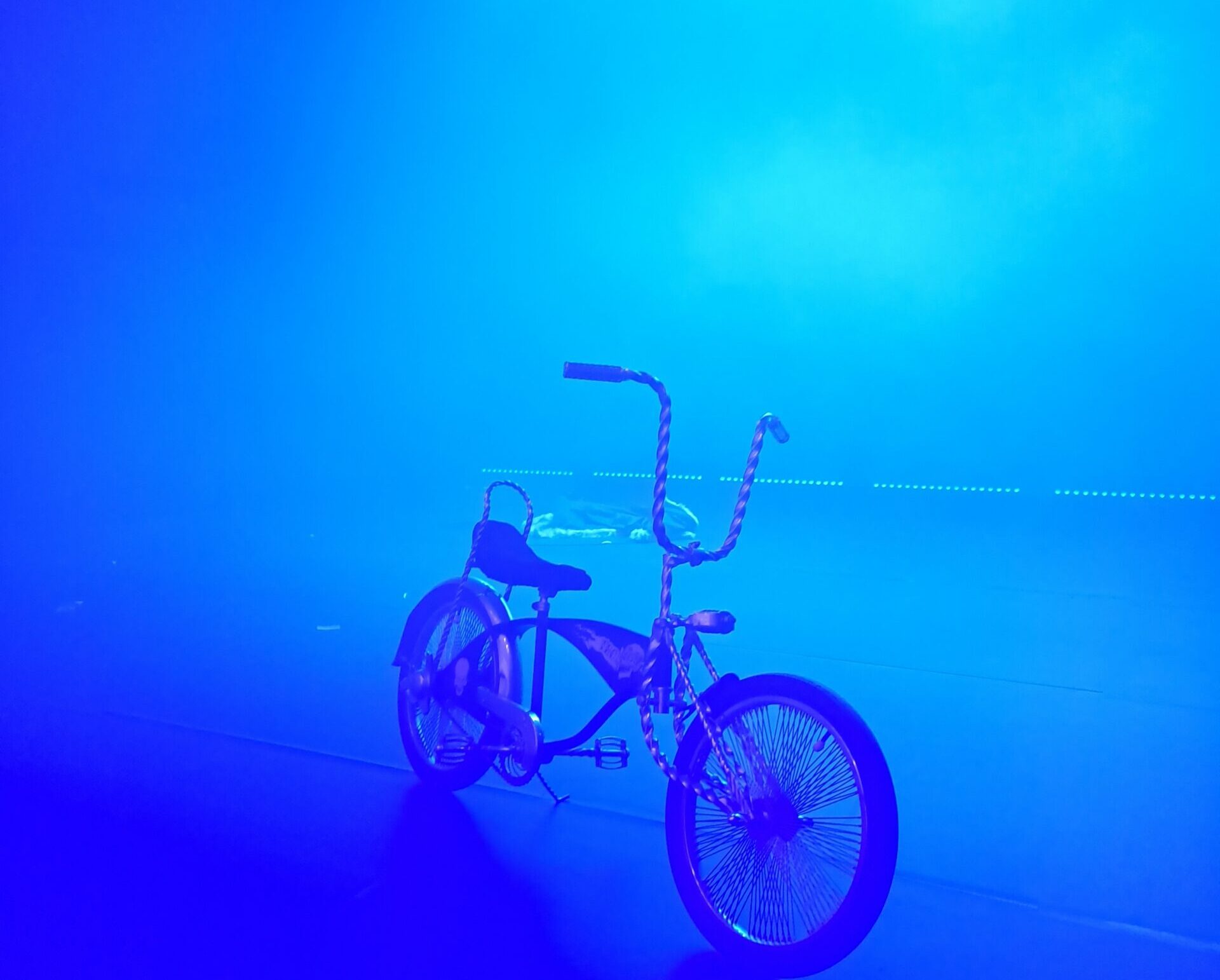
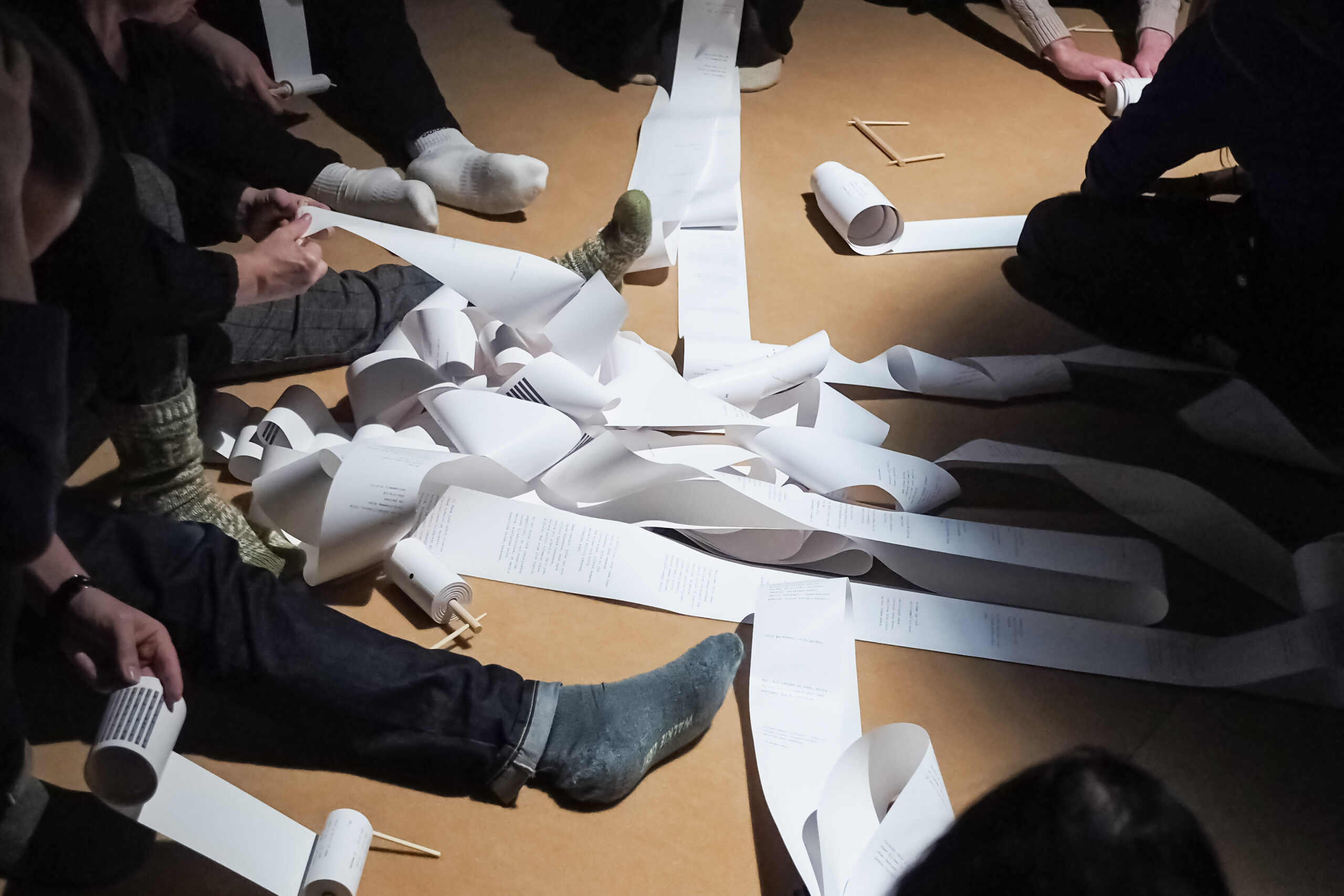
Conversation between Meg Stuart and Kerstin Schroth about Solos and Duets and the video works

Solos and Duets is an evening carefully composed out of excerpts of already existing works and small solos and duets creating a new performance. How was the idea for this evening born, that takes us on a time travel through a significant part of your body of work?

I wanted to show Inflamável, a duet I initially made in 2016 for ‘The Greatest Show on Earth’, which was a ‘21st-century performance-circus’ produced by the Hamburg Internationales Sommerfestival Kampnagel and Künstlerhaus Mousonturm (Frankfurt am Main). This short piece had not been shown anywhere else, and I thought it would be interesting to frame it next to a duet from my evening-length piece Until Our Hearts stop, which we call ‘The Punk Girls’. We have always been doing small-scale works as well as larger group pieces, so it was a matter of shifting to a different scale and sharing the pieces with new audiences, who would not have had the chance to see these works otherwise.

This idea of transmission works on many levels. In most of my pieces, there is a solo or a duet that could stand on its own in another context. Presenting these fragments in a different framework makes it possible to strip the work down and reduce it to its essential qualities.

As a program, Solos and Duets is so tight, and the pieces work so well together, that they really started to speak to each other. They connect in ways that aren’t obvious and offer another way of looking at those connections. For instance, the two duets (Inflamável and The Punk Girls) seem like total opposites. Inflamável is very stylized, with elaborate costumes and a sci-fi atmosphere, whereas The Punk Girls has a bare-bones setting. But they are both about a desire to connect, a longing, and a kind of friction. In each of these duets, the two dancers create a bubble of intimacy, so that they form a world unto itself – in that sense, the pieces are almost like a short story. The solos Oh Yeah Huh (a fragment from the 1995 piece No One is Watching) and Signs of Affection are also connected, insofar as they are both dealing with loss, erasure, desire, impossibility… The only one that kind of stands on its own is Maria Scaroni’s solo from Built to Last, which works on the notion of set and reset, a continuous shifting and transforming. When we created this solo Maria used the 1978 video of Yvonne Rainer’s Trio A as a starting point. Trio A is an allusion to how art can survive as a living archive, as a constant work-in-progress. So this solo aligns with the themes and materials of Built to Last, but it also works by itself.

In your work you often build communities with the artists on stage, almost like parallel societies to ours. Could you speak about this process and the research and desire when starting a new creation?

It’s a very intensive process, where we start with very little. We’re all sharing the same risk. Often we are in spaces where we’ve never been or doing actions that we haven’t done before, during a compressed period of time. That means that we’re also trying to transgress our normative way of doing things and of working together, which makes us quite interdependent. And in that container and exchange of ideas, we often ask for input from others.

I don’t know if it’s a parallel community, and I don’t know if it’s that different from how anyone else makes their work, to be honest. My collaborators bring their history, their aesthetics, and their questions with them, and that affects the process. We know that we meet through healthy tensions or dialogues, and not just through shared agreements. This dialogue shapes the work and creates collective questions that are open to a broader community.

Often, my works build on each other, so you could think of them as spin-offs of other dialogues or collaborations that continue to grow and deepen over the years. That is the case, at least, for the artists that are involved in Solos and Duets.

I try to look at people as a whole, and to take into account not only what happens in the studio, but also outside of it: the moments when we hang out together, or go on an adventure together, carry their own creative potential. Maybe it’s the process, or maybe it’s the kind of people that gravitate towards the work, but I find that these creations are very bonding. And because there is a lot of improvisation in the creation process, until the last minute and even during the piece, it feels as if this process is always fresh. It’s renewed and remade, every time we do it.

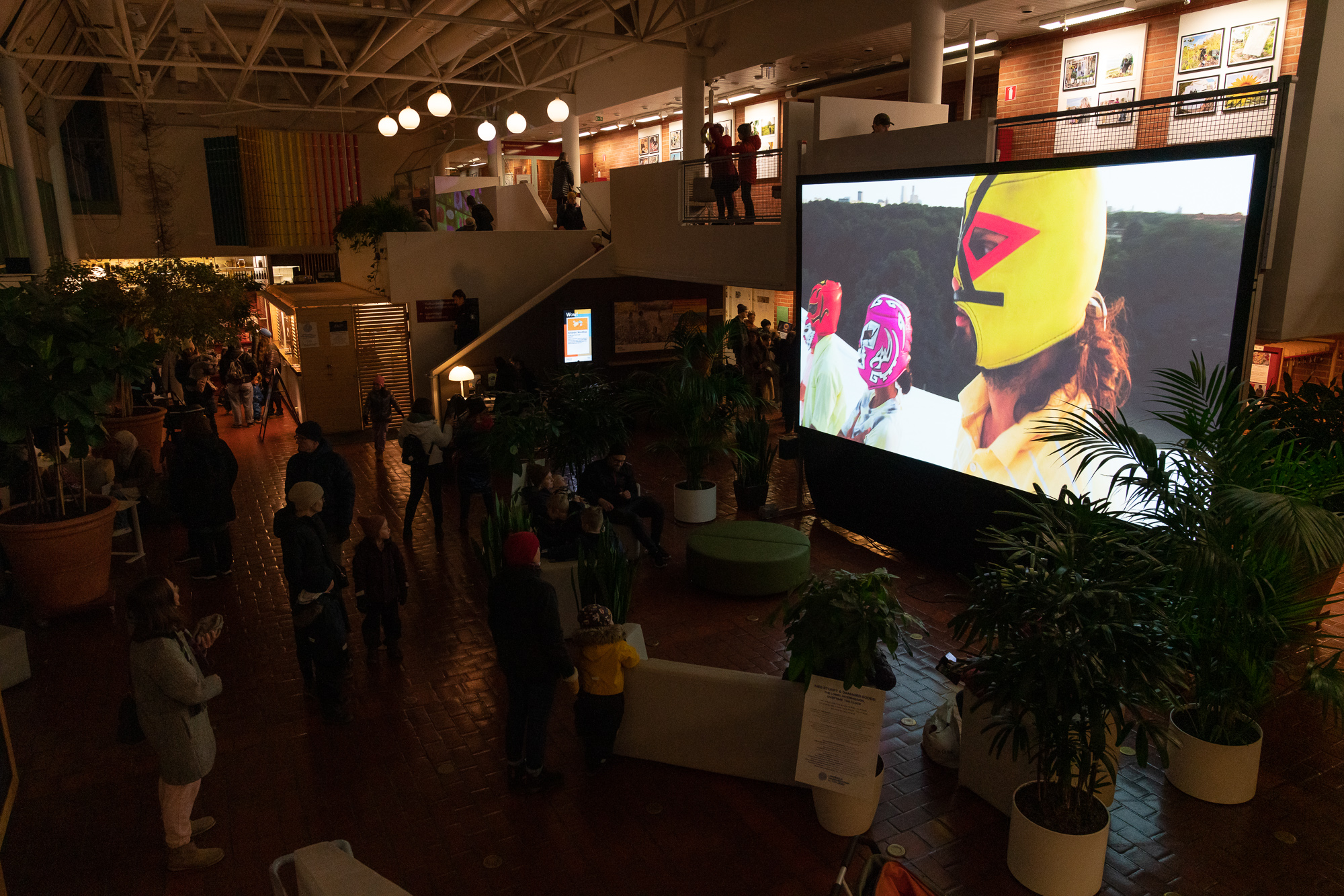
Parallel to Solos and Duets we are presenting video works by you in the foyer of Stoa. It was made in 2020 as a response to the current state of the world. Four videos situated at different sites in and on a mythic building in Berlin. A study on aloneness, togetherness, emptiness, hope, and the unknown?

This series of four videos, The Lobby, Intermission, Overtime, and The Clock, was commissioned by the Haus der Kulturen der Welt for an online ‘exhibition’ called CC:World. They are also about resilience, and about being connected over distance. Barbara Raes’ term – ‘unacknowledged loss’ – seems very apt here: during those first covid waves, people were dying, and it was not possible to honor or process these deaths as we normally would. Rituals were disrupted. Our habits were questioned: habitual connections, rituals, or gatherings that marked arrivals and departures, disappeared for a while. Of the four videos, The Clock addresses this most explicitly.

It was also very special to use a part of a cultural building which we wouldn’t be able to access under other circumstances. We performed for the clouds instead of an audience, and we used the lobby – normally a meeting point – to meet through our fantasies, imagining those things which were no longer taking place in the world. That brought a bittersweet sense of longing to the work.

However, these video works are not just about the loss and disorientation that we all felt during that time, they also have a lightness, a sense of humor. After all, Covid also opened up new possibilities; it allowed us to dream differently and to imagine new ways of life. When you see the dancers reaching for the sky, they are also reaching for that.

Photo: Petri Summanen

Conversation between The Hut working group and Kerstin Schroth about The Hut

The Hut is part of your long-term project and research Herbarium. Can you share with us the research- working- and collaborative process behind The Hut?

Jared: Thinking back to when it began seems like so long ago. The bigger project of Herbarium began in 2019 after we were invited by the Goethe Institute Colombia for a residency with Mas Arte Mas Accion in the Choco region of Colombia. There we met many inspiring human beings, rock beings, bird beings, plant beings, insect beings and animal beings…beings from the past, present and future. Everywhere we looked was knowledge and wisdom to be gleaned and embodied. And it’s there we (Angela and I) really met the fungi together for the first time. (I will often use ‚I‘ when answering these questions as I know we are all answering them and I don‘t want to speak for the others.)

I had a particularly special and intense experience one night with Jonathan Colin from Mas Arte Mas Accion. I asked Jonathan about glowing mushrooms because I had heard they might be around in the jungle. He said he’d seen them before, but it had been a while since his last encounter. After sunset one evening he invited me for a walk. We got our headlamps and put on our boots and walked towards the edge of their property, the threshold where the rainforest meets the food forest meets the beach meets the river meets the ocean meets the sky. We approached the area and turned our lights off and it was pitch black. We turned them on again to see where we were. Then back off. Suddenly a small green glow appeared on the ground below us. We turned our lights back on and ‘nothing’ was there. We turned our lights back off and slowly a green glow began to reveal itself to us. Along the forest floor, off to the side of us and in the distance. We turned our lights back on and still, we saw no mushrooms only decay. The decay was glowing. The ‘dead’ leaves, the broken branches, the fallen trees. Even the tall tree standing before us was glowing all the way up its trunk. It was the mycelium connecting everything. Suddenly the glowing green was everywhere, speaking to us, teasing us, joking with us, showing itself to us. Jonathan spoke of the spider with one glowing eye that hangs out on the ground and beholds…there it was. The fireflies lit up the air around us and we started laughing and couldn’t stop. He then invited me for a swim in the low tide of the Pacific Ocean. The Milky Way swimming above us. The lightning storms in the distance all along the horizon. We went into the ocean, already dizzy with joy, and our bodies began to glow. All around us, with every movement the microscopic animals swam with us lighting us up and mirroring our forms. Light shining and glowing around us, underneath us, above us, and seemingly out of us from our joy and wonder. Afterward, I couldn’t stop laughing for two or three hours.

The magic of the glowing mushroom deeply moved me. They are light bringers. Angela and I went to visit the glowing spot again and began dreaming with it as a source of inspiration and a kind of initiation into the fungal queendom. We met many other fungi during that time, including a glorious choir/cluster/symphony of Turkey Tail which was growing out of a fallen log over the creek in the rainforest. There we met and felt a strong sense of joy and playfulness. From there we began to articulate our desire to meet the fungi more deeply.

When we met with Kerstin Schroth in 2019, about possibly creating something with Moving in November, one of the common and inspiring points was that we all wanted to work on long-term projects that lived outside of the theater.

The Hut itself was born out of a zoom meeting with our working group. We knew we didn’t want to ‚just’ make a piece about mushrooms. Our encounters with them already pointed us in the direction of other forms and formats, other timelines, shapes, and processes that take their own time and lead us into something else.

Angela and I often work ‚alone’, however, we knew for this project we needed to reach out to others and create or strengthen new connections. We had met Alm Gnista through our friend and colleague Shelley Etkin. So with Shelley, Alm, and our long-time musical collaborator Stefan Rusconi, we knew we had a great team to dive into the understory together. In my memory, Alm was talking about log cabins in Finland as an inspiration. I think I asked if it would be possible to inoculate a hut, and the ideas and logistics just kind of unfolded from there. Again, I might remember that totally wrong. I hadn’t even met Alm in person yet, but we began our collaboration by dreaming BIG together. ALL of us.

Since that meeting, we have all been encountering, learning from, and researching fungi and their partners independently. We are not living in the same place, so we followed different streams of interest. Even before The Hut, we knew we wanted to inoculate a piano for Stefan to ‚play‘. He has been building a new machine to connect with fungi and produce sounds and rhythms. Shelley has been tracking and tracing all of us independently through language. Alm has been busy all year sorting out the spores and the ‚guest list‘, what else the hut might need, and how to best support it in its fungal decay and growth.

Prior to that meeting, we‘d had a residency with Moving in November in 2020. It was a generous time (during the pandemic) and was used mainly to look for potential locations for Yew: outside and Yew: kids. Along the way, while we scouted with our bikes and feet, we were meeting fungi and the November weather of Helsinki along with the plant life and the autumn life.

Angela and I returned to Choco, Colombia at the beginning of this year for a project with the local community and lost knowledge (called The School of Lost Knowledge). There we spent much of our time meeting and re-meeting the incredibly diverse fungi living on the coast and in the jungle. There was a giant Mango tree next to where we were staying which was home to at least 15 different species of fungi and while we were there, they were showing their fruits and sharing their processes. While we were in the rainforest, Alm was hunting the winter forests of Finland for the most optimal hut. He found one that we all agreed would be the most suitable for the project: good price, good size, good condition, not too far away, and over 100 years old. Shelley was speaking to each of us, listening to what we are learning and experiencing. And Stefan was finding out how to build a machine for the first time.

In May, Stefan, Angela and I came to Helsinki to perform our earlier outdoor works (YEW: outside and YEW: kids) and stayed for a residency in Alm‘s place for about a month. While working and learning there, we moved the hut log by log from the place where it sat for the last 100 years and placed it in Alm‘s yard. At the end of our stay, we brought the bottom of the hut to Stoa‘s courtyard to construct the base and plant a wildflower garden in it. We also inoculated the wood of the hut, the piano, and the logs that we had brought with us. These logs were buried halfway in the ground and stuck up like a kind of forest. The plants were important for the soil and mycelium, allowing place and space for connection and transference. At the end of September, the hut will be completed and built back into its original form.

The main idea was to co-create a space, a living space that we could inhabit and share with other beings and processes. We wanted The Hut to be the piece itself, a piece about growth and decay, regeneration, connectivity and encounters, the unseen, and of course the fungi queendom.

Shelley: The Hut has been evolving as a material architecture as well as an imaginative space. Both these aspects have facilitated us as a working group to envision and labor towards a place that makes encounters and learning experiences with fungi more possible and accessible.

We have wondered and mused about it, visualized it, drove it around, touched it, hauled it, placed it onto different grounds, reconfigured it and reconfigured it again, meditated inside it, inoculated it, watered it, planted into it, visited it, left it alone, entered and exited it, played music and danced in it, written in it, read in it, spoke in it, envisioned its pasts and futures over and over again.

Still, all these actions do not make us masters of The Hut. The ‘we’ here extends far beyond ‘us.’ These are some of the ways that the hut has been weathered, but much more has been part of the process within and behind this hut’s life because that is what The Hut is: a living being.

Alm: For me, The Hut was not created through a collaborative- or working process, but the process itself organically grew into The Hut. These processes have very much been focusing on giving space for The Hut to materialize, and just as the working group has been giving space to The Hut and all its entities, I see that we have been learning how to exist as full entities as well, however small those might be.

For me, part of the research lies in being and finding what I am, human in the possible multiplicity of its meaning. How to enable that, in the midst of a multitude of voices and movements, human and more than human, and witness those ring out as well. Since the idea came to be, we have all been working on our separate processes, which started as for The Hut, but now come together in The Hut. Some processes and people have become more entangled than others, and during our meetings, we have not so much constructed a project but witnessed where we are and how it grows. The Hut is a fruiting body, and we and all its entities have been part of the conception, in times as the ambiance, in times as the hyphae seeking to find that state and place, when and where fruiting is possible and vital, in times even as the potent zygote, ready to burst into multiplicity.

For me, The Hut, both as a body, an agent, and as a process constantly inspires new ways of relating. I believe that relations are intimately connected to knowledge, as a human exploring social and cultural encounters my knowledge both conscious and subconscious alters how I experience and relate to my surroundings, and vice versa, my relations alter my knowledge. To me, these are the underlying processes of The Hut, both research- work-, and collaboration-wise.

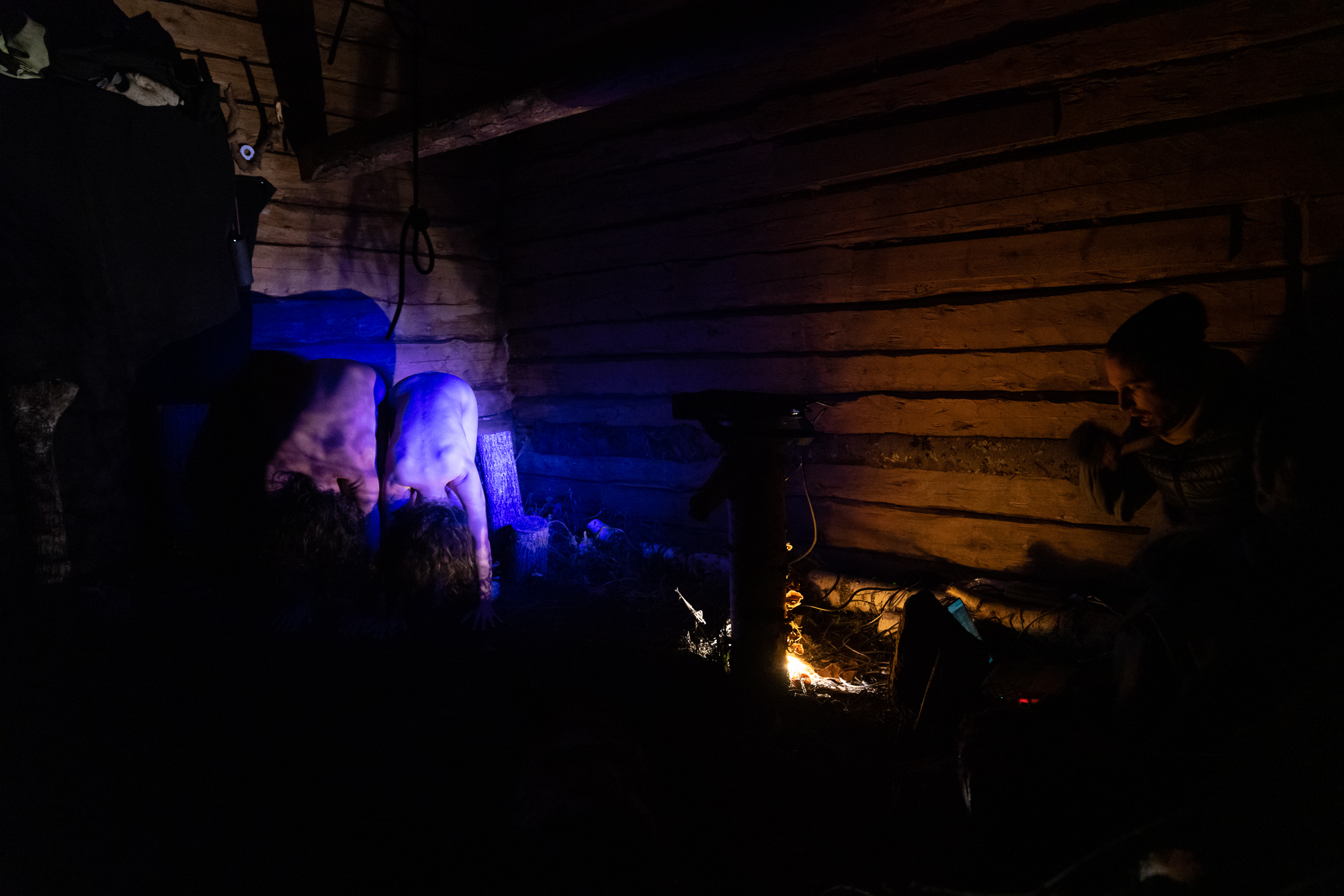
Stefan: Jared, Angela and I have been collaborating on several pieces in collaboration with nature but for me, it’s the first time we actually built a garden, we actually started (?) a garden – The Hut is a garden to me. My main focus lies in understanding more about Mushrooms. How they grow and build networks, why, when, how they fruit, what it means to me to meet them in The Hut, and since I’m the musician in the project what this means to me when it comes to music. In the pieces we developed together before, I had a device that could measure micro-fluctuations in the conductivity of a plant and translates it into (MIDI) data that I could use for musical sonification. But in this project, that didn’t go far enough for me. I wanted to figure out how to translate these plant impulses into movement and light. For me, the process of listening to music has something very introverted, something that throws me back on myself, and I dissociate in a way. But the movement of a machine, triggered by impulses of the plant has again something very present. Space and time can be experienced very directly and as a spectator, I begin to understand “life” in a different way. Nature is life, is living, is movement is fluctuating light. So I developed a machine that could implement this. The Mushroom Piano was born.

Angela: For me it all started with a glowing mushroom in the dark in the Columbian jungle night and the desire to make a dance duet, that the audience would witness in the dark, surrounded by those mushrooms. Something magical and light in those mushrooms and suddenly the mushrooms became the core being for our Finland „Herbarium“ project. For me, the mushrooms are unknown creatures and have a very different energy than plants I am more used to being with. It was definitely unknown ground. From the outside, the mushrooms always have something hard, repulsive, and terribly foreign. But when I closed my eyes there was joy and happiness. This joy surprised me over and over. It’s so cheerful. I met the true outlaws, wayfarers, trackers, globetrotters, party people, the eternal tourists, that were so happy to be on this planet, yet not interested in owning, occupying, land or property. „What is the morbid feeling I get?“ I kept on asking. „Morbid is your sentiment, not ours.“ They kept saying. „But all is slimy, rotten, revolting…“ I kept saying, „Are you kidding us? This is great!!!!“ They kept saying.

I loved how they were breaking with the idea that the weaker needs to be strong and how they were pulling me into a steady movement with no settlement and growing into my folds. Loved, how their joy couldn’t penetrate my sadness but how my joy could join their joy in a multitude, and when I was stable like a tree, rooted, they came to dance on my skin with tickle energy. They are not the same listeners as the trees. Or even like me, like us, human beings. We are listeners and we need to learn to listen they repeated over and over. That´s what we tried to do.

Can we speak about the overlap and interwovenness of your artistic work, zooming in on plant knowledge and the own dynamic plants have?

Jared: All Plants have their own unique signatures and dynamics and wisdom. Phenomena such as blossoming and decay do as well. Fungi also have their own dynamics and timings and rhythms and ‚individual’ relations. They are connected with basically everything, even the weather.

Plants have brought me into another relation to time and have opened me up to a wider/expanded reality in my life and work. In the work with Angela, the plants transformed our bodies. They guided us into a new movement making and another kind of decision-making. They taught us to relocate, to trust in the unknown, and be open to other forms. Sometimes they bring me into such clarity; partly because they themselves are so clear, with their reasons for being here, clear with their directions and needs. Sometimes they open up a realm behind them, behind the physical realm which allows for another type of imagination and inspiration and sometimes leads us to a new intuition. Some of these teachings/learnings have been integrated into our artistic practices/works, some were already there and have just become more present and articulated.

From working with the plants and fungi in different capacities, I’ve become inspired to join their time and ‚thinking‘. I’m seeking to join or develop regenerative practices and products that feed back into something somewhere somehow; benefitting the whole or at least parts of it. I’m interested in long-term commitments of mutual learning sharing and dedication. I want to join at that time. Those rhythms and dynamics while losing the tight reigns of human-centric creation in hopes of cocreating another way, more in line and in flow with natural phenomena.

Shelley: Plants are my oldest friends, my greatest teachers, and my longest-term relationship. The wisdom of plants is endlessly complex and I am endlessly curious to keep listening, becoming familiar, unfamiliar, and re-familiar with the knowledge they embody and how I might learn to embody them as well. Fungi and plants have been collaborating for a very long time. This phase of artistic research has offered small hints of insight into their intertwined existences. My work with plants is also deeply informed by medicinal perspectives steeped in an understanding of healing as an ongoing process taking place not only on individual layers but socially and structurally as well. How might the co-creation of this hut be a container to host these considerations towards rebuilding our relationships with/in fungal and plant worlds?

Alm: For me, the emphasis has always been on the fungi, and how we all draw from them, how we all learn from them, how they evolve us and teach us, nurture us, and decay us. Whether we want it or not. The Hut is both an artwork and an artist, a space for performance and a performer as well as a ground for encounters and the fungi are the inspirer, instigator, facilitator, and even the audience and subject.

I actually went into the topic of this question in the answer to the previous question already, but I could continue to say that for me when trying to work with a project where the aim is to give and share space with more than human, the way I relate, connect and let go comes into play a lot. Humans and fungi share an evolutionary line, more so than they do with plants, which separated into their own group further back in time. I’ve often experienced that I connect with plants but connect to fungi even on a physical level, plants grow outside of our bodies, while fungi grow on and in our bodies.

So how does the artistic work overlap with knowledge of plants, fungi, rock, algae, bacteria, and the dynamics they exercise or share? Naturally, there is a core of cooperation, which might also extend into mutualism. It seems clear to me that no life would exist without cooperation, and if I ever learned anything from the fungi, I’d like to believe it to be a viewpoint where I don’t view life or the evolution of life as a mere fight for life and death, but as a collaborative dance of mutualistic interdependencies.

Finally, I´d like to add that it is also a lot about consciousness. How can we perceive, communicate, and acknowledge the consciousnesses or the consciousness of all involved?

Stefan: The plants send me a flow of information that has no beginning and no end. So what I depict musically in performance is only a snapshot. I find this fact exciting. Jazz and improvisation, where I come from, I understand similarly. There you become part of a movement, an attitude. Fugues by Bach can be understood in a similar way. You should play them as if they started way before the actual notes and never stop. This gives the music a completely different dynamic. As an active listener and spectator, I experience a brief temporal glimpse of something that began long before my time and will survive me by far. There is something very beautiful and comforting about that, I think.

Angela: Plants can’t push with their will and that creates another dynamic and another time. three months for creating something is nothing. Growing, decaying, learning to listen, and teaching each other all take their sweet time. I am always so drawn to being moved and being lived by other forces than myself, because I guess I felt so bored and isolated within myself, trapped sometimes. And plants have such a beautiful way of being so abundantly specific and idiosyncratic each and every one of them but also always being connected.

So everything is just growing from there. First the desire to create a movement language, a dance. But then also to create the space for this language. Or to co-create together which then suddenly informs all: the way we create, in which space we perform, what performance is, what process is. This is just beginning to be honest.

Building The Hut was also a challenging experience in terms of how much energy it takes to materialize and build something so solid, and stable as this wooden hut. It is different from dancing and requires other skills that I am not sure I am the best partner for. It was a humbling experience. It made me admire humans, that have that ability to manifest in those ways. And I am curious to hear what plants and mushrooms have to say about all this in the future.

What will happen with The Hut after Moving in November? An artistic project that was conceived as long-term.

Jared: To be honest this is one of my favorite aspects of the project. In our field of work, there isn’t often much thought going into what happens to the sets and costumes and things we buy for production. It’s understandable, but my feeling is that this needs to change. In a sense, this work is focusing on that dilemma and we have helped to prepare it to return to the earth and transform it into knowledge for the younger generation.

The Hut has been in the courtyard of Stoa since June, growing and decaying and bringing in new life and energies. Alm works as a teacher of ‚forest’ and ‚lost knowledge ‘ in Töölö, the Swedish-speaking gymnasium. Thinking about the future, we had the idea to bring The Hut to the school as a part of their curriculum and then to rebuild The Hut as a classroom/ laboratory/garden and mushroom garden, where they can participate in and witness the forestal interactions within the city limits. Learning from the mushrooms and other beings that will be inhabiting it. So basically, this work has been preparing a classroom for learning and growing and decay.

Shelley: The intention was always a regenerative one. It’s not about making a thing that will shine and then be discarded. We adopted a structure that was standing empty of human inhabitance for some time, but already existed as a house and previously to that a forest; each log a timber of many trees. By moving it through the context of Moving in November, the wish was to transform it into a house of fungi, repurpose it as a temporary sanctuary for meetings in various forms, and ultimately gift it to the ground where it can humbly decompose. The Hut has certainly schooled us in many unexpected ways throughout this process. The wish is that it continues serving as a vividly decaying classroom for others, a fungal bouquet for the soil and land it lives on and with. Stewarded by Alm’s offering of a course on lost knowledge, it is being adopted next by a local high school. The Hut’s history is extensive, we will have been a strange and devoted moment in that broader time span, yet its futures are still unfolding in ways beyond our knowledge or control. We don’t know how those interactions will go; between root and hyphae, place and people, structure and deconstruction. Nevertheless, we strive to tend to The Hut in a way that will support its connectivity to regenerative contexts and processes.

Alm: One could say the project started a few centuries back with small pines growing, then being felled, and made into a hut, a century back or so. And now, this hut has been invited to, or directed on, a path of increased decay instead of preservation. For a short-lived organism, The Hut might still be a host for the entity of its life, maybe even for several generations of that organism. For a human, one might follow the hut for the rest of The Hut’s lifespan, even if decay were to take decades, and for some of the stones which have supported the hut during the past century, who have seen millennia, even eons before that, the acquaintance with The Hut could be seen as brief. Some of these stones still inhabit The Hut and will accompany it for the rest of its being.

The Hut
will stay at Stoa for a while, then move on to Tölö high school to continue to be a garden and a classroom for encounters between fungi, plants, humans, and all that join in. When The Hut has rested in Tölö for some years, it will be moved to a final destination to de- and regenerate into the unknown.

Stefan: The Hut as a research and learning experience will not stop for me. Getting to know the different processes of the mycelium and their regeneration, decomposition, networking and interlacing work better and implementing them in a closed system is also instructive for my artistic processes. I found the collaboration with mycologists, foresters, music machine builders and programmers very fruitful. Especially the approach to this work in the dark at night with fluorescent fungi and mosses is exciting for me.

Angela: The Hut will continue to be a house for all kinds of beings and creatures and will become a classroom for teaching students. We will all stay connected with The Hut and will make sure it lives on in many forms, known and unknown, seen and unseen.

Photo: Petri Summanen
Conversation between Calixto Neto and Kerstin Schroth about Feijoada

During Moving in November 2020, we saw you as a performer in the solo “O Samba do Crioulo Doido” by Brazilian choreographer Luiz de Abreu. We also showed a movie made by you about the working process with Abreu after. What influence has this encounter and performing the work by Abreu had on you and your own choreographic work? In another interview, you said that there is a before and an after of “O Samba do Crioulo Doido”. 

I don’t know if I can say for sure how this work will impact my path. Maybe I can answer that in some years, seeing my path in perspective. Of course, I want to believe that there was a transformation in my way of thinking and working, that I can somehow inherit (or learn with) the sophistication and geniality of Luiz de Abreu. I like to think that something more than a dance piece has been transmitted to me when we were working around O Samba do Crioulo Doido. Somehow this is the way to think about learning and legacy, that’s the history of culture itself.

But those are not more than desires. There are no rules to this transmission, learning, legacy… I don’t know if it works like that at all. If it will happen to me. But I can rely on hard work with honesty and engagement. That is what I have, beyond all speculations if I have changed or not.

So I try to do my best, being fair with this role of being the dancer of O Samba now, considering this piece as a tool of reading the world. Because I consider that there is a responsibility on it. It’s like O Samba is a line, that once I have crossed it, I have an engagement with the discussion that the piece brings, keeping it as deep and sophisticated as possible.

Feijoada transports culture-historical friction deeply inscribed into the self-image of Brazil. In the center of this performance stands a famous dish: feijoada. At the end of the piece, you serve the dish to us. With it, we seem to eat altogether a part of Brazilian history. Could you tell about the urgency behind the development of this work?

When Feijoada was created, we were in the end of the worst part of the sanitary crisis caused by the covid-19. Almost two years with social distance ruling our lives. When the invitation came from Festival d’Automne à Paris to join choreographer Lia Rodrigues’ portrait, I knew I needed to do something where the audience would be invited to be together, to share something more than the experience of seeing a piece, a moment of celebration.

During the pandemic, I remember going to my favorite Brazilian restaurant in Paris and meeting a community of expats (or migrants, depending on whom we are talking about) insuring their mental health by the stomach. That informed me how important food is to creating community and the feeling of belonging. Rooting.

After making a film about the transmission process of O Samba do Crioulo Doido, I still felt the urge to give an artistic response to that experience, a kind of wrap-up of this “samba-do-crioulo-doido” universe. So I had the reenactment of the piece and the film about the transmission process. I wanted to create a piece that would somehow give continuity to one of the discussions that O Samba propose. As a work that flows from another.

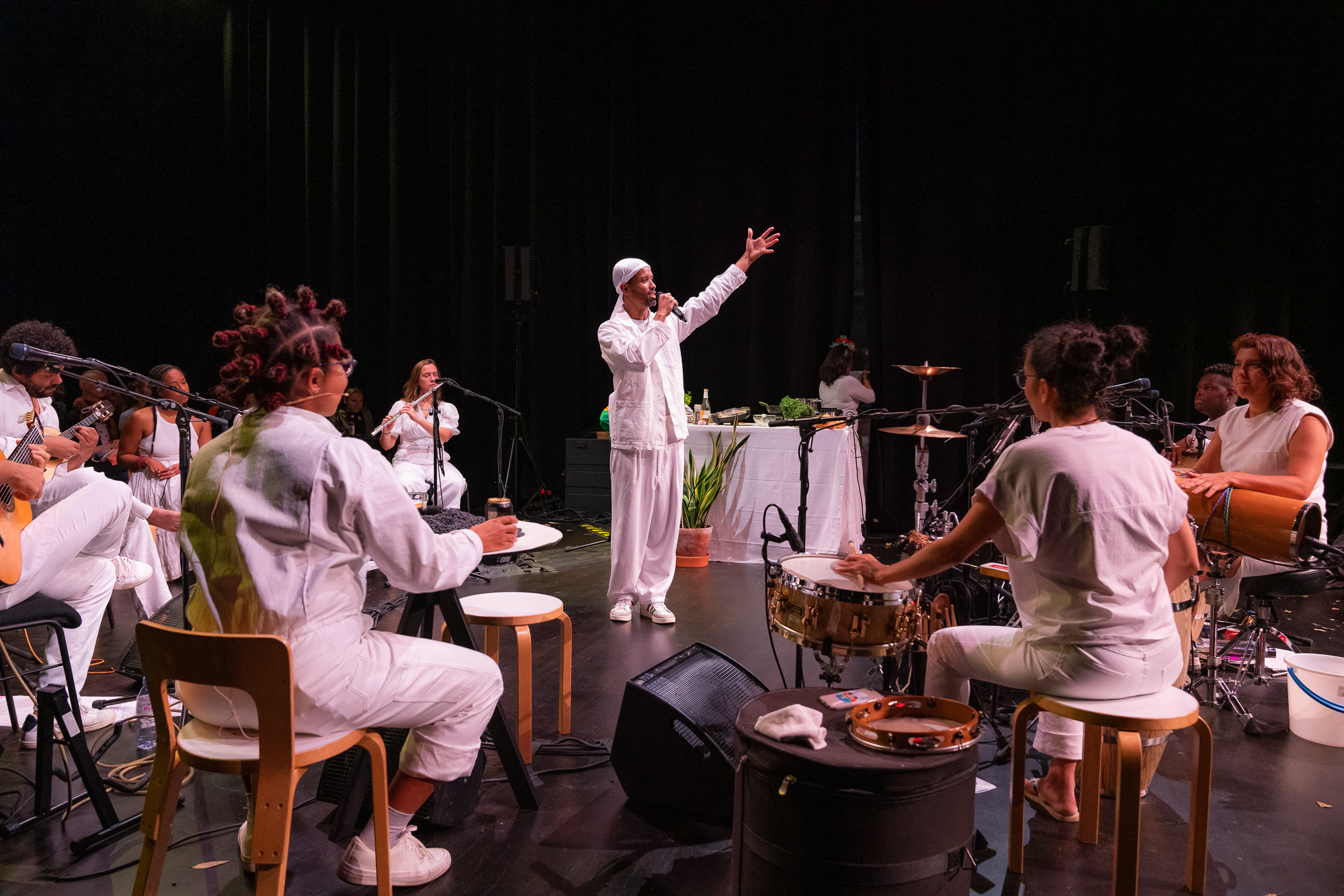
I always felt very intrigued by this scene where Luiz dances a Bossa Nova, in which the lyrics are a recipe for a feijoada, sung in French. There are so many layers of appropriation, violence, and joy in that scene, that I wanted to dig into it and explore those elements.
At the same time, I wanted to connect to this kind of basicness of the experience of samba and feijoada that I have in my childhood memories. So there is the most popular formation of musicians playing samba, the circle of ( Roda de ) samba, someone cooking a feijoada while the party is happening, as we use to have in Brazil. And I wanted to say things, I had this urge to share some thoughts by talking to the audience, looking into their eyes, being close to them, to connect to the idea of violence and joy that I see in the scene of O Samba, but in a very close and welcoming way, inviting the audience to a discussion that belongs to everybody.

I always thought Feijoada was an experience with a lot of words, that the choreographic thought on this work would rely on how we would be able to manipulate the atmosphere of the performance throughout the two hours of the show by our presence, our relation to the audience, the ton of the texts we were saying, and so on. I was always interested in what an ex-teacher of mine once called “the choreography of the welcoming”, referring to my very first solo work.

And Feijoada was created in strict collaboration with Ana Laura Nascimento, who is a storyteller, so with very practical relation to the word. And we both had this urge to say things, share questions, address problems, expose and share the discomfort.

In each city/country you show the performance, you intend to work with local performers and a cook from the afro-diasporic community. What does working with artists from the local communities do to the performance and your team?

I don’t know! Helsinki will be our first attempt!

This idea came to us at the very beginning of the work of writing the score of the piece.
What I and Ana Laura had in mind at that point was that by doing this work and showing it in different places, Feijoadawould be a bridge that would connect the Brazilian community through the cities where we would be invited to show the work. Knowing that the Brazilian diaspora is very spread across the world (and especially in Europe, where we all live now), we wanted this work to be a common point between those artists. So we imagined that we would always work with someone who works with Brazilian food in the town and have two local Brazilian performers with us.

We slightly changed our plans by working with Silex Silence, a Cameroonese performer based in France, that is part of our (French) team. We realized that there is a common heritage that connects us, and the histories we share with the audience, even if they come from our Brazilian experience, they can resonate with the experiences of the people from Africa or the diaspora.

So this experience opened our minds to the possibility of having performers from other origins and we count very much on them to be the closest connection between the performance and the local audience. Through language, specific facts, or their thoughts and impressions of the local society. This familiar aspect of the performance is very important for us, so having someone that is closer to the local culture is very precious to the constellation of artists that we have in Feijoada.

Also, I have the impression that it will be a gift for our team as well, to get in touch with local artists and get to know how they live their lives, and how living in this specific place shapes their thoughts and artistic practices. And put all that side by side with our experiences.
This experience needs to be made in partnership with the direction of the festival or venue where we would present because we need some local knowledge to introduce us to the artists and the new cook. Also, it is a kind of idea that demands previous work: writing new texts, e-meetings, rehearsals. It’s not simply rehearsing the piece one day before the show but changing a bit the structure and content of the work. Even if it’s small work, there is work to be done. And the festival needs to be engaged to make this additional work happen.

So we are very excited that Moving in November accepted to partner with us in this adventure to show the piece in the way we conceived it.

Photo: Petri Summanen

Thank you for the shared time!

Thank you for the shared time! Thank you for attending and participating in Moving in November 2022. Thank you for your good feedback and enthusiasm for this year’s edition!

It was a truly special moment to present this year’s program with artists from abroad and from Helsinki to you. Engage in conversations and build further connections.

An edition concluding two special long-term projects: The Hut by Jared Gradinger, Angela Schubot, Stefan Rusconi, Alm Gnista & Shelley Etkin and Nature Untitled by Veli Lehtovaara, Eija-Liisa Ahtila & Jani Hietanen, projects we started talking about already in 2019. It’s nourishing to see and share these outcomes that have been a travel of exchange, inspiration, trust, and engagement throughout these years between the artists and us.

We are more than content about the presented works, that involved local performers and created an intensive dialogue with the local performing arts scene, Feijoada by Calixto Neto, Time has fallen asleep in the afternoon sunshine by Mette Edvardsen and DAWN by Sheena McGrandles. We want to especially thank the local artists Geoffrey Erista, Edit Williams & Carolina Florio Castro, Freja Bäckman, Satu Herrala & Mikko Hyvönen and Herman Nyby, Kauri Sorvari, Riikka Theresa Innanen & Alen Nsambu for their engagement and trust and of course the artistic teams around these works.

Moving in November continues spreading over the Helsinki area. Finding the right location for each work we like to present. We leave our traces, not only in your memory but hopefully also in the areas Moving in November’s program appears. The Hut for example can still be visited from the outside at Stoa’s square for a while before we move it to a gymnasium in the Töölö area to become an unusual classroom.

In case you are in the mood for Moving in November´s afterglow, the Instant reflections by Nina Vurdelja on the works presented during the festival are up. And don’t forget to listen to Memory Garden by Jared Gradinger during your next walk.

For now, a warm and big thank you to the artists and their lovely working groups, that presented their works during this year’s festival! Namely: Calixto Neto, Jared Gradinger, Angela Schubot, Stefan Rusconi, Alm Gnista, Shelley Etkin & Suvi Kemppainen, Meg Stuart & Damaged Goods, Jeroen Peeters, Mette Edvardsen, Veli Lehtovaara, Eija-Liisa Ahtila & Jani Hietanen, Eisa Jocson, Sheena McGrandles, Tuomas Laitinen, Cherish Menzo and the hosts of the Soup Talks: Antonia Atarah, Karolina Ginman, Anna Talasniemi, Paul O’Neill, Vincent Roumagnac, Maija Mustonen, Anna Kozonina, River Lin and Otso Lähdeoja.

And equally a warm and big thank you to our partner venues for hosting us and thinking along and to our funders for their support.

Warmly,
Kerstin Schroth & Moving in November team

We would appreciate for you to answer our visitor survey. It is short and sweet, takes only about 2-5 minutes of your time. By taking part you can win a book by Jeroen Peeters or Mette Edvardsen. Answer here.

Photo: Kerstin Schroth

Instant reflections VIII by Nina Vurdelja

Instant reflections is a series of notes and remarks by Nina Vurdelja about Moving in November festival 2022. These texts will be published throughout the festival.

Nature Untitled by Veli Lehtovaara, Eija-Liisa Ahtila & Jani Hietanen, REDI, 13.11.2022

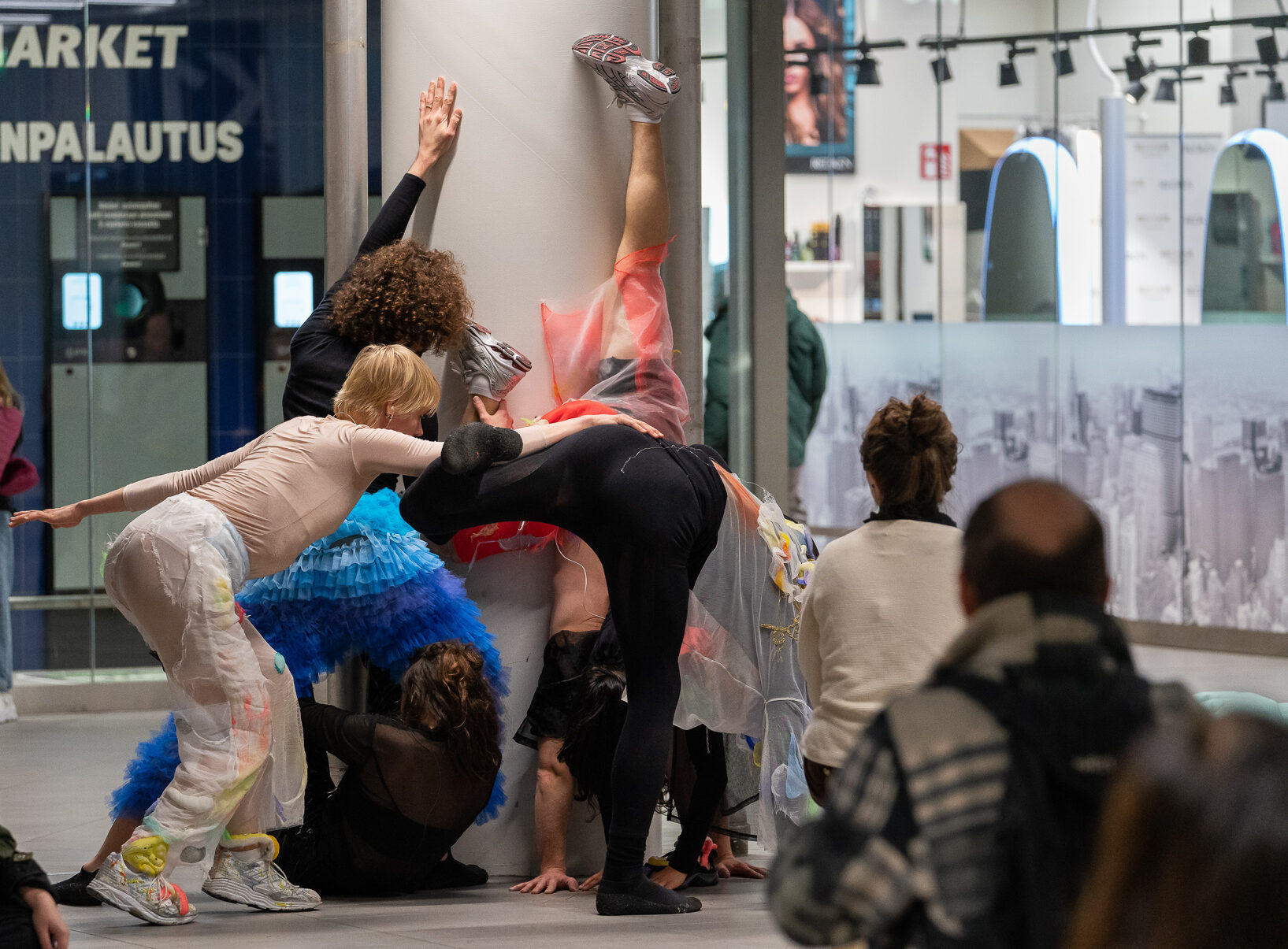
The wooden crates spread across the shopping mall floor tell me I am in the right spot. I can smell the timber while we wait for arriving audience to settle around the loose contours of the stage.

Movement III of Nature Untitled is a journey into the multifaceted imagination of the primeval forest. Situated in the open space of the Redi shopping mall in Helsinki, the setup challenges conventional narratives of nature and natural as they meet the consumerist cultural milieu.

Upon arrival, one obtains access to audio text that freely supports the movement of six dancers, while at the same time invites wondering in the enchanting world of the Paljakka, an old-grown forest in Northeast Finland. The polyphonic sonic and verbal associations open a space of forest imagination contained by dancing bodies. Wonderous forest encounters and soft entanglements of more-than-human life unfold through the piece in changing shapes and pace. I evoke trees, mushrooms, mosses, birds, insects, light, moisture, and clearcut inbetween and around performers, audience and rushed, already winter-wrapped bodies of passers-by. In almost one hour of duration, the liminal zones of speculative forest habitats, (un)intentional spectators, stage and shopping center environment clash, touch upon each other and gradually blur.  I witness beautiful moments of curiosity as groups of teenagers negotiate their relationship to what they happen to be seeing in their usual weekend stroll in the mall. They and many others become part of the performance space for a brief moment, or longer, slipping in and out, or hanging around its edges for a stretch of time. The embodied experience of the performance resonates on many levels with how one moves through the forest: senses are finding their way through the mash of surroundings and the sensuous richness they provide us with. One can follow a path, but also get lost among the trees. One can purposefully head into the forest, or just happen to find oneself in it. Nevertheless, the levels of presence, attention and body responsiveness, or response-ability, belong to complex webs of relationships, taking place in the hybrid body of the forest. The magic of the forest happens through the experience of people who have come together.

Movement III is the continuation of the working group’s research on choreography as a relational practice. As a part of the Nature Untitled project, it follows up on the performative of dancing the space, as a practice of collective making space-with. With a reference to Lehtovaara’s piece, Ikimetsä/Clearcut from 2021, the space of the shopping mall enters a triptych-dialogue with stage and silo from the previous two movements, deepening a complex set of references to the body, energy, consumption, etc. It is, once more, a collective act of revisiting, rewriting and re-composing the embodied relationship to nature and its multifaceted cultural meanings and narratives. The forest in Movement III is at the same time a space of imagination and memory, a “concrete” natural site, and a micro-local sensation in the body.

Nature Untitled takes place as a continuous exploration of the unknown and unknowing through the body: a practice of relating to what one cannot see and moving with what one can not grasp. It is also an ongoing rehearsal of creating relationships with oneself and others through this unknowing. Negotiating the perception, bodily affordance and response in shared spaces of becoming with. Learning new skills, practice and intuition when the learned and habitual ways of appearing as restricting, or cease to accommodate what is emerging. Accepting the unfamiliar and regulating the state of the passage to meet it in the body. Taking in and releasing the different impulses that happen in between the moving bodies, sensing and articulating the multifaced play of diverse natures.

Also, the language. Throughout the project, the inquiry is carried out toward what is left beyond spoken, represented in the linguistic system of knowing, or captured in words. What are the abilities of the body-mind to articulate connection, consciousness and situatedness in place by means other than language as we know it? Nature Untitledmakes space for un-learning, or learning to see, hear or move differently, to intervene in generational, historical or local, in order to invite new encounters through traces of ones that were already made.

– Nina


Nina Vurdelja

Nina Vurdelja is a performance researcher and cultural worker of international background, based in Tampere. Her interests reside around more-than-human sensuous encounters and ecologies of being together. She has been doing Ph.D. studies at Tampere University, dwelling in meeting spaces between culture, art, and philosophy.

Photo: Petri Summanen

Instant reflections VII by Nina Vurdelja

Instant reflections is a series of notes and remarks by Nina Vurdelja about Moving in November festival 2022. These texts will be published throughout the festival.

SAMMAL/MOSS by Angela Schubot & Suvi Kemppainen, Stoa, 13.11.2022

SAMMAL/MOSS is a solo dance piece by Angela Schubot and Suvi Kemppainen, premiered at Moving in November. It is a part of a larger Herbarium project, opening new perspectives on plant consciousness and human-vegetal encounters. How can dance bring us to the more-than-human sentient zones, to symbiotic realms of entangled, enmeshed forms of being? What happens in intuitive and porous conversational spaces unfolding along the contact zones of different lifeworlds? How can a human body and human-made infrastructure accommodate moss-ness? How can one bear witness to their radical exposure, sensitivity and openness to the world?

In SAMMAL/MOSS, the artistic duo works with minimal, necessary conditions for the experiential shift to take place, to invite underestimated intelligence and neglected models of resilience. Bodies spread in space, some light and water. Repetitive dubbing sound. Sticking together, sinking in reservoirs of life and the passage of time. Healing, regenerating and replenishing relationships with self and others. SAMMAL/MOSS is a process of negotiation of knowledge, curiosity to what we yet don’t know, (un)knowing through the body and bodies connected by effect, touch and liquid. Scratching underneath mushy surfaces to unveil traces of moss in human and human in moss, accumulated in a long cultural history of an interspecies encounters.  Where does the human begin and the nonhuman end, and vice versa?

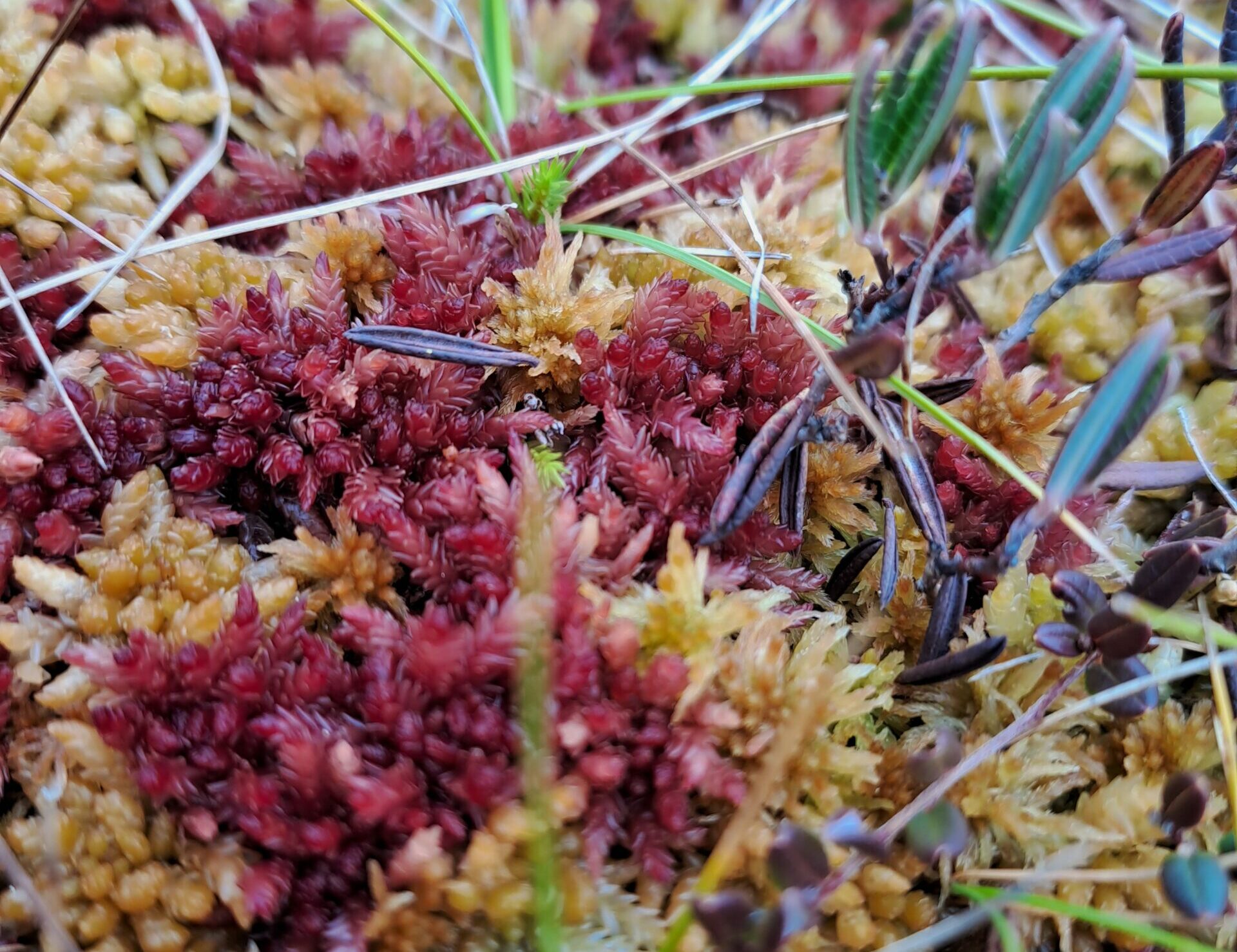
I’ve read that some sorts of moss can absorb water amounting to 20-30 times of their weight. It is also known that the human body is made of almost 60% water. It might be this watery quality of being that activates a process of metamorphosis happening inside, outside, across and in between bodies. Water carries a particular way of knowing, one that flows, leaks, and can never be fully contained.  During the performance, I thought of the book “Gathering Moss” by Robin Wall Kimmerer. She writes about the power of paying attention and a special kind of connection that arises from a long time spent looking and listening. This sense of sensuous interconnectedness makes it possible for new, alternative knowledge and stories to be shared.  SAMMAL/MOSS is a sympoesis, telling stories of others, storytelling with no roots nor skins, only radical softness and an extraordinary capacity to take in and release.

Next to this piece, Herbarium project also encompasses The Hut and Memory Garden. It is a collection of the experiential; a volume of sensuous exchange and reciprocity. Specimens in this work are living, sentient and conscious more-than-human thinking and making assemblages. Ever transforming, shifting shapes, expanding.  Collaborative, collective entities made of layers of (in)visible, (un)imaginable, (im)possible. Inoculating, cross-pollinating, seeding and preserving. Composing and decomposing beyond single authorship and final piece. A familiar sound of unfamiliar origin. Fungi, moss, herbs, trees, soil, maggots, and their collaborating humans, open doors to frequencies of life inaccessible and unaffordable to human senses alone.

In conversations, I had during the festival it often appeared that one can hardly say what it is that makes Herbarium experience so distinctive, almost mesmerizing. There is something in the comfort of this gentle being, generous space-making and curious acceptance. It is a joy of sense-making beyond human-made classifications and systems of organizing life; against reductionist and static knowledge, without ownership or control. It is a vibrant knowing of the world by staying with and spending time together.

– Nina


Nina Vurdelja

Nina Vurdelja is a performance researcher and cultural worker of international background, based in Tampere. Her interests reside around more-than-human sensuous encounters and ecologies of being together. She has been doing Ph.D. studies at Tampere University, dwelling in meeting spaces between culture, art, and philosophy.

Photo: Nina Vurdelja

Instant reflections VI by Nina Vurdelja

Instant reflections is a series of notes and remarks by Nina Vurdelja about Moving in November festival 2022. These texts will be published throughout the festival.

JEZEBEL by Cherish Menzo, Kiasma Theatre & Time has fallen asleep in the afternoon sunshine by Mette Edvardsen, Helsinki Kunsthalle, 12.11.2022

It wasn’t until the last minute that I got aware of the tricky program choices I made for that evening. Heading to Time has fallen asleep in the afternoon sunshine living book reading session just after the intense, hip-hop show of JEZEBEL felt like a challenging transition. Strong aesthetics and deep beats were still resonating in my body as I push the massive doors of Helsinki Kunsthalle and step into the thick silence of the lobby. My chosen book Silence will not protect you by Audre Lorde takes me into the exhibition hall, and, as we lean to the window frame, we immerse into the essay Uses of the Erotic: The Erotic as Power and two poems.

It doesn’t happen so often that I have a feeling that something has chosen me, like at that very moment. Almost half a century apart, the conversation between Audre Lorde and Cherish Menzo sounded so urgent and relevant. Even more moving was the fact that this imaginary encounter happens in the shared space of two white women in Helsinki.

In these two works, two women of different generations and backgrounds address mechanisms of oppression and control over the female body, the black female body in particular. They both protest (hyper)sexualization and manipulation of the female image in a men-dominated society, and turn to powerful, sensuous self-consciousness as a response. Resisting the male gaze and its attempts of imposing exotic, objectifying and stereotypical frames happens through speaking up for oneself and owning one’s sensuousness to surface. Whether in 20th-century non-fiction literature or in the contemporary hip-hop industry, publicly reclaiming the body from the inside out is an empowering and genuinely seductive endeavor.

The warm presence of Sarah Ludi as the living book makes room for a unique and generous experience of the feminist texts. Her calm voice and relaxed posture articulate a deep commitment, yet spacious reading of Lorde’s ideology. As soft words land in my mind, I let my gaze wander toward the high white ceiling of Helsinki Kunsthalle, where it meets its echo. Just an hour before, I was sitting in the black box theatre in Kiasma, losing my sight in a deep blue stage filled with heavy smoke. Urban style appearance infused by stark allusions to “hip-hop honey” stereotypical black femininity evolves into energetic self-confirming performance.

It is not a coincidence that these two experiences feed associations for their cross-reading. They both affirm female existence as liminal to submissive and dangerous, inferior and powerful; both advocate self-recognition and fulfillment beyond rigid and numb gendered constellations. Overall, they articulate cross-generational voices to confront a tendency to instrumentalize and commodify womanhood within unjust and insensitive social dramaturgies.

– Nina


Nina Vurdelja

Nina Vurdelja is a performance researcher and cultural worker of international background, based in Tampere. Her interests reside around more-than-human sensuous encounters and ecologies of being together. She has been doing Ph.D. studies at Tampere University, dwelling in meeting spaces between culture, art, and philosophy.

Photo: Nina Vurdelja

Instant reflections V by Nina Vurdelja

Instant reflections is a series of notes and remarks by Nina Vurdelja about Moving in November festival 2022. These texts will be published throughout the festival.

Audience Body by Tuomas Laitinen, 10.11.2022, Zodiak

A love letter: to many, scattered, anonymous, yet a community, a body, together. An invitation: to read, to immerse, do digest, to witness, together.

The Audience Body seeks to make visible contours of the abstract notion of spectatorship, a possible space for the experience of art (event) to take place. Tuomas Laitinen’s artistic research questions the necessary conditions for the audience as a collective entity to emerge, to be formed, to act.

It provides points of engagement that aim to materialize the moments of reciprocity, exchange, creation and reception central to an artistic process.

The proposal works around the concept of the open space, where embodied constellations unfold at their own pace. The offering in form of immersive installation involving different materials and environments put forward textual content as a starting point of the happening. The passage of time, sensuous activation, and direction of attention do the rest. The feeling of interdependence, connectedness and common ground are co- and re-created by individual-collective bodies moving on the stage, indulging in the composition and breathing the same air.

Instead of conclusion: a shared experience, here and now, at the heart of the audience body.

DAWN by Sheena McGrandles, 10.11.2022, Tanssin talo

I choose my seat just in front of the two performers simulating sexual intercourse in the opening scene. It is going to be fun. It’s a musical, after all. But can a reproduction thing be entertaining? The worrying thought slowly lands as the first fifteen minutes pass. A feeling of restlessness, and a quick gaze over the audience tells me, this might be getting uncomfortable, intimidating and not-so-fun. Well, let’s stay with it, there is no way out anyways. (I am sitting in the middle row).

DAWN hits straight to the point. You cannot escape it, even if you try. The continuation of a kind, extension of yourself, ephemerality of one’s life, termination, choice, hope, regret, control, and confusion is probably what the human condition is pretty much about. Theory, art, science, and speculative futures could possibly soothe it, manage it in this or that way, and get it out of sight, but it still sticks.

In a brave queer-feminist spirit, the well-teamed group of artists behind DAWN face the myriad of questions, doubts, and alternative scenarios around the phenomenon of parenthood and the making of a family.  The eclectic mix of musical scenes, movement scores and choir numbers give birth to sharp self-reflection, a dash of parody and blurred boundaries of play and confession. Together, they create a necessary intervention into societal inertia, systemic discrimination and regressive structures tied to heteronormative discourse. Obviously, a “serious talk” can be fun. It can also be safe, warm, and playful.

– Nina


Nina Vurdelja

Nina Vurdelja is a performance researcher and cultural worker of international background, based in Tampere. Her interests reside around more-than-human sensuous encounters and ecologies of being together. She has been doing Ph.D. studies at Tampere University, dwelling in meeting spaces between culture, art, and philosophy.

Photo: Visa Knuuttila

Instant reflections IV by Nina Vurdelja

Instant reflections is a series of notes and remarks by Nina Vurdelja about Moving in November festival 2022. These texts will be published throughout the festival.

Nature Untitled – Movement II by Veli Lehtovaara, Eija-Liisa Ahtila & Jani Hietanen, 7.11.2022, Zodiak

Movement II: Sentient landscapes of, with, and for dancing bodies

In Movement II, the interplay of visual image, sound, physicality of movement and materiality of the stage cocreate the space for exchange, a conversation: between body, or bodies, and human- and nonhuman-made landscapes; between acting and perceiving in diverse spaces of moving and being moved.

Sourcing back to Lehtovaara’s Feldweg/Conversations from 2018, the piece contains an embodied inquiry on hybrid agency, trans-corporeality and mutual becoming. As a second part of the triptych Nature Untitled, it invites to rethink and reflect together ways of relating and situating ourselves in shared, multispecies environments. Experimenting with the notion of space in many ways, the performance process embraces making-of-space, or becoming-with-space through reworking collective embodied practices and cultural technologies.

The piece unfolds as an exercise in being together with internalized otherness. The movement repertoire suggests more than human, beyond human and nonhuman that returns, revisits, informs and transforms the human.

The chorographical study deals with, among other, issues of language, access and representation. The performative techniques throughout the piece allow the human body to coexist in the horizontal space of acting, perceiving, observing and responding; where information, impulse and affect draw lines of interconnectedness and channels of communication beyond anthropocentric exclusivity of the linguistic code. Language turns back to dance, to what it once was. Movement re-creates, on many levels, unexplainable, otherworldly, divine, impenetrable by words.

The ongoing metamorphosis taking place on the stage takes in the spectator, re-distributing the sensuous towards deep listening; the eyes give floor to aural, re-cognition to relationship, definition to intimacy. The changing rhythm of distance and proximity between bodies, pixelated screen and bare, black floor underlines the contrasting yet merging textures of imaginary and physical spaces, landscapes made of flesh as much as of memories.

The performance holds ways of remembering, reenacting and representing though the bodily, intuitively re-arranging the layers of embodied experience.  Complex and unfinished accounts of historical binaries expose the collective dramaturgies of “humanity” through cross-references to “nature”: to land, ancestry, cosmos. These “vertical memories in horizonal spaces” are tentacular, rhizomatic, and singular-plural. These are contact zones organized along and around points of attunement and disruption into time-spaces of being larger than human.

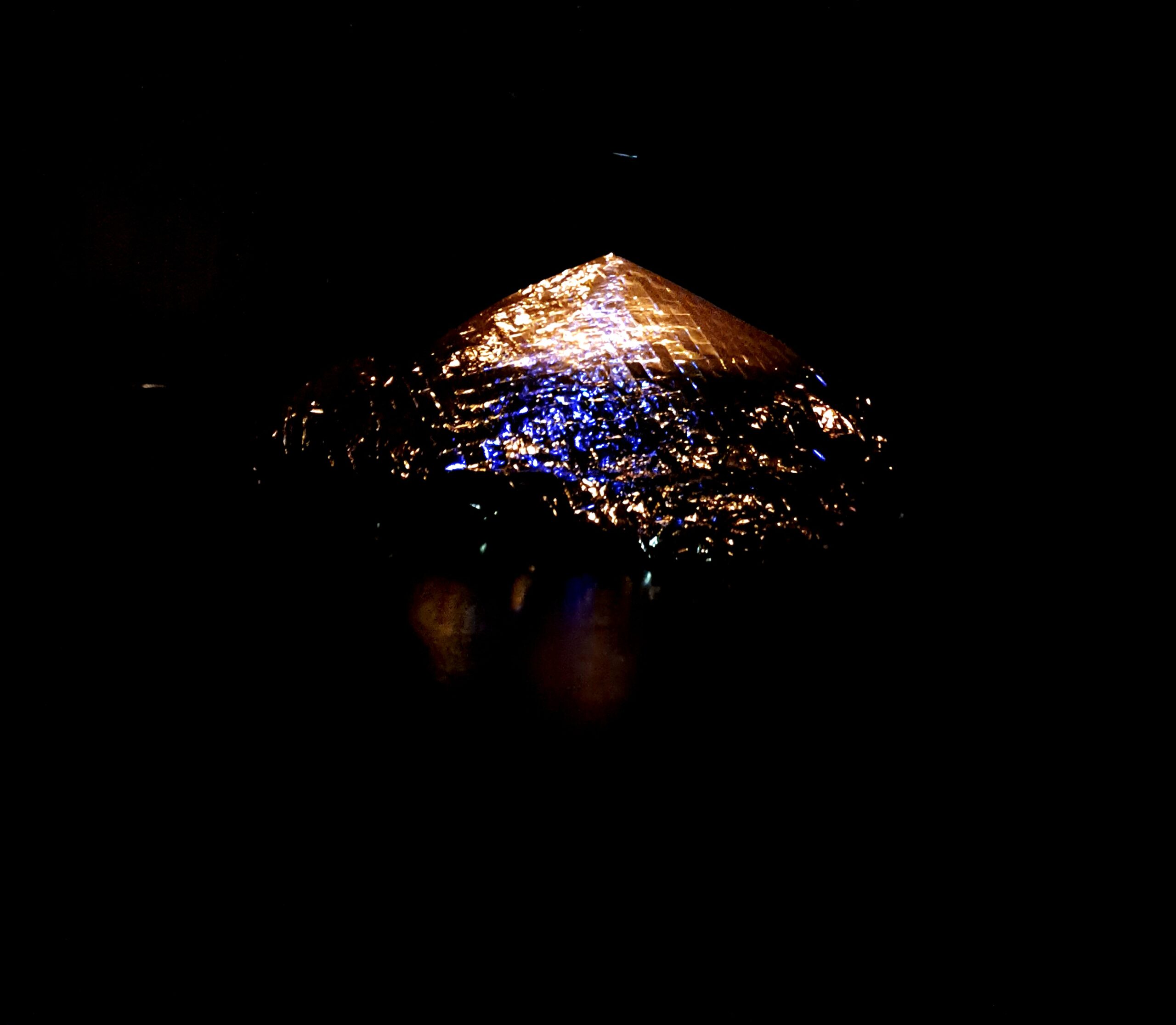
The elaborate handling of the aluminum foil- thermal blanket in opening and closing scene of the performance emphasize Lehtovaara’s long-term interest in relationship between energy, emission, and the body. At the same time, the only prop in the performance also possibly triggers the visual sensation of the sublime to contemplate upon, and stay-with while the lights dim.

Nature Untitled adds to possible ways of imagining being together differently at this edition of Moving in November festival. Stretching over the whole duration of the festival, it allows the experience of resonance, presence and an ongoing conversation that happens beyond obvious, staged and spectacular.

– Nina


Nina Vurdelja

Nina Vurdelja is a performance researcher and cultural worker of international background, based in Tampere. Her interests reside around more-than-human sensuous encounters and ecologies of being together. She has been doing Ph.D. studies at Tampere University, dwelling in meeting spaces between culture, art, and philosophy.

Photo: Nina Vurdelja