A glimpse into the future!

It’s already three years since we together started re-thinking Moving in November. The festival grew, it extended in time and space. It spilled over to other seasons of the year via two editions of Traces from November. We reached out to other areas in Helsinki, we build new partnerships and gained new spectators.

Today we are thrilled to announce that we have been asked by our board to continue this adventure together for the coming five years. We have happily accepted!

“We are very happy that both Kerstin and Isabel are able to continue to develop together Moving in November in the coming five years. The covid-restrictions in years 2020-21 took its toll of the performing arts field in general and put a burden on all of us working in this field. Despite of many problems and backlashes caused by the pandemic Kerstin and Isabel developed Moving in November in an immensely creative way which has been inspiring for us – the board members of the festival. Through her understanding and her connections of the international contemporary dance field Kerstin has been able to create fresh ways to approach the content of the festival and through various collaborations and partnerships to reach new festival participants. The ways in which Moving in November is enabling a dialogue between the local and the international artists and networks is truly important for the dance field.” – Liisa Pentti, Chair of the board

“Looking back – starting to work with Moving in November, filled me with an immense excitement. Thinking a festival each year, all the different shapes it can possibly take, is still so very rich and inspiring! As much as being in conversations with artists, engaging and working together on making their presentations and projects happening in the frame of the festival.

To me Moving in November has become an invitation to come together. To experience artistic works from the local scene and abroad. Artists voicing their critical thinking, their visions, their experiences, their dreams, opening small windows to the world we are living in. I am committed and exited to continue this started path, together with Isabel.”  – Kerstin Schroth

Together we are especially drawn to further develop Moving in November into a place to enhance the social. Bringing people together, creating space for exchange, conversations, thought and laughter. Presenting performances that propose a different way of being together in theater spaces.

We will continue developing Moving in November in the directions we have planted during the past three years. We wish and hope, that you follow us on this journey, that we continue to have fruitful encounters and conversations during the festival and beyond.

This year Moving in November takes place between November 2nd to 12th. Make sure, that your calendar stays empty in this period! The program will be released mid-September.

See you soon,

Kerstin Schroth, Artistic Director & Isabel González, General Manager

Photos: Mariangela Pluchino

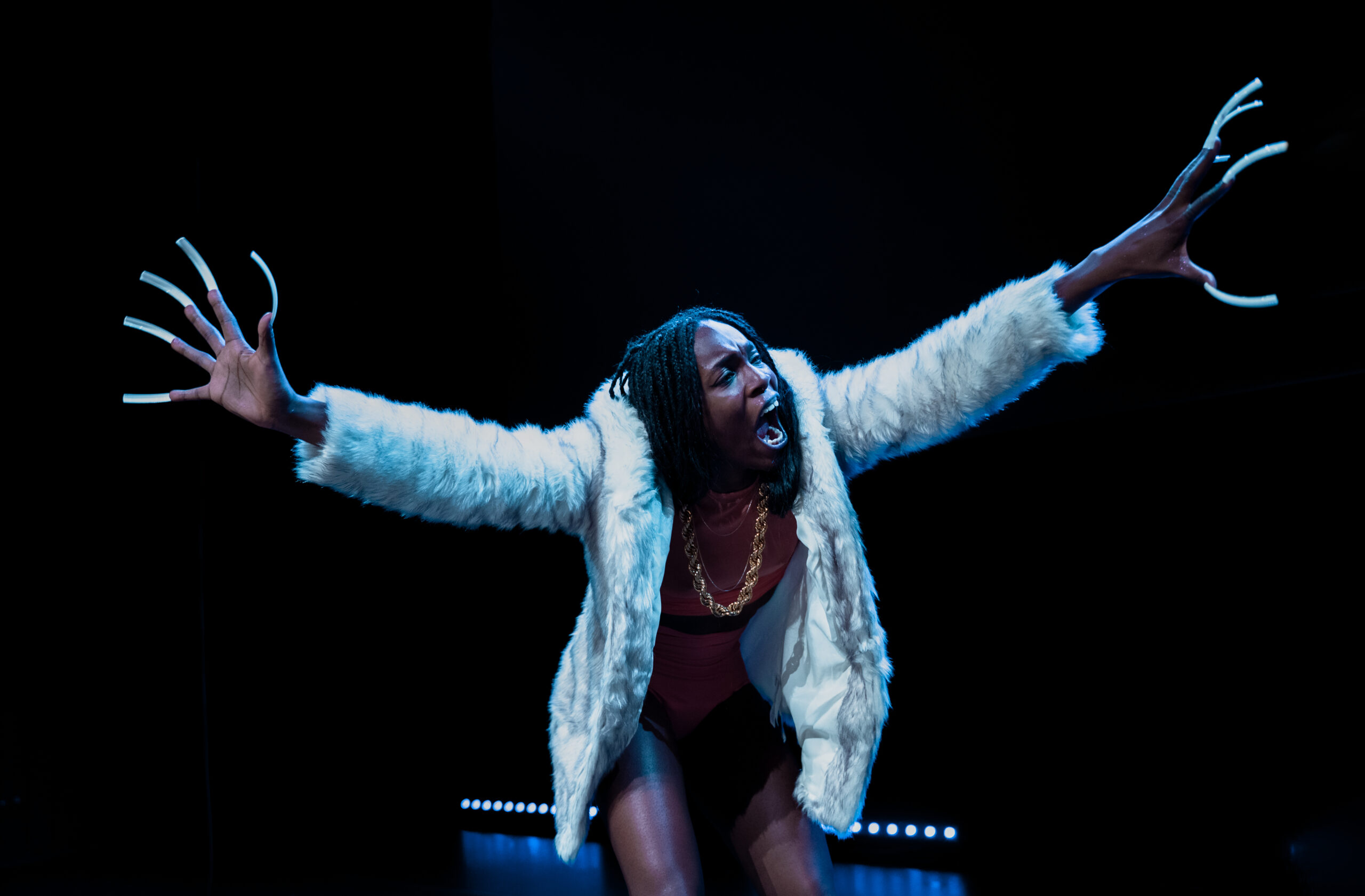
Conversation between Cherish Menzo and Kerstin Schroth about JEZEBEL

What were your desires and questions when you started to work on your solo Jezebel? How does this project stand in relation to your work, as a performer and choreographer?

My starting points were my own experiences within the Dutch contemporary dance scene and the way in which the bodies of female performers were presented and related to. I guess an idealized representation on stage, the imposition of a physical ideal I couldn’t identify always with. I felt the need to reclaim the ways in which I use my body on stage. I grew up with MTV, and my references in terms of female representation are more on that side than what I saw in the contemporary dance scene. This combined with the hyper-sexualized representations of Black women’s bodies in visual culture and in the media, something which brought discomfort, contradictions, and questions, led to this solo. I do not believe in a generalization of the ‘Black woman’, because there are many ways and intersections of being and becoming. Each one of us is both one and many. In JEZEBEL I use the figure of the Video Vixen to explore a.o. how Black women are portrayed in our visual culture, and more specifically how particular narratives processes, and stereotypes frame the Black body. JEZEBEL was the first installment in a trilogy of which the second part – DARKMATTER – premiered in May of this year. In DARKMATTER, the Black body and blackness – and its associations – were again a starting point. Together with a second performer, Camilo Mejía Cortés, I wanted to bend further and disconnect my personal view of stories linked to the body and to blackness. Is there room to dream and rethink and redraw this body? Can this process be disconnected from historical and existing ways of thinking, or are these fertile seeds that I should take with me in my work process?

Would you share your view on popular culture in relation to contemporary dance with us? Also your interest in bringing them together and questioning one by the other?

I want to question the frame of reference we use within contemporary dance. Why has something become the standard? Popular and hip-hop culture are the building blocks I grew up with. When I entered the contemporary dance world, it felt like I was supposed to unlearn what I knew and liked. The references that kept coming back, what I saw around me, and what was considered the norm, were something I wanted to achieve but didn’t always recognize myself in. Over time, I realized that I could question that norm, that it was important to influence the frame of reference. I reached back to hip-hop clips from the 90s and 00s and let these influences seep into the contemporary dance milieu within which I move.

What is your idea and vision of femininity in relation to the black female body today? How can we get rid of still existing stereotypes? Do you have a wish regarding this for the future?

There is still a sensitivity regarding existing narratives around the Black female body (bodies). The question I ask myself is whether we should get rid of these stereotypes or train ourselves to stop seeing some of them as stereotypes. The Black woman is not the norm within the western context, how can her image be normalized instead of marginalized? When we see a Black body on stage / TV / in other media, certain aspects are magnified and/or ignored. My strategy is to find out where certain readings come from, and how archetypes are constructed. I then make these visible and look for a strategy to dismantle them. Trying to transcend stereotypes by employing them but also questioning, stretching, and alienating them onstage. As to the question about femininity and womanhood: both cover such a large spectrum, I am just a pixel within it. I don’t aspire to be the signpost of Black womanhood. There are so many different voices, and different bodies contributing to a wider social debate. If I have a desire, it is to hear more of these voices, to see these bodies on stage, so that a wider, more diverse group of people can share their stories.

Photo: Bas De Brouwer

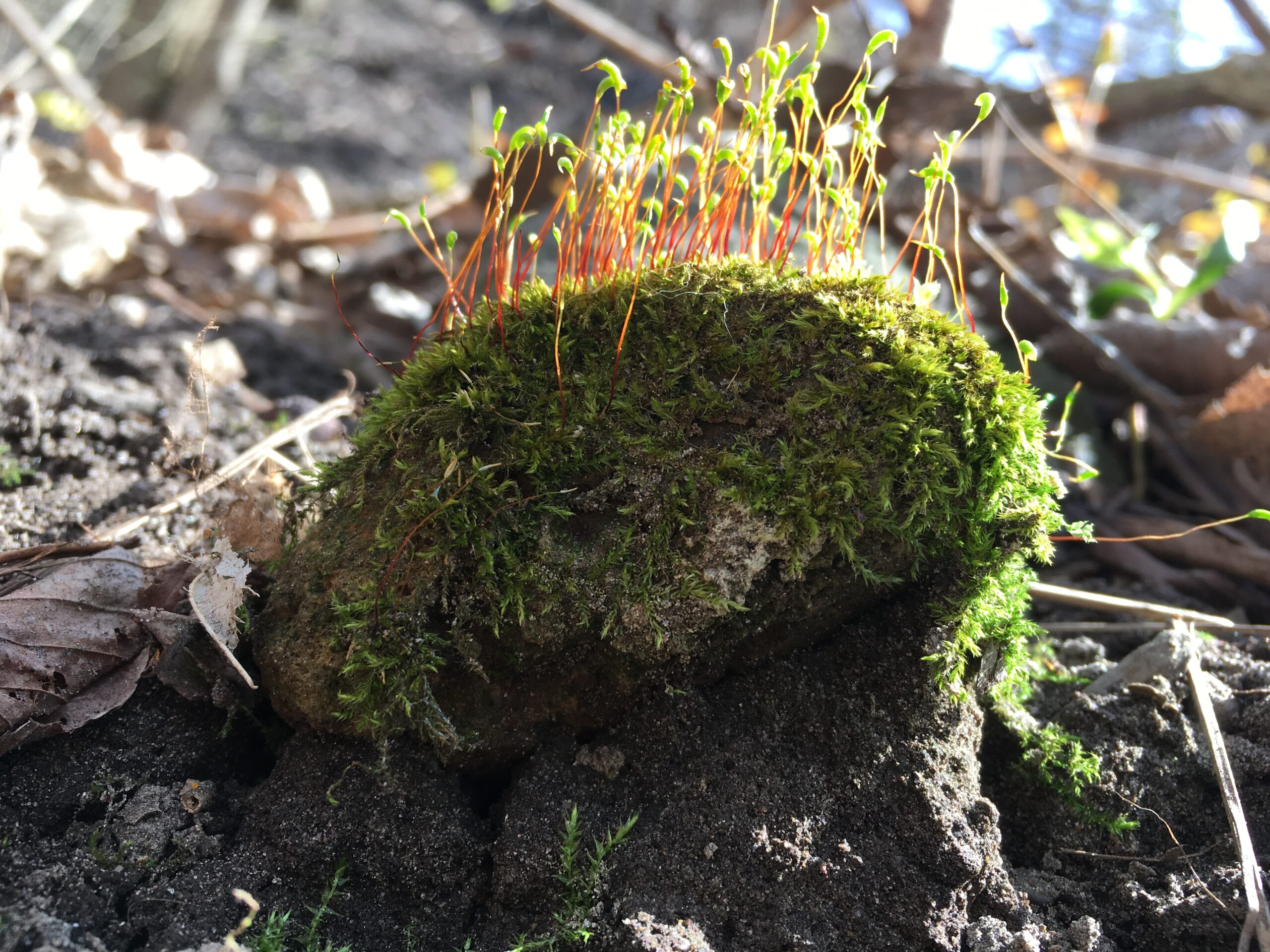
Conversation between Angela Schubot and Kerstin Schroth about SAMMAL/MOSS

This solo is part of your long-time research and encounter with moss. Can you tell us more about moss, your interest and your research? What does moss represent for you?

My interest is mainly a deep encounter with a certain plant and creating a movement language that evokes and invites the presence of the plant back into the space through the dance. I am always so impressed by how each plant opens up truly new spaces in the human body, in space. And these are truly new spaces and places that we can share with the plants. And also bodies that we can share with them. New bodies. I am wondering where the body can take place if not in our human flesh and bones. Because not every plant takes place there. Plants for me blow the imagination of what the physical is and on what levels the physical can take place. And it is so exciting to experience how each plant invites a unique space for the physical as its very singular terrain and domain. And I love the differences between different plants.

I say that with deep loyalty to the physical and acknowledging that there were times when I lost the physical to very transcendent and spiritual realms and I almost lost my desire to dance and move. Because suddenly moving and the materiality of the body would defile or disturb or destroy the connection. Now my work wants to try to strengthen the connection to a certain plant through the dance and I am still at the beginning with this approach.

Moss was the first plant I encountered through my hybrid practice of Plant-Trituration and movement research. Trituration is the hour-long grinding of a plant introduced to me by Shelley Etkin who received it from Aune Kallinen. From there I developed my own practice of grinding and moving.

Moss is my longest friend within that specific practice and the first in line to create a choreography. Moss is a plant that has to share utopian knowledge about a non-aggressive expansion and sustainable life in-between spaces. It teaches us to give space for others and to be the ground for others. Its relationship to water and the transition from water to land brings us back to our beginnings and our more-than-human ancestors. But also to the vital energy of departure, of “we are going off even if we don’t know where to go”. A thought that seems important to me, especially in the present time. There is a correspondence of moss as the surface of the forest and human skin. It invites us to stay on the surface and not to underestimate it. Mosses are for me also horizontal and polyrhythmic movements without a center, which split the coherence of the body into multiple, finely polyrhythmic multiplicities. Moss is such a group being that paradoxically helped me to find strength in loneliness and the simplicity of connection. It Invites a light form although the content can be heavy.

Moss is the first solo you choreographed for someone else, for dancer Suvi Kemppainen. Where did the wish come from? Could you tell us about the working process you embarked on together?

Mosses’ Spectrum oscillates between collectivity, connectivity, isolation, and loneliness. That’s why I thought it’s nice friction to work with it within a singular human body that meets the multitude of the Moss in an almost impossible way. I like those impossibilities and what happens if we try to overcome them. But then also breaking our habitual understanding of „one” body. Because on the other hand I am fascinated by the impossibility of the “one body“ and of an understanding of beings as never “one” and never “isolated”, but of an ecological understanding. The body as a shared ecology.

This friction is held very well through Moss and through my very appreciated collaborator Suvi Kemppainen. I met Suvi being their mentor when they studied in Berlin. We found a deep connection and they inspired me to dare to choreograph for others. The work with plants and becoming a mother myself somehow shifted something in me. I wanted to work with younger dancers and for the first time choreograph for someone else. Up to now, I have always danced in my own pieces and collaborative works. I would now like to develop other, perhaps more expansive, and more ecological forms of creating artistic works. Together with many plants and many people. In the working process, I invited Suvi into the practice that I developed. We are still in the process of making. We try to tune in and connect to the Moss and create and co-create with the Moss together.

Part of the work is other bodies dispersed on stage. Could you reveal your thoughts regarding this body landscape?

Mosses need other structures to grow on. In my first self-experiments with moss, I had the intuition to work with older women as landscape and structures in space. Mosses’ connection to our ancestors and the first big step from the water to the land leads me to invite old people in, reinforcing a line from old to young. A tribute to those who have held the space before us. A line of past, present and future but also of the omnipresence of past and future in the now, as one encounters it in many plants.

Photo: Angela Schubot

Conversation between Tuomas Laitinen and Kerstin Schroth about Audience Body

“How is a theatre audience formed?” is the underlining question of your performance Audience Body. What is your definition of “an audience body” in comparison to the terms “audience” and “spectator” and how they are commonly used and questioned nowadays?

Ok, here comes a short history of my terminology! Back in the day, I started with the term “spectator” as a default option. I think this was the main convention in the field in which I began to work in the early 2000s. Then, with my colleague Julius Elo, we realized that it didn’t really fit our work and coined our own term, “spectator-experiencer”, to allow a wider spectrum of reception while lingering with the conventional term at the same time. Later on, we moved on to “participant”, as our works started to allow more agency to them.

However, when I entered academia and started to work on a doctorate, I opted for the word “audience”, or in Finnish “yleisö”. This was due to its wide usage and, in comparison to “spectator”, its collective nature. The term is simultaneously singular and plural: a single being and a group of individuals. I also fancy the history of the Finnish term, it was invented in the 19th century by Wolmari Kilpinen, the same guy who also coined the Finnish words for an object, person, relationship, circle, religion, science, and art. So you see how new these concepts are in our tradition.

To connect the audience with the body was inspired by the consequences of the pandemic. As theaters were closed, two things became obvious. Firstly, there is something special about bodies gathering in the same place at the same time. When that did not take place, something was lost. Secondly, performing arts is not limited to that – there seem to be infinite possibilities on how to perform across space and time. So I thought that the different modalities of receiving art are related to the qualities of bodily collectivity; thus the title of the work.

What is your relation to time regarding this performance?

Now, when I am writing this, it is the 8th of August. I am in Covid, my solitary body in an Airbnb flat near the city of Tampere. Superimposed on top of this moment is the moment you, Kerstin, are reading this email after your vacation, in early September. And on top of that is the moment when an audience member has the program in their hand in the foyer of Zodiak in November. It is all here; I can feel it. And at the same time, it is not.

In this performance, I superimpose the modality of time of finished artworks (books, paintings, etc.) and the modality of time of live events (theatre, performance art, dance, etc.). Its time is both in and out of the hands of the audience. And both in and out of mine. I’ve been creative regarding the time when making this and I invite the audience to be as well.

If you could wish for something from us, as your audience in relation to viewing Audience Body, what would it be?

It is comforting to answer it now after you have attended. You would know by now that the work is full of my assumptions of how you will receive it and my attempts to persuade you (or more accurately the collective body) to experience something I have imagined. So I am not sure if I should add something. As a minimum, I have hoped for a donation of time and attention – and as an inevitable consequence an affective contribution. For you to feel something. To think something. To surrender in some way.

Photo: Petri Summanen

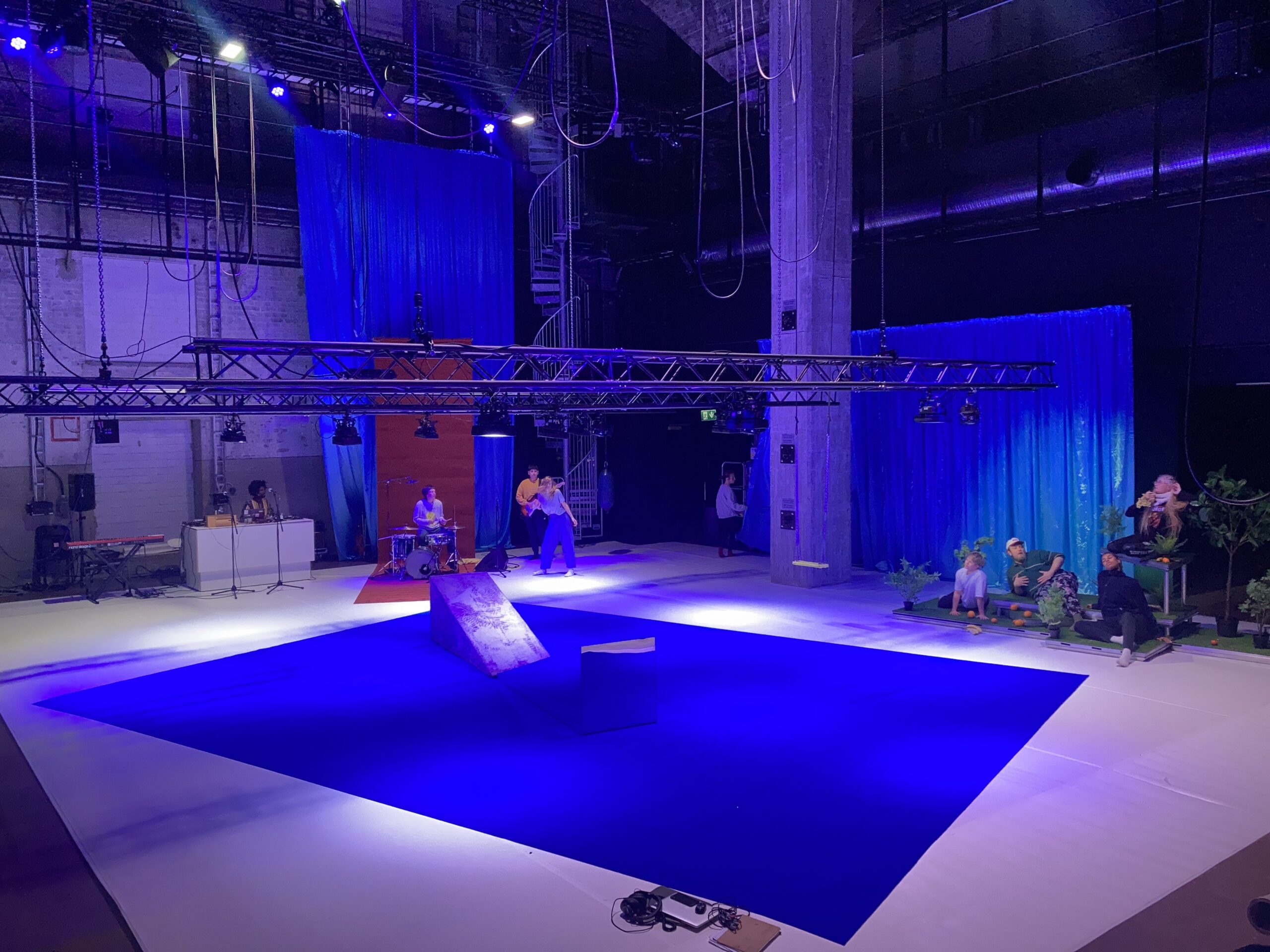
Conversation between Sheena McGrandles and Kerstin Schroth about DAWN

What were your desire and the initial questions when starting to work on a performance dealing with reproduction and parenthood? Why did you choose to stage this work as a musical? 

DAWN started from my personal experience of making a child with my wife and reflected on the complexity of family making from various perspectives. I didn’t only want to share our homosexual/queer experience, which was highly medicalized but to produce a work that speaks about the many experiences of making families and being part of them. The work also sets out to look at the child as an ambiguous figure of hope, a figure that some of us live for, a figure for which in certain narratives our future is responsible for. And then what happens when we decide not to reproduce or can’t, who then is the future for if we don’t have any children? The work for me was to make a statement, to say yes to family beyond biology, in all its constellations, with all its troubles, complexities, joys, and support it can offer.

Who doesn’t love a musical – right? In conceiving DAWN as a musical firstly I wanted to connect to my early encounter with dance and theatre. I remember as a child with my mother I used to watch endless musicals on TV from the 1950s, “Singing in the Rain”, “Westside Story”, “The King and I”, etc. It was the only access to art or culture that I had growing up in a working-class area in Northern Ireland during the troubles. Secondly, dealing with the thematics of family and reproduction which at times can be heavy and emotional I wanted to juxtapose it with the lightheartedness and humor that the musical allows through song and dance. At the moment I am very interested in working with these bigger genres of dance and theatre such as the musical, opera, and ballet that seem inaccessible because of their size, history, and male-dominated form. In all, leaning into these genres and borrowing principles becomes a way in which I can work with bigger groups, bringing together my interests in dance, text, song, and music and entangling this with socio-political thematics.

The music, songs and texts are written by you and your team. How was the working process on DAWN?

The process of DAWN has been one of the most powerful and generous projects I have done and this was because of the devotion, softness and openness of the team. It was really important for me to create a work that allowed for a collaborative way to share our personal experiences and to work together to find the right context to make them public. Due to creating a bigger work in the middle of the pandemic the concept and shape of this project took many twists and turns, from a black box, to a playground, to 3 parallel spaces, and in the end produced in an industrial space. We had a vision for all of these spaces which brought hyper flexibility and possibly to the work. From the beginning, I was very much interested in world-making as a way of sharing our individual perspectives through collective formats. We spent a lot of time creating practices around ‘worlding’ either through singing, improvised song making or storytelling. This led to developing methodologies around auto-fictions supported by our dramaturg Mila Pavičeivč in which we entangled personal stories with myths, or entwined all our stories together, or combined past, present and future as one narrative. During the process, I asked Claire, Colin and Moss to write a song, based on some of the topics that had been reoccurring for them over the research, and then together we worked on the musical arrangement and setting. We spent a lot of time together talking about being a child, or parent, having kids or not having kids and our fears and joys connected to these experiences. Our talks spilled into lunches or became dances, or songs, or mini-musicals and at times we just played music together. Creating DAWN was about building a small world in which we wanted to share with others our personal stories that are maybe just like yours or someone’s you know, or new perspectives on doing families.

What do you think, where does the human need of creating a family or families come from? And on a personal level, how do you define family for yourself?

What a question! Gosh, the family structure can be great, but it can be toxic. I grew up in a huge Irish Catholic family, on my mum’s side, I had 32 first cousins and everyone lived within 10-15mins of one another. I remember a lot of joy from that time, the parties, playing, exploring and sleepovers. Family was central to daily navigation and there was deep comfort in the many. My life now is very different in that my partner and I both live very far from our families so we are pretty much alone in bringing up our son – which I find very challenging. Due to living circumstances being based in the city and a capitalist-driven society that produces an individualistic way of life I feel pushed into a secular way of doing and producing family. Also not to mention having a child in the middle of the pandemic solidified us as a small household. I find it fundamental to have other folks closer and involved in the upbringing of our child to escape the duality of parenting, so currently, we are working on extending and changing our living situation to work against this. I also think our ideas of how we think a family should look and act are very much influenced by Hollywood. When we look around, there are many different constellations of families evolving from divorce, death, adoption, love and desire, but often these ways are not upheld within society.

The need to reproduce, I can only answer for myself, which was connected to doing family differently and being public in that difference. I love to be confronted by the questions that are asked to my partner and I such as: ‘who’s child is it?’ And we say ours, and then the next is often, ‘but who carried it’. The idea of biology and belonging becomes very important for people paired with the need to know who his real parent is. In consciously choosing to make a family as in our constellation it obviously can’t just be an accident, I was personally excited to be with another person as they experience the world. The element of play, slowness and innocence that has entered my life expands my horizon on humanity as never before. I am also learning a lot about deep resilience, understanding, and care at all costs.

Photo: Kerstin Schroth

Conversation between Eisa Jocson and Kerstin Schroth about Macho Dancer

In Macho Dancer you explore the economically motivated language of seduction, focusing on the erotization of the dancing body. Can you tell about your urgency behind and motivation for making this work?

I started conceptualizing Macho Dancer in 2011, in response to my feminine movement formation in classical ballet (from 7yrs to 14yrs old) and pole dancing (from 19yrs old first as a student, then as a teacher and a performer). I had finished two works around the subject of pole dancing: Stainless Borders and Death of the Pole Dancers. I felt the subject that I was trying to unpack was eventually packing me in. And so with learning Macho dancing which is at the opposite end of gender performativity in the sex work industry, I wanted to further challenge my own formation as a middle-class woman artist in Philippine society, as well as to hijack art/dance institutions and its standardized western dance bodies and art products.

Macho dances are a unique phenomenon in the Philippines. Male dancers perform macho dances for all genders. How is it for you to work with this dance? What does it do to your body and physicality?

I could speak at length about the infinite ways that macho dancing has and continues to widen my perspective and physicality. For brevity I will focus on what I found most fascinating in the process of learning macho dancing; it is the friction and negotiation of the new movement vocabulary (macho dance) with what I was fluent in then (ballet and pole dancing). From a body steeped in training to achieve illusions of flight, weightlessness, length, grace, and ideal female desirability to learning and training for the opposite; illusions of weight, being grounded, volume, solidity, and the ideal male desirability. With almost 10 years of practice and performing, principles of macho dancing have been digested, transformed, and embedded more deeply. I am sensually rooted and grounded in my body, in my guts, muscles, sinews, and bones.

Your body of work in general explores the politics of Filipino labour. Where does the necessity for you comes from to continue investigating and working on this subject?

I am Filipino and I question, make visible, and infiltrate the conditioning of our bodies to serve the demands of the patriarchal hyper-capitalist world order.

Photo: Giannina Ottiker

Conversation between Doug Weiss and Kerstin Schroth about All the Way Around

All the way around is an intimate concert that you perform in different contexts and settings. One could also look at it as a dance performance. Why did you decide to frame it as a concert?

Doug: Originally, this work was created for a gallery space that primarily featured concerts. I was offered an evening by the curators, and the musicians I asked were all busy. So I decided to ask Meg if she might be interested in trying something. Of course, they were thrilled at the idea, because it was something new for them as well. And Meg’s reputation had preceded her! Since I am a jazz musician, I primarily deal in song forms, in the context of a set of music. My knowledge of and experience in Avant-Garde Theatre and Contemporary Dance was limited at that point to being an audience member. We both felt strongly that the Dance would not exist solely to support the Music and vice versa. In other words, we wanted to meet as equals. We settled on the idea of investigating songs, how they are played, and what they would stimulate in Meg’s imagination. We had some false starts and moments where we did not understand what the other was doing, but we also had trust, and were dedicated to investing time into the pieces so that we could create a cohesive set.

How did you work on this journey together?

We began by going to the studio and rolling out our Yoga mats. The bass was also there. We would warm up, and then I would eventually pick up the bass and start bowing long, slow notes just to warm up on the instrument. Meg would also start moving around the space. Somehow the first piece began, with Meg tapping into her archive and me just trying to be present with the notes and aware of her movement. It was very organic, really. The first ‘song’ had a beginning, some development, and an ending. From there we tried other things, some having to do with the sound of extended techniques on the bass, and others more concretely rooting in actual songs like “I’ll Remember April” and “Lonely Woman”. Once we had a dozen workable ideas we then tried different orders, to try to get a good flow of the overall work happening. We didn’t want too much ‘sameness’, rather we looked for a variety of intensities. I also realized that it would not do for me to simply stand there and play the bass; I eventually found my legs (or back) as a dancer.

In the announcement text, you write about memory. How is memory translated, written into the composition of music and movement, and both together? Could you elaborate on this?

Meg has spoken at length about bodily memory. Trauma, Joy, Fear, Exultation, Privation, Success and et cetera are not only experienced; They are also passed down from prior generations on a cellular level. Acknowledging these energies within us seems to be a starting point. Meg creates her movement language through many trials of improvisation, and then ‘sets’ it at a certain point. Still, within that set point, there is some wiggle room. The way the room feels, the audience, and of course the collaborators (in this case me) also affect each performance. We are not robots after all.

My early training in Jazz involved years of apprenticeship with Master Musicians who were sometimes 20 or 30 years my senior, as well as African Americans; I learned that to get the chance to play with them, I needed to gain their trust. In order to do that I had to speak the language of music in a way that they would be able to relate to. Then we could meet each other. My mentors also gained the advantage of playing with a younger musician and were therefore able to continue broadening their own spectrum of musical choices. We would meet in song forms, where there are certain unwritten rules of engagement. These ‘rules’, or formulas, have evolved over time and allowed musicians from around the world to gather and improvise together. They are the basis for Jazz Improvisation.

So, when Meg and I ‘play’ together, I am very much beginning in a place of memory, even including nostalgia, with the ultimate goal being to get to that place where the piece is just flowing within and out of and around us. In a way, we are erasing memory and nostalgia with new experiences. Or we transmute bodily and musical memories into the present, giving birth to a fresh dialogue between dance and music. To be able to experience this in this context is really quite special for both of us.

Photo: Iris Janke

Conversation between Veli Lehtovaara and Kerstin Schroth about Nature Untitled

Your new work is thought of and presented as a triptych situated in different sites. What was your motivation to structure your new performance like this? 

For the new creation, I decided to work on recycling materials, concepts and choreographic principles from my three previous works created between 2016-2021. Eventually, I came to recycle also the performance environments or sites. During these pieces, my choreographic practice was clearly shifting towards ecological problems and their relations to corporeality, performance and stage. For me, the places and environments from which the dance emerges and to which it connects matter a lot. I like to think that dance and choreography can make the places we inhabit with many other kinds of beings matter more fully and perhaps more equally; to quote Chrysa Parkinson.

I see dance as a relational art practice, which has a specific capacity to connect through performing bodies with different kinds of spaces and environments. Dance is an act of belonging, crafting perception and movement with the actual environment. For this reason the site matters for the kind of dances I write. Dances that create spaces with, rather than take place in. Choreography has the potential to question Euclidian conceptions of space and time and to suggest altered ways of perceiving and experiencing these fundamental concepts.

You sign the work together with visual artist Eija-Liisa Ahtila and sound designer Jani Hietanen. How did you work together? And how do you experience the connection between the choreography, Eija-Liisa’s visuals and Jani’s sound work in Nature Untitled?

At this point in the process, I’d like to sign the work with everyone on the artistic team. I feel deeply touched by the honesty, commitment, and creative power of each member of our group. It is true that I have initiated and led the creative process. It is also true that Eija-Liisa’s and Jani’s artistry in sound and scenography play a major role in the work. Yet it is equally true that the work of the performers stands at the heart of this creation. Anni, Elias, Erik, Inga, Kevin, Matilda, and Sofia each have their specificity as artists and unique ways of crafting the dance. Likewise, Luc, Pia, and Heide have theirs in crafting lights and costumes for this creation. Conventions of signing an artwork are not often transparent or convenient in telling about the actual working process, its roles, and hierarchies.

Preparing this creation I was thinking of the possibility of creating a company, something more stable and continuous than a project-based working group. That initial thought has made me pay even more attention to the ethos of working together. How to make space for diverse voices together, what it means to listen to and respect each other, and where does the safe space begin? In precarious circumstances, it is hard at times to not make decisions and establish relations based on fear. Trust is a strange plant, takes practice to garden.

With Eija-Liisa, I find we have an ongoing conversation, we talk relatively often. That is the ground from which the ideas emerge and decisions grow. Working with Jani is for me about listening, in many registers. Listening to the sounds and the dance. Connections between choreography, visuals, and sound vary in each movement of the triptych, and I do not dare yet to say more.

In a talk we had, you spoke about the diverse meanings of the word “energy” in different contexts. Especially about how the word is used within a dance context versus when referring to fossil fuels. Could you elaborate on your thoughts about this?

I got particularly interested in the concept and experience of energy in 2018 while working on a performance titled Katkelma 468. The question was and still is, how to connect theoretical conceptualizations of energy with the sensuous corporeal and kinaesthetic experience. I find dance and choreographic practice an appropriate context to investigate this relation.

The first movement of the new work is inviting the audience to a vast and empty oil silo at the end of October to experience collectively a dance in the lack of warmth. Once a solid container of fossil fuel now transforms into a porous vibrating entity reminding us of many forms and notions of energies that exceed the modern industrialized ethos of measure, control, and burn. Rhythm is a key notion here, accompanied by frequency and intensity. These apply to the performing bodies including the steely body of the oil silo, which is not only containing the performance but performing itself. Sound will be the connecting element creating resonances and ruptures, reaching over the distances.

Photo: Petri Summanen

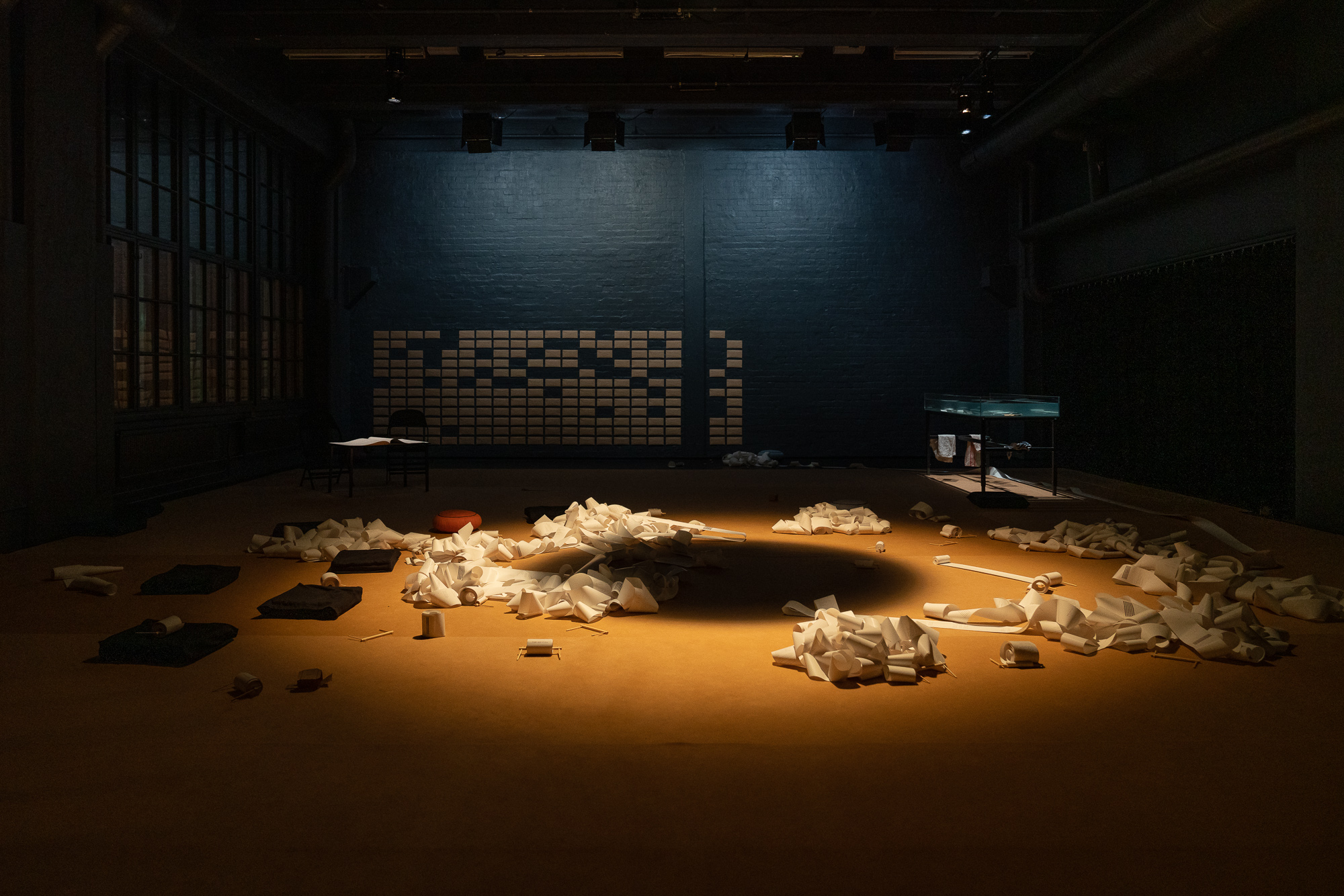
Conversation between Mette Edvardsen and Kerstin Schroth about Time has fallen asleep in the afternoon sunshine

How has this project come to life? What was your urgency behind the making of this work?

There are several points to trace back to the beginning of this project, its genesis. The novel Fahrenheit 451 by Rad Bradbury (1953) was an important source. It tells the story of a future society where firemen burn books because they are deemed dangerous, and an underground movement of people start learning books by heart in order to preserve them for the future. Another source is the story of Russian poet Anna Akhmatova (and as a ‘source’ I discovered it later). She was memorizing her poems together with friends, then burning them in her stove, and this is how her poems survived censorship.

Then, the reason I was drawn to this, to want to work with the practice of memory in this way, was prompted by a call for papers and proposals from an artistic and academic context, with the question: what do we bring with us for the future? One reference here was the Global Seed Vault on the Svalbard archipelago in the north of Norway which opened in 2008. To help protect the existing plant life on Earth from various global catastrophes, millions of edible plant seeds from around the world are stored in a repository in the permafrost, deep inside the mountains close to Longyearbyen. Taking the question a bit at face value, it made me wonder about what futures we are able to imagine and on what timescale we view the future. In relation to the performing arts, this brought some interesting reflections. Not only to insist and fetishize the moment, as I see it the present doesn’t exist without past and future, but to understand something else about why now is important.

Then as a project, it also had an interesting story of how it was first realized. I was invited by artist Sarah Vanhee to contribute to her project The Great Public Sale of Unrealized but Brilliant Ideas with an idea that for whatever reason had not yet been realized. So I prosed to her this idea, to learn books by heart and recite for readers, which at this point was just a formulation of an idea on a piece of paper. My idea was then auctioned in the ‘great public sale’ and was bought by an arts institution. This, which is a bit of a longer story, meant that I could realize the first iteration of the work without having made a project application, and more importantly, without having made promises for the future (of which I knew nothing!) I take with me many interesting reflections about how work is formatted in the arts, and how that doesn’t always work or isn’t the model that fits all processes.

Time has fallen asleep in the afternoon sunshine premiered in 2010 and was presented in various cities and countries ever since. In almost every city you add new books to the library of living books, possibly in the local language. What does the unfolding over such a long time of one of your works does to your thinking and artistic practice? What does the aspect and notion of time do to the project itself?

We started in 2010 as a group of seven people becoming ‘books’ in Dutch and in English. Now we are more than 100 ‘books’ and in many languages. This was not my aim when we began! In fact, I would never have imagined this, and this is also so wonderful. To be able to be with a practice, a project, to follow its steps and developments, to let new questions arise, to learn from it, see where it brings us. More than growing in numbers, it’s growing in its capacities, contents, knowledges, encounters, formats. We do, as you say, sometimes add new ‘books’. Usually, this is in places where we don’t have any ‘books’ in the local language, as now in Helsinki for instance. This also allows the project to breathe, to be close to practice because we are sharing it with new people. Not just what we are doing, but the intentions of it, the choices of books, what motivates choice, the methods of learning, all the things that are discovered, and the spaces of sharing. All of this makes the project. So to be able to be so close to the process, as an ongoing thing, keeps the project so vital for those involved, I believe. Then there are also all the different steps that have developed from this practice; the second generation, where we pass on our books orally to someone learning from us instead of learning from paper pages; the rewriting editions, which are our memorized versions written down again by heart, back to paper – and so many other formats of exchange, research, ways of sharing. As a project, Time has fallen asleep in the afternoon sunshine keeps activating and proliferating, by still doing the same. It has taught me a lot about how to take care of a work, how to be attentive to its processes and needs, to not always reply to the demands from the outside – sometimes even to protect it.

Learning a book by heart and spending time with the book is at the centre of this work. Please share your experience of learning a book by heart, carrying it with you and sharing it with potential readers.

The original set up of the one-to-one encounters between ‘book’ and ‘reader’ is still the base of the work and still feels so relevant and strong to experience. It’s the heart of the project.

Personally, learning a book by heart has changed me as a reader. The closeness of reading, to be able to read ‘into’ the writing the way one experiences when memorizing, is opening up many aspects of both reading and writing. For instance when reading poetry, as I have been busy with this lately, (and I think the best way to read poetry is to learn it by heart), it is not from understanding through analysing, but from repeating it, again and again, and letting the poem come towards you, you towards it.

When memorizing a book, it’s not just about the story, of course. It’s the words, the rhythm, it is something more abstract. And this reading becomes very visible, and readable, through the process of learning by heart. It’s like the book grows thicker and thicker, not only through the pages added, but the density of detail of each page. It may sound heavy, but it’s not. It’s a porous and light affair. Like a little treasure, we carry around in us, something to go to.

Photo: Petri Summanen