OPEN CALL: Cats & Poetry – Practicing Pancor Poetics a workshop by Pontus Pettersson

Moving in November is inviting professional dancers and movement practitioners to participate in a two-day workshop lead by Swedish choreographer Pontus Pettersson, as part of the process leading into his choreographic installation and performance Pancor Poetics, which will take place in this year’s Moving in November Festival. Based on the workshop, a group of performers will be selected  to take part in the work as performers.

Over these two days, Pontus will open up his practice to host the different methods and practices that are part of the work Pancor Poetics, including one of his seminal pieces The Cat Practice. As simple as it sounds, it involves practicing being a cat.

In the workshop, participants will transition from Cat Practice to poetry writing, then to dancing, exploring how these practices inform each other, the different embodiments they create, and various modes of listening and being together.

About The Cat Practice and Pontus Petterson

Since 2012 Pontus has been developing a performative and physiological practice informed by the cat, seen as a body that is neither human nor alien. The cat acts as a companion, friend, witness, and shadow to the human, shaping these specific relations. The Cat Practice produces a specific attention and presence in the performer, as well as a rewriting of the gaze and the politics of attention. The now stands in power, not as an infinite, but as radical shifts of focus and intention. The practice has existed in many of Pontus works and in different formats, most recently as a performance at the very first Vilnius Performance Biennial 2023 and as part of Pancor Poetics at Shedhalle in Zurich.

Pontus Pettersson is a Swedish choreographer, artist, dancer, and curator based in Stockholm. By applying choreographic principles to all his works and projects, Pontus creates a variety of artistic expressions, ranging from large-scale installations and poetry to small objects, Cat Practice, and dance. Pontus is also the initiator and curator of the participatory, movement- and publicationbased platform Delta, alongside Izabella Borzecka, and a co-founder of the annual dance and performance festival My Wild Flag, together with Karina Sarkissova.

When and Where? How to participate?

The workshop takes place on August 10th and 11th between 2 p.m. and 5 p.m., in the community space of Pihlajamäki Church (Liusketie 1, 00710 Helsinki).

The workshop will end with a small showing on Sunday 11th from 5 p.m.-6 p.m.

The workshop addresses professional dancers and movement practitioners. We encourage you to join, when having an extra interest and experience in interspecies relations and theory, queer aesthetics and concerns and/or poetry.

The participation is free of charge.

If you like to take part, please fill in this questionnaire until June 27th.

Photo: Nemo Hinders Stocklassa


OPEN CALL Life Long Burning – Artistic Exchange Residency in Leuven, Belgium

In the frame of the EU project Life Long Burning Moving in November and STUK are offering a residency for an individual professional artist or a small team (max 3 persons) from the field of choreography and dance, based in Finland. Application deadline is 28th of June!

What’s the offer?

  • 2 weeks residency for 1-3 persons
  • Travelcosts reimbursed up to 750 euro
  • Accommodation for 1-3 persons in an apartment
  • Lunch in STUKcafé Mon-Fri + per diems to cover dinner and weekend lunches
  • Residency fee 2.000€

STUK offers a studio (19/11 – 01/12 2024) with the possibility of limited technical support. Possibility of end-of- residency presentation or studio visit for the STUK audience development groups (LOUVAIN VAGUE, PULSE) & local professionals. During the residency it is possible to attend the public program of STUK. You will be hosted by a local artist.

How to apply?

Please send your biography and a short motivation letter in English describing what you want to work on and how you imagine profiting from the residency and your stay in STUK.

Send your application to: 

Applicants must be available during the whole duration of the mentioned time period.

Who we are

Moving in November is a contemporary dance festival organised yearly in the Helsinki area. The festival is an invitation to come together. To experience artistic works from the local scene and abroad. Artists voicing their critical thinking, their visions, their experiences, their dreams, opening small windows to the world we are living in. www.movinginnovember.fi

STUK is an international arts centre in Leuven, Belgium, that takes care of artists and audience across generations, brings them together and looks for an active relation between both. STUK is a House for Dance, Image and Sound where experience, encounters and dialogue are key. www.stuk.be

Looking forward to your applications!

Kerstin Schroth & Moving in November team

Photo: Joeri Thiry

OPEN CALL Life Long Burning – Scholarship – application deadline: 04.02.2024

In the frame of the EU project Life Long Burning Moving in November Helsinki and danceWEB Vienna are offering a slot in the danceWEB Scholarship Program 2024, in the frame of ImPulsTanz – Vienna International Dance Festival, for dancers and choreographers with decidedly professional ambitions.

WHAT IS THE DANCEWEB SCHOLARSHIP PROGRAM
Each year, the five-week program allows dancers and young choreographers from around 40 countries to take part in all workshops and research projects, and to watch all ImPulsTanz performances. The festival’s international orientation provides an ideal platform for up-and-coming artists and enables the sharing of ideas with teachers and choreographers to establish a network. In addition, the participants are mentored by internationally renowned artists from the dance and performance scene.

In 2024, the visual artist and choreographer Isabel Lewis, who works in the fields of dance, music and theatre, will be danceWEB mentor. Who’s work was presented in the frame of Moving in November 2021.

ARTISTIC STATEMENT BY ISABEL LEWIS
Having had a long history of collaboration with the ImPulsTanz Workshops I am particularly excited to take on this new role as the danceWEB mentor in 2024. The ImPulsTanz workshop program has always been a place that has invited and encouraged me to radically experiment with my practice and to share this process with others. In a time where the demand for and expectation of visibility is so high, we may often feel hesitant to allow ourselves to dive into unknown possibilities in front of one another. In honoring the space that has been extended to me over the years at ImPulsTanz, I would like to consider the summer program as such a space of intention for giving oneself the permission to escape the habit (and requirement) of representing a coherent and continuous image of oneself or one’s work AND for the collective effort of hosting and holding a compassionate space for taking such risks.”

THE SCHOLARSHIP INCLUDES:

  • Participation in the ImPulsTanz workshops
  • Free admission to all performances at ImPulsTanz
  • Salons exclusively available to danceWEB participants
  • Lecture demonstrations and roundtables
  • Accommodation
  • Mentoring by the artistic mentor of danceWEB 2024, Isabel Lewis
  • Inclusion in the constantly growing international danceWEB database
  • European travel expenses

WHEN:
From 10 July to 14 August 2024.

Applicants must be able to participate for the entire duration of the programme.

APPLICATION DEADLINE: 04.02.2024
Only individual artists based in Finland can apply, no duos/groups.

HOW TO APPLY:
Please send your biography, picture and a short motivation letter in English to:

Looking forward to your applications!

Kerstin Schroth & Moving in November team


A conversation between Outi Järvinen and Kerstin Schroth

YLE Kulttuuriykkönen recently published a podcast and article about contemporary dance that contained many controversial claims, perhaps intentional provocations, by journalists Jenny Jägerhorn and Liisa Vihmanen. The headline itself was quite sensational: “Contemporary dance has turned inwards and there is no longer interest for internationalization”.

(Kulttuuriykkönen 29.11.2023: https://arenan.yle.fi/poddar/1-66752100)

Contemporary dance curator and artistic director Kerstin Schroth (Moving in November) and producer-manager Outi Järvinen (Arts Management Helsinki) started a dialogue prompted by the article and podcast.

Outi:

There is very little airtime or media space given to contemporary dance by YLE, so it feels quite horrible to read these outdated claims when dance is finally discussed in the national media. Are we in a time machine, did we just go back twenty years? There is so much to unpack, but let’s focus on the claim that Finnish choreographers do not want to reach out, or that they are not visible in the international context. This does not reflect the reality that I know, and the field that I work in. I am very fortunate to work with a number of Finnish choreographers and dance artists, and many do create or present their work internationally. Not as a brand like Tero Saarinen Company that was mentioned by the journalists, and not in the opera houses for those kinds of brands, of course. But in contemporary dance and performance contexts.

What is this idea of “international success” anyway? I guess it is linked to the idea of a cultural canon, the desire for Big Names, the desire for Heroes. Do the journalists, and perhaps our society in general, still long for some mythical Artistic Genius that returns triumphantly from foreign lands? Not only is this totally lame, but it also really angers me. Our understanding of the Artistic Genius has culturally always been closely linked to masculinity, so the most desired heroic Choreographers are also ‘naturally’ presumed male. This was blatantly obvious in the names that the YLE journalists could come up with, but also a serious problem in our arts funding, media space, perceptions, and public recognition. Thanks, patriarchy.

Kerstin, you are a curator and you follow the international dance scene, or better said, you are part of the international dance scene. What is your take on this?

Kerstin:

I am as angered as you are about the content of the article. I perceive it as narrowminded. Claiming an ‘expert-ship’ and narrative, that seems outdated and far from reality of many, audience, contemporary choreographers and performing arts institutions. It also reads limited on real expertise, profound research and curiosity. My first question when reading this article was, what’s the purpose of it? My second who is addressed?

When thinking about nowadays, first of all, we need to acknowledge and take into account that we are living in a dispersed world. That there can’t be assumed anymore one storyline, one common sense, hence one direction to think and do things. Stating that the contemporary dance scene is turning inwards and that there is not enough movement to be seen in dance pieces anymore (especially the last claim) is a discussion that seems so extremely outdated – from beginning of the 2000s – I don’t even know where to start with my response. Why do I read so much resistance in the article towards a contemporary dance scene that evolves, develops and changes its way of thinking, working, moving, researching and creating pieces? Artists that have a different take on choreography, that want to address and engage a potential audience in a different way than via big worldwide tourable dance pieces.

In my experience the so-called audience is often more intelligent than that. I have an enormous problem with general assumptions regarding audience, what they might think, relate to or like to see. I experience this as an infantilization of audience, that appears in this storytelling as a grey mass. In the end, we speak about singular people that have a brain, a taste and come with their own stories, backgrounds and lived life into our cultural spaces. They might enjoy seeing different proposals on stage, purely movement-based pieces, but at the same time they might be more than moved by looking at highly contemporary works that ask them to activate their brain and involve their emotions or senses to unpack them.

Why is it that one and the other can’t exist alongside each other, in the narrative of the article, pure dance pieces and contemporary works, that expand the notion of choreography and what dance can be and provoke in our society nowadays?

Looking at and to an international scene, there is simply both and I think this is amazing! Also on the level of arts education. In France I see e.g. schools visiting with their students highly contemporary exhibitions and performing art works, as well more historic works.

Indeed, as you write the take on the big stars… stardom is not gone… but changing and not only directed towards necessary big shots anymore. I think and observe that stardom can take other and different forms today. During Moving in November, we had a group of students that asked each of our contemporary choreographers for their autograph. Does this not say a lot about younger generations? The search for something else, namely, the experience, the connection, the non-hierarchical, the personal, inspiration and knowledge from different and various storylines, and not only from a white, male, cis-normative point of view?

Outi, what do you think? Can I ask you to write more about your thoughts in relation to the Finnish choreographers you are working with, when it comes to the notion of the international? And the urge or non-urge to present abroad?

Outi:

As you pointed out, we are living in a dispersed world. This is true to the contexts that the choreographers work in as well, and their artistic aims. There are choreographers who work inherently in an international setting, often because they have studied abroad and created their professional networks outside of Finland. Some feel that they connect more to communities and audiences outside of our national borders, and for some working abroad is a necessity, as there are limited production possibilities in Finland. On the other hand, as professor Kirsi Monni pointed out in the Yle podcast, not everyone wants or is able to a live a nomadic lifestyle and tour around the world.

From all of this, the claim that choreographers want to turn inwards is incomprehensible. Such a generalization. But if I were to generalize anything, I would say that the choreographers I work with are not trying to make themselves stand out as the Big Shot, the Chosen One. They know that this is an interconnected world, that they are part of a larger artistic community and field. That does not equal to hiding yourself or not taking your platform. Artists want to have their work seen, to connect, to make a mark and shed light on their chosen topics and artistic voice. But this is very far from the egotistical, old-fashioned Hero cliché. I just wish the media would stop perpetuating the old narrative, which is of course also fed by the dance field itself. Who is this serving? I think it creates a lot of damage.

The old narrative is fitting to the economic talk of today. Where are the export revenues, why is art funding going to operators that are not raking in the money etc. It seems that this economic talk is used as a tool by some artists and companies themselves, in an effort to stand out and secure their own spotlight.

Kerstin:

Yes, indeed the context of the dispersed world is also counting for the choreographers you/ we are working with and their artistic aims.

I think that the initiators of the article are actually confusing a dispersed, differentiated, diverse performing arts field that grew its various branches over the past 20 years, as turning inwards, rather than seeing a quality in variation and the beauty in different scales, formats, intentions and aesthetics. A contemporary performing arts field that is able to reach various and different communities and needs, and does not try to create one workable model for everyone, not for artists nor audiences.

What is wrong with niche culture that is only for a few, that can identify with it and are nourished and encouraged by it? I am saying the obvious here and am not trying to be cynical, but are big dance houses or opera houses that are showing largescale works in the end not also only for a few?

My experience with the artists presenting in Moving in November is that they are all interested to show their works and share their thinking in different countries, but not only! Touring the world and being a nomad is not necessarily the main occupation anymore. So many of the artists I know also invest in education and projects that are grounded on a local level and not thought for touring. Again, there is not only one narrative, also here.

I would for example recommend that the journalists of the article look into the work that deufert&plischke do at the moment with spinnereischwelm in Germany, a space for art and society. What might look at an ‘inwards turned bubble’ addresses and involves a whole community of a small city. A visionary project of two artists that are anything than interested in creating performing arts only for themselves and their colleagues, but are eager to offer a space for experience, exchange and encounter through the lens of artistic thinking.

Outi:

The beauty in different scales, formats, intentions and aesthetics – well said! I think that is exactly how dance reaches various audiences and becomes more relevant in people’s lives.

But what about the finances, how to cope with that? As we are writing this, the Finnish government has announced more cuts to the public arts funding. We already knew that times will be tough, but the bad news just keep coming.

I am afraid that we will have a stronger polarization in the arts field. Those that have better funding will get more, and those with very little will be left with nothing. There is a false assumption that ‘mainstream’ performances in big theatres are the best, or perhaps only, financially viable option. All this feeds into the old narrative. Whenever someone argues that public money should only be geared towards ‘big sellers’, I reach for my calculator… but then again, I don’t want to fall into the trap of neoliberalist money talk.  Calculations of the real cost structures might win the argument, but in the end everyone loses. Real value does not equal money, and real value does not lie in money.

In this gloomy political situation, how can we build structures that serve the forward-thinking artists of today and tomorrow? What are the building blocks of a thriving dance ecosystem?

To quote the British journalist Paul Mason: “In order to un-cancel the future, we need to revive our reflexes for utopian thinking.” My utopia is a world where arts organizations and funders use their administrative staff, spaces and resources to serve the artists, not burden or exploit them, and where journalists use their skills and curiosity to create new knowledge, not perpetuate old clichés.

What is your utopia?

Kerstin:

I mirror your utopia and strangely, or rather sadly enough, I kind of always believed that it’s not an utopia, but common sense.

I would like to live in a world in which art is recognized fully as a driving force to reflect and enhance change in societies, to bring people together. Seen as creating alternatives towards old structures and habits. In a world where art and artist are exempt again from market logics, allowed to drive into different temporalities and we with them, plunging into a parallel world.

I read once somewhere that the state of a society can been seen by the way the artists are treated. What do you think about that?

Outi:

The European Parliament’s recent resolution this November urges the Member States to improve the social and working conditions of artists, among other things. I think this is a positive signal, and I see hope on a European level. Too bad our current national policy points to the opposite. There is such a dark cloud or even hopelessness hanging in the air. Our cultural minister has already announced that our cultural budget will not reach the desired 1% of the state budget in this whole decade. However, policies and politicians change – I refuse to accept this gloomy view of the future.

Back to the idea of our dispersed and diverse world. Maybe, instead of clinging to old clichés and looking for ‘easily understandable’ content, we should look even more for what dance can be and provoke in our society? If audiences are baffled by difficult texts, as some claim, then we should have MORE of those texts, not less. If audiences are becoming more conservative, then we should present MORE art that shakes them. We should fill the largest stages with the most experimental and outrageous works. Or perhaps with the most intimate and small-scale. Flip the narrative.

Anything but lukewarm crowd-pleasers.

Kerstin:

Well yes, I fully agree with you and that’s what we are doing with Moving in November. I am actually convinced that the people taking ‘audience’ as an excuse to present lukewarm crowd pleasers, as you call them, talk about themselves and their own limitations. I experience spectators rather as open and ready to see works that propose other narratives, expand the notion of choreography and are not just confirming what they anyhow know already or have seen, but provide experiences they might not have had yet, that enrich their universe, stimulate and are nourishing.

Of course, it needs mediation and a careful and open communication bringing pieces with more difficult texts or aesthetics that the so-called audience is apparently not used to and might be scared off. I see it as my work as curator to share with an audience, what moves and challenges and surprises myself. I am the one that travels and sees all these different works and has the opportunity to present a selection in a country where not that many international works pass. Building a bridge to the invited works and also educate the audience in a certain way, or better sharpen their gaze. I see my responsibility in not only bring works that confirm what our audience already knows, or feels comfortable with.

Someone said to me, after this year’s festival opening with the piece “Bacchae – prelude to a purge” by Marlene Monteiro Freitas: “That was a bold opening.” Was it? We had two nights a full house with standing ovations.

Outi:

Moving in November has clearly demonstrated that audiences are open to new, unfamiliar and stimulating experiences. And the way you present local artists side by side with international artists, and involve locals in the adaptations of international works, I think it all proves that our contemporary dance is not turned inwards.

And there is interest towards international work among dance artists, and many already work internationally. Out of all the 50 wonderful artists at Arts Management Helsinki, there are many choreographers who are visible in the international scene: Anna Maria Häkkinen just created a new commission last month for the Performa Biennial in New York, Elina Pirinen has collaborated with such companies as Iceland Dance Company and Carte Blanche (Norway), Maija Hirvanen had a world premiere at Tanz im August (Berlin) last year, Sonja Jokiniemi’s work has been supported by such venues as STUK (Leuven), MDT (Stockholm) and BUDA Kunstcentrum (Kortrijk), Samira Elagoz was the winner of the Silver Lion at the Venice Biennale last year, Annamari Keskinen has created commissioned choreographies for Staatstheater Kassel, Staatstheater Braunschweig, SEAD etc… just to name a few. Not to mention all the international residencies, collaborations and other works by many more. We manage the international performing engagements for some artists, and the international invoicing this year alone has been 100.000 euro. The scope of international activities of Finnish dance artists is not meaningless.

But more than money, awards, or international recognition, it is really the quality of the work, the depth of artistic thinking, and the sharing of unique moments with various audiences that really counts. It all starts with making the work of artists possible.

Kerstin:

Thank you, Outi for bringing this up. Always so very good to read facts and indeed, all starts with making the work of artists possible, we can’t say it loud enough!

It would be nice to leave the last word to an artist, to choreographer and dance artist Elina Pirinen, who said this after having been invited to the reception of the Finnish President at this year’s Independence Day celebration:

“It is touching and wonderful that dance art is celebrating through my body on our Independence Day at the presidential castle. Often behind a great man is as big and often bigger a woman or something else. The freely associative, affective and feminist dance art that I represent and its perspectives hopefully carry on through this.

The world has fallen apart and artists can therefore experience incapability and a lack of faith in connection and comfort in their art. That is why I myself intend to work even harder than before, defying the external and internal regressive forces of the industry, to shake the way to the audience and help new generations to do the same in their own ways.”


Photo: Kerstin Schroth

Everything that keeps us alive, part II by Nina Vurdelja

Moving in November festival continued with empowering statements and a hopeful presence of diversity of communities that put their voice, and their dancing bodies, for just, collectively-supported and safe lives everyone deserves to live.

The wondrous explosion of teenage energy, bringing forward the beautiful universe of coming-of-age, still pulses and resonates days (and weeks-counting) after the festival’s finale. I come back to Venus and HORDE performances first, both dedicated to this fragile yet powerful age.

Venus performance by Janina Rajakangas tackles delicate issues of sexualization of young girls and their experiences of sexual harassment. Identifying as a woman that once was a teenage girl too, feels like an invitation itself. Soon with the first lines of “The Sound of Silence” acapella, the sparkling world of four young girls opens its doors for us, the spectators and allies, in the cozy embrace of a piece that promises magic to happen. Venus is magical in so many ways- for making the beauty, honesty and acceptance win over ugliness of harassment; for a marvelous transformation of these young girls into pioneers of freedom; for one hour spent together becoming an eternal longing for a safe and soft pillow to rest one’s body and soul on. Yet, the biggest beauty of Venus is in sincere and truthful voice it speaks to us and gives unconditional space for teenage girls themselves, supporting them to own their stories in their full glory. These greatly talented and brave teenage girls dance, spin, cuddle, take selfies, scream and shout, and rise over injustice and dark side of humanity, and we do with them, in our seated yet much moved presence.

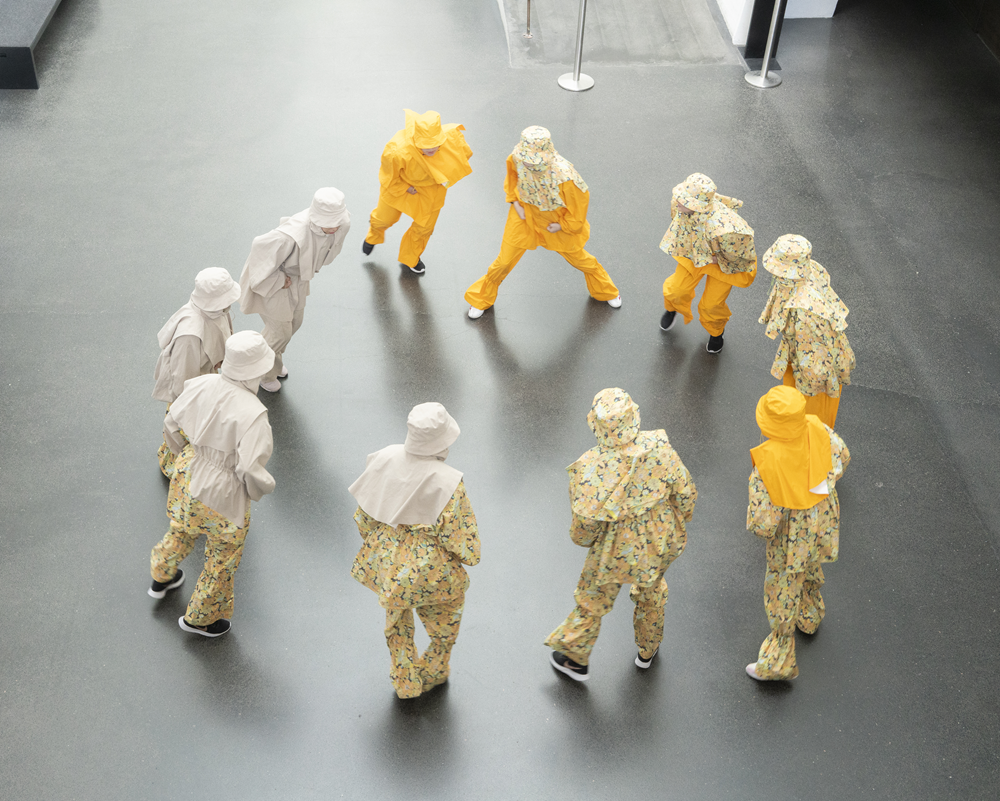
HORDE by Ingri Fiskdal and Solveig Styve Holte continues giving stage to young people and spreading their contagious joyful being, this time intervening into semi- public space of Kiasma contemporary art museum.
HORDE
 is a collaboration between the artistic team and the local teenagers, and as such addresses many crucial aspects and thresholds of artistic work and professional artist’s life, that these young people are invited to explore and shake.
The colorful, voluminous costumes act like an urban camouflage and a special attire for an enchanting social event. The sound of fabrics in motion as a first step into an intrigue of the piece, is followed by subtle, almost levitating moves somewhere in between biomimicry and yet again, magic. The diverse forms of group organization existing in nature come to mind: a flock of birds, bees, fish; the rhythmic precision and synchronization of movement suggest efficiency, roles, strength of collective, but also a powerful entanglement and sense of interconnectedness. The way that HORDE expands the spectatorship, space and the dancing itself is hypnotizing and teleporting to some other realms, perhaps ones of non-human, fairy, otherworldly, somewhere where preconceptions of one/many, young/adult,  et cetera, cease to exist.

In SCORES THAT SHAPED OUR FRIENDSHIP, Lucy Wilke and Paweł Duduś invite us to step into intimate, caring and curious space of their friendship. The very settings of the piece with free seating, and a possibility to change place, position, to enter and leave as desired, as well as to make sounds and reactions, communicates an intention to strip down restricting socially induced roles and enact being together in a deeply personal, meaningful and vulnerable way. The duo explores their own (also-real life) friendship and relationship, beyond frames and dictations of romantic partnership as an exclusive space for intimacy. They gently dive through depths of (dis)ability, agency and difference. Through a sequence of seven well-structured “scores”, held by seductive live beats by Kim Ramona Ranalter, Lucy and Paweł test and twist many possible embodiments of desire, gaze, play and pleasure, learning together how to relate to another, bodily different, human being, with an ultimate care, compassion, and love.

SCORES THAT SHAPED OUR FRIENDSHIP emphasize the transparency, a breaking of taboos or hindering, controlling and dismissive social formulas as also pushed forward by, among others, plays such as Venus and Submission Submission. Openly un-packing issues of sexuality among groups that are often trapped into roles of victims, passive objects of desire or asexual beings, these performances advocate for a radical, vibrant and liberating attitude and a space for a self-expression.

On that note, the dance piece Submission Submission by Bryana Fritz performs the historical biography scripts of four female saints through her fun and sharp take on hagiography- a Medieval literary genre of writing of saints’ lives. Portraying female saints through dynamic sequences of dance, storytelling, and a digital performative writing, she moves us through intense states of madness, holiness, pleasure, miracle and fantasy. Intervening into commodifying narratives of women-saints offered by historical religious structures, the performer gives back her chosen characters deprived identities of sentient and sensual beings. Performative instances of “being possessed” provoke the long-maintained ideas of female as passive and submissive, and kick back in an unexpected and untamed manner.
The projected computer screen with magnified real-time text abandons its “background” quality and performs-with the dancer in a hybrid performance space. This might also give a reference to contemporary context that Medieval histories are transferred to by embodied act of (re-)writing, with a limitless capacity to carry the corporeal, the alive. The similar quality is granted to saints reenacted in the piece: instead of being figurines at mercy of the god or the devil, or represented as nearly disembodied portals-messengers, in Submission Submission these women fully possess the divinity of their female bodies. For this edition of Moving in November, the portraits of Hildegard of Bingen, Catherine of Siena, Christina of Bolsena, and Joan of Arc have been presented.

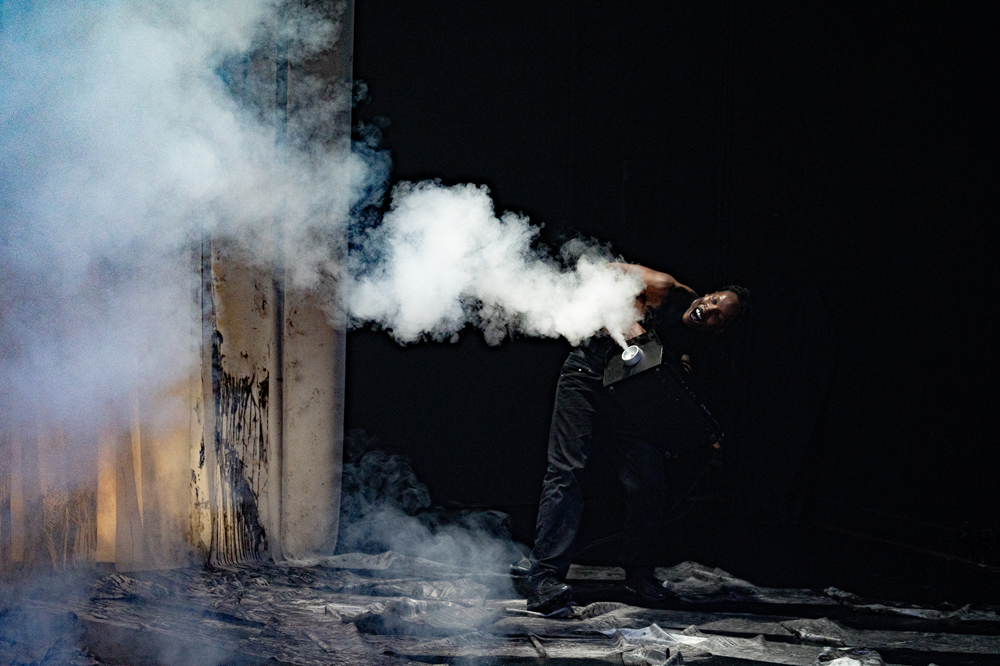
The final piece, DARKMATTER by Cherish Menzo, pushes further the issues of perception and representation of identities, working around common, yet shallow, discourses of blackness.  With a dark stage, black, a liquid-muddy matter that co-acts with virtuous black bodies, the piece is sourcing inspiration from yet unexplored cosmic matter. For its not-fully-known, fluid and ever-transforming quality, the dark matter holds a capacity to be anything, and everything. Can identity act in the same way?
The performance collaboration with a dancer Camilo Mejía Cortés develops in direction of dystopian posthumanism and Afro-futurism, seeking in future time for the experiences of blackness with a possibility to diffract and open up for new readings. This speculative moment comes as a leap in time from 2000-nostalgia in JEZEBEL, a Menzo’s piece performed at Moving in November last year.  Also, while JEZEBEL looks into  the imagery of female black women in hiphop and pop currents, DARKMATTER leans towards rap as a music form, but also, more importantly, as means of self-expression and community belonging. In this regard, Cherish worked with a group of local participants identifying as African diaspora in “Distorted rap choir”, a workshop-format preceding the performance. The created “rap anthem” was then incorporated into existing soundscape, dialoguing with already collected vocal contributions. In that way, the echoes of black community get on stage and take part in poetic negotiations between the spectator and the performers, where both undergo a self-reflection that keeps rejecting ready-made positions.  Through a distorted, multilayered stage vocabulary, Cherish and Camilo explore and expand the inspirative imaginary of what blackness is and can be, confidently returning and disobeying the impoverishing gaze.

Once again, they stand, together with other pieces from this text, and in festival in general, for a fundamental right, a liberating power and an irresistible urge to set the terms of one’s own being and acting in the world.

In a growing culture of oppression and harmful othering as a threat to freedom and autonomous difference, spaces of possibility for a radical and fearless collective being are a necessity and prerequisite for just and promising futures. This year’s Moving in November selection suggested a hopeful direction to move towards, led by sincere love, pleasure, protest, tears and laugh, madness, (add more)- everything that keeps us alive.


Nina Vurdelja

Nina Vurdelja is a performance researcher and cultural worker active across disciplines and geographies, based in Finland. Her interests reside around more-than-human sensuous encounters and ecologies of being together. She is a Phd Candidate at Doctoral school for Communication, Media and Performing Arts at Tampere University, dwelling in meeting spaces between culture, art, and philosophy. 


Cover photo: Kerstin Schroth

Pictures in the text:

Janina Rajakangas: Venus. Photo: Tani Simberg

Ingri Fiksdal & Solveig Styve Holte: HORDE. Photo: Petri Summanen

Lucy Wilke & Paweł Duduś: SCORES THAT SHAPED OUR FRIENDSHIP. Photo: Jean-Marc Turmes

Bryana Fritz: Submission Submission. Photo:  Michiel Devijver

Cherish Menzo: DARKMATTER. Photo: Bas de Brouwer

Thank you for the shared time!

Thank you for the shared time. Thank you for your overwhelming presence in this year’s Moving in November. Thank you for your good feedback and your enthusiasm towards this year’s edition!

It was a truly special moment to see the program unroll in front of my eyes – something that I had imagined for so long. To experience the connections between the works that I had thought of, when composing the program and to see others appear. While watching the works again, while listening to the Soup Talks and having conversations here and there in the festival, the pieces started resonating with one another and new aspects got revealed. Humor appeared as a strong bond between the works. Can humor and laughter help us to process this world?

It was a pleasure to present this year’s program with artists from abroad and from Helsinki to you. Engage in conversations through the Soup Talks and build further connections. Digesting the happenings around us is not self-evident anymore. It is even more important to be in conversation. To give extensive time for exchange, for listening in, asking questions, thinking together, debating, agreeing and disagreeing and for laughing together.

We were lucky that this year again several student groups could follow the festival. One group was visiting from Vilnius experiencing the whole program, seeing all performances and joining us in each of the Soup Talks. To my surprise, one of these students asked autographs from the artists after each Soup Talk. This touched me tremendously! Thinking that if contemporary performing arts and dance artists can be role models for younger generations, maybe there is a lot we can initiate through these intense festival moments, through watching pieces and being in conversation, and perhaps after all, there is hope in this messy word!?

For now, a warm and big thank you to the artists and their lovely working groups, that presented their works during this year’s festival! Namely: Marlene Monteiro Freitas, Vincent Roumagnac, Dana Michel, Ella Skoikka, Alessandro Sciarroni, Lucy Wilke & Paweł Duduś, Bryana Fritz, Janina Rajakangas, Ingri Fiksdal & Solveig Styve Holte, Cherish Menzo and also a warm thank you to the hosts of the Soup Talks for initiating the conversations: Elina Pirinen, Masi Tiitta, Sara Grotenfelt, Marika Peura, Nina Vurdelja, Riina Hannuksela & Aku Meriläinen, Samuli Emery, Simo Kellokumpu, Joel Teixeira Neves and Edit Williams.

And equally a warm and big thank you to our partner venues for hosting us and thinking along and to our funders for their important support!

Warmly,
Kerstin Schroth & Moving in November team

Photo: Kerstin Schroth

Everything that keeps us alive, part I by Nina Vurdelja

Bending, twisting, mourning, unpacking, drowning, (un)building, holding on, close together – that is how we are moving this November.

With the carnivalesque madness of Bacchae- Prelude to a Purge, hybrid wave expansion of Data Ocean Theatre/Tragedy and the Goddexxes, and crucial physical labor of MIKE, the opening weekend gave a rise to incredibly important, intelligent and intuitive performances.

Marlene Monteiro Freitas’ Bacchae- Prelude to a Purge announced this year festival with the intense, surreal staging of the Euripides’ play. Its rich and rhizomatic volume repeatedly references to Dionysian ceremonies fueled with irrationality and absurd, and a passionate embrace of grotesk and a bursting desire for a freedom and a pleasure of being. Somewhere in the tension between elaborate and complex stage solutions and the precise, eloquent details resides the powerful encounter between classical and contemporary, abstract and grounded, institutional and personal, anthropomorphic and what is not.

Data Ocean Theatre/Tragedy and the Goddexxes  by Vincent Roumagnac, shares the ambition towards a macro-narrative and a rhizomatic multiplicity of micro-encounters and net of poetic instances over time and space. Again, it is exactly these details that act not only as the pillars of dramaturgy and holders of the narrative structure, but these are also check-in points for the audience, a moment of silent, soothing acknowledgement of our collective being.
A soaked headkerchief in performative installation of Data Ocean Theatre/Tragedy and the Goddexxes, or metamorphic moment between pain and pleasure in performers’ mimic in Bacchae- Prelude for a Purge, or a graceful way of handling a carton box in MIKE, details are connecting tissues and delicate threads of connection, understanding, and mutual care.

MIKE by Dana Michel, continues to deeper dig into the obvious and reveal phenomena that that been already suggested by the preceding two performances. Three hours of honest and transparent play brings forward the crucial aspects of work as such; work as a physical and emotional engagement, work as a very basic precondition for the art process. Bringing into question the rigidness and intolerant nature of the work cultures, MIKE advocates the possibility to do differently, a space to be different, yet safe, together. In the open-space constellation of the piece, watching and being watched intensifies the social moment and, significantly, makes the work visible in that same social milieu.

In all of three pieces, we encounter aliveness and storytelling achieved not only with a human performer, but also by the most various stage objects (instrument and microphone stands, racks, carpets), technical and backstage equipment (reflectors, stage construction parts), or everyday items (coffeemaker, chair, blanket, et cetera).
Within a re-discovery of a site-specificity of a black box, one witnesses the capacity to create highly affective environments backed up with a genuine curiosity and a factor of surprise.

Additionally, specific qualities of each peace, such as, among other things, duration and routine (MIKE), gradation and repetition (Bacchae –  Prelude to a Purge), or intermediality and interactivity (Data Ocean Theatre) hold the space for intimacy and imagination to develop over time. This state of awakeness and emotional bonding happens with spectator- participant who is provoked and comforted at the same time, navigating together streams of awkwardness, difference, mourning, care, humor, and much, much more.

The contours of artistic form and concrete narrative references (“big stories”: Euripides’ Bacchae, Greek tragedy, climate crisis, et cetera) are expanded and worked “from inside”, accommodating multidirectional and unexpected interventions that highlight the contemporary context and postmodern momentum embedded in creation(s).

Ongoing negotiation and compassionate listening amongst performers, to their own selves, or with audience, allow extreme emotional states, radical ways of doing, and knowing the world, to unfold and coexistent in the festival experience. Moreover, the changing, repetitive states of sensuous, logical and spatial playfulness, with halt and suspense, amplify trust and transparency as qualities of the performative encounter to cherish and celebrate.

The moving, touching embodiment of care and trust arrives in its fullness with Save the Last Dance for Me, by Alessandro Sciarroni. In the contemporary reenactment of an almost-forgotten folk dance from Italy, we see two men holding and carrying each other though the jaw-dropping spinning dance moves. Traditional men-only couple dance comes in its revived form to speak about suspension of inhibiting social norms and restrictions to freedom, in the hear-warming spirit of unconditional trust and love for another human being. Save the Last Dance for Me resonates with the power of details as anchors in the performance: dancers’ (Gianmaria Borzillo, Giovanfrancesco Giannini) smile, for instance, works as energy release and point of connection with each other, and the spectators. The contextual twist  and the temporal  stretch over a century, turns bodies into precious archives, powerful amplifiers of forgotten voices, containers of memory and resistance.

In Poet in my- My life as Fabou, Ella Skoikka pulls us gently into her hypnotising universe of poetry, dance and music. The shape-shifting appearances and uncanny forms emerge and fade away in the sticky melody of loss, life, joy and sadness.

The atmospheric black-box stage with an immersive interplay of fabric, light and voice, accommodates bodies real and imaginary, flesh-like and ghost-like, dancing and singing in sweet unknowing, day-dreaming and despair. The show follows up on the contradictory sentiments, present and entangled in the state of being alive. Its beauty sources from the sensuous enmeshment into tragic, bright, loving, soft, unexpected, fatal, mysterious, and an unreserved exposure towards what is yet to happen.

We keep on moving with it as it comes, together.


Nina Vurdelja

Nina Vurdelja is a performance researcher and cultural worker active across disciplines and geographies, based in Finland. Her interests reside around more-than-human sensuous encounters and ecologies of being together. She is a Phd Candidate at Doctoral school for Communication, Media and Performing Arts at Tampere University, dwelling in meeting spaces between culture, art, and philosophy. 


Cover photo: Kerstin Schroth

Pictures in the text:

Marlene Monteiro Freitas: Bacchae – prelude to a purge. Photo: Laurent Philippe

Vincent Roumagnac: Data Ocean Theatre/Tragedy and the Goddexxes. Photo: V. Roumagnac

Dana Michel: MIKE. Photo: Carla Schleiffer

Alessandro Sciarroni: Save the Last Dance for Me. Photo: Raoul Gilibert 

Ella Skoikka: Poet in my – My life as Fabou. Photo: Eva-Liisa Orupold


Conversation between Cherish Menzo and Kerstin Schroth about D̶A̶R̶K̶MATTER

DARKMATTER, a literally dark and extremely powerful performance trying to dissolve the fixed attributions and categories given to bodies marked by images linked to skin color a.o.. How did the conceptual frame for the piece come to life?

I believe that the conceptual frame of DARKMATTER was already provoked during the creation of JEZEBEL, in which, for that solo performance, I focused on the representation of the body of Black women in our visual culture. I bumped upon a figure I would see on the television often as a teenager, called the video vixens. I started to investigate these collected narrations and images that are so recognizable in a more European and Western context. This recognizability was something that I wanted to challenge for JEZEBEL. I wanted to see how something recognizable can be distorted, potentially provoking different readings or relations to how we would relate to an image before. So this process of distortion and taking this tool of distortion in my own hands and seeing how it could be implemented and how the body could be perceived in a multi-faceted way was the first trigger for DARKMATTER. The distortion aspect, or wanting to go beyond the known, has drawn me very quickly to speculating about the future, which led me to look into post-humanism, which already brought a lot of friction in relation to the references that I had of post-humanism and the relationship it does or doesn’t have with the Black body. So, the question of what is considered human and how to be able to speculate about this post-human state was a big frame in the sense of how to make that into material.

With this piece, you have the desire to bring multiple voices on stage. In almost each city you are performing, you are forming a so called Distorted Rap Choir, inviting people from the African diaspora to record a Rap anthem. The different recordings are integrated in the soundscape of the performance, creating multiple layers of voices. Can you tell more about your thoughts and urge regarding this initiative?

Something that also got triggered very quickly when creating JEZEBEL, or closer to performing and sharing it with an audience, was representation and which stories and bodies are represented in the contexts and environments that I move in: the performing arts. And how does that relate also to the audience?
A question arose from that where, especially due to the matters that I attempt to tackle or bring about in my work. I questioned myself how the theaters that I present my work at relate themselves to the local African, and African Diasporic communities and what is the relation the other way around? Do these theater spaces feel accessible and inviting for the communities? And what would be necessary to look deeper into these questions?

So this brought me to bring a format of workshops prior to the performances, where, together with the presenting partner, we look into how to reach these communities, whether that is with other partners or organizations, sharing an open call, and where we then invite, if people apply off course, a maximum of ten people to share these two days before the performance where we work on the material that comes back in the performance, but where for me it was also essential to make this space of gathering and exchange tangible. At first, the ambitious idea was to have the people locally on stage with us in each city, but that seemed to come with several complexities, which would require more time to investigate how to facilitate that at the different places we would present the performance. So, this brought me to a different form: we record the voices of the various choirs and add them to the final soundscape so that these voices travel with us. In this way, there is also a layering or stacking of voices that might feel like, during the performance, there is a big distorted rap choir, which actually consists of several choirs.

Another choice – coming back to the public – is to then provide two free tickets for the participants, with which they can use one and they can invite someone who’d they like, and then see what kind of dynamic or shift that also brings, with who comes to the theatre. In the hope that it doesn’t just stay with seeing DARKMATTER, but that there is this sense of invitation to the spaces that is triggered and hopefully allows them to come back to these spaces ‘’or’’ witness or realize that these spaces may not be for them.

Would you like to share your thoughts on the connecting points between your earlier performance JEZEBEL (shown in Moving in November 2022) and DARKMATTER?

I came to the realization that this fascination that I have with distorting reality somehow, and thus creating a ‘’new’’ reality or a different parallel meta-reality, has been something that I keep on reaching out to: this act of distortion of movement, time, maybe more specifically, linear time, sound, light, and image. By it happening already in JEZEBEL and pushing it even further in DARKMATTER, I feel that this tool of distortion brings quite a specificity and a sort of coded reality that connects these two performances. Something that I realized very recently is that this act of distortion, on multiple levels, provides a space for monstrous figures to arrive, to be present. Meaning the performers themselves, but also other entities, the sound, the light, or entities we cannot perceive optically, provoke a sense of monstrosity.

I feel that distortion that generates monstrosity is a linking thread within these two works.

Photo: Bas de Brouwer

Conversation between Ingri Fiksdal, Solveig Styve Holte and Kerstin Schroth about HORDE

HORDE is a choreography shaped as a summer job, for nine teenagers between the age of 15 to 18, recruited and re-worked in each place you are showing the piece. Could you tell about your interest behind this work and the working process you are engaging in with the teenagers in each city?

A motivation for us was to create a project that has a political agenda through its modes of production, rather than working with an explicit political theme as subject matter. A central aspect has been to provide a job opportunity where the youths get to experience the inside workings of a choreographic process, which might nurture the idea of following a pathway towards art themselves, either as a career or as an audience.

We focus on developing tools and capacities amongst the participants, both on the level of work training, but also in the sense that the practice of the choreographic language in itself can provide skill sets that are useful in life at large.

Could you speak about stereotypes and expectations that you encounter during the rehearsals working with non-professionals coming from different backgrounds and educations?

This is the second time we realize this project with a new group of youths after the initial iteration in Oslo in 2021. During this process it has been necessary to develop new sets of pedagogical as well as choreographic tools. We have been challenged in relation to what types of dance materials could be the basis for the choreography, and how to work with creative contributions from youth with a variety of movement backgrounds. We have also been focusing on conveying choreographic principles as much as specific form or given steps, which for many of the youths has been a new approach to dance.

From the teenagers we got the feedback, that in their usual dance classes they normally learn to master a specific movement material in front of the mirror. Contrary to the work with HORDE, where movement material is mainly developed from tasks, not involving pre-existing forms. The teenagers described this as challenging and as a different approach. Departing from a non-frontal way of working, developing material through listening and trying out tasks and being together as a group, made them dare new things, leaded to new findings and more confidence, they said.

You are using costumes for the performance, that erase difference and potentially also gender. We are literally looking at a flock of teenagers performing together, without that one or the other is sticking out by appearance. What is your thinking behind it, in times, where the individual as such and specifically the individual appearance is highlighted more than ever, especially also through social media?

A central idea behind the choreography was that we wanted to create a community where an emphasis was on experiencing the power of being together and performing together in order to create the potential for change. An aspect of this was, as you suggest, to offer an alternative to individualized culture. The costumes created by Elnaz and Mathab Gargari became an important visual key to convey this idea.

Photo: Petri Summanen