Conversation between Janina Rajakangas and Kerstin Schroth about Venus

Your latest work Venus is about the erotization of young girls. Posing the question what it is like to be a girl in the 2020s, you worked with four teenage girls in a collaborative process (your daughter included). How did the idea for the piece came to life and how did you develop the performance together with the four teenagers?

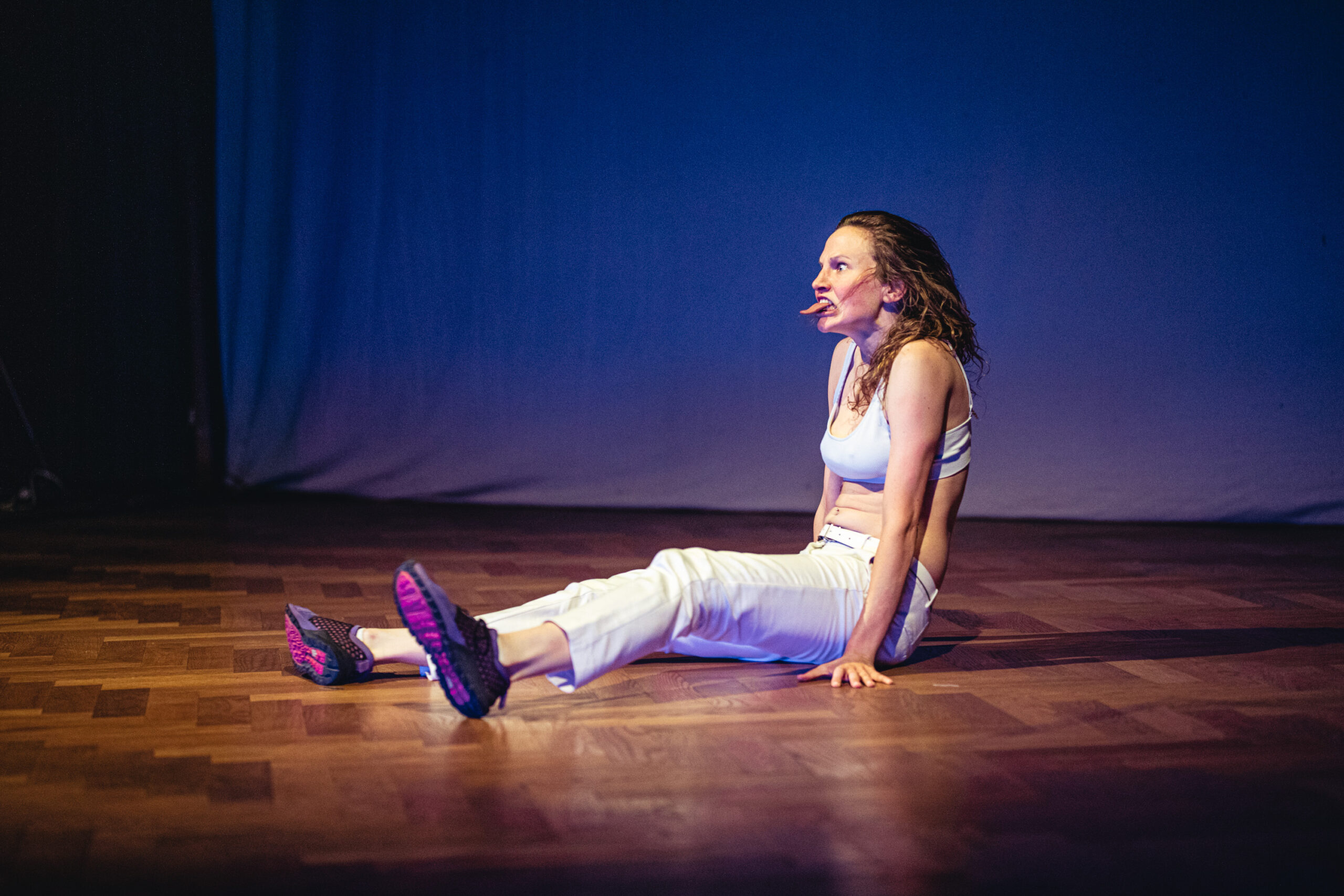
Some time back, when my daughter was in her pre-teens, I started noticing a change in how she was presenting herself online and out in the world. The little unaware child was replaced by someone acting out (accompanied by her friends) classical so called male gaze material. She had learned how to dress, what sort of positions to take and what angle to use the camera in. I found that was unsettling and decided to start making a piece about that with her. It happened to be Covid lock-down as well so I had no-one else to work with. We did a couple of residencies, just the two of us, making and sharing material between us.

Then I invited three teenagers I had worked with previously in Teen (2017/2021) and designers to join us. The whole working group is made of people who grew up as girls and the process was beautiful! We talked about what it was to be a girl now and how it was when me and the other adults grew up. Then we made texts, movement and relation to audience based on these discussions. Hanna Parry, who commissioned the work for Baltic Circle festival found us a space in Lauttasaari to put the show in. The place has feminist history and inspired the work even further.

Let’s speak about Venus and the associations that are evocated by the title of the performance, regarding love, beauty, desire and the image of a perfect body. You are challenging the images of the goddess of love through the lens of teenagers growing up within the attention economy of social media – exposing their life and bodies to the gaze and judgement of others. Would you like to talk about this?

Well, we all need the attention of others and when you are in your teens or a young adult the need is even bigger because everything in you changes so quickly. So girls put material online to check if they are desired and they learn what sort of material is successful or accepted. We went on a quest to dismiss what is accepted and asked what sort of a goddess we want to be? So we collected words to describe this new goddess and made spells to bring it out! We ended up with: Angry, Dopey, Dramatic, Problematic, Adolescent, Intimidating, Trouble-making, Delusional, Not funny, Too much and too little, Gullible, Shit faced, Slow-paced, Like everyone and like no one, Crazy, Loud, Unstable.

We ended up in a place where The Venus of this piece is honest, humble and kind, but also dopey, problematic and loud. We want there to be girliness that is manifold. Girls don’t fit one mold. It is incredible that such a basic thing as acceptance is so rare to come by still.

There a spells, witch-circles, rituals in Venus. I am curious to hear your thoughts about screaming and girls using their voice! Are loud girls, loud women still not accepted in our society?

Don’t think so. Women scream and men shout. We use different words for making loud noise, women seem to be in trouble, men not. Also being loud is taking the space and attention, and there are not many spaces for girls to express themselves fully. Women are only recently taking more space in politics for example. How we are expected to behave tells about the power structures surrounding us.

Venus has been a place for the girls to articulate feelings and experiences on being a girl. Just sharing experiences between the group has been very empowering. We realized that there are a lot of things we should not accept . As an example online harassment. We don’t talk enough about it, even though it is widespread and very young girls fall victim to it. Even worse, they blame themselves for it. If anything, this needs to be shouted about!!

Photo: Tani Simberg

Conversation between Bryana Fritz and Kerstin Schroth about Submission Submission

What was your desire and the questions when you started working on your solo Submission Submission?

When I first started working on Submission Submission, my desire was largely to study women’s lives in the medieval period in order to learn from the particular strategies that they were using to subvert their immediate circumstances and present. I was fascinated by their modes of self-organisation both within monastic and non-monastic settings, as well as the multiple techniques they were developing to learn to read and write independent of educational structures, and also the different ways of practicing and embodying spirituality on their own terms. This resilience which was corporal, strategic, and spiritual felt like an important material to practice aligning with. So the starting question was very much rooted in this, how can I learn from these women and in which ways can their strategies be relevant today, what is necessary to tell and how to tell it.

As I began to work more thoroughly with scholarly texts, very quickly I realised that rather than taking a historiographic approach, I was actually more interested in a hagiographic one. Hagiography, being the writing of saints’ lives, was actually one of the most popular literary genres in the medieval period and currently it is used as one of the important sources for historians to read first-hand accounts. In it, one can find not only biographical information about a saint but also persuasive tellings of levitation, miracles, phenomenal stories of healing, and beautiful exchanges between the human and heavenly realms. Hagiography, being theological, devotional, moral, and yet spectacular in nature, appealed to me because its aim is to convince its readers of a saints’ holiness. It doesn’t ask, did she actually levitate or not, but rather chooses to agree with her claim and then works to structure its narrative in order to affirm even the most inexplicable miracles.

A fundamental part of hagiography for me is also the fact that a saint’s life is never just told once, it is told again and again and in each version the details or emphasis change and another interpretation of her life is offered up. Essentially, it is a genre of iteration, retelling, and adaptation, which I feel even more offers up the necessity to keep the momentum of the story going. My desire therefore in Submission Submission is to use the versioning nature of hagiography as a continuum between historical and contemporary forms of narration. And by offering up my version, I am merely adding one more voice into the mix. My politics is here not to rectify history, mine is rather to participate in, adjust, and practice its narration – with my body, my words, her echoes, and the public. And to be honest, my ultimately hope is to smuggle these saints away from the canonising church and give them back to the public realm.

As I am only working on a small subgroup within the enormous landscape of hagiography, meaning women saints, I try to focus on the set of tropes that are proper to their lives and understand what are the commonalities and differences with exaggerating. A commonality being that she would use her body as a site of revolt and as her main tool to subvert insurmountable forms of power. A difference being the techniques she would use to do it.

In order to contextualise a bit more what these women were up against and to appreciate the profundity and nuance of her subversive acts, it is important to acknowledge that during the middle ages, a woman’s tongue was considered venomous and spewing lies. She was often hatefully blamed as the descendant of Eve, as being solely responsible for the fall of man. All sense of spiritual influence was extremely compromised as she was not permitted to teach, and rarely had access to a decent education. If and when she was able to exceed this widespread misogyny, she would be sure to face numerous denunciations – motivated by the devil, slave to her belly, a liar, a drunkard, and forever guilty – she will pay for everything at the Last Judgement. In order to manoeuvre the possible attacks, a holy women would have to strategically frame her words, body, and actions in order to produce her very own form of compromised authority both during her lifetime and after her death. For me what lies at the very core of a medieval woman saints’ expression of holiness is a nuanced terrain of submission as a political practice.

For example, one interesting and recurring strategy can be found in the writings of Hildegard of Bingen. There is one particular letter that I worked on for Submission Submission where she describes the nature of her visions, in it she explains to her addressee that it is not I that speaks, but rather god that speaks through me. In “her own words”, “The words I speak are not my own, nor any human beings…I merely report those things I receive from my supernatural visions.” In this instance, the holy woman submits her lips and vocal chords to a higher, heavenly power whilst simultaneously validating her own words and making it possible to speak.

Another interesting example can be found in the hagiographic writings of Raymond of Capua on the life of Saint Catherine of Siena, where he describes how she constructed (with the help of the holy spirit) an architecture within her own body, an inner cell, in which she could separate herself from the outside world to exist more independently. ‘[…] the Holy Spirit had taught her to erect a little cell in the interior of her soul, whence she resolved never to come forth, notwithstanding her pressing exterior occupations. When she was privileged with a room, she was often obliged to leave it, but, nothing could oblige her to leave this interior retreat — external truth has declared that the kingdom of God is within us.’

This invention of an interior architecture is also paralleled in the writings of Saint Teresa of Avila, in a book literally entitled The Interior Castle, where she says, ‘This magnificent refuge is inside you. Enter. Shatter the darkness that shrouds the doorway… Believe the incredible truth that the Beloved has chosen for his dwelling place the core of your own being because that is the single most beautiful place in all of creation.’ By constructing these interior spaces of spirituality, the saint manages to create the conditions by which she can practice her faith on her own terms. As we can read in the life of Saint Catherine of Siena, she was not privileged with having a room of her own for she was often obliged to leave it. So that even as she submits to an itinerant spiritual practice imposed by the outside, she is nonetheless able to have an interior cell to retreat into. That is, she constructed a conceptual loophole, a place which she could not be denied, to practice her own relation with god.

For me, all of these stories in their own ways use submission, or submitting to one’s circumstances, as a way to subvert them. In Submission Submission, I name myself an amateur hagiographer of these saints and their various acts. Amateur because I am both a beginner and an amator (latin root) or a lover of these saints. And my work is to submit myself to the labour of bringing them into body and this is conflated with my body and its labor.

Your performance is an ongoing collection of performative portraits of medieval women saints. Could you say something about the research, selection and working process for the portraits?

Maybe its first good to talk about the overall format or structure of the piece… the idea with Submission Submission, like you said, is to make a growing catalogue of performative portraits, but for each iteration of the performance I only choose four saints to embody. I like the idea that project is too expansive to fit into a single evening-length performance and that an audience member will only ever get a partial view into it. Like this, the work feels structurally open to me. In the sense that it is a performance that would rely on disparate publics in order to create an imaginary sense of whole. And if two audience members from two different versions of Submission Submission would meet, perhaps they would need to retell what the other missed and then it would slip beyond my own authorial grasp and into the gossiping lips.

Partially I choose this format because I felt that the literary, historical, and performative study that I wanted to engage with was so vast, that it was necessary to conceptually and dramaturgically build it a structure that it could accommodate for years of research and creation. On the other hand, as much of the work is about testing out different genres of performativity and particular relations to the public, it was also important for me to make sure that I could continue playing it even as it was still in creation. There was no real premiere in that sense – each time I add a new saint, she has a premiere, alongside three other portraits that are already finished. In time this way of working has felt different than I imagined. What is interesting for me now is that each time I begin working on a new portrait, the world around me, my physical state, my bodily training and theoretical interests have all changed and each time I have the luxury of taking another stab at challenging and refining the work.

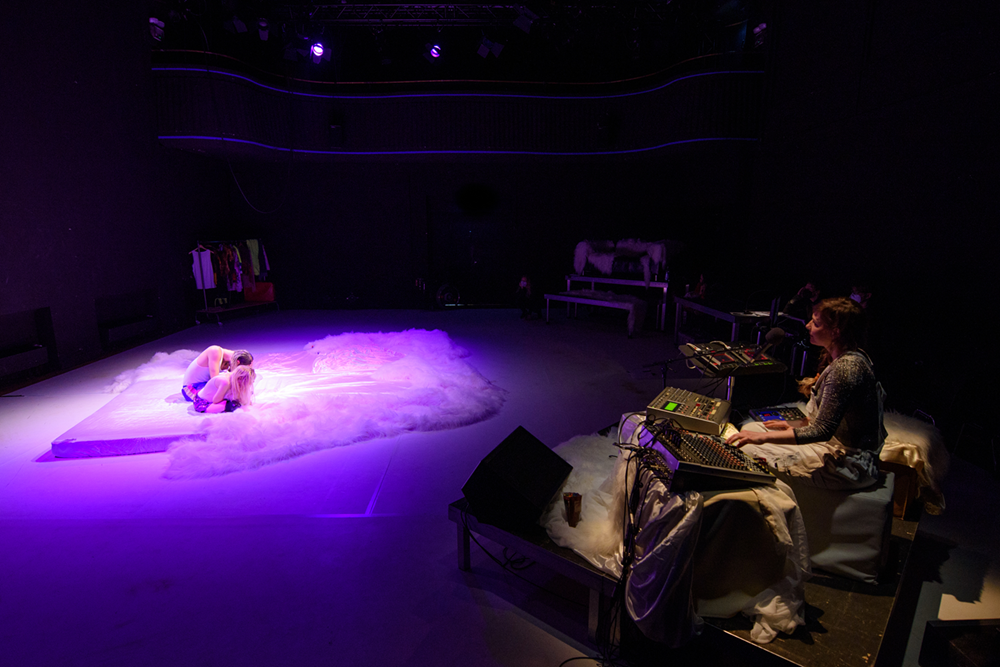
The unit of the portrait is important, partially because it is a convention within hagiography, but also because the work feels most specific when I can handle each saints’ life separately. Each portrait is about 15 minutes long, and generally I add one new portrait per year. The choice of saint happens rather fluidly as she often quite readily presents herself to my fascination. First the encounter is through books, both secular and spiritual, all the different tellings I can find. Then I try to identify the specific (usually corporal) strategies that she was using; she might cut her hair off or take out her eyes to avoid a potential marriage suitor or prove her union with Christ by taking only the eucharist or even her own breast milk as her sole source of nourishment. Then there is a mysterious jump where I search for the genre or form of the portrait. It is usually intuitive and starts with a one-liner relation — Hildegard of Bingen is dance improvisation, Catherine of Siena is monologue, Christina of Bolsena is all-girl punk band, etc. — and from there it gains complexity by thinking through its narration. There is a hagiographer John Capgrave, who writes “My labour is to bringe them into o body.” I therefore try to ask myself: How might this strange and delicate exercise of bringing this saint ‘into o body’, against time, and into the secular realm be embodied and performed? But also… How does one perform historiographic and literary research of mystical or spiritual materials with all the tools one has at hand – one’s physical, digital, and extended body?

Even though I’ve been going at this subject matter for a long time, nonetheless when reading Medieval literature, I often face moments of non-comprehension, misinterpretation, and awe as the paradigms for everything, especially notions of the body, have radically changed. As a reader today, it often feels like Medieval literature is some kind of textual equivalent to the film genre of Body Horror, low-fi and filled with completely awkward scenes of body modification and limb dismantlement. Saint Christina of Bolsena has her tongue cut out, Saint Agatha has her breast cut off, Saint Lucy rips out or has her eyes ripped out and then carries them on a plate. Or perhaps with a bit more nuance, Saint Catherine of Siena who says that her heart was taken out and replaced by the heart of Christ and that she was gifted the foreskin of Jesus as a marriage ring. The integrity of the body was an extremely volatile terrain. But something like the notion of resurrection can actually give many clues. Throughout the medieval period, the resurrection of the body was a very charged and hot topic, which actually manage to route the question of what is a body through the question how will we come back to life before the last and final judgement. What age, height, and sex will we have in the resurrected body? Will all matter that has passed through the body at any point be resurrected? Must bits of matter return to the particular members (for example, fingernails or hair) where they once resided? What is interesting in these debates, which is reflected in saints lives, is the overarching question of where does a body begin and where does it end, how do we comprehend the continuity and transformation of self, and what is the relationship between the parts and the whole.

Beyond the miraculous stories of cut members, resurrection, and transformations of the body, I am also extremely fascinated by the performativity saints. During a saints lifetime, probably before she ever became a saint, because her actions are so extreme, the community around was often in distrust. Questioning what her ecstasies were motivated by – god or the devil? When making a portrait, I always try to evoke a similar dynamic with my public. I equate them to the community surrounding the saint. I want those that are witnessing me to be in a similar dynamic of wondering if this person before them is holy or a heretic. I flip between the position of the storyteller (the hagiographer) and the resurrection of the saint herself. An ambivalence of over-identification, penetrated by love, and transgressing the limits of the physical body. It is my own small confusion tactic for unsettling a clarity seeking public.

In Submission Submission, I often try to elaborate the narratives like a fan fiction writer would – imagining alternative endings, fantasising romances and scenarios unfounded in the original text. If we have been taught to mine a text for authorial intentions, historical content, and indicators of genre and style, we continue to practice modes of taking distance to a text. On the contrary, I try to work with text as a decaying corpse who ushers its readers to move into its tightened tissues and cells to make stabs at animating it, feeling out its contours, and appropriating it for the readers own needs. I try to propel these existing narratives by forcing its contents to snap to another grid of desire – the desire of the reader, myself. Opening up the frame wider and wider to accommodate for the dancing body, the writing body, the extended body within the reading of the text.

Submission Submission blends between your body / yourself on stage and the multiple use of video images, alternating between distance and proximity. How did you work with the creation of the video-images during the process and what place are the images taking in your work?

As I am interested in narration, I find it important to address the question of how and with what tools am I telling these stories. Though my body here is one fleshy problem, perhaps at the center, I also try to evoke through video-projection a second surface for reading, movement, and written text. As my computer is ultimately the place where the majority of my work happens, I try to integrate and interrogate what it might mean to physically, aesthetically, and practically use my computer as a participant in the performance. In fact, more than a specific meditation on the importance of images or video for the work, there is a more backwards justification to their use at stake. The logic I try to build for Submission Submission is a digital one, and the presence of my computer is merely an expression of the underlying tenets. I’ll try to flesh them out now…

As a metaphor for the structure of the piece I often use the image of a Medieval codex. Most simply, a codex is a sequence of grouped rectangular surfaces, superimposed and sew together. What is interesting about the advent of this kind of writing surface, as opposed to its precedent – the scroll, is that it engenders what we could call in retrospect ‘random access memory’ or RAM. That is the possibility to access an arbitrary element directly, rather than in sequence as one would read the scroll. It engendered the possibility for the reader to structure her reading herself and to renew the order of her page-flipping time and time again. For me, as there are only four portraits shown at a time, essentially in each performance I can flip from page to page, from portrait to portrait, depending on the context. The entirety of the performance therefore only exists on a virtual plane.

Another aspect of the digital logics present in the piece has to do with versioning and variation. As the intention of a hagiographic text is not necessarily to tell the whole story in all its truth, variance is always fair play for the aim is merely to portray the saint in all of her holiness. Perhaps rather than seeing variation as a threat to historical accuracy, maybe instead it can be seen as another way of constructing narratives across times and mouths and hands. On another level, I also think the processes of rereading, rewriting, and reactivating are an important part of contemporary technologies for circulation. Like re-posting, for example. When thinking about narratives, what if publishing is not about putting something in print, but rather circulating it? Additionally, when thinking about the larger-scale imperative for history to be rewritten, I think we have to acknowledge that the entire landscape of writing has changed. It is therefore important to ask the question – how has electronic textuality shifted and expanded our understandings about inscription, erasure, repeatability, variability, and survivability.

Perhaps the final aspect to bring up here is the computer as a writing, reading, performing, and publishing surface. The video screenshot work I am doing in Submission Submission has been a recurring technique and tool within my work. In fact, even the interest in submission stretches further back. In 2016, I made a performance called Indispensible Blue (offline) which is a computer choreography or screen-based poem or offline dance. It used the OSX user interface as its scenography and as its publishing surface. By burrowing poems into all usable desktop surface, opening folder onto folder onto folder, flickering between screenshot video and liveness – it was an attempt to use dance and poetry to escape the pre-programmed patterns which guide our daily computer actions. It chooses for the position of the computer user (not computer programmer) and tries to construct a poetics from within her illiteracy. One of the core principles is that it happened offline – the action of turning off the wifi was even integrated into the choreography itself. All materials for the performance (music, video, image) were made in duet with the softwares or in-built features already available on my personal computer: garageband, text edit, default desktop images, etcetera.

In many ways, I believe that the technologies one uses and the surfaces one touches always, in one way or another, exert a choreographic pressure on the user. Suggesting or dictating how it should be used and what it could be used for. The soft pressure our computers put on us both guide the movement of the user and the aesthetics of her expression. But the submissive thinking I wanted to arrive at here was: certainly one can take pleasure in leaning into the fulfillment of a demanded form. Falling into form can also be a way to detect what is being asked of you. Enjoying this submission can be a way to avoid conceptualizing or strategizing an attack. By looking at submission as possessing a range and a quality gives way to feeling out the more subtle uses, misuses, and abuses. And assumes the risk of losing the potential to re-gather and dominate by stepping away from the guarding of power and what it entails.

Photo: Michiel Devijver

Conversation between Paweł Duduś, Kim Ramona Ranalter and Kerstin Schroth about SCORES THAT SHAPED OUR FRIENDSHIP

SCORES THAT SHAPED OUR FRIENDSHIP is an intimate performance exploring the scope of your friendship. What was your desire to make this work?

Pawel: Before the actual work came to place, before we started to work on it, there was a friendship. We met with Lucy in 2017 in another theater production that initiated the beginning of our friendship. There has been a desire just between the two of us as friends to explore the potential of our relationship and also explore intimacy that is beyond the romantic conditioning, where we think intimacy is only reserved for our intimate partners, lovers, spouses, whoever we choose to be intimately, romantically involved with. And we were both also in a phase of curiosity about our bodies. We were hungry for experiences that we have heard of but not experienced. Those were different practices coming from BDSM and kink culture, but also involving a lot of playful ways of being together, adding a lot of embodiment and mindfulness into the movement.

We always worked very intentionally, in all the actions that we would do together. For example for some of the afternoons we build a playground together in the living room, where we set intentions of what we were doing and what we wanted to do. We pulled out tarot cards or read any other plant oracles, so this would be for us a sort of intentional way of spending time together. Only later we talked about, if we’d apply for some funding to explore this creative energy between us in a studio space. We applied with a concept that actually later did not really resonate with us anymore. Therefore we decided to do the piece based on our friendship, as we had so much interesting material and our story as such is very poetic in many ways. Thinking off what we have been through together and how the friendship has evolved. After that we started to observe our friendship from another perspective.

I remember, that for Lucy it was really important to explore the idea of passivity and activity. A disabled person who has less mobility is automatically seen as a passive one. What constitutes an active role? In the end we came to a very simple conclusion, a state of mind that puts you in a certain role, whether your mobility is in the fullest spectrum or if you are restricted in a certain way. That was the foundation and present element in our choreographic research. How do we find a quality of moving that is not about me manipulating Lucy. But to move in a way, that we could actually find a common ground on something that we both fully share. To work on the same eye level felt important. And that was a beautiful challenge for me personally to let go of everything I knew from my dance training and career as a performer working with other physically abled bodies. This was an important point for me to open to new possibilities and to explore the potential of our physicality, for what has been given and what is available. And that went fantastic. We had lots of fun and it was beautiful for Lucy to also explore movement sequences that she never had the chance to do before. I remember that Lucy was sometimes hysterically laughing during rehearsals because her nerve system was so stimulated. There were all these bubbling feelings in the body because it suddenly moved in a way it previously had no chance to move.


How did you develop this piece together and how did you work with Kim Twiddle accompanying you with an eclectic soundtrack?

Kim: the base and idea was already there, and they wanted to have music. I know Lucy from earlier times and we have wanted to work together for a long time. I was also very moved by their idea. I have done collective theater pieces in the free-scene and then have gone more and more to the music production, but as a performer I’m very into the live interpretation of my music. So I’m not so much sitting on my computer and buring it on a CD, I like to perform the music. Of course I also produce music for theater pieces where I’m not on stage and I don’t always have to be, it has to make sense when and why I’m on stage.

In this piece I had the feeling that it was the best decision to play the music live because it’s also fun about what Pawel said about activity and passivity. Often music is consumed passively but it’s very controlling. Like you have the music, but you have to have all the ques exactly on the music because its repetitive all the time. And also for the emotions, you have all the same emotions and expressions and this performance is really pure out of the feeling of the now. All parts are evolving from the movement and intimacy, from Lucy and Pawel meeting each other at the specific day, the meeting can be slow or smooth and on another day more fiery and strong.

With the live music, in this triangle, I can support them from the outer. They have their own ques and tempo, but we are also communicating. It was important while working with Pawel and Lucy that it’s not all about the two of them on stage and their relationship, but also the relationship between them and the other people in the room. There is the interaction with the outer world. I like this way of staging very much. I’m actually together with them in the piece, taken into the circle and being a part of their friendship and their experience. During the rehearsals I learned a lot and took also part in the practices, finding scores and chapters. Participating in the physical research, was a big present for me.

Pawel: It was again a dialogue and as Kim mentioned, Kim joined rehearsals quite fast, maybe after a week or two, and has accompanied us. We worked in a constant dialogue and Kim has been a part of our somatic practices. We also had a workshop around intimacy and sexuality held by a friend of mine, David Bloom who is also a choreographer and an expert in that subject. This also contributed to Kim’s working process and in a way when we have been busy with our bodies, the same exercises have been stimulating Kim to experiment with music. It was very organic. Later towards the end when we had to crystallize the chapters we also thought of the atmospheres we want to create, distinguishing soundscapes.

Kim: The supporting role in Lucy’s and Pawel’s work is important, of course according to the energy on stage. As preparations, we always do some practices before together, by coming together, by coming into a transcendent and also vulnerable and honest situation. Giving the piece as a gift. Not in a way that we have to perform perfectly, we want to be in a real and pure mood to transport the piece. That’s why we do everything to connect between us three before going on stage. During the piece, when we have a physical distance and Lucy and Pawel are on their stage positions, I´m their metaphysical ally, having full focus on them. I literally am with them, noticing every small note of their encounter. Through tones, sounds and rhythm I speak to and with them, partake in, translate and comment on their intimate experiences. That “inside-out eye”-role of mine makes it easier for the audience to feel more in a participant (like me) than in a viewer’s situation.

Pawel: Yes and I would like to add that we always work with what is present in the moment. We are highly sensitive group and we often happen to be full of input coming from all different directions of life. It’s our preparation before the performance to tune in with each other, to find this state and energy where we can sense each other beyond our bodies. This is really important to us and we give a lot of attention to find each other.

Each performance is also for us a celebration and having the opportunity to come together and share this beautiful work with other people. In this state of authenticity and embracing what is present, if there are things going differently during the piece or if there are certain technical issues we embrace them, work with them. For example sometimes Lucy lands in a position where she isn’t comfortable with and she communicates that and we correct it, we don’t try to pretend it’s a flawless work. One of the primary principles is to have the acceptance for that what’s in the present moment, which energy levels in the body are available, so of course it’s a performance that also requires us to deliver something but also it’s really not about creating this toxic pressure and pushing ourselves, its finding the strength through acceptance. It’s a different way to connect to your own power. And we also give a lot of value to the enjoyment of being there. Before every performance we wish each other a good performance, not to do it in an automatic way but putting back again the pleasure of all these things from the playground phase.


You create an intimate, comfortable space also for the audience in close proximity to the performance area. Could you share your idea about the space and set design we are immersing in?

Pawel: At first we really envisioned performing this work in a living room. We wanted to make it as comfortable and cozy for the audience as possible. I see the piece as, well, we are telling a story, like an evening of storytelling. And we wish that those who are listening can relax and be comfortable. That just supports audience receptivity I believe. It’s much nicer to see the performance from a comfortable place than on an uncomfortable theater chair. Also it’s not a frontal piece, we are not performing in one direction, there is more surface where we can come in contact with the audience and favor the created proximity.

This further away perspective in the theater works for other pieces. I think what we wanted was to create an opportunity to have the audience close and be able to look into their eyes and see their faces. Since it was a low budget production, most of the set design we received as a gift, so again, we have been working with what has been available. Same with clothes, we didn’t have the money for costumes so we worked with our own clothes which again fits to the concept of the piece, it’s about us, we are not really wearing any costumes, it’s just us. Kim’s position in the space was also important that there would be a good possibility for connection. I can’t imagine Kim somewhere far away behind the audience, we develop the piece together so it’s really important that Kim is also on the stage with us, in a position that holds and supports us.

Kim: I’m in the audience area, and the guests are also a part of the stage in a way. You said it a few times Pawel that it’s about intimacy and sexuality, a vulnerable picture and a story which is to move the people and let them be a part of the work, it’s important to have them in the inner circle rather than far away. And the performance itself is so detailed, with delicate hand movements and atmosphere that you have to see closely to feel it.


A spoken interview transcribed by Maaria Sainio.
Photo: Jean-Marc Turmes

Conversation between Alessandro Sciarroni and Kerstin Schroth about Save the Last Dance for Me

With Save the last Dance for Me you put on stage a dance, a popular tradition in danger of extinction. Could you share your interest in the research and revival of this dance?

It was a surprise. I didn’t know this dance. Lisa Gilardino send me a video of this dance and then we decided to go together to see it live in 2018. We met this man, Giancarlo Stagni, a ballroom master and he told us that there were just a few people practicing this dance including himself. Besides the beauty of the Polka Chinata, in my mind there was this element of the dance almost dying. It’s not a very old dance, just a little bit more than 100 years old and the idea that it was already disappearing was very moving to me. I think it was disappearing because it used to be a courtship dance, common among the males before getting married in the beginning of the last century. The lives of girls and boys were very separated, so basically during the parties where all the society came together, the men were showing this dance to the community as a way to show off. The dance was not practiced by women at all. Men were practicing this acrobatic movement in their free time, on their own.

I was very fascinated with this dance because it’s not very common to see a ballroom dance performed by people of the same sex. Practicing this dance was almost like a sport to men. At the beginning of the century it was already performed outside in the courtships and streets and the audience were watching which pair of dancers were the fastest and the best. It was almost like a competition. And about why this dance was disappearing, well it was performed on the courtships and then society changed, there was no need to practice it anymore. Also, the dance itself is very difficult. It’s not something you learn in a few lessons. Giancarlo Stagni found some old videos of Polka Chinata and decided to learn it through them.

Having seen several of your works, where does your fasciation and dedication to circular dances and turning come from?

If I am completely honest I think I have been very fascinated by this sort of spinning and whirling movements since I was a child. But in my work at a specific moment in 2015 I was invited into a project between Europe and Canada. Migrant bodies, a group of choreographers were studying about migration, immigration of the humans but also migration of the animals. I was fascinated by the migration of animals, like salmons for example. They were born in the river and did their first metamorphosis to move from the water of the river to the water of the sea, where they spent the most of their life. And when they think they are dying, they go back to the same place that they were born. In that moment I was fascinated with the idea of using only one movement in each show, so I asked myself which was the movement of migration and it was a circle. That’s how it started. I went to my studio and started spinning to find a technique of my own. I made a lot of mistakes but in the end I finally found out the way of spinning without getting sick. If you see me spinning you don’t of course think about the salmons anymore, but that’s where the idea came from. Turning in English means changing, evolving besides spinning. And the movement still keeps evolving and changing. There was a need to research it with different groups, performers and designers, and when I received the videos of Polka Chinata, they were spinning. Once you learn the technique of spinning, it’s more of a pleasure, physical and mental journey, because while spinning some memories might appear in your mind, which make the movement even sweeter. When I teach it, people are really enthusiastic about it.

Save the last Dance for Me is also an intimate performance on trust and reliance on the other, creating an intensity of movement and expression, what are your thoughts in relation?

I totally agree with the mention of trust. Actually when you spin so fast and when you are hugging someone else while doing so, you have to believe that the other person is not letting you go because otherwise you both are falling to the ground. It’s about trusting your partner, doing your best to support each other at the same time. I think this questions opens the question of intimacy. Actually something we were not very focused on when we started creating the work in the sense that, we never thought that from the audience perspective there was a layer that was connected to intimacy or the fact that the two dancers can describe this kind of a relationship trough dance. Then we started to show this piece to some friends, we really realized that people were kind of reading “love meaning” in this dance, which is actually far from the original dance, man showing off and all of that. We decided not to underline this layer. I only asked them to go on a stage already hand in hand. They keep touching each other until the very end, even while the audience is applauding. I think this reflects the trust very well. I got one beautiful comment from a programmer in Paris. She said after the show that she had a feeling that she wanted to go out and fall in love with someone. And I kind of like it, although it’s not really our intention. We didn’t want to transform something that has a very different connotation into something else. I think everyone can see slightly different things in this dance. In some point of the performance there is a switch, where the dancers transform the effort of the dance into “pleasure” and they start smiling. This changes the atmosphere and transforms this energy of the room.

The dancers were traveling from Milan to Bologna over six months to get lessons. But we produced this piece in the studio only in eight days, because we thought it was going to be presented only in Santarcangelo Festival, as a sort of “sharing”. Also the composers of the piece sent us materials from Barcelona and weren’t even physically present in the studio. I thought it would have been an experience that you do one time in a festival and not do it after that anymore, but now the piece tours the world.

Regarding the dancers in this piece, I was already collaborating with Gianmaria Borzillo, because he was in another piece of mine. Giovanfrancesco Giannini instead was an artist I never worked before. I thought it was going to be a beautiful pair. That’s how it started.

I was talking with an anthropologist in Bologna about this forgotten dance. She told me that dance, doesn’t go in extinction like vegetal or animal species. Extinction of dance only happens, when no one remembers anymore about that. Dance is already immaterial so it has the capacity to appear and disappear and pop up again. It can also jump over generations. We are also doing workshops with this piece, not just to learn the dance but to keep the memory of it alive.

Photo: Raoul Gilibert

Conversation between Ella Skoikka and Kerstin Schroth about Poet in my – my life as Fabou

Your performance has a curious title, would you like to reveal your thoughts behind? And maybe also share with us, who Fabou is?

The title has two parts and leaves room for interpretation which is what the performance might also do. The title refers to the way the performance was built, and reflects my art practice around it. “Poet in my” is a reference to an old solo demo that this performance is loosely based on. The words are from Fleetwood Mac’s song Sara, where Stevie Nicks sings: “You’re the poet in my heart”. Well, I wanted to place the poet in different places, undefined places, some lost dreams… in my body and in the space I am working in. The poet also refers to Fabou.

I have many thoughts about who and what Fabou is. However, one idea is that Fabou is an imaginary friend or an accompaniment that takes different forms – has a fluid identity. It lurks behind the curtains. Wants to be heard but also doesn’t want to be chained by strict definitions. Fabou is the one that has been guiding the performance. Fabou is what comes into existence through the piece. It might not be the same for the spectator as it is for me.

I have thought of Fabou as a friend, a lover, a sabotage, a distraction, a glitch, a reminder, a message, a dream, a nightmare, an awakening. Also something born out of the betweenness of lovers: the possible tragedy, the beauty, the desire, the loss. Fabou is a medium for all this, and also the inspiration behind creating atmospheres with sound, movement and text that the performance is about.

Fabou is something or someone that is born out of loss and grief, of letting go. But also, Fabou is a force of nature, a wild wind in the room, a desiring energy, a merging. So I guess Fabou is born from the basics of life haha: desire, death, loss, imagination.

The whole practice was concentrated on figuring out what Fabou could be and how this question could birth a performance. “My life as” refers to empathizing, to metamorphosis, to being connected, to merging, playing with the boundaries, to the fluidity in being – internalizing Fabou and their message in oneself. To put it simply, Fabou is a logic of its own through which to think and create.

The art practice around the performance was about giving voice to something that I imagined to possess me or possess something else in the space. Perhaps possessing the sound or the fabrics. Something acute and craving for attention. The acuteness refers also to the ecological theme, all the destruction that awaits around the corner, the loss that is already here and that pierces through everything in life.


We see on stage a performance that plays with the boundaries between a gig and dance piece, how did you develop and work on this piece?

Poet in my – my life as Fabou is a performance fueled by emotions. Developing it has been a lot about exciting oneself into feeling, imagining, and then reorganizing (in) the space according to this – all this is channeled through the sound, movement, language and fabrics.

The performance is based on my art practice where dance, music, writing, choreography and performing all inspire each other in the creation process. In this performance I worked with fabrics as well. I was interested in diving into different kinds of atmospheres with the sound, the fabrics, the corporeality – all through a play of imagination, through this practice of “Fabou”. Some days I would just concentrate on my keyboard, some days I would go to the studio with all the elements in the space. As I stated previously, the idea was to follow what Fabou could be and what it wanted to say through the different mediums.

I was interested in exploring how personally intimate themes and more universal themes could intertwine; for example ecological grief has come up in the process and in the worlds created through sound, dance and choreography. Fabou was thematically also about this: how it all merges together in life, the micro personal and the macro universal themes that touch everyone in different ways. How emotions get mixed up and tangled. I wanted this practice of imagining, this practice of emotions, to form its own logic for the performance.

I have been working with fabrics before and wanted them to be a part of this piece and therefore I worked closely with scenographer Kaisa Rajahalme. The fabrics and the whole spatial design has been a big part of my practice and the final outcome. I composed the music for the performance and then with Karin Mäkiranta in sound design we especially focused on the spatial aspects of the sound, the entirety of it, the transitions. Finally the whole working group has affected the piece with Irene Lehtonen in light design and Tuuli Vahtola as dramaturgical assistance. The final form of the performance took shape from our cooperation in Kutomo, Turku (Ehkä-production). Now for the Mad House/Moving in November performance, we got Julia Jäntti to do the light design for this black box version.


Could you tell about your connection with, and interest in poetry in connection with your work in general?

I mostly write in my diary, do freewriting or make lyrics. I don’t usually write poetry specifically. I am personally more interested in creating lyrics: how the quality of the voice, the emotion, the atmosphere and the melodies play a big part in how the language and meaning are formed.

What interests me in poetry though is the idea of creating atmospheres, intensities and aesthetics with rhythm and gaps. And unlike in lyrics, in poems this is perhaps more in relation to silence(s), or stillness, or emptiness even? Or how about the idea of poetry as defining what that silence and betweenness is, perhaps not emptiness at all but very much a fullness.

Also some kind of a ritualistic aspect to poetry interests me, how poems have historically been used for rituals and magic spells. Then looking at modern poetry through that lens. The idea of poems as spells, inviting something to come into existence with words, perhaps to arrive from the past, to become existent in the moment or in the future. I attach the idea of “poetry” more widely (not only as a form of literature) to the art of having gaps, traces, echoes, openness, open meaning, even open identity. Revealing betweenness. Or trying to grasp or define something by leaving openness in the air, stating the betweenness, revealing the echoes. And then the magic of spoken poetry: producing sounds, words, sentences, gaps, relations, atmosphere and meaning – that is a whole body liaison!

Photo: Eva-Liisa Orupold

Conversation between Dana Michel and Kerstin Schroth about MIKE

Mike is a piece negotiating our relation to work. What was your starting point and desire behind the development of this performance?

My desire, when creating this work, was to create an environment for myself and the audience where I could work in a rhythm and inside of a flow that was as native to my personality and as conducive to my optimal living modalities as possible.

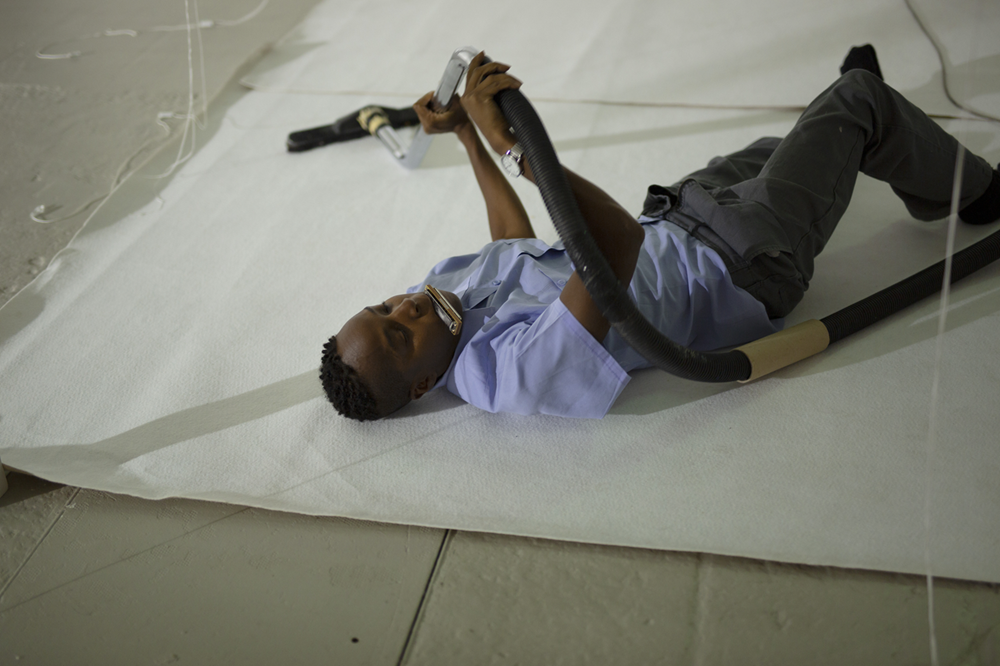
I was working on making a piece where I could question my relationship to trust. and Iwas making this piece as I was also deeply questioning my relationship to work. I was observing workplaces, work habits, work troubles. Things had gotten real quiet (uh, pandemic) and I finally had time to slow right down and do more of this observational work that keeps me curious about being alive. I was observing how people worked and it was troubling. decided to turn bend this trust question around working, workers.

Mike is your first durational work. How does performing this work influence your way of being on stage and the notion of time? 

I am constantly doing detective work, hunting for ways to feel more alive and closer to natural state for larger chunks of the day and therefore larger chunks of my life. It’s been really obvious sinceI was a child (and I get reminded of this tension as I raise a child who is just so much like I was) that I seem to move way slower than most people around me. And that this slowness seemed to affect people in negative ways that I could never understand. it is very painful when your natural state seems to not only not be tolerated but seems to actively be coerced out of you on a regular basis. Makes it hard to understand how one should be if one cannot be “oneself”. Yeah, so, I keep trying to find ways, places, times to make it back to finding this comfortable, fruitful, flourishing, peaceful, engaged in a positive way self. And I figure doing this in public might offer a place where people might think about how they can offer this to themselves too.

Performing this work allows for this stretchy, this expansive, this non-distinct, this spiraling and non-linear sense of time that is native to me. I need to create alternate worlds where I can be a POSSIBLE way to be, to do, to live.

The piece is especially not composed for a black box. How do you work with the different spaces you encounter and how much is your performance influenced by a new space?

I love walking into new spaces, from a space where I have been offered to propose artistic ideas, to a person’s kitchen, to a grocery store. I love to observe and learn and absorb information because it helps me to learn how to be there, helps me to maybe know more about how to be in the world. Keeps me safe, keeps my mind nourished, helps me to feel closer to people. With this new project, Igot really excited about figuring out how to wipe away a few more expectations…how to maybe try and open up some more space to let myself and to let people wander inside of that vital imaginative space that I find we (fatally, discouragingly!) have less and less time to spend time inside of. An easy hack seemed to be this really basic thing of changing positions – in this case, just getting out of the theatre for a hot minute (or uh hundreds minutes!)

Photo: Carla Schleiffer

Conversation between Vincent Roumagnac and Kerstin Schroth about Data Ocean Theatre/Tragedy & the Goddexxes

Data Ocean Theatre/Tragedy & the Goddexxes was first shown in Titanik Gallery in Turku. Within Moving in November, you bring this performative installation to a theater space. This is quite a shift. What does this mean on a conceptional level for the work?

Before answering what does it do conceptually to the work, it is important to me to answer your question by positioning the project beyond a disciplinary and antagonistic polarization between the white cube (gallery) and the black box (theater). Of course, it is impossible, and it is not even desirable, to deny our history of the conceptual and lived categorization of the contexts of the visibility of the various artistic disciplines, and the way they perform and orientate perceptions. And many spectators, perhaps less and less the youngest ones, might still perceive these given architectures, and the events displayed within, and, consequently, the displacement of a discipline-specific form from one to another, through this categorizing habit.

However, as metamorphosis is the dynamic principle of the project, and as I recently proposed the notion of ‘discipline-fluidity’ to open a space for contemporary de-disciplining hopes and needs, what interests me is both to aesthetically recognize, embed, and queer, this heritage of the modernist binarity, and at the same time, to transition the practice beyond it. Therefore, I am not interested to didactically provoke by making a theatre piece for the white cube, or vice versa, an exhibition on the stage of a theatre, but rather to invite mixed audiences to experience a work which’s DNA is fluidity and versatility, relying on a non-essentialist movement of shapeshifting through diverse architectonic conditions. To put it another way, I am interested to respond sensitively and formally to specific contexts, and let transformations and variations of a same corpus of works happen within the hosting ecosystem. May the latter be a gallery, a theatre, underwater, or online… I am aware that we are still depending on the disciplinary ecology (and economy), and I hope our discussion, and the experience of the work itself, can contribute to share infrastructural thinking and processes of ecosystemic transformation for inventing new stages-shelters-interfaces for the growing community of discipline-fluid artists and the emancipated public.

More concretely, and in line with this site-sensitive ethos, I am interested to work with Kiasma theatre stage first and foremost with and through its material qualities and see how the works can enter into a dialogue with these. As much that I was more interested, in Titanik, to install the work in a space by the river Aura. In a space that used to be public toilets divided in three rooms with a huge glass wall, with an interesting window-pattern at the front, than installing in a «visual art gallery». The height and the possibility to hang things and play with verticality, the darkness – and the specific redness – of Kiasma theater, the means to produce immersive light and sound, the possibilities to play with the distances and multiplying the experience of the work from close-up to long distance gaze on it, and the theatrical, maybe choreographic, potential generated by the random distribution of the viewers on stage and in the audience seats… are excitingly offering other material and corporeal parameters for the works to re-appear, situated. In addition to the affective tonalities and surrounding specters linked to the theatre as historicized container… Black box is the new site-specific.


Could you talk about your interest in marine mythology and sea creatures regarding this work?

The reading of an artwork through the biographical lens is not the most interesting, but it seems important to me to share here where I come from, and through which stories and legends I intimately grew up. I was born in the French (francized) Basque country, on the Atlantic coast, and from the very beginning, the ocean has been a founding and animating partner of my becoming, and consequently of my artistic becoming.

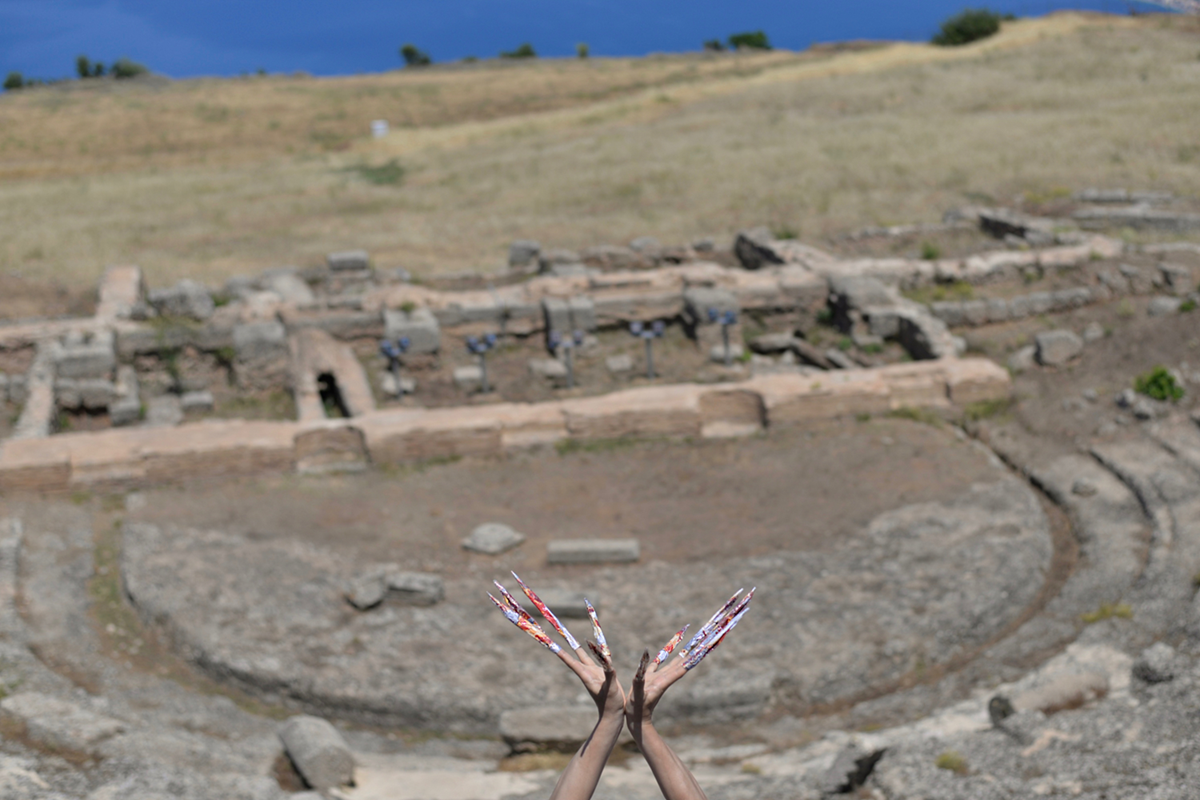
Just like the Finnish culture, the Basque culture is originally based on animist stories, and from the myriad of spirits inhabiting these founding myths, a sea creature has popped back in the project. Their name is Xixili, spirit of the ocean (itsaslamina in euskera), a merfolk with a human torso and a fishtail bottom, but with the particularity, and a difference with the other merfolk species, of having duck feet. Alongside Xixili, we indeed meet other sea and ocean creatures, like Iku-Turso, the leviathan-octopus from Finnish Kalevala, or Hanzaki, the giant salamander, from Japanese mythology. The interest for marine mythology is directly linked to the chosen field of research, i.e. the seas and oceans, in relation to the general climate crisis, and more specifically the alarming forecast of water levels rising.

Swimming with the basco-finno-japanese goddexxes shoal and masquerade, the visitors will also encounter several divine figures from Greek marine mythology. This comes from the fact that my project finds among its multiple origins the critical endeavor of «re-mythologizing» Western theatre, by giving back narrative space to other-than-Greek-alpha-cismale-gods to preside over what I call the “new tragic”. Among these Greek deities we meet Amphitrite, the queen of the seas and oceans, who is an Aeneid (a sea deity), a daughter of Oceanus and Tethys, and – the function for which she is famous for – the «wife of Poseidon». In the very origins of the work, Amphitrite was summoned to be the inaugural figure and protector of the Tragedy & the Goddexxes project. This choice was motivated by the fact that the goddess is almost non-existent in mythological sea-related stories, and completely neglected in classical tragedies with a marine backdrop. Unfairly overlooked figure in comparison to her famous husband, the project started from this injustice, and therefore, involved imaginary repair, and an alternative to androcentric stories. Accompanying the queen of the oceans, gather on stage other deities from Greek mythology such as the Oceanids, the Psamides, but also imaginary gender-neutral goddexxes, whose names were generated by name generators for video games online.

Talking about online matters, another reason comes from the fact that the project is looking into the phenomenon of contemporary hypertech submersion in simultaneity with the phenomenon of the rising seas and oceans levels. In the project, I relate this technological ‘drowning’ on the one hand to the metaphorical use of nautical vocabulary, like sea imagery and analogies, as a dramatic illustration of our computational realities (surf, flow, flood, explorer, navigation, storm, contamination…), and on the other hand, to the fantasies, even fears, of “technology-as-monster” narratives in which alien creatures and supranatural phenomena are often connected to the former aquatic metaphors.

Therefore, intimate oceanic feeling, remythologizing theatre endeavor and calamar-morphic submarine data-cables playfully engendered the project marine mythology, within an époque of a collective imaginary made of tentacular thinking, hydrofeminism, seapunk amongst other underwater-oriented movements.


Tragedy and the Goddexxes is the first part of the Data Ocean Theatre project, would you like to give some insights about this title you have given to this large project?

Data Ocean Theatre (DOT) is my postdoctoral project, in the continuity of my artistic research on “re-ecologizing theatre” which has materialized through and within a series of artworks that were eventually gathered in my doctoral publication titled «Reacclimating the Stage». DOT, as much as the «Reacclimating the Stage» project, is based on my urgent needs, shared with many other artists, to ecologically impact art practices – in my case, scenic – with the contemporary realities of climate change and technological hypergrowth. To embrace this challenge, I myself adopted almost now 10 years ago the strategy of reversing the duality «human stage/non-human backstage», placing the latter at the center of attention and agency, and moving the human presence to the periphery. DOT continues to experiment with this dramaturgy of the (once) backstage in the (now) leading role, with a focus on the dynamic concept and scenic imaginary of submersion, considering simultaneously the phenomenon of the rising of the seas and oceans, the exponential growth of big data and automation, and their emotional response, in relation to the marine and oceanic memory of Western theatre.

DOT is mainly about continuing to transition my practice of theatre directing, shifted into “redirecting” (myself, agencies, and attentions), and to open a scenic/theatrical language and imaginary for the audience at the crossing of the urgent challenges of our times in terms of climate crisis and algorithmic determinism, and their infrastructural impact of our ecologies of artistic practices and experiences.

Drawing on a cross-disciplinary, or discipline-fluid to use the term I introduced above, methodology, based on environmental intelligence and media hybridity, DOT seeks to contribute to changing human-inhuman political ecologies by triggering affective formations and opening senses on the heterogeneous contemporary condition. In the project, the simultaneous forces, and fragilities, of the transforming marine ecosystems meet the growing algorithmic-conditioned life and the crossbreeding of diverse art disciplines and research fields in order to make appear, flickering, fluent, and nebular scenographies, maybe seanographies, as imaginary prototypes for the relational constructions to come. Diving into the “techno-oceanic” as a dramaturgical model of inquiring, staging, forming, sensing and making senses, is an invitation to project the commons through opaque depths, radical otherness, unknowability, guided by a few mythological cyber-aquatic beasts, whose chants, shapeshifts, and wet glitches are signals to maybe enter stages of other possible worlds.

Photo: V. Roumagnac

Conversation between Marlene Monteiro Freitas and Kerstin Schroth about Bacchae – prelude to a purge

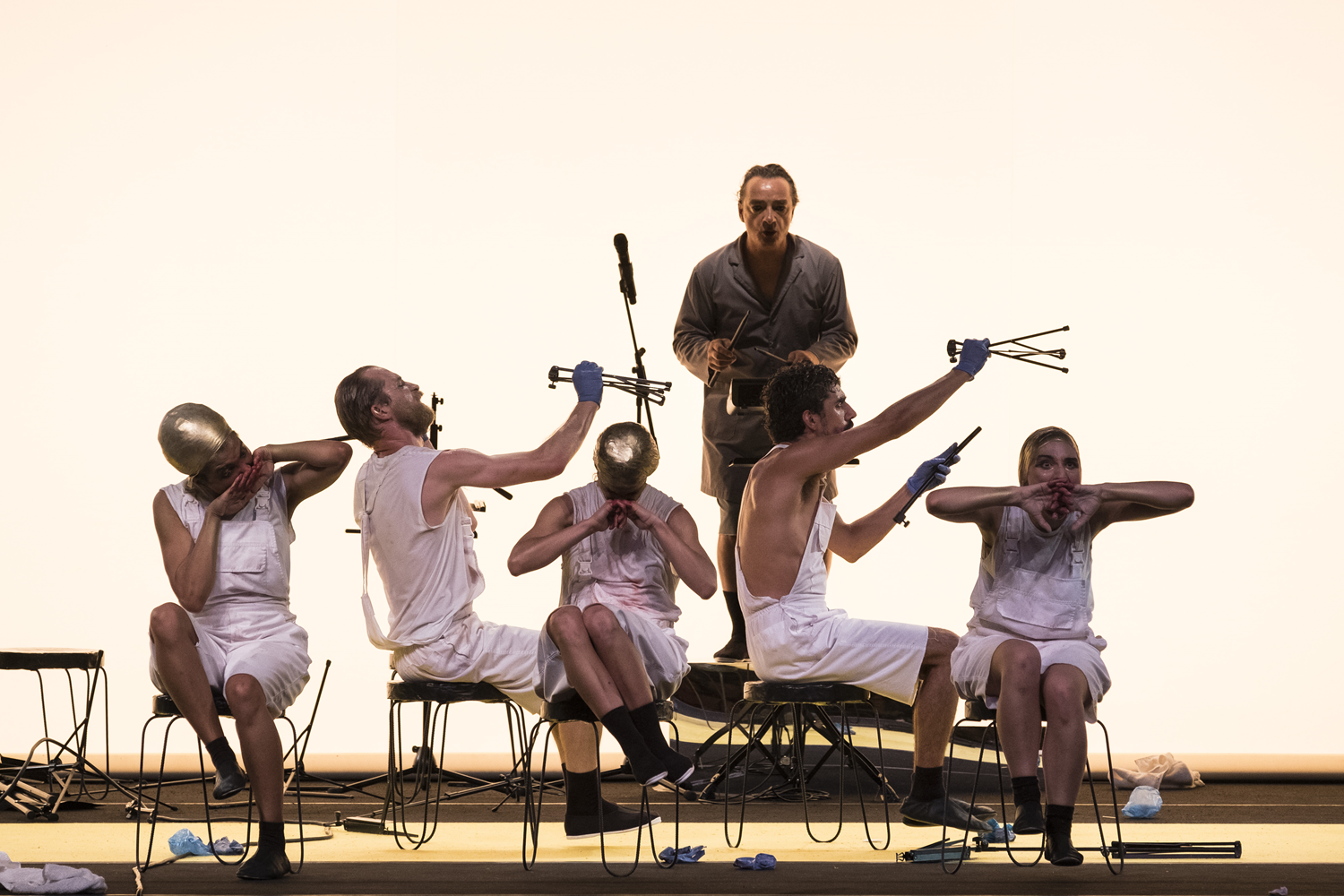
Bacchae – prelude to a purge, is an excessive performance, bringing together performers and musicians, how did you start this work?

According to Nietzsche, in The Origin of the Tragedy, Bacchae is possibly the only survivor of the ancient tragedy tradition, that indeed combined performance and music, had its roots in the Dionysian ritual, was a cathartic experience, rather than the narration of a story. And, in fact, if you read the text looking for a story to tell you will immediately be in trouble, as it is highly fragmented, illogical, chaotic, etc. Whereas if you see it from the perspective of Nietzsche it not only makes sense, as it opens broad possibilities for its staging. This is how I have started working with the idea of music as the central element, and how I came to the figure of the musician, i.e. to the chair and the music stand. Later the chair became a stool, as I systematically looked at Hellenistic iconography (reliefs, vases, etc.). As I worked in the studio with these elements, I realized how highly anthropomorphic a music stand could be, enabling situations of dismemberment and metamorphosis, aspects that play a main role in this play of Euripides. This object, with its foldable different parts, became central in the creation of our Bacchae.

Your works have a sustained rhythmical foundation. You construct very specific figures on stage through rhythmical movement, facial expressions, the use of costumes and colors, often in close relation and connection to objects that take an integral place in your performances and often almost become alive. Would you like to speak about this special and very recognizable universe of yours, its background and where you take your inspiration from?

On one hand, I believe that each and every aspect of a show is important: music, set, costumes, make-up, choreography, performer, sound, etc., just as a narrative is composed by words, images, punctuations, etc. You cannot take away a little word, or a comma, of a poem without damaging it. On the other hand, equally important are detail and rhythm. The former, guiding the performer along the creation process, and performer and public along shows. Details are very tiny words with which we write our language, the choreography. The later, allowing a more emotional relation between public, performer and piece.

What is your relation to fiction, narration and the absurd?

Our Bacchae was crafted in a close relation with the play of Euripides. Likely the audience will see figures in transformation, images arousing other images, sensations, the unpredictable, situations unfolding… in a way that relating to the “resolution ex-machina”. The guiding line is this, not Euripides’s narrative, as already indicated there is not really one. Thus, the elements of our piece are rhythmically arranged, composed, instead of in arranged to “make sense”. Rhythm is therefore an alternative to sense. This is what I call “fiction”. It is not simply a matter of “my relation”, my own choice, but of exploring the deeper sense of Euripides and Greek tragic culture – I think.


Photo: Laurent Philippe

Soup Talks – Conversation Series

Counting down to the festival opening, a reminder and a warm welcome to sign up for Moving in November’s discursive series Soup Talks.

Soup Talks are an invitation to come together and discuss. We invite you for a bowl of soup and to engage in informal discussions with the artists presenting their works in this year’s festival. You are also more than welcome to lean back and just listen in.The talks are taking place each day during the festival between 12-1:30 pm @ Caisa and are hosted by an artist from the Helsinki area.

With one exception: we are extremely happy about this year’s collaboration with Goethe-Institute Finland. Inviting us for the Soup Talk with artists Lucy Wilke, Paweł Duduś & Kim Ramona Ranalter on November 8th to their facilities.

3.11.2023 
Performance Bacchae – prelude to a purge
Guest: Marlene Monteiro Freitas
Host: Elina Pirinen

4.11.2023 
Performance Poet in my – my life as fabou
Guests: Ella Skoikka & working group
Host: Masi Tiitta

5.11.2023
Performance Data Ocean Theatre/Tragedy and the Goddexxes  
Guest: Vincent Roumagnac
Host: Sara Grotenfelt

6.11.2023
Performance MIKE 
Guest: Dana Michel
Host: Marika Peura

7.11.2023
Performance Save the last dance for me 
Guest: Giovanfrancesco Giannini
Host: Nina Vurdelja

8.11.2023 HUOM! @ Goethe-Institut
Performance SCORES THAT SHAPED OUR FRIENDSHIP 
Guests: Lucy Wilke, Paweł Duduś & Kim Ramona Ranalter
Host: Riina Hannuksela & Aku Merliläinen

9.11.2023
Performance HORDE 
Guests: Solveig Styve Holte, Amie Mbye & Sofia Charifi
Host: Samuli Emery

10.11.2023 
Performance Submission Submission
Guest: Bryana Fritz
Host: Simo Kellokumpu

11.11.2023
Performance Venus
Guest: Janina Rajakangas
Host: Joel Teixeira Neves

12.11.2023
Performance DARKMATTER
Guests: Cheris Menzo & Camilo Mejía Cortés
Host: Edit Williams

Register to Soup Talks here.


Photo © Petri Summanen


Soup Talks are organized by Moving in November within the frame of European Network Project Life Long Burning – Futures Lost and Found, funded by Creative Europe 2023-2026.