blackmilk

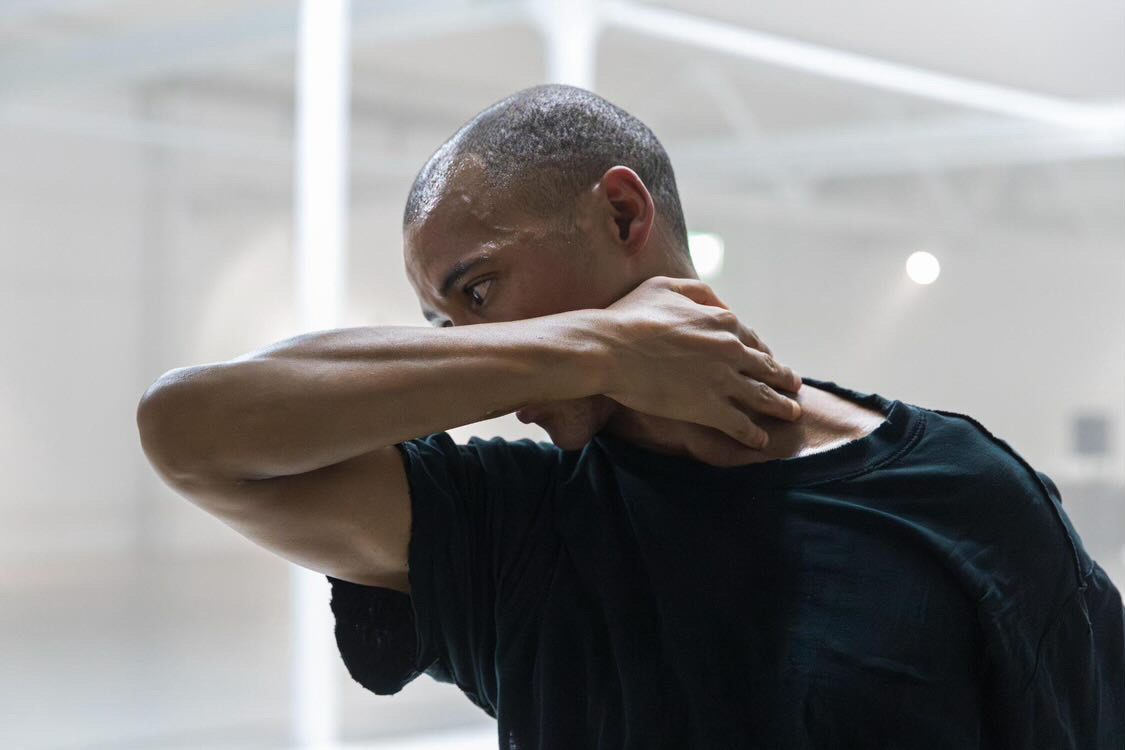
blackmilk is the first part of a triology titled “trompoppies” created by Tiran Willemse. Trompoppies is Afrikaans and describes drum majorettes performing a formation dance in uniform. The performance examines one of the choreographic elements of these dances:  the precise hand gestures. 

By weaving the trompoppies disciplined movements with the melodramatic flourishes of white femme starlets and the dynamic gestures of black masculine rap icons, the performance navigates the chasm between portrayals of African and Afro-American male-presenting bodies. blackmilk challenges this narrow spectrum of representation through performativity. 

Willemse probes the myriad affective bodies residing in the grey zones of legible identities, revealing a nuanced sensibility they term “black male melancholy.” In this charged performance, the artist, a virtuoso with a haunting, possessed gaze, subverts conventions and directs the spectator’s attention to the margins. 

Tiran Willemse is a dancer, choreographer and researcher from South Africa based in Zurich and Berlin. Their performancebased practice is rooted in a careful attention to space, imagination, gesture and sound, focusing on how they relate to the ways in which construction of race and gender are performed, communicated and challenged. They worked and collaborated with Trajal Harrell, Meg Stuart, Jérôme Bel, Ligia Lewis, Eszter Salamon, Susanne Linke, Andros Zins-Browne and with Cullberg Ballet under Deborah Hay and Jefta van Dinther. Willemse was recently awarded the Performancepreis Schweiz 2023. Their work has been shown in e.g. Arsenic Lausanne, Impulstanz Vienna, Tanzquartier Wien, Gessnerallee Zurich, Sophiensaele Berlin, Palais de Tokyo Paris, and MCBA in Lausanne.  

Dance improooo!

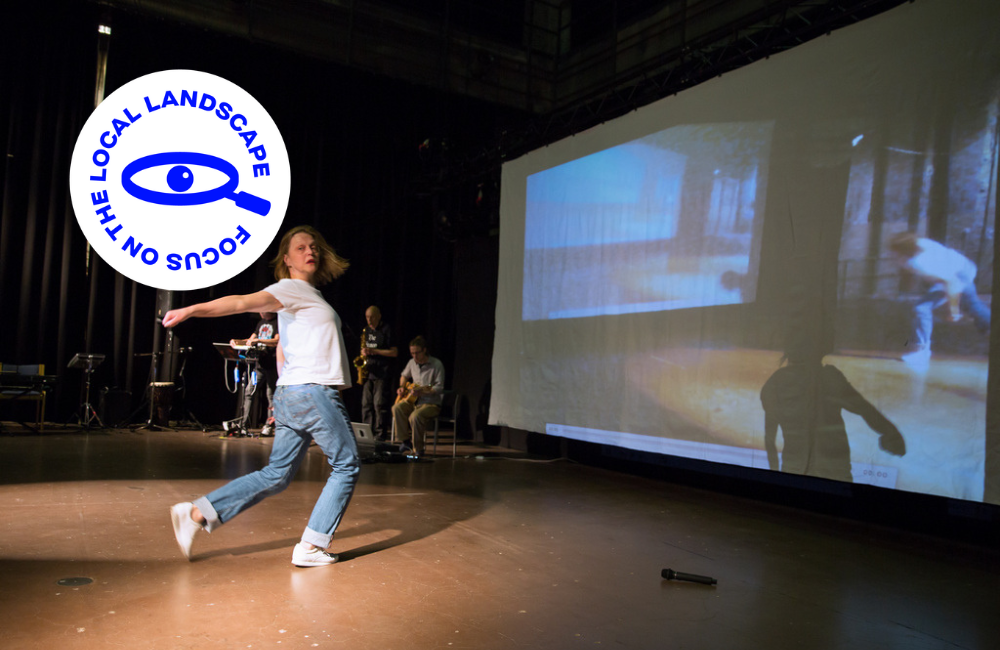
On Saturday November 16th, dance company Liisa Pentti +Co hosts a whole day dedicated to dance and music improvisation in Oodi’s Maijansali hall. The event is free of charge and open to everyone. The program consists of two workshops and a series of performances by young and more experienced artists alike; altogether eleven dancers and musicians, all working internationally, will appear on stage.

Schedule: 

12:00 workshop on music improvisation
13:00 workshop on dance improvisation
14:30-18:00 performances

Dance improooo! is a part of the Focus on the Local Landscape within the frame of Moving in November.

Liisa Pentti +Co is a Helsinki-based dance group founded in 2000. The group’s artistic profile is situated in the field between dance, performance art and contemporary theatre. Experimentation and the search for new forms of expression are central to the company’s works. Liisa Pentti is one of the trailblazers of Finnish contemporary dance, and her unique intellectual work forms the artistic core of the company. Her works often find their starting point in the unnamed, in the night and in dreams-That which the everyday does not reach. In addition to performing, Liisa Pentti +Co hosts residencies and organizes dance events, talks and workshops in collaboration with a wide range of partners from Finland and abroad. Liisa Pentti has a long history of teaching both dancers and actors, and the company also organizes weekly dance classes to people on the autism spectrum and with developmental disabilities. 

A cloud and its shadow

In 1971, an artist pinned a peanut on a gallery wall. The peanut’s shadow formed the outline of a cloud. The work was titled “Cloud and shadow”. Every time I hold a peanut shell in my hand, I recall this poetic gesture. I was born in 1985. Is there anything real in my memory of that performance?   

One shared quality between performance and memory is imperfection. Both are an unfortunate search for an original which is no longer accessible. Both often use prompts to recall the initial event. This year, in the frame of Moving In November, Reality Research Center explores the relation between performance, documentation, reality and memory.  

To that end, RRC’s members artists Emma Fält and Alina Sakko are invited to remember two performances from the Moving in November festival in 2022 by RRC’s members without having witnessed them: Tuomas Laitinen’s Audience Body and Matilda Aaltonen’s and Veli Lehtovaara’s Performing Animalities – A Praxis. Is it possible to remember a performance without having experienced it?   

A cloud and its shadow is a three-stop journey that revisits the various ways and places in which the memory of each performance may bring us together during the festival: Alina’s performance gesture recalling Performing Animalities – A Praxis, the day’s Soup Talk organised by Moving In November, and Emma’s performance gesture conjuring the Audience Body. 

Note: “Cloud and shadow” was the work of Marina Abramovic from the exhibition “Little things”.  

This event is a part of the Focus on the Local Landscape program within the frame of Moving in November. 

Schedule:

Alina Sakko at 11.15, Sörnäinen metro station
Emma Fält at 14.00, Kallio Library

Reality Research Center (RRC), founded in 2001, is a Helsinki-based collective of artists with the shared aspiration to observe, question, and renew reality through performance. RRC believes that art opens the spectrum of reality. Performances are both the tool and the outcome of our research. Every year RRC produces several projects that challenge and expand not only the prevailing concept of reality, but also the borders and definitions of Live art.  

Emma Vilina Fält is a multidisciplinary artist working in diverse working groups with drawing, installation, performing arts, and participatory practices. Their main interests are listening, contact and togetherness that unfold through the act of dialogue and drawing. Fält is inspired by bodies, their boundaries, and ways to connect with the world. They seek to expand and stretch the understanding of drawing, the ways to present it and research reality through the acts of drawing.  

Alina Sakko is a dance artist interested in researching the accessibility of contemporary dance on experiential and conceptual levels. Through choreography and performance practice she explores and wishes to share the bodily experience of presence. She dances between the concrete and the abstract, visiting recognisable imagery and poetic landscapes, playing with elements of spectacle. She is interested in kinesthetic empathy as a possibility for dialogue. 

IL FAUX

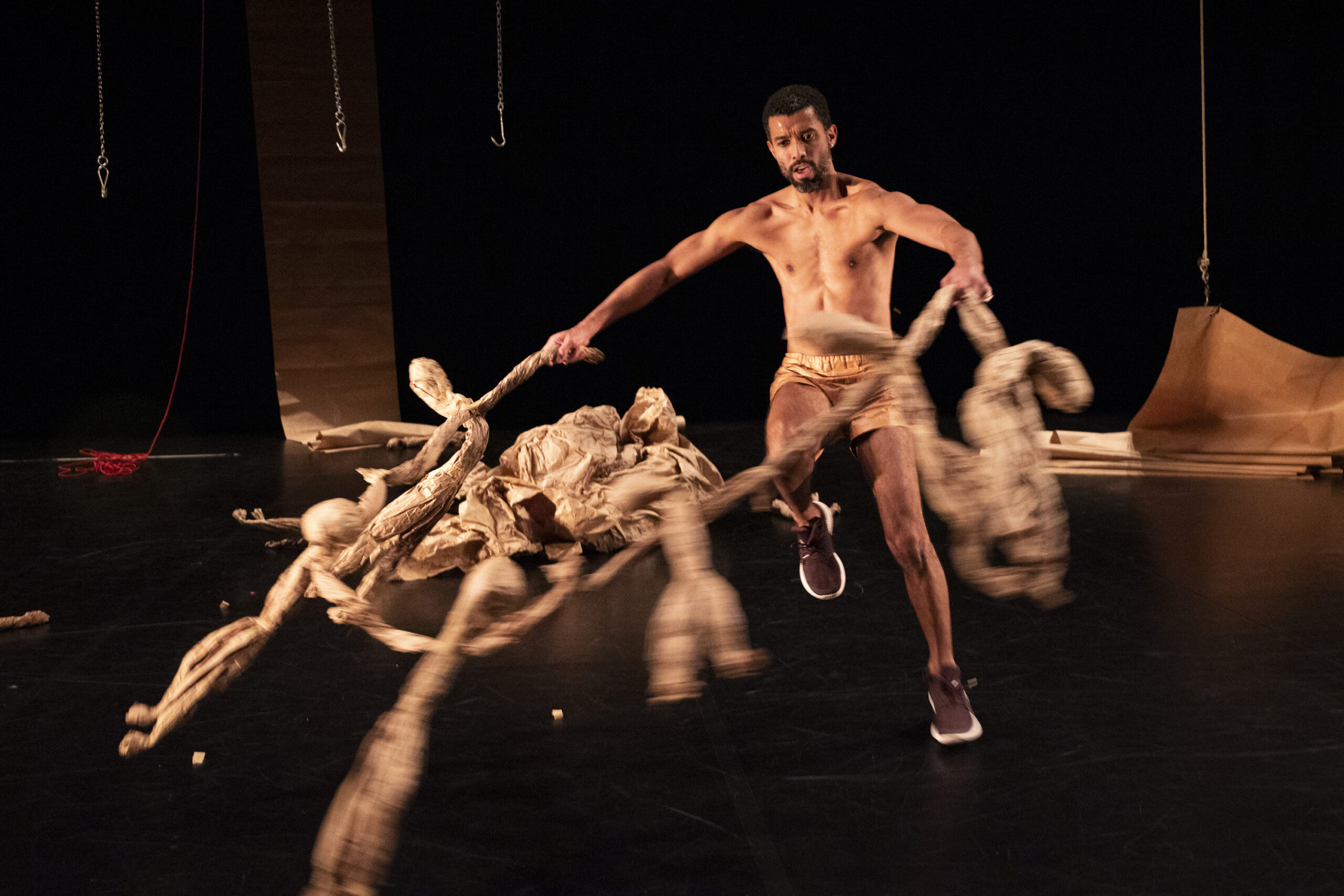
Calixto Neto returns to Moving in November with his latest solo IL FAUX. By taking Ta-Nehisi Coates’s book Between the World and Me as a source and starting point, in which Coates writes a letter to his 15-year-old son to warn him of the dangers the world holds for his black body growing up in North America, this everyday reality and threat guided Neto in the creation of the performance.  

Which bodies are perpetually on the verge of being lost? IL FAUX delves into the transmission of fear and the conditioning of the body in the language of survival and examinates the potential subversion of the societal roles assigned to Black bodies. The performance navigates through dissociative practices such as manipulation, dispossession and fragmentation, and it uses ventriloquism as an element in the dichotomy between the domination of a body and the exposure of its emptiness. 

IL FAUX focuses on imagery, transforming and distorting social representations that define Black bodies. These repeated images, similar to gifs or memes, form an imaginary prison of social roles. By manipulating these visuals, the performance offers a subversive commentary on this confinement. 

“Dance for a dispossessed body. 
Illusion-confusion feat. power-resistance. 
Dispossession meets fiction meets state violence. 
meets meat.  
meets flesh. 
Creation as manipulation. 
Smile like you like it, say hello to the guests. 
Applause! A round of applause! 
Everything you see is real”  

– Calixto Neto 

Calixto Neto, originally from Recife, Brazil, has lived in France since 2013. He studied theatre at the Federal University of Pernambuco and dance with Grupo Experimental de Dança, later earning a Master’s degree in choreography at CCN de Montpellier. A former member of Lia Rodrigues’ company, Neto has performed in pieces by Ève Magot, Anne Collod, Mette Ingvartsen and Luiz de Abreu, reviving Abreu’s O Samba do Crioulo Doido in 2020. He founded his company VOA with Julie Le Gall in 2021. Calixto is currently associate artist at Points Communs – Nouvelle Scène Nationale de Cergy-Pontoise. 

Calixto Neto’s performance Feijoada was part of the Moving in November’s program in 2022 and O Samba do Crioulo Doido by Luiz de Abreau opened the festival in 2020.  

Audience Club

Join the Audience Club at Moving in November 

Moving in November festival invites art lovers, curious theatre goers as well as dance and performance professionals of all kinds to join the Audience Club at its 2024 edition.

Would you like to have more opportunities to discuss dance and theatre shows you see on stage or encounter in public spaces? Do you feel inspired or irritated, excited or confused about contemporary dance and performance but see no platform to express your opinions, ask questions and bounce back ideas? Do you want to get vocabulary, framework, or a community to share your experiences as an audience member? Then the Audience Club is for you. 

What is the Audience Club

Audience Club is a participatory format that invites festival’s visitors to get deeper understanding of dance art in relation to pressing issues of our contemporary world. It allows you to learn more about the language of dance and performance, gain confidence in articulating your questions and opinions, find a community for discussions and immerse deeper into this year’s festival’s program.  

In a group of 10-15 people guided by dance researcher and facilitator Anna Kozonina, the Club members will collectively watch the festival’s shows, explore relevant dance and art theory concepts through mini-lectures and try out various fun formats of discussing the festival’s pieces in a profound and involving manner.  

The aim of the Club is to expand the participants’ understanding of the contemporary dance field and its diverse points of contact with our private and social lives while helping to build confidence in expressing their thoughts and feelings about the art they experience. The Club strives to balance expertise with emotional responses of the spectators and build fruitful connections between feelings and judgments around performing arts.  

Audience Club Theme 

This Audience Club’s edition topic is “We are undone by each other: intimacy, violence, love and transformations.” 

While experiencing the pieces of the festival, we will discuss, among others:  

  • how formal artistic choices open up spaces for audience members to create meanings and interpretations; 
  • how the practice of dance and choreography challenges the idea of an autonomous self-sufficient body; 
  • how we navigate complex identity matters moving between various dance and performance genres; 
  • what are the opportunities and limitation of inventing ourselves through dance and performance; 
  • and how bodily exposure, vulnerability and ability to transform can or can not be a tool for empowerment and resistance. 

Each show of the program will become an entry point for us to dive into all these matters through various discussion formats. By the end of the program, the participants will have concepts at hand to talk about performance as well as enhance their confidence in expressing their ideas about art. 

Who is it for? 

The Club is welcoming dance, theatre and art lovers of all ages over 18 years old. Artists, culture professionals as well as people with no previous background in performing arts can take part on equal terms. The course is created individually for the festival’s programme and takes into consideration the unique group composition. 

Programme 

Session 1. 7.11 

  • 18:00. WELCOMING SESSION: Introduction, backgrounds exchange, expectations, tips 
  • 20:00. SHOW: Ligia LewisA Plot / A Scandal 

Session 2. 8.11 

  • 16:30. SHOW: Pontus PetterssonPancor Poetics 
  • 18:00. SHOW: Mette Edvardsen – LIVRE D’IMAGES SANS IMAGES 
  • 19:30. POST-TALK: Intimacies, empathy and inhabiting each other’s bodies 

Session 3. 9.11  

  • 15:00. SHOW: Tiziano CruzSoliloquio (I woke up and hit my head against the wall)
  • 17:00. SHOW: Ola MaciejewskaThe Second Body 
  • 18:00. POST-TALK: In solo, you are never alone. Entering collective disasters through personal stories 

Session 4. 11.11 

  • 17:30. PRE-TALK/LECTURE: Pushing through or giving up? Endurance, perseverance and boundaries in life, sports and performance 
  • 19:00. SHOW: Milla KoistinenGRIT (for what it’s worth) 

Session 5. 12.11 

  • 17:00. GUESTS SESSION Patricia Scalco & María Villa Largacha: Dealing with expectations: imagination as a political space 
  • 19:00. SHOW: Rébecca ChaillonWhitewashing  

Session 6. 13.11  

  • 17:45. PRE-TALK/LECTURE: Puppets, pleasures and humour 
  • 19:00. SHOW: Cade & MacAskillThe Making of Pinocchio  
  • 20:30. MODERATED DISCUSSION 

Session 7. 15.11 

  • 17:00. SHOW: Tiran Willemseblackmilk  
  • 18:00. MODERATED DISCUSSION 

Session 8. 16.11 

  • 14:00. SHOW: Stina NybergSkvallret (The Gossip)
  • 15:00. WALK and TALK: Encountering the city through other species’ dances + DINNER 
  • 18:00. SHOW: Calixto NetoIL FAUX
  • 19:00. POST-TALK: Bodies in danger vs. bodies taking risks 

Session 9. 17.11  

  • 15:00 AUDIENCE CLUB WRAP UP: Sharing, feedback, tips for the future encounters with dance and theatre 

How to take part? 

To sign up for the Audience Club, please fill in the Google Form by October, 12.  You will receive instructions by email after registration, how to book and secure your spot. 

The Audience Club is a part of the Focus on the Local Landscape program within the frame of Moving in November. 

Anna Kozonina is a dance writer, researcher, and educator based in Helsinki. As well as obtaining an MA in Political Science and Linguistics, she studied dance history and performance theory and holds an arts MA from Aalto University. Since 2017 she has been reviewing pieces by emerging and established European choreographers, and diving into somatic discourses in contemporary dance, which she observes from critical and political perspectives. She currently gives lectures on dance and performance theory, curates educational programs, and conducts research projects. She collaborated with institutions and festivals across Europe including Norrlandsoperan, Impulstanz, Baltic and Nordic Dance Platforms, Rail2Dance, STHLM DANS, etc. She is also a regular contributor at Springback Magazine (Aerowaves Network Magazine). 

Anna’s website.

Patricia Scalco is an anthropologist (PhD, University of Manchester) who uses ethnographic methods to explore the interplay between personal and collective experiences of naming, expressing, and regulating “negative” emotions. She is a researcher with the Irritation Project at the University of Helsinki, and she draws on her research background to collaborate in live-audience facilitation.

María Villa Largacha is a doctoral researcher at Tampere University, educator and independent curator. She has an academic background in Philosophy (BA, MA) and Curating and Contemporary Art (MA), and has worked extensively with public art programs as editor, facilitator, and public program coordinator in Colombia. Her research focus for the past decade has been designing spaces for discussion, collaboration, sustainability, and social change with varied participatory methods and a feminist intersectional frame. She teaches creative writing and curatorial practices at MA level in Helsinki and is currently the co-curator of the New Performance Turku Biennale.

Soup Talks

Soup Talks is a series of informal conversations with the artists presenting their work during the festival. The talks form a discursive line that goes through the festival and brings people together. We want to welcome the audience and the artists around a big table with a bowl of warm soup. Everybody is invited to join in, to listen, to pose questions and to take part in the discussions. Each of the talks will be hosted by an artist based in the Helsinki area.

The Soup Talks are organized together in collaboration with Caisa.


7.11.2024 
Performance Pancor Poetics
Guest: Pontus Pettersson
Host: Maija Hirvanen

8.11.2024 @ Goethe-Institut Finnland
Performance A Plot / A Scandal
Guest: Ligia Lewis and the working group
Host: Gesa Piper

9.11.2024
Performance LIVRE D’IMAGES SANS IMAGES
Guest: Mette Edvardsen & Iben Edvarsen
Host: Laura Cemin

10.11.2024
Performance The Second Body
Guest: Ola Maciejewska and the working group
Host: Tuuli Vahtola

11.11.2024
Performance Soliloquio
Guest: Tiziano Cruz
Host: Eurídice Hernandes

12.11.2024
Performance Skvallret (The Gossip)
Guest: Stina Nyberg
Host: Chen Nadler & Tim Winter

13.11.2024
Performance Whitewashing
Guest: Rébecca Chaillon
Host: Kadence Neill & Pierre Piton

14.11.2024
Performance The Making of Pinocchio
Guest: The team behind The Making of Pinocchio
Host: Even Minn

15.11.2024
Soup Talk Panel
Guest: Rahalël Beau, Sara Grotenfelt, Milla Koistinen, Anne Naukkarinen, Lydia Touliatou
Host: Simo Kellokumpu

16.11.2024
Performance blackmilk
Guest: Tiran Willemse
Host: Geoffrey Erista

17.11.2024
Performance IL FAUX
Guest: Calixto Neto
Host: Patricia Scalco


Maija Hirvanen is a choreographer and performance maker. Her interests range from the relationship between art and different belief systems and ways of re-learning to questions of embodiment and the more-than-human approach in performance and choreography. She makes performances on stages and in places, writes, researches, and teaches. Maija has co-led and planned several artistic laboratories and discursive programs. Hirvanen’s work has been presented at festivals and venues e.g. Tanz im August/Hebbel am Ufer/Berlin, ImpulsTanz/Vienna, Sadler’s Wells/Lilian Baylis Studio/London, SPRING Festival/Utrecht, Seoul Performing Arts Festival, Saal Biennaal/Tallinn, Rencontres chorégraphiques internationales de Seine-Saint-Denis and Dansens Hus/Stockholm, Zodiak, Kiasma, Baltic Circle Festival, Helsinki Festival and Moving in November Festival in Helsinki.

Gesa Piper is a German-born dance-artist and -pedagogue. She has been based in Finland since 2011 and is active as a performer, teacher and choreographer nationally and internationally, eg. as a soloist for Fabien Prioville and Jude Walton. Her own artistic work has dealt with ecological and ancestral themes for several years and has been staged in various venues and festivals, such as “Bog Stories” at UrbanApa 2023 or “Memory Matter” in collaboration with Georgie Goater and Maikki Palm at Zodiak Centre for New Dance in 2020. She holds a BA in dance and choreography from ArtEZ Arnhem and a MA in Dance Pedagogy from the Theatre Academy Helsinki. She has worked at the Theatre Academy Helsinki in various programs and tasks since 2014.

Laura Cemin (b. 1992) is an Italian visual artist and choreographer based in Helsinki. Her work delves into the choreographic power of language, examining how language influences movement and physical interactions. Her work has been presented both nationally and internationally at venues such as Kiasma Theatre, Helsinki Art Museum, the National Museum of Contemporary Art in Athens, and Bozar in Brussels. In addition to her artistic practice as an author, Laura works as a dance dramaturg and guest lecturer at various international institutions.

Tuuli Vahtola is a dance and performance artist who lives in Helsinki and works as a performer and choreographer. In her artistic work Tuuli is intrigued by questions of intimacy, the sense of touch and the corporeality of language. These questions connect to a larger interest of social relationalities, realities and responsibilities and the possibility of queering them through experimental performance. Her latest works are Here, there, somewhere (2023), shown in New Performance Turku Biennale, and intimate expectations (2023), co-coreographed with Ella Skoikka, in Contemporary Art Space Kutomo, Turku. In 2024 Tuuli is performing in works of choreographers Sonja Jokiniemi and Oda Brekke. Tuuli holds a BA in Dance Performance from DOCH/Stockholm University of the Arts (2017). In 2024 Tuuli was a danceWEB Scholarship recipient at ImPulsTanz – Vienna International Dance Festival, nominated by Moving in November. 

Eurídice Hernández Gomes is a Doctoral Researcher in Latin American Studies at the Doctoral Programme in Political, Societal, and Regional Changes at the University of Helsinki. She is dedicated to unveiling the intricate links between public spaces, migration dynamics, and identity development. In her doctoral thesis, Hernández examines the creation of Latin American “places” within the social infrastructure of the Helsinki Metropolitan Region and their impact on individuals with mixed Finnish-Latin American background. Eurídice applies ethnographic methods and arts-based research to explore the intersection between city spaces and transcultural identification.

Chen Nadler is a choreographer and dancer based in Helsinki, integrating community, philosophy, culture, and tradition through cross-disciplinary approaches. Her work explores what the body can do, celebrating the knowledge carried and evoked by individuality and the collectivity of dancing bodies. She is busy with the dilemma that lies in meeting with the other, the emotional, energetic and political nature that emerges from a human encounter, followed by ethical wonders and responsibilities. Chen creates gatherings, performances, video art projects and presents works in international festivals. She co-facilitates inclusive community projects in Germany and a Multidisciplinary Jam project in Helsinki, supported by the City Cultural Grants. In 2024, she hosted a workshop at ImPulsTanz – Vienna International Dance Festival, sharing her bodily-visiting practice evolved from a ritual rooted in her Moroccan ancestry. Chen holds a professional dance certificate in dance (Tel-Aviv-Jaffa, 2013), studied for B.Ed in Steiner and Social Education, (Haifa, Helsinki, 2022) and currently studying for an MA in Choreography at the Theatre Academy, Helsinki. 

Tim Winter is a choreographer and performer,  currently based in Oslo (KHiO) and Berlin (HZT), finishing his MA studies in choreography. He holds degrees in environmental sciences as well as economics. In his artistic research practice, he explores the togetherness of observation and action, and the role of resonance as a connecting and constructing element of space, movement and sound. Key elements are questions on aesthetics, space/time and narrative, and how these are experienced and used to create environment. Practicing and involving Togetherness could thus mean to be involved, to experience and create in the same moment and to access sub- and intermediate spaces. Most recently, Timworked in collaboration with Clemens Winkler (Berlin) and Linda Wardal (Stockholm), as well as on his own practice, in which he merges movement, live sound and spoken language. 

Kadence Luella Neill is an interdisciplinary artist traversing the realms of dance, theater, education, and somatic healing practices. For the past 8 years she has worked primarily as a performer with the New York based dance theater company Nature Theater of Oklahoma, performing at festivals/venues such as Frankfurt Bockenheimer Depot, Dusseldorf Schauspielhaus, HAU Hebbel Am Ufer, Kampnagel, The Skirball Center, Espoo City Theater, Wiener Festwochen, Epidaurus Festival, Steirischer Herbst, Arctic Arts Festival, Zurcher Theater Spektakel, Norderzon Festival, and Spielart Festival.  This past summer she participated in Danceweb under mentorship of Isabel Lewis at ImpulsTanz Festival. Born and raised in New York City, Kadence has worked with many New York based choreographers including Walter Dundervill, Stacey Sperling, Rebecca Brooks, Pavel Zuštiak, and is the longtime student of choreographer and teacher Katiti King. Additionally, she is the long-term teaching and research assistant to Dr. Megan Poe, founder of the NYU Love Class. Kadence is a certified breathwork instructor and holds breathwork as an integral part of her creative practice. She also trains in Muay Thai. Kadence holds her undergraduate degree from the Experimental Theater Wing at NYU Tisch School of the Arts, and is currently pursuing her MA in Choreography at Uniarts Helsinki. 

After their first training at the National Conservatory of Paris, Pierre Piton studied at La Manufacture Lausanne. Upon obtaining their Bachelor’s degree, Pierre joined Corpus at the Royal Danish Theater Copenhagen and went on to work with Juliette Uzor, Natasza Gerlach, and Mark Lorimer amongst others. In 2018, they founded La PP in collaboration with Romane Peytavin and became Associated Artist at l’Abri Geneva. The duo created several works such as Dédicace (Swiss Selection in Avignon 2022), Farewell Body (Swiss Dance Days Basel 2022), and Open/Closed (La Bâtie 2022, June Events 2023). As of June 2019, Pierre enters the collective The Field and works with Simone Aughterlony, Ofelia Jarl Ortega, Isabel Lewis, and Meg Stuart. After a summer at danceWEB Impulstanz, Pierre began the MA in choreography at Stockholm University of the Arts. 

Even Minn is a writer and dramaturg working in the fields of performing arts and literature. Minn is the house dramaturg at Ehkä-production. They also work as a critic at Nuori Voima Literary Service. Latest works include Enter Exude (Kiasma Theatre 2023), Alien Mother (Vleeshal 2023) and Deep Time Trans (Baltic Circle 2021).

Simo Kellokumpu is a choreographer and researcher based in Helsinki, working in the fields of choreography and contemporary art. In his work, Kellokumpu explores the transdisciplinary interplay of bodies, choreography, movement, and space/place, influenced by post-internet hyper-reading practices, queer speculative fiction, and site-responsiveness/ability. In addition to his solo work, Kellokumpu collaborates with other artists, and his latest works have been presented at the Toaster Festival in Copenhagen, Tokyo Arts and Space, Kohta Gallery in Helsinki, and Konstmuseet i Norr in Kiruna. After completing a Doctor of Arts degree in 2019 at the Performing Arts Research Centre (TUTKE), Theatre Academy, University of the Arts Helsinki, based on his artistic research project Choreography as Reading Practice, Kellokumpu has worked as a visiting researcher at TUTKE with his postdoctoral artistic research project titled xeno/exo/astro-choreoreadings. In addition to his artistic work, Kellokumpu currently works as a lecturer in the MA in Dance Performance program in the Theatre Academy, Uniarts Helsinki, and as a curator-facilitator at Pengerkatu 7 – Työhuone art space in Helsinki. 

Geoffrey Erista has performed in theatre, dance, moving picture, installation and performance art productions. His artistic passions are in site-specific art, documentary and politics of art. Erista is interested in exploring socially relevant topics and finding ways to bring up more diverse art. He is a Sudanese-Ugandan actor, dancer and live art maker, who in 2020 received an MA in Acting from University of Arts Helsinki’s Theatre Academy. After graduating he has purposefully pursued to practice policies that combine theory and physical expression.  In 2019 his artistic thesis N.E.G.R.O. – Nhaga & Erista Growing ‘n Reaching Out was part of Tampere Theater Festival. Since then he has worked in contemporary dance productions choreographed by Anna Maria Häkkinen, Sonya Lindfors, Sara Gurevitsch, Karoliina Loimaala, Mikko Makkonen, Jenni-Elina von Bagh, Calixto Neto and Lin (Lin Da) Martikainen. As a performer, he has been most influenced by the studies of Mikhail Chekhov, Jerzy Grotowski and Tadashi Suzuki.  

Pre-note Moving in November 2024

Pre-note Moving in November 2024
Program release September 12th

While thinking about the pre-note for this year’s edition of Moving in November, which will be published in early September, I find myself reflecting on last year’s pre-note. The diffuse and yet palpable sensation of ‘dancing on a volcano’ in the face of the currant state of the world – a world in crises, which I felt while writing last year’s text – remains unbroken.

That said, we cannot simply publish the same text each year again until world politics comes to its senses, discrimination and racism is overcome, equality is established at a societal level, and hope is created for the species with whom we co-exist. So, I try to find other words for a program I am especially enthusiastic about and for artists I admire, who explore movements, body language, images, words, and sounds to find a form to communicate about the world we are living in. Artists, whose performances I am thrilled to present in this year’s festival.

Moving in November continues to create a place to gather, to experience performing arts, to share conversations, discussions and laughter. We believe in social spaces to experience art collectively – we value the encounter between artists and spectators, and we think that those encounters, those spaces are more necessary than ever. This year’s program hopes to open up your imagination, to view the world from a different angle, to literally change the perspective and dream up possibilities of another world.

The curation of the upcoming edition of Moving in November started with seeing several performances that introduce text and spoken word, reference novels, and incorporate theatrical elements alongside their unique choreographic language. Their stories cannot be fully conveyed through movement alone anymore; the accompaniment of the spoken word has become essential, the choreographers told me afterwards in conversations.

These conversations brought me from the initial question of ‘who tells the stories’, to ‘how do these stories need to be told on stage’ nowadays. What are the artistic tools and forms used, to draw us into the universes of each artist?

As I continued to work on this year’s program, I became equally interested in artists from fields beyond choreography, who naturally use text in their performances but also incorporate their bodies as tools to deepen the way a story is conveyed.

I became increasingly intrigued by these two developments and the choreographic aspects, the different languages of these pieces, aside from the subjects they address.

In close connection, this year’s program highlights performances that explore themes such as the body at risk, the transmission of fear, the body in danger, the suppressed body, and the disappearing body, later also in relation to the ‘body’ of nature.

The program also addresses the human body in transformation and transition, and in relation to this, the fundamental right of existence, liberty and the freedom to choose one’s own way of living and making choices for one’s body.

Furthermore, we will look at the playful and transformative power of choreographic language, exploring the blurring of boundaries between different species, roles and taking on other bodily forms.

Last but not least, this year you will experience an international program alongside our Focus on the Local Landscape meandering through the ten days of the festival.

Focus on the Local Landscape is both an artistic program and the starting point of a discussion, addressing the local culture-political situation that is becoming increasingly complicated and hostile for the performing arts scene. There are insufficient resources to research, rehearse, produce and present performances, but also to curate a festival. Yet there is a university that highly educates dancers and choreographers and releases them into a world that seems to hold less and less space for them. This raises the profoundly troubling question: What would a society without a diversity of different art forms and a variety of diverse artists look like?

With Focus on the Local Landscape, we embrace artistic proposals from the local performing arts scene that came towards us by chance. Choreographers who, for example, received funding to produce but lacked venues, or a frame and visibility to present their works. We decided to include these proposals into this year’s program. Examining what happens when different resources are brought together to create a program.

Artists and companies, institutions and Moving in November joining forces and gathering resources (communication tools, funding, production skills, spaces, staff, technical equipment, time, visibility etc.), is a response and a political statement.

Can we together imagine a different future? By imagining it, maybe we are creating it already?

Yours,

Kerstin Schroth & the Moving in November team
24.7.2024

*(You can read the last year’s pre-note here.)

Picture: Kerstin Schroth

The Making of Pinocchio – Detailed Content Description

Ligh­ting and Sound

There are no strobes, flashing lights or haze.
One of the moving cameras has a bright light.
There is a short section with loud music and a loud blower machine.
There is music underneath performers talking but there are captions integrated into the show.
There are no moments of complete darkness.

Par­tici­pa­tion

The performers speak directly to the audience.
There is no expectation of audience participation in the show.

Content Notes

There are no strobes, flashing lights or haze.
There is a short section with loud music.
Contains nudity.
The show briefly talks about transphobia, and sometimes explores the exploitation and misrepresentation of trans people’s lives and bodies.

The Space

The stage will have a large screen, hanging near the front. There will also be a large red drape hanging on the left and going across the floor. There will be 2 more visible smaller screens on the stage that the performers use.

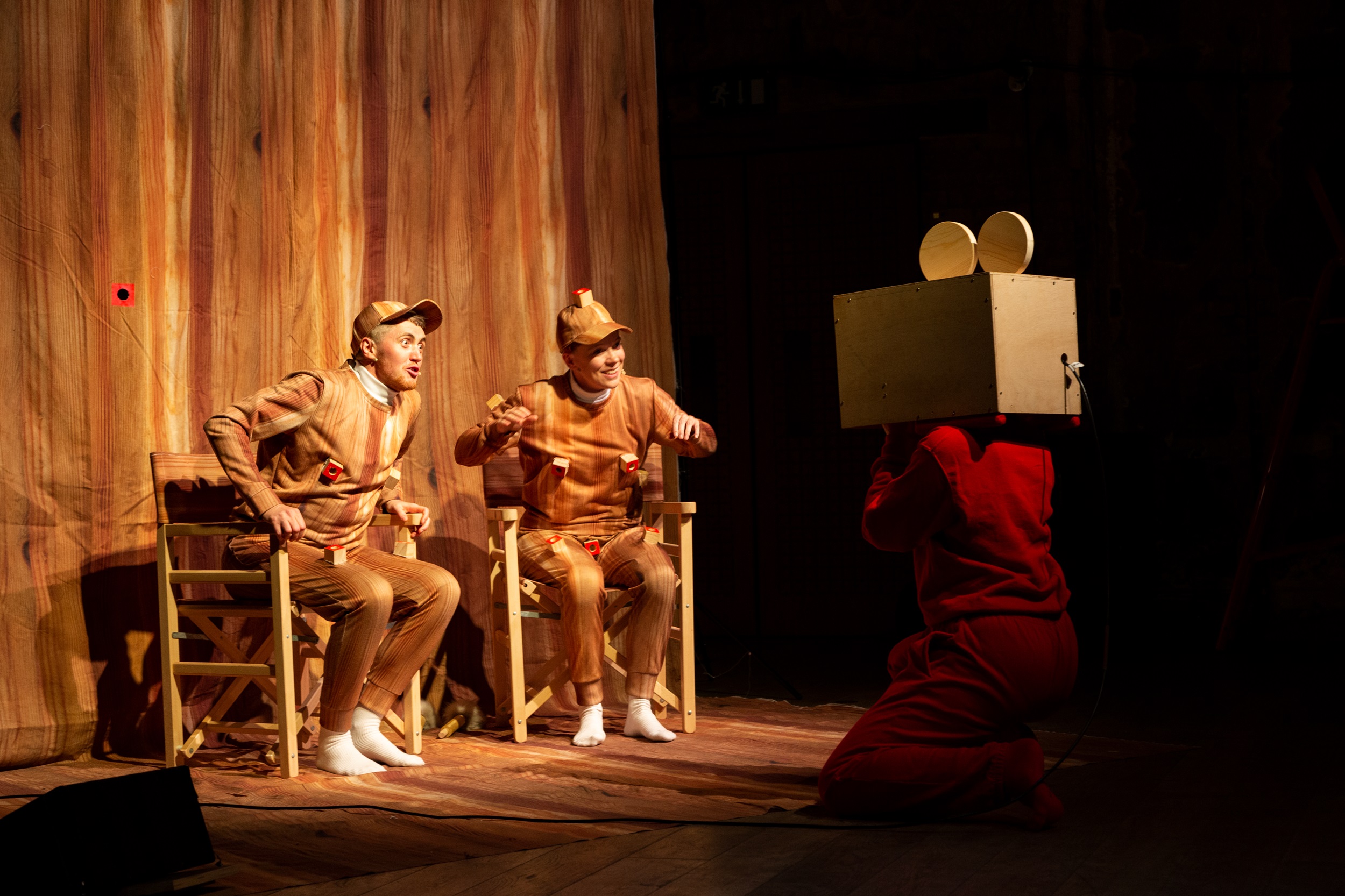
Near the front there will be a drape of material with fake wood printed on it, with 2 directors chairs in front of it. There are lots of props lined up against the back wall and some of these will move to the front of the stage during the show. There are wooden cameras in the space and some of these will move.

Often there is action happening live on stage, and this is being filmed by a camera from a different angle and projected onto the main screen, so you are watching 2 different perspectives at the same time.

The performers are:

Ivor MacAskill
Rosana Cade
Tim Spooner
Jo Hellier

Compre­hen­si­ve content desc­rip­tion

The Making of Pinocchio is a performance about gender transition. Rosana Cade and Ivor MacAskill are artists and lovers. They created The Making of Pinocchio alongside and in response to Ivor’s gender transition. The story alternates between retelling the story of Pinocchio, a puppet who wants to be a real boy, and a film studio where Rosana and Ivor are trying to make a film of their version of Pinocchio. As Ivor and Rosana make the film they talk about their experience of gender and their relationship. Rosana and Ivor mention different parts of the story of Pinocchio but you do not need to know the story to follow what is happening.

Ivor talks a little at the beginning about transphobia but does not tell any specific stories. The performance attempts to centre queer joy and pleasure. It is playful and it uses humour. Ivor and Rosana check in with each other throughout the performance.

Ivor performs a dance where he is fully nude at some points, at a distance from the audience. When Ivor is nude audiences will see that he has had chest masculinization surgery. There is also a short film clip where we see Ivor’s chest before top surgery.

Rosana describes a sexual fantasy between Pinocchio and the artistic director of the venue, which plays with the artistic director having power over Pinocchio and seducing him. All of the characters are consenting to being involved in sexual activity and experience pleasure. The nudity and sexual fantasy scenes are performed in a playful way.

Rosana and Ivor have thought a lot about this performance. They are sharing their experiences and their bodies in ways they are comfortable with. They have also found ways to take care of themselves when they perform.

Photo: Christa Holka

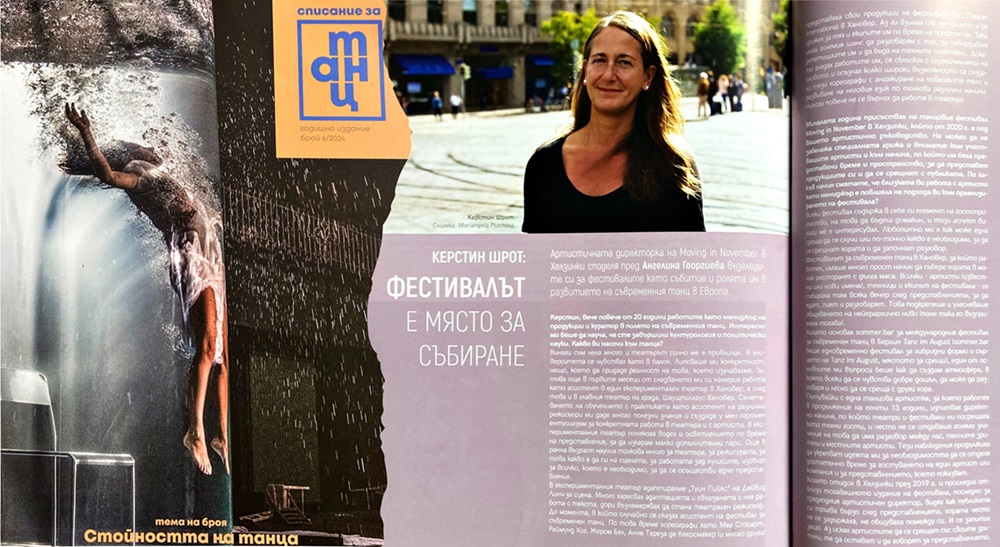
The festival is a place to gather – Interview with artistic director Kerstin Schroth by Angelina Georgieva

Bulgarian dance critic and journalist Angelina Georgieva visited last November the Moving in November Festival as part of Capacity Grid exchange program between the festival and Brain Store Project, Sofia. The visit provided an occasion for a conversation with Kerstin Schroth, the festival’s artistic director, on the value of contemporary dance festivals and their role in the development of the art form. The conversation was published in the current issue of Dance Magazine, the Bulgarian specialized annual edition for ballet, contemporary dance and dance culture.

Kerstin, you’ve been working for almost two decades as a production manager and curator in the field of contemporary dance. I found it interesting that your educational background is in Cultural Studies and Political Science. I’m curious to learn what made you engage with the world of dance?

I’ve always read a lot and I was very attracted to the theater. University studies felt like a bubble. I missed some kind of concreteness, to put a reality on what we were studying. As a direct consequence, I got myself an assistant job at an experimental theater in Hannover, already after the first months at the university, and later on at the local Schauspielhaus. Combining the studies with the work in these theaters as assistant of different directors gave me very useful insights and created an immense enthusiasm about the concrete work in a theater, with artists, that the university did not manage to create with me. I also ran the light cues at the evening shows at the experimental theater, to earn some extra money.

I learned so much through these continuous jobs at a young age, about theater as such, about directing, being on stage, being behind the scenes and everything needed to make a stage play happen.

At the experimental theater we adapted Twin Peaks by David Lynch for the stage. I loved the adaptation and the text work that came with this and for a while my plan was to become a theater director, until the moment when ending up by accident working as an assistant in a contemporary dance festival. At that time choreographers like Meg Stuart, Raimund Hoghe, Jérôme Bel, Anne Teresa De Keersmaeker (and many others) presented their works in Hannover in the festival called TanzTheater International. I picked them up from the airport and took care of them and their teams during their stay and had the big chance to have conversations with them, see their rehearsals and the evening shows. While seeing these pieces, I was somehow confronted with the limitations of the spoken word and witnessed how much more these choreographers made possible through engaging the human body and language in a different way. I never went back to work with theater.

Last year I had the chance to attend Moving in November Festival in Helsinki which since 2020 is under your artistic directorship. I couldn’t not notice the special care and attentiveness towards the participating artist and the way they were given time and space to present their productions and encounter audiences. In what way do you think your close work with artists as a production manager has influenced your approach towards organizing and programming the festival?

I’ve always been highly interested in the aspect of hosting within a festival context, curious about when and under what circumstances encounters can happen, or maybe better, what it needs to make people encounter each other and start a conversation.

The contemporary dance festival in Hannover, I was working for, had a very simple way of bringing people together in a small restaurant with a long table. Everybody, artists (famous or upcoming), technicians and the festival team gathered there each evening after the performances around the table to eat, to drink, to chat. This supported and facilitated conversations on a non-hierarchical level (at least, that’s how I experienced it back then).

When creating the festival sommer.bar for the Berlin dance festival Tanz im August (sommer.bar was both a festival for hybrid forms and the heart of Tanz im August, the festival center), one of my main questions was how to create an atmosphere where everyone feels welcome, can be in conversation and can encounter others easily.

Traveling with an artist for almost 13 years, I experienced very directly the way we were hosted by theaters and festivals as their guest and that there was often very little importance put on initiating a conversation between us and their spectators and the local working artists. These observations continued to strengthen my idea about hosting and giving time to each participating artist/company and to the work they are presenting.

When arriving in Helsinki and closely following the festival in November 2019 (the last edition of the former artistic director), I realized that the audience left quickly after the performances, that people did not often hang out, did not really mingle. And I was wondering why. I wanted the artists to meet their audience and people to stay and speak about the work they just saw. That’s why we now invite everyone for a bowl of soup after each presentation, to make people stay and converse or share an afterglow of the work they just saw.

To answer your question more concretely, yes, working with artists and being on the “other side” has influenced and informed my way of working profoundly. We experienced very strange things on tour (like, that there is no audience in the foyer anymore when we came out, as they hurried to another show or simply went home, artistic directors or curators never showing up), sometimes unpleasant situations.

A festival for me is a place to gather, to spend time and meet and all this I try to provide, think of, maybe orchestrate while organizing Moving in November.

International festivals have started playing a huge role in contemporary dance as a relatively new field at least since the 1990s. In your opinion, in which aspects have they proven their significance to the development of the art form and where have they had a rather negative impact? What do you think should be reshaped in the dance festivals’ landscape in Europe?

That’s a large question to answer. International dance festivals made this art form flourish and cross borders. They brought contemporary dance and choreography to people in many different countries and cities in the first place and showed that there is more than spoken theater and ballet. They support creating local audiences for this art form. International festivals did and still do educational work, help to build careers of artists and embrace younger generations, building up an art form in cities where before often only local theater houses existed. Touring performances on an international level and being presented in different context also gives artists the possibility to present their works outside of their own context, prolong the lifespan of the productions and create the possibility to deepen each piece by performing it over a longer time and maybe also to see it from different perspectives when presented in different cities.

There was maybe a turning point when resources became smaller and more and more festivals gathered in European networks, with the intention to better support, co-produce and circulate the work of choreographers within the network. In my opinion this started to narrow down the variety of presented performances and artists. Festival programs started to resemble each other more and more.

Consequently, festivals in the European sphere tend to be relatively similar and are operating more and more in the logic of bringing international works and showcasing local works in a kind of package deal. I would wish for programmers to become more courageous again and not only show the already proven. I would also hope for more curators taking the lead of festivals again, that engage and think about context, situating the festivals in the cities/countries where they take place. Where thinking develops around a local audience and presentations for this local audience and local artistic scene, rather than for international colleagues.

How do you reflect on the internationalization of the art scene and especially of contemporary dance that allows a professional like you living between Germany and France to curate a major festival in Finland? This has become more than usual (still not a practice in Bulgarian cultural institutions) and according to you what additional value and dimension does this possibility bring both to local and international contexts and scenes?

I came to Finland basically as an outside eye, bringing with me the knowledge from working and navigating in other contexts. In my opinion and experience, this opens up reflections, adds knowledge and introduces different ways of thinking and working to the local scene.

In the case of Moving in November, this created the chance to re-think the festival (together with my colleague Isabel Gonzalez, the managing director of Moving in November) and defend the importance of an international contemporary dance festival towards politicians and funding bodies, with fresh eyes, within a relatively small scene where almost everybody knows each other.

One of our main focuses is to foster connections between the local working artists and the international artists presented in the festival. We initiate exchange and conversations. We also bring performances that include and work with local dancers, something that supports the knowledge building within the local scene, also educates and grows an audience here for contemporary dance and choreography.

I am also taking with me, what I see here in Finland made by Finnish choreographers to the international scene, via my travels and the conversations I have with colleagues and shed light on a local scene that often feels too far away, disconnected from central Europe, where it supposedly “all happens” (as unfortunately often the narrative still goes).

This is highly important, working internationally for me also means connecting and bridging and including the countries that are not necessarily in the spotlight. I like to think decentral!

One of the main concerns in the performing arts today is how to work, produce and tour internationally in a sustainable way in times of severe climate changes. How do you address this concern in your work?

We work in collaboration. Last year for example Dana Michel presented her work MIKE in the frame of Moving in November. After the performances with us, she traveled further to Stavanger to RIMI/IMIR. To give you one strategy.

We also try to make the most out of the artists’ stay when coming to Moving in November. We do not show a piece only once, but several times. We organize public conversations with the artists, and these Soup Talks are always hosted by a local artist. We also connect our guests to the university here in Helsinki, to work with the students.

An important aspect of our work within Moving in November is that we do not produce new works with the local scene but organize re-plays of older works from local choreographers and place them alongside international works in the festival. This prolongs the lifespan of local works that usually are only shown 3-6 times before they disappear. This is important in a performing arts scene and funding logic where the new is often more valued than the already existing. This thinking for me also has to do with sustainability and taking responsibility for the performing arts field.

Another way of thinking in a sustainable way about presenting performances, is that I often invite bigger international pieces that are re-adapted or re-worked for the Helsinki context partly with local performers. What makes it lighter to travel the pieces up here and at the same time build a strong connection with the local performing arts scene.

From your perspective, what are the leading current trends in the world of contemporary dance, and how do you want Moving in November to stay attuned to these developments? Could you walk us through the curation process for the festival? What value do you want to attribute to it having in mind that your mandate as an artistic director was prolonged for another 5 years?

Please join us for Moving in November this year, to discover the themes I am working on for this edition channeled through the artistic works I have the privilege to see. It is simply too early to give you a sneak peek now in February. I have to admit, that I do not like to think in trends, although I observe them closely, but might not necessarily want to highlight or always relate to them. My curatorial line has a clearly female handwriting. One of my main focuses is to put female identifying artists in front and at the same time advocate diversity in the program by asking the question what kind of bodies we see on stage and what stories are told by whom and especially also for whom.

For me, curating is a process. I see a lot of works throughout the year and am relating to them. It happens often that very early on, I decide for one performance directly after I have seen it and the rest of the festival constructs from this first choice onwards. For this year’s festival, its four works that I saw last year, that somehow related to each other through several subjects, that crystalized the two straights for this year’s edition.

Another important aspect related to my prolonged contract and working in Helsinki has to do with the development of a festival that has very little resources attributed from the city of Helsinki and the state and does a lot with a little. Together with my colleague Isabel Gonzalez we are working on putting this festival on stable feet. We have achieved a lot over the past 4 years, but there is still a long way to go. The festival is now for the first time part of a European network. We extended our collaborations with various venues in the Helsinki area, broadened our audience and we are working in partnership with European institutions and festivals. But we still need our local government to fully acknowledge the importance of Moving in November for the local community and the northern regions that feel often disconnected from the rest of Europe. We bring international guests that would not come here otherwise, and we highlight Finland, Helsinki and the Finnish performing arts scene by organizing this festival.

You teach in various European universities curatorial concepts, production and management among other subjects. What understanding of the role of curator and of the production manager do you want to convey to your students? Has your view on that changed over time?

I think one of the most important aspects I try to highlight when teaching is that I always think from the artistic. The artist and the artistic project are central in my thinking as a curator and as a manager. I do not think detached from the artistic project, everything is built around this, the budget, the organizational and productional aspects. My view on that has not changed over time, even though I see a lot of market orientated logic and pure thinking of economics kicking in besides me. If we lose the view and passion for the artistic and put this off center in our work, we better go working elsewhere, I think then we have nothing more to do in the sphere of performing arts.

February 2024

Capacity Grid program is part of Life Long Burning – Futures Lost and Found (LLB3) supported by Creative Europe.

The interview is published in Bulgarian in Dance Magazine, nr. 6/2024, published by Nomad Dance Academy – Bulgaria and Brain Store Project, Sofia, partners within LLB3.