Tribute – the library version

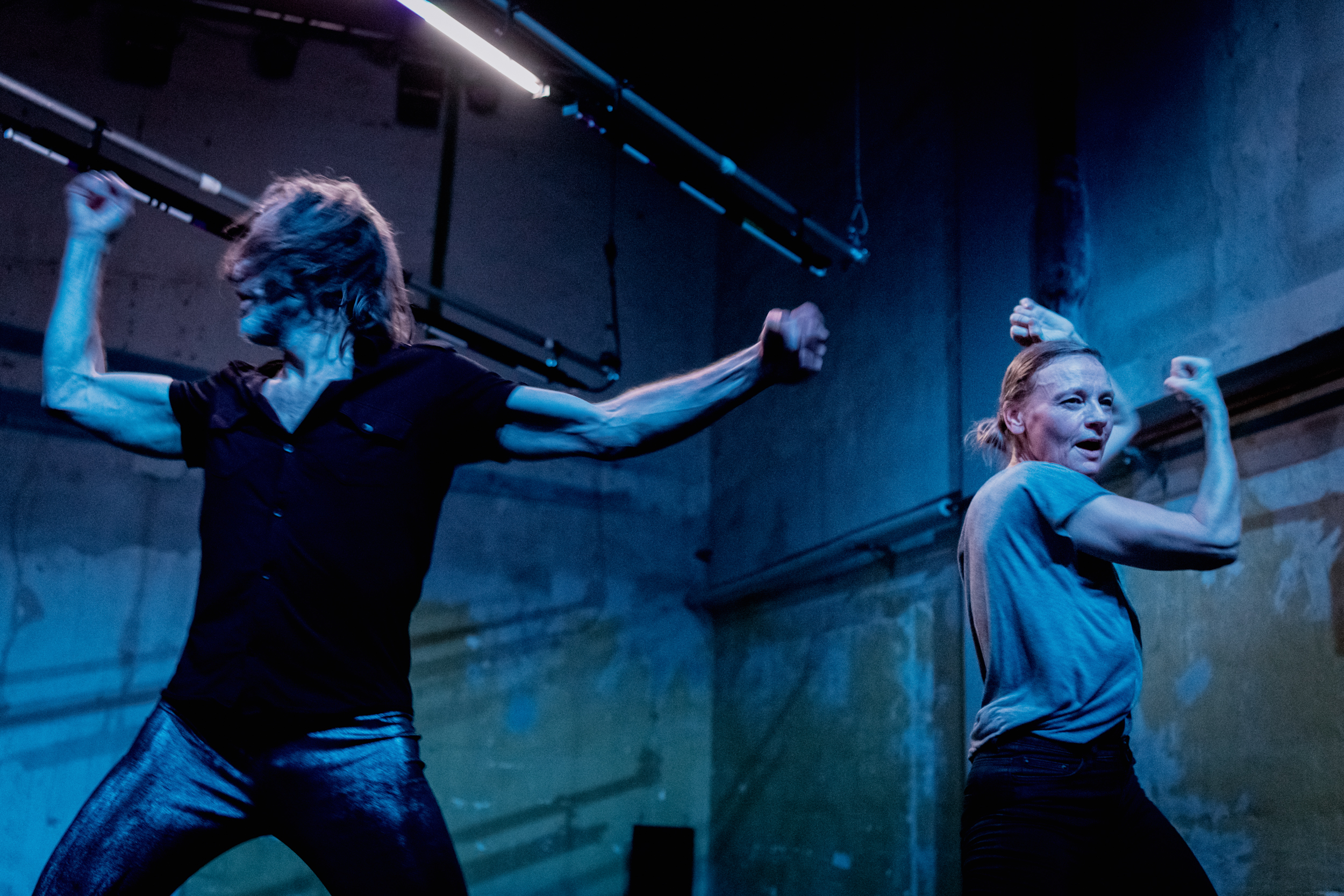
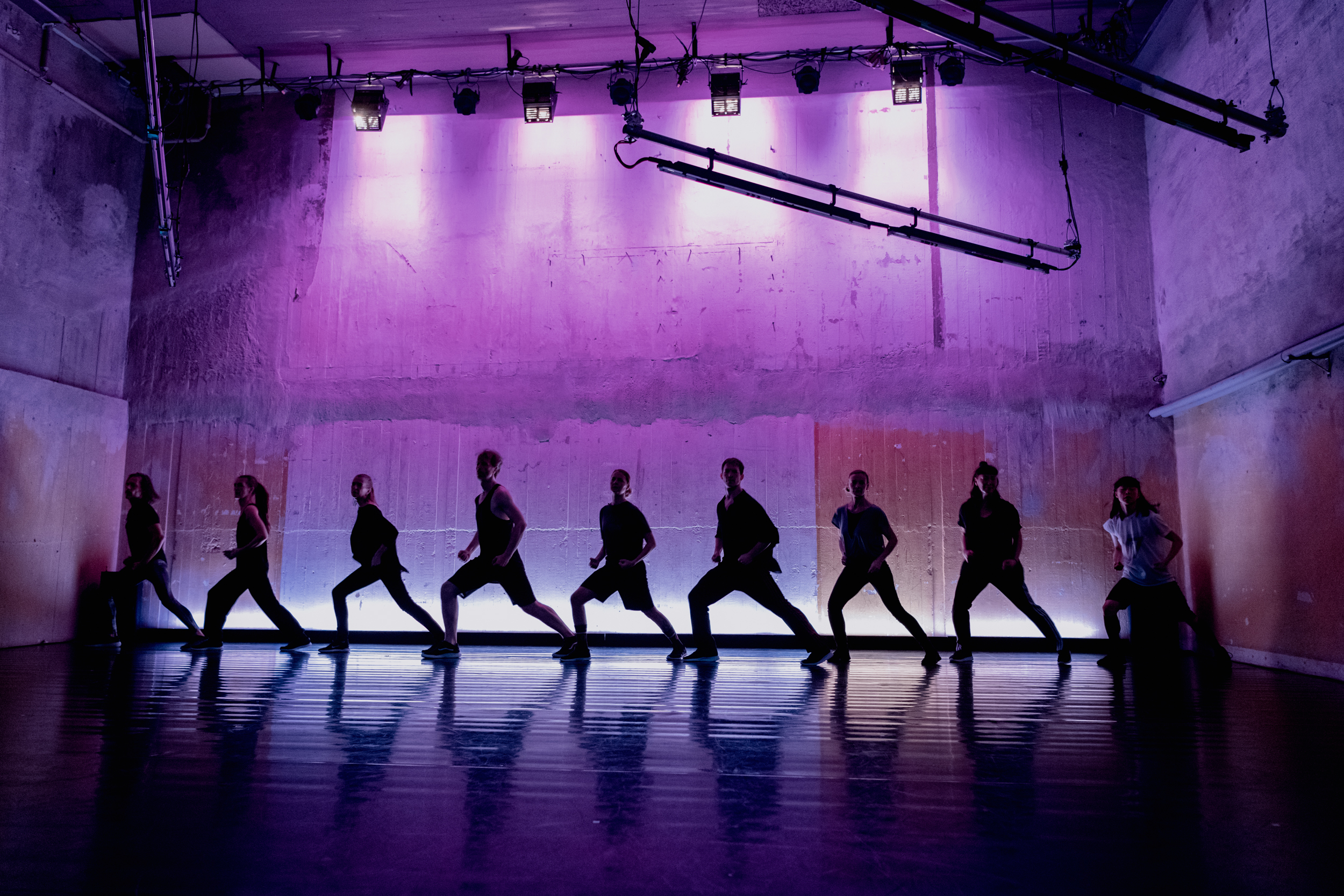
In Tributethe library version, made especially for Moving in November festival, you have the chance to see the choreographer Frédéric Gies himself dancing the piece originally conceived for a group of nine dancers. The original version was created in fall of 2018 when the company invited Gies to create a choreography for them. In this adapted version, a group piece becomes a solo.

Due to a global health crisis that makes it complicated for larger companies to travel and present works coming from another country. An exceptional situation, that asks us to rethink, adapt and find creative solutions to continue presenting works and engaging with artists. We invite you to share this special evening, the trace of a work, with us. The original version we aim to present to you during 2021.


A First Dance. A Manifest.

Looking back at my first year as artistic director of Moving in November, Helsinki

2020 started for me with intensely thinking about what it means to arrive in another country, a new city, a different culture political situation, in another dance scene, as the freshly appointed artistic director of the oldest contemporary dance festival in the Helsinki area. A festival that grew out of an artistic initiative, out of a local artistic scene that felt the urge to bring international artists and their works to the city.

How to rethink and restructure a festival that has educated generations of artists, and that has grown a significant and stable audience over all these years (namely 35)? How to convince the city officials, cultural foundations, and funders in general, that an established organization with a history and a reputation is as sexy as a new adventure? That continuation in a city, within a community, is of high importance. How to re-think a contemporary dance festival in a scene situated between the premises of a dance house (currently being built) and a local center for dance dedicated to the local scene? Players that are stable and potent, engaged in various networks and situated within houses, with their own stages. The conditions of Moving in November are that we do not have a house, but we can interact with different venues in the city and reach out in different areas to audiences and to artists. One could think that a festival between those two is an important component to add, as we can handle our work way more flexible, and we are the ones bringing contemporary dance from the outside. Highlighting an opening to the world.

When applying for this job, I was especially keen to work with an organization rooted within an artistic community, on a local and international level, and inspired to re-think what a festival in these times can be. To question the international versus the local; to reflect how both could be present in Moving in November in different ways, developing the festival as a meeting point and a place of exchange. Being driven by art and artists, and not wanting to highlight their nationalities or draw a line between artists living and presenting in Helsinki and artists producing abroad. Wishing to work with an organization that already has an audience, as much as the capacity and ability to widen and enlarge this audience, by bringing in new perspectives and another way of operating.

I discovered that Moving in November, since its beginning, is running on the enthusiasm and engagement of a few and is definitely not standing on well-funded ground. Coming from the outside and carrying a different image of Moving in November, it was a major surprise to me to look at the festival’s finances in relation to the years of its existence and the catalogue of its achievements, within the city and the community, in comparison to other bigger European festivals in cities like Berlin or Brussels. To actually discover that Moving in November has hardly any stable support needed to plan ahead or engage with artists on a longer-term basis, to continue building an audience, to reach out to other areas of the city, and to find new partners locally and internationally.

Moving in November is loved internationally and locally, its importance, outreach, and work is recognized by artists, audience and professionals, but city officials and local funding bodies still think of the 35-year scene-changing organization as a “project” and finance it as such. Moving in November has received multiannual support from the city for 3 years (2019-2022), in an amount that is helpful but far from providing this organization any kind of stability.

I was looking at a festival that, before I started, could only operate 6 months a year, program decisions being finalized by late June, sometimes even in August, the work on communication, public relation, press and audience outreach operating in the imposed time limit of 2 months a year. What had I gotten myself into?! The first grant application we wrote early September 2019 to Kone Foundation was exactly about this, as much as about the chance of giving Moving in November a certain kind of freedom in operating. Luckily, we have been granted a 3-year funding, to double up our salaries and to work throughout the year. Without this funding, Moving in November would not have survived 2020.

This was one step in the right direction to grant Moving in November continuity and a first shimmer of what stability could possibly be. It would be far too early to take a rest on this. It is the moment that the festival could take the jump from cooking on a low flame to a stable funded organization operating all year around, engaging with artists and audiences on continuous terms.

Cultural politics here in Finland do not necessary go with the idea of supporting further development, growth, and outreach of already existing organizations (apart from the ones subsidized by law). The logic of funding projects and single new initiatives seems, to my surprise, a priority. Coming from the outside, I am looking at a vivid performing arts scene that has learned to develop quality work and a unique handwriting with little means, in small venues; venues that are often not on stable ground themselves and that can only give space to artists for rehearsals and performances through an application process and/or rental agreements.

The same applies for Moving in November. It is remarkable that such an organization has so little financial support from the city and the government, that it is treated like an artistic project, that each year it is asked to apply anew and prove all over again its outreach and relevance. An outreach and relevance that cannot grow, as there is no time or resources granted to raise both. And due to this, it can never agree to longer commitments with artists (local and international) and develop sustainable relations and initiatives that would bring stability in working, producing, and presenting artistic works in the long run. Moving in November is not a simple project, but a whole year-round organization, working within the artistic scene through conversations and assistance. That is what we started to provide in 2020 for some of the local and international artists, and that is, in the end, what I can bring to the Helsinki scene after having worked internationally for many years with artists, as manager, mentor, and festival initiator.

Moving in November could easily be turned into an important and stable partner for the contemporary dance scene in Helsinki and abroad.

“Finnish artists are not seen internationally”, interestingly enough one of the reappearing phrases I have heard since I started in September 2019, in combination with artists asking me for advice on how to enter the international scene and how to present works on a more continuous basis outside of Finland. This made me think of and investigate the operating culture political structure. And basically, I encountered the same problem as we are facing with Moving in November. Just like the festival, artists apply for a multitude of projects every year from a multitude of funding bodies, to realize one project. At the same time, artists apply for co-production money, rehearsal and performance spaces at various theaters and festivals, to rehearse and to show their project with the (hopefully) granted money they have applied for. How can a single operating artist, while writing applications after applications for every step of the process to realize a project, possibly think about long-term development, when each step of the realization of a project is uncertain and heavily guarded by gate keepers, reading and judging the different applications? The development of an artist as such does not stand in the foreground here, but rather the single smartly written project description that will fall through or be picked up. I have worked long enough as a manager of a well-known choreographer to understand that this uncertainty on all levels prevents any planning and gaining stability. Artists (as much as festivals or theaters) cannot grow and develop in an environment that is driven by project thinking and an overdose on application processes. Building a career as an artist requires time and energy, and in the end, the trust of theaters, festivals, and funding bodies in the artists and their practice, and not only in one artistic project realized every now and then. Basically, I found myself looking at a scene that needs trust, conversations, exchange, and resources for artists, for their careers to develop and for moving themselves out into the world of international circulation, if they wish to, combined with some strategical thinking of funding bodies, foundations, and venues on how to best fund artistic careers on a stable and continuous basis.

Looking back, it has not exactly been the year I imagined when appointed artistic director of Moving
in November Festival in autumn 2019. Starting a new job, in a city and scene I barely knew, especially as artistic director of an international contemporary dance festival, definitely a work that involves traveling, meeting artists, and seeing pieces, was not obvious in these times. As much as I was busy with restructuring Moving in November and cooking up a first edition, I saw myself thinking about the value of contemporary dance in these times and defending an opening to the world, in times where the call for the local became a little too loud for my taste. Reflecting on the responsibility and impact we can have as cultural institutions, as dance artists, as voices that question the structures and the world we are living in, through the poetics of movements and words and through the lens of abstraction. Thinking up the future and utopian worlds, digesting the seen and the unknown in front of our eyes.

The festival program was done by April. By September, we started doubting if we were able to have a festival at all. With a lot of good luck and a big mountain of work, we opened Moving in November in the end, presenting even three pieces performed and choreographed by artists from aboard, alongside two pieces by local artists. Moving in November took place as one of the very few international festivals in 2020 worldwide, a smaller edition, but not less exciting and relevant than the originally planned bigger edition could have been. It has been important to bring people back together to share the experience of watching live events, as it is not only about the pieces shown, but also about the other people, the community one shares this experience with.

Looking forward, after having experienced one year of work on this festival, my deepest wish for the future is that Moving in November can be lifted to stand on stable feet. That Moving in November would be granted the recognition it deserves after all these years, by funders and city officials. Allowing us to develop it further and engage with artists and audience on a long-term basis. We are not able to achieve this alone.

Wishing you all a Happy New Year!

Warm wishes,
Kerstin Schroth
Artistic director 

Spilling over, Traces from November – dates will be announced soon, stay tuned!
Thank you for the shared time!

It was a truly special moment to open Moving in November, to receive artists from abroad and from Helsinki, to present their pieces and to welcome everybody to share time in the theater.

This time we live in is challenging. Even more important to have opened the door to this festive explosion now. To a joined experience in the theater, to conversations and laughter. To not let go, to insist and to move. Highlighting once more the importance of the live-encounter and performing arts as such. In a moment while on a European level theaters and festivals had to close down, already for a second time this year. Did we have good timing? Luck within bad luck? I’m not sure but it brought us again to the transformative force of art in our world. While watching the pieces, listening and engaging in various conversations with the presenting artists, the local hosts and festival visitors/ guests, this force was sparkling through, realizing once more that art is a motor and big part of our way of looking at this world, namely through the eyes of artists and their works. Shine bright small island of performing arts!

Now it’s time for us to say thank you to everybody who has made this festival possible. Thank you to the artists that stayed in quarantine, that traveled to Helsinki to present their pieces. Thank you to the theaters and other venues that have hosted us. Thank you to our audience, for your longing to be in a theater space together with others, for conversations, clapping together, sharing soup. Thank you to precious collaborators and funders a wonderful Moving in November team and board. Thank you for thinking together, collaborating, engaging and visiting a contemporary dance festival in these times!

Thank you for the shared time!

See you in spring 2021 (dates to be announced soon).

Kerstin Schroth & Isabel González

Conversation between Antonia Baehr and Latifa Laâbissi and Kerstin Schroth

“The idea was mainly to get together without having an a priori project but to start a conversation about what was important to us at this moment, about our desires, urgencies in our work on several levels: the aesthetic, political but also ethical dimensions.”

A written conversation between Antonia Baehr and Latifa Laâbissi and Kerstin Schroth

How was the idea for this collaboration and the content of the piece born?

The idea was mainly to get together without having an a priori project but to start a conversation about what was important to us at this moment, about our desires, urgencies in our work on several levels: the aesthetic, political but also ethical dimensions. So it was very open as a starting-point, and all this being in the middle of the Breton countryside in the middle of the fields and ideas began to emerge blowing on desires …

Could you tell more about your interest in hybrid and queer figures in your work? In Consul and Meshie, but also in other stage works you have both created independently from each other over the years.

Our artistic projects are very different from each other, but I believe we have in common the question of hybridity, of un-stabilized identities, as Donna Haraway would say “staying with the trouble”, inhabiting the trouble.

So it is not a posture but rather a relationship to the world, a way of allowing oneself to be possessed by the multiple, the unresolved, and seeking to inhabit the spaces of transitions…

Consul and Meshie unfolds in front of our eyes over a period of 3,5 hours. What is your notion of time and space in this piece?

The duration is like a journey, with landmarks, because the score is relatively precise, but the fiction totally carries our imaginations away. So the strategy for respecting the duration of the piece is a little bell that signals the end for us, as well as for the audience.


Conversation between Frédéric Gies and Kerstin Schroth

“This is kind of very romantic, but at the end, I would say that Tribute is a love letter to all the dancers who are already dancing in me, and to the ones who will in the future.”

A written conversation between Frédéric Gies and Kerstin Schroth

In Tribute you are opening up your library of dances to the dancers of Weld Company, could you reveal a little more about this library and your thinking behind the piece?

When Anna Koch (artistic director of Weld in Stockholm) proposed me to make a piece for the company, which I follow since its beginning, I started to reflect on what is the project of the company instead of immediately thinking of a piece. Very important aspects of the project of the company are the focus on sharing knowledge and on processes, as well as a connection to diverse areas of the dance field and dance history, through the variety of the dancers backgrounds and of the invited choreographers. The dancers also occupy a central role in the company. The company gives a central place to dance as well, as the headline of its publications suggests: No Talking, No Props. I connect very much to all of this.

Dance is central to my work. This might sound like a redundancy, but I am mentioning it because I think there are a lot of works put under the umbrella of dance, in which the interest lies somewhere else than in dance. Dance being a pretext for something else or even sometimes being absent from it. I am not taking a conservative stance here about what is dance and what is not dance, but I just try to be specific about where the interest lies. I am also mentioning it because in the way I work, the choreography often emerges from the dance, and/or the choreography serves the dance instead of the opposite. Furthermore, being a choreographer has always felt for me like a sort of byproduct of being a dancer.

I also give a lot of importance to processes during creation periods – I see the process as indissociable from the piece, and the connection to dance history is a crucial aspect of most of my pieces. So it became self-evident to share my library of dances as a starting point for the piece, and that this process will be the soil for the choreographic project.

Sharing my library of dances is also acknowledging all my lineages, and all I have learned from other dancers. I have been always fascinated by the amount of knowledge that circulates between dancers when working together, how both skills and aesthetic choices are passed on just by sharing the dance floor. I am fascinated by how this knowledge is then inscribed in our bodies. I am also fascinated by how dances can get inscribed in our bodies just by witnessing them, as a spectator.

My library has different sections. First, I was educated in ballet, then I started to work in the field of contemporary dance in France in 1992 and lived in three different countries throughout my career. So it covers these last three decades of professional experience in different contexts that intersect. It is also infused with historical references previous to my birth and comprises as well dances I witnessed or danced in techno clubs and raves. It is also greatly influenced by my encounter with somatic practices.

I didn’t share my whole library, but I anyway believe that the whole is present underneath the small selection I shared. Concretely, I shared with the dancers a kind of anthology of club dances, a few movements from some of my pieces, and this part of my library that is linked to the beginning of my career in France. In the first years, I danced for choreographers who were former dancers of Dominique Bagouet, who died of AIDS in 1992. I had seen his work for first time a few months before he died. I totally fell in love with his work and the dancers who were on stage. This is still a major influence for me, on so many levels.

This is kind of very romantic, but at the end, I would say that Tribute is a love letter to all the dancers who are already dancing in me, and to the ones who will in the future.

How was it for you to work with a company that brings together choreographers and dancers representing different generations, working methods, and ways of expression?

It has been a very rich process and I think this is linked to what I mentioned above, to how knowledge circulates and is transmitted from body to body when we work together on a dance. This was enhanced by the diversity of the backgrounds. On the other hand, I could also really see how there was a culture of work specific to the company, which probably originate in a need of finding a common ground within the diversity of backgrounds in order to encounter very different choreographers. Working with this company felt pretty much like taking part in a dance nerds gathering. So much curiosity, openness and dedication. I also find so beautiful to see the different layers of the history of each dancer showing through the material I transmitted and through the common ground we defined for this work.

Speaking of finding a common ground: in a way, it has not been that different from what happens in the rest of my work. For me, this is where the work starts in each creation process. I would argue that this is fundamental in every process, but I also think that it became more important to do so nowadays because the conditions of production have changed very much compared to how it was three decades ago. We have way less time for making work, and dancers have to hop from one production to another, each of them requiring very different skills. So as a choreographer, I find very important to share with the dancers the fundamentals of my dance, of my approach to dance.

So as usual, I gave a class almost every mornings. Very old school in a way… I have to say that I find more and more value to this. If you don’t fall into the trap of policing bodies, it is a way of digging further into the roots of a work, of making it more specific and of avoiding merely brushing its surface. This is also a way of honouring the dancers craft, of putting it at the center of the work. It was wonderful how the company took that so seriously, with such a commitment.

Your work brings together different dance forms in a non-hierarchical way, could you elaborate around this?

By this I mean that I don’t give more value to a dance phrase composed by a famous or less famous choreographer, which incorporates a whole choreographic tradition or breaks with one, than to this particular way of dancing of someone I have seen in the darkness of a sweaty dance floor. They are not the same, but to my eyes, one is not more important than the other, from a dance point of view. They are just different manifestations of the act of dancing and I am just passionate about this.

I am also fascinated by unexpected connections between different dance forms, traditional or emerging, and between erudite and popular forms of dance. So I tend to make visible these connections in my dances.

This is also connected to my relationship to forms. For me, forms are not a constraint, but rather possibilities. So I don’t see any hierarchy between a butchy way of club dancing and a grand jeté in ballet. I just see the poetic potential of each of these forms.

At the end, I guess this is very linked to how I understand what dance is. There is this beautiful quote from Bonnie Bainbridge Cohen, the originator of Body-Mind Centering, about dance: “our primary language is movement. Dance is the poetry of that language”. My interest for bringing together different dance forms in a non-hierarchical way is very linked to this understanding of dance, to dance as a poetic language. It is linked to this capacity of dance to speak, without having to demonstrate anything.


Conversation between Sonja Jokiniemi and Kerstin Schroth

“Each piece resonates in another”

A written conversation between Sonja Jokiniemi and Kerstin Schroth

In your new group piece ÖH, you combine textile work and live performance. Could you tell about the starting point of your research for this piece?

I believe each piece resonates in another. Either by returning to some questions, creating kind of sequel, by continuing to develop further or looking at another aspect of a same thing. I have been working with this idea of multi-textural languages for quite some time. This work has taken different formats from stage works, drawings and community engaged practices. I have been exploring object human communication as associative meshwork, where categorizations and binaries of thinking momentarily blur. Where set of lingual propositions place themselves in relation to categorization. These multi-textural associative threads raise the fantastical, the unconscious, the intimate resistance.

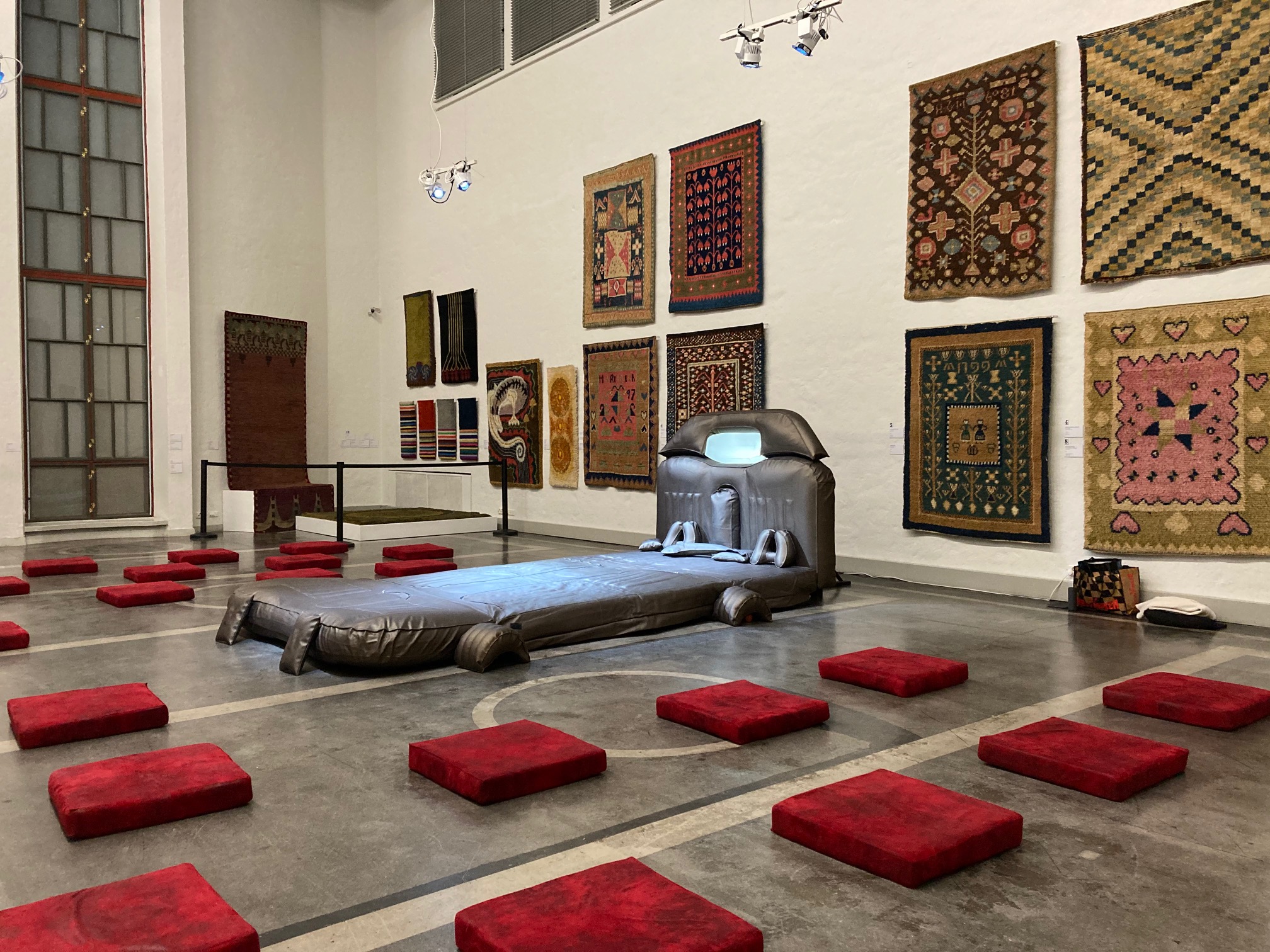
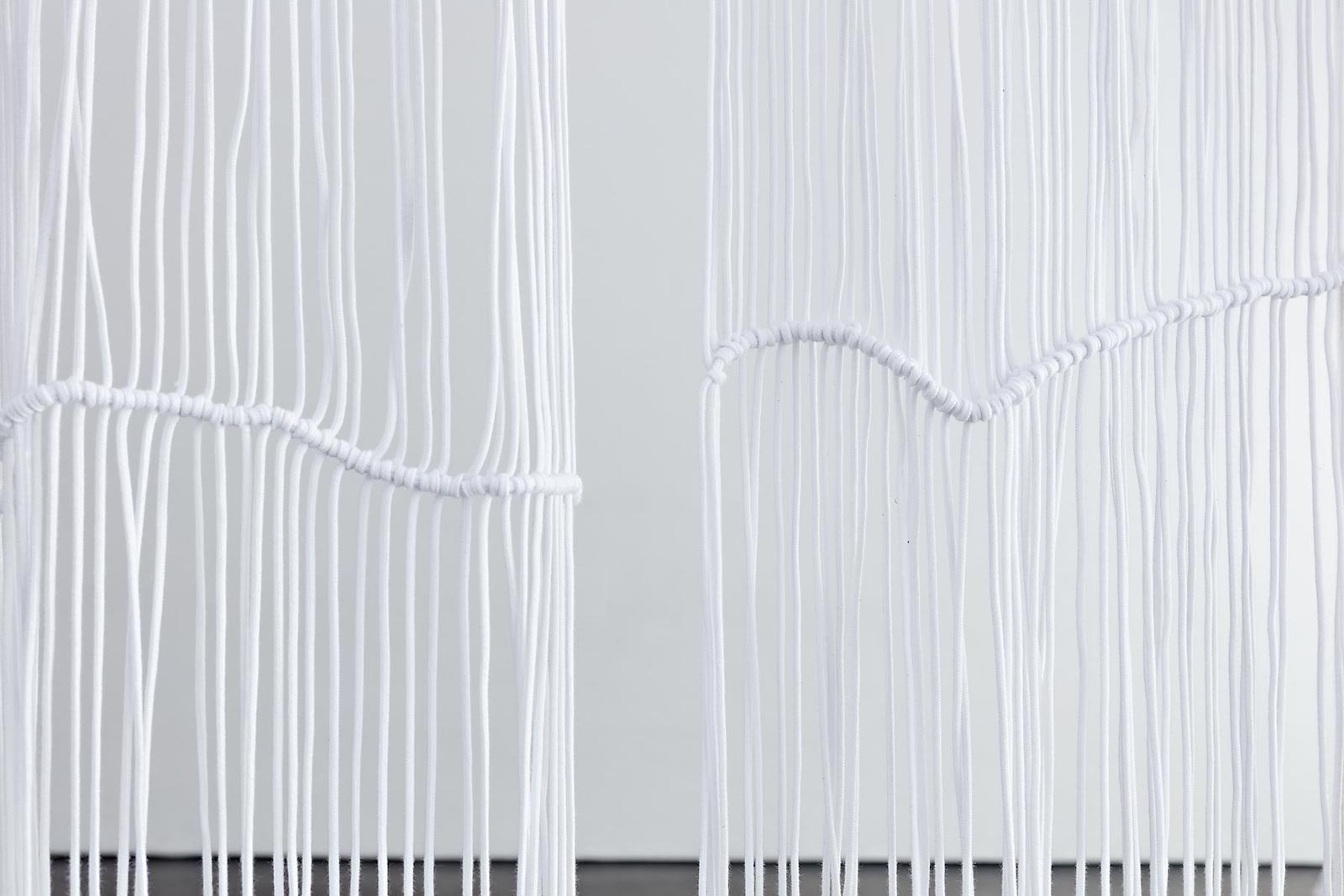
In my last work Howl I worked with textile lacing in combination to my drawing works, making holes, ways to see through textile, making a meshwork that one could peak through. I found a teacher in a weaving studio called Filambule in Lausanne. Under her guidance for some months I was making bobbin lace. In Blab (2017) there were textile lumps and a suit made of latex. In Mound Bound, (2020) I worked with curtains. In textile there is something that connects to memory, to haptic sense, to a way of generating sensory experience. In ÖH, I wanted to create something soft, something fluffy without introducing the soft, the fluffy as a tool to soften out friction and contrasts.

This kind of rya rugs used are very traditional in Finland although a lot of contemporaries have been explored. It has been way to make blankets at first, then more decorative objects. I am busy with the connection of hand and matter; touching, making, changing, breaking. And making textile is a process of hand and thread, shaping its meaning on the way. And a blanket, immediately connects to intimacy.

I invited textile designer and artist Aino Ojala to implement my drawings into rya rugs. As Aino was making rugs in Helsinki, I simultaneously kept making smaller rug pieces by hand at home. This way, even in remote places, we connected in the act of binding.

What is your thinking regarding the notion of the body in your stage work in general and in relation to your drawings? 

In previous works drawings have had different roles but I always work with drawing, either as a way to think the performance work, create a parallel language or to respond to the embodied material. In ÖH I started making a catalogue of drawings, which I sent to the performance collaborators. I asked them to respond with a texture. This was a way for us to tune in to another way of talking with the visual material.

In terms of bodies, I believe I work as much with the bodies of objects, bodies of humans and bodies of drawings. That is my choreographic practice; that relationality and singularity at once. How does a human work with objects as tools, as playmates, as equal, as dominated, as extensions…There is no fixed school of theory in my work. I am interested in thinking with, speaking with, doing with and all the multiple affects that are created there. And that is where language comes in for me, in handling things, doing things with hands, sounding with an object, realizing small pieces of narrations, wanting to become a lump, or recognizing the lump in oneself, rocking with desire. Body of language as a multi-textural process.

I want to propose a kind of labor that works with repetition, exhaustion, physicality and meeting of materiality. Labor as something ordinary that I feel an urgency towards.

Thinking about the importance of the live encounter in performing arts, how do you see the role of performing arts in a crisis during which we were asked to be in a physical distance from each other?

I think we live in dark times. For me more scary than the virus is the human aspect of all this. Fear is a powerful tool. And I guess there is also something to be said in how these policies affect the psyche of people, sense of freedom, ability to practice their profession and be in contact with other people. In that sense I believe live performance plays a hugely important role in society. I believe that even with COVID, we need to explore physicality, touch, gaze, being in the same space. We need to explore all those questions live performance in different ways and styles is busy with. I think we must not forget the fact that we are living organisms, that cannot control all their fluids, gestures and need for connection with their species.

Conversation between Reality Research Center & Ferske Scener & Western Norway Research Institute and Kerstin Schroth

“In the Nordics, but also elsewhere in the world, we talk about weather all the time”

A written conversation between Reality Research Center & Ferske Scener & Western Norway Research Institute and Kerstin Schroth.

Can you tell about your idea behind the piece and the different meanings of the weather conditions in each city the talk show has been and is presented?

In one sense the idea is simple: Weather is something all humans relate to in a personal, physical and emotional way. It affects us every day, one way or another. It is something that is easy to talk about, even with strangers. It is so easily accessible that it has become a cliché, meaning uncommitted small talk. When we talk about the weather, we also talk about the conditions that we are putting our bodies into, as well as many other things.

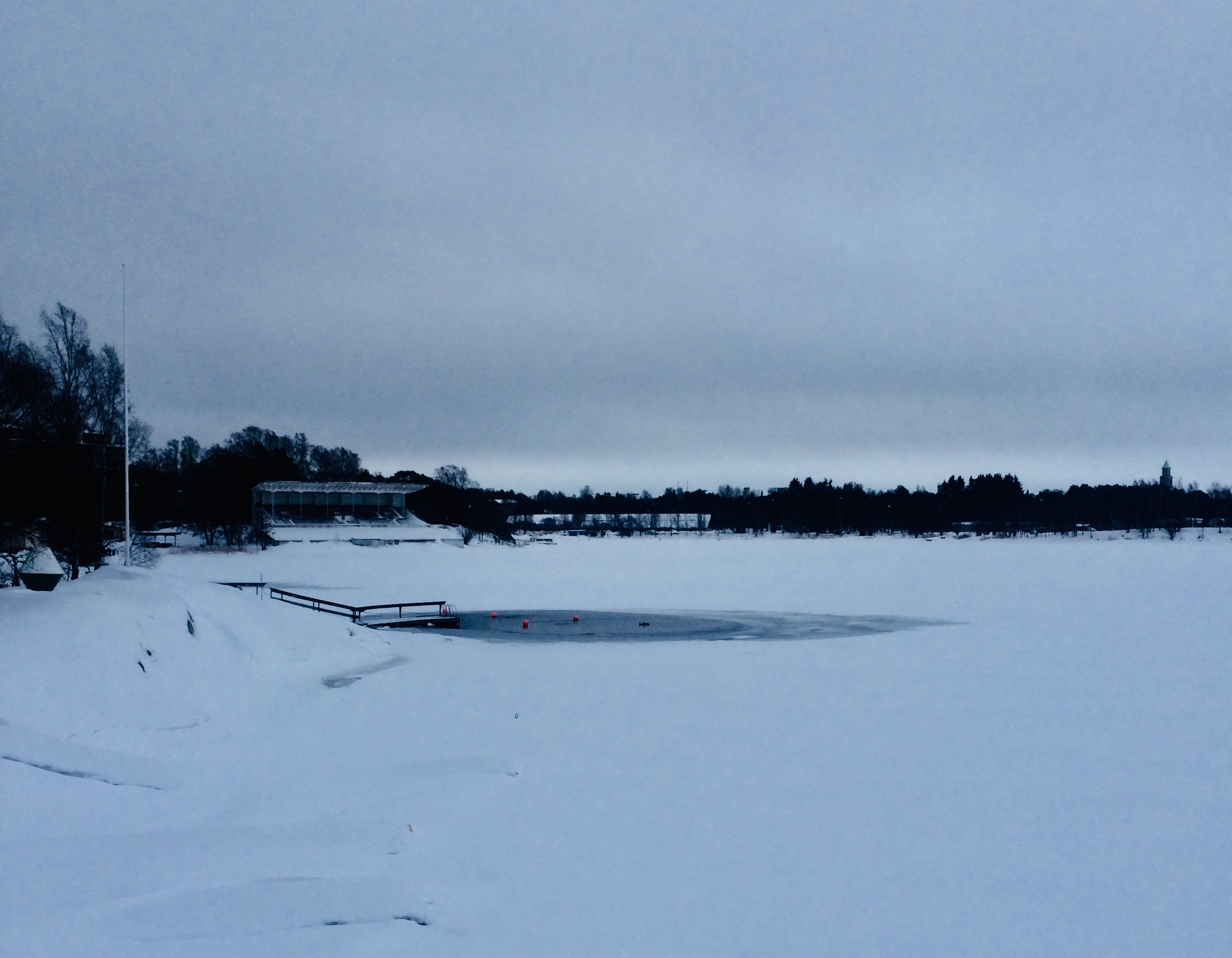
We are looking for something specific about each place where we make this performance. In Hammerfest, the small oil city – in the very north of Norway, it was snowing heavily while we were there in the midst of April. Everyone was talking about the snow and the winter coming back. The show emerged through our own embodied encounter with the snow while we were dancing on the mountain covered with emergency thermal blankets. In the performance the audience could taste the snow, be disturbed by snow balls put on their skin and was guided through text messages while walking in the snow. The local community was also involved through their expertise and practical skills people of Hammerfest have in choosing the right footwear to any type of weather and surfaces: Snowy, icy, rainy…

In Sogndal, a rural community on the Westcoast of Norway, the week of the show turned out to have the most beautiful autumn weather. All the gardens and farms were full of ripe apples. The whole place smelled of apples, and we made this an important part of the show. The apples became a highly visible part of scenography, and were also used as content, as the mythical idea of the forbidden fruit of knowledge.

Even though half of our working group lives in Helsinki, we can still not say what will be the main material in our performance as we are the midst of the creative process. We want to work with the specific element that is unique to just this place and the time of the performance. The performance is highly time and site specific and as we all know, there have happened a lot of changes these last months, and we have to be true to these changes as well. However, what we think we know about the weather in November in Helsinki is that it will be raining a lot – and we are not afraid to dive deep into the water.

The piece is a collaboration between several organizations, could you speak about the collaborative process of creating the different versions of the piece?

Formally we are three organizations that collaborate: The artistic organizations Ferske Scener of Tromsø, Norway, and Reality Research Center of Helsinki. The third partner is the Western Norway Research Institute, located in Sogndal, Norway. And, like always, we are first of all a working group of different people collaborating and who have different connections to each other, also beyond our organizations. The collaboration is a meeting and entanglement between Finland and Norway. Between people that have just met and people that have worked together for 30 years, embodied practices, talked and showed, humor and serious concerns.

The whole project is also a meeting between art and science, trying to find a way where both are equally evident in the final result. In art-science collaborations, what often happens is that either the science becomes the background and inspiration of the art, with the art “in power”, or the opposite, that artistic expressions are used to illustrate the science, or “explain” it to the public. Neither of these positions interests us. We want it to be a collaboration between different methods and ways of seeing the world. We strive to find a common way of working where each of our practices and knowledge are given space, but also challenged. We want it to be a collaboration between different methods and ways of seeing the world.

Every time we meet, digitally or in the same room, we go a little further. And the times we have succeeded the most, has been when we develop together, in the making. When we put our feet into the snow, make a dance video together with the apples or eat the coal while we are reading the performance text. In each place we have in a sense started from point zero and we have let the situated elements, weather conditions and performance context lead our making. This time, in Helsinki, we were very much challenged by the situation of the pandemic and the fact that we had to cancel several working periods on site. We decided to use this as an entry to artistically research how we can be distant and at the same time work with physical material, embodiment, community and weather. So, the way we work is also taking a stand towards the possibilities to make an embodied performances at this time, dominated by covid-19.

This has lead us to new ways of working together and collaborating. We are very much looking forward to share our experiences about this process when we have walked the path.

What do we talk about, when we talk about the weather?

In the Nordics, but also elsewhere in the world, we talk about weather all the time — but a conversation about the weather is hardly ever only about the weather — it is a way to converse also about all the small and big questions in life.

  • We talk about weather all the time
  • We talk with strangers
  • We talk about the temperature in the water.
  • We talk about being afraid
  • We talk about what clothes to wear
  • We talk about our need to create contact with others and not to be left alone
  • We talk about or feelings, the feeling of low pressure or sun in the face
  • We talk about climate changes
  • We talk about something we share

The weather is in relation to your own experience. We are talking about the condition we are putting ourselves into. The condition of what we are in relation to.

Foreword (and afterwords)

Moving in November festival is built on close partnerships between artists, production houses, international and local partners, and supporters. Our common goal is to create optimal conditions for artists and audiences to meet during the time and place created by the festival. I am happy for the trust and respect enjoyed by the festival and its audiences. It enables a fast-moving and forward-looking culture where one can face the new with a curious and friendly attitude.

I believe that the works and artists of the 2019 edition of Moving in November provide a strong sample of the interesting international dance art of our time. It appears as a crucial part of the contemporary performance scene and its quest for new thinking and aesthetics. Some of the works of the program have been touring around the world in the last couple of years, gaining considerable attention and recognition. There are also new works and concepts that I look forward to with a great deal of enthusiasm and interest.

Moving in November festival has a long and significant history as a key meeting place of international contemporary dance in our country. I have had the privilege to follow it, from the viewpoint of the spectator as well as the organizer, during several decades already. To me, it has always presented itself as a polyphonic and communal art event that wants to welcome everyone, and that creates an atmosphere where one can freely express one’s thoughts and feelings of the shared experiences.

The purpose of Moving in November festival has been to present dance and contemporary performance of our time, with an emphasis on exploring and critically revising the aesthetic conventions of the stage, exploring new ways and forms of doing things. It has not aimed at creating so-called ‘threshold experiences’, but rather at participating in the international art discourse and developing a culturally ambitious event in the Greater Helsinki area. At the same time, however, the festival has managed to continuously expand its audience base. I am convinced of its ability to communicate with a wide range of spectators and provide uniquely expressive experiences of dance.

With slight sadness, this year’s festival marks the last time for me as a member of the team responsible for its content and activities. The future of the festival moves to very capable hands, and I’m sure that it will survive and develop as an important international actor. The Finnish dance scene, along with the whole field of the performing arts, will experience many changes in the near future. The Dance House, which will open in a few years, and the efforts to develop better funding structures for art, will create both challenges and new opportunities for all players in the field. The importance of Moving in November as a fresh, innovative and ambitious festival must also be better recognized by funders.

It is time for thanks. In this context, I would like to highlight the new cooperation with the Cultural Center Caisa. This year, Caisa will serve as a platform for new and deepening cooperation with Estonian actors. The University of the Arts Helsinki is joining as a new partner to develop the festival’s multidisciplinary discussion and education content. Thank you.

I would like to thank all the members of the festival organization and those on its board for their support and trust. Our warm thanks also go to all the long-term partners and supporters of the festival. In particular, I would like to highlight the professionalism, vision and dedication of the festival staff. Many thanks to Isabel, Ilkka, Riikka, Jaakko, Soili, Mariangela and all the employees and interns of previous years. But most of all, thank you to all the artists and the audience!

Ps. Welcome to Kerstin, I’m looking forward to next year’s festival.

Helsinki 22.9.2019, Mikael Aaltonen

Open Studio

Choreographer and visual artist Sonja Jokiniemi will be opening her studio for the Moving in November audience.

During the four festival days, the artist will be working on a visual environment in Caisa that is open for the public daily from 12pm to 1pm.

The work will continue towards a new creation premiering at Moving in November festival in 2020.