Moving in November and Institut finlandais launch together a new, long-term collaboration between Finland and France

Moving in November festival in Helsinki and Institut finlandais (the Finnish Institute in France) launch together a new collaboration providing an opportunity to foster exchange between the two cities (Helsinki-Paris), the two countries (Finland-France) and several international partners. The collaboration is based on a model by following and supporting one Finland-based choreographer per year to produce a new piece, and to include a residency and the presentation of the work in Paris. Vice versa, a similar wish exists to host each year a French choreographer in Helsinki, in order to support the work with a residency and presentation.

During the operating year 2020, the collaboration was started with a co-production order from the choreographer Veli Lehtovaara and the piece Corpus Hubris, whose work period sets between 2020–2022. Luiz de Abreu’s O Samba do Crioulo Doido and Antonia Baehr’s and Latifa Laâbiss’s Consul and Meshie were presented during the Moving in November festival in November 2020. During that time, the visits of the performers were supported by the TelepART mobility program, organised by the Finnish Institutes of culture and science. The work is co-produced by in France by La Briqueterie – Centre de développement choréographique national du Val-de-Marne

“During the era of an environmental crisis, a profound change in the mindsets and practices is highly  needed. As promoters and producers of the art of dance, we have the responsibility to promote sustainable change and provide alternative ways for thinking, discussing, experiencing and acting”, says Kerstin Schroth, Artistic Director of the festival Moving in November. “This is done by providing projects with long periods for research and production, active international dialogue, good working conditions and new opportunities for collaboration in another country, as well as public and local professional networks for the artists. The aim is to jointly promote the art of dance, which is exploratory and sustainable”, adds Johanna Råman, the Director of the Institut finlandais.

Through the collaboration, new opportunities are created for dialogue, networking and collaboration between professionals in the field of dance in Finland and France.

Institut finlandais (The Finnish Institute in France)

Institut finlandais is an independent and multidisciplinary platform between Finland and France. In collaboration with different international institutions, academia and creatives, Institut finlandais engages actively with critical discourse through its onsite and off-site programming. We seek to explore how a cultural framework can foster international conversations in creative fields, such as design, fashion, architecture, cinema and performing arts.

Podcast

Alongside Moving in November events, Esitysradio publishes podcasts discussing the works that are presented during the festival. Performance makers Janina Rajakangas, Mira Kautto, and Tuomas Laitinen invite featured artists to discuss their working processes, the choreographies they present, and the state of the (art)world in general. During the coming iteration of Moving in November, the podcast will focus on what is stirring in the shifting conditions of the festival and more broadly in an artfield that is currently in the midst of several radical changes. The pandemic, a global re-focus on discrimination, and a new artistic director set the festival on a new, or in the least altered landscape. What is the role of Moving in November and the artworks it presents in this new situation?

Esitysradio (Performance Radio) is a series of audio conversations on performances. It was founded in 2015 and has collaborated with Moving in November festival since 2018. During the festivals of 2018 and 2019, Esitysradio presented Radio Salon, a series of hosted discussions that concentrated on the performances presented during the festival. These discussions were accompanied by a small audience and published later as podcasts.

Esitysradio can be listened on iTunes and Google Podcasts, as well as on the website: esitysradio.fi/en.

Thank you for the shared time!

It was a truly special moment to conclude the Moving in November edition 2020 just now in June. Dark times need bright moments.

Having left the November darkness, as well as another lockdown behind us, receiving artists from abroad and welcoming you, our audience, in different theater spaces and amphitheaters all over this town was a true pleasure! Bright midnight sun and a heatwave – November in June did the trick!

In the frame of Traces from November we showed the works of Sheena McGrandles, Nada & Co., Giuseppe Chico & Barbara Matijević and Frédéric Gies & Weld Company and hosted the Masterclass with Esther Severi.

Traces from November together with the invited artists highlighted once more the importance of the live encounter, of performing arts as such. The relevance of a joined experience in the theater, of conversations and laughter, reflecting on the world we are living in.

Now it’s time for us to say thank you to everybody who has made this festival possible. Thank you to the artists participating in this edition. Thank you to precious collaborators, partners, and funders (especially also the last-minute collaborations with KokoTeatteri, Espoo Cultural Center, Puppet Theatre Sampo). Thank you to a wonderful Moving in November team and board.

Thank you for thinking together, collaborating, engaging, and visiting a contemporary dance festival in these times!

Thank you for the shared time!

Kerstin Schroth, artistic director

Forecasting

How to use a dance performance as a source for poetical observations and insights?

The idea of this orientation is to suggest tools for observing the performance consciously. It means active inner participation through the act of observation, thinking, and if you wish, note making.

I think that the acts of thinking and observing in themselves (also) without goals are important. Not everything needs to be useful immediately or prominently or at all. Thinking, observing and note making are already acts. They can be clearly articulated or they can move in a boundariless humming area. Not all writing needs to have a clear purpose or use outside of itself. Those can also be found later.

The ability to focus the attention: to surrender, to have an inner dialog, porousness, to undress assumptions. The skill of exclusion: note making requires concentration, while writing your notes exclude the surroundings, let it become background noise. Accept that you miss something while writing.

It doesen’t matter if your notes are related to the actual piece or to some other things that came to your mind. Your innerness is anyway part of the performance. This is not about accomplishing something but about being with the piece and yourself.

Make notes generated by the stream of thoughts, observations and associations during the performance and after it. You can also just think about these. (But I encourage to make notes because your experience becomes more visible to yourself this way. The immaterial stream also vanihses and passes out of mind easily.) You can choose to concentrate on either one or several aspects.

Your notes can be poetic, outspoken, contemplative, in vain, concrete, philosophical etc. You can continue writing on other side of the paper. You can also draw.

Some typical means of poetry:

  • uncommon associations, words, connection between verses
  • the meaning can stay open, ambiguous, contradictory, impossible to give
  • multiplicity of the forms: prose poem, verse poem, aphorism-style poem, poetry prose fragment, essay poem, visual poem
  • fast transitions, compact expression
  • repetition, multi-layerd
  • to simplify, to complicate

  1. History: Does something in the piece bring to your mind a detail from you private history or the collective history?
  2. Source for art: If your task were to write a play, for example a relationshio drama, on the basis of this performance, what would your notes be?
  3. Deviation/breaking down: Does something arrest your flow of experience? Does the piece break down at some point? Grasp it. What menings and interpretations do you give to it? Where does it lead?
  4. Reflection of the inner landscape: What if the performance were a reflection of your own
    consciousness or inner landscape or dream? What does the performance tell about ourself?
  5. Taste: If the piece would have a taste, what would it be? Does something in the space and in the performance bring a certain taste? Where does it lead to think about the taste?
  6. Manual”/guidelines for future: If you had to compile for yourself a list of guidelines for future on the basis of this work, what would your notes be?
  7. Quality of the movements: What kind of qualities of movements do you observe and how would
    you describe them? What do they inform to you? How does the movement feel in your body?
  8. Give yourself a task: If all the aspects mentioned here feel familiar, try to figure out what are your usual orientations and challenge yourself to figure out somehow new spectator position. How is it and what it generates?

FIGURED

How to use a dance performance as a source for poetical observations and insights?

The idea of this orientation is to suggest tools for observing the performance consciously. It means active inner participation through the act of observation, thinking, and if you wish, note making.

I think that the acts of thinking and observing in themselves (also) without goals are important. Not everything needs to be useful immediately or prominently or at all. Thinking, observing and note making are already acts. They can be clearly articulated or they can move in a boundariless humming area. Not all writing needs to have a clear purpose or use outside of itself. Those can also be found later.

The ability to focus the attention: to surrender, to have an inner dialog, porousness, to undress assumptions. The skill of exclusion: note making requires concentration, while writing your notes exclude the surroundings, let it become background noise. Accept that you miss something while writing.

It doesen’t matter if your notes are related to the actual piece or to some other things that came to your mind. Your innerness is anyway part of the performance. This is not about accomplishing something but about being with the piece and yourself.

Make notes generated by the stream of thoughts, observations and associations during the performance and after it. You can also just think about these. (But I encourage to make notes because your experience becomes more visible to yourself this way. The immaterial stream also vanihses and passes out of mind easily.) You can choose to concentrate on either one or several aspects.

Your notes can be poetic, outspoken, contemplative, in vain, concrete, philosophical etc. You can continue writing on other side of the paper. You can also draw.

Some typical means of poetry:

  • uncommon associations, words, connection between verses
  • the meaning can stay open, ambiguous, contradictory, impossible to give
  • multiplicity of the forms: prose poem, verse poem, aphorism-style poem, poetry prose fragment, essay poem, visual poem
  • fast transitions, compact expression
  • repetition, multi-layerd
  • to simplify, to complicate

  1. Feeling: How does the space feel? Why? How do you feel to yourself in the space created by the performance? Who/what are the performers in the space? How do they feel? What if this happened under the water? What if this happened under the world wars?
  2. Precision of the obscure: Describe how some detail, situation, movement appears to you as an intuitively precise ”presentation” of an emotion, intention, thought or thing. Grasp a detail and let it speak to you. Tell something about yourself via this detail.
  3. Politics: In what sense the performance is political? What are the things it is standing for? Do you reach the reasons for the battle? What the politics in the piece evokes in you?
  4. Reflection of the inner landscape: What if the performance were a reflection of your own consciousness or inner landscape or dream? What does the performance tell about ourself? What does the performance tell about the collective consciousness?
  5. Manual”/guidelines for future: If you had to compile for yourself a list of guidelines for future on the basis of this work, what would your notes be?
  6. Source for art: If your task were to paint a painting on the basis of this performance, what would your notes be?
  7. Give yourself a task: If all the aspects mentioned here feel familiar, try to figure out what are your usual orientations and challenge yourself to figure out somehow new spectator position. How is it and what it generates?
  8. Contemplation: Who are you after the performance? Did it change your view to something or to yourself?

Traces from November. Moving in November. June 14 – 20, a very warm welcome!

Summer is in the air! We invite you to the second part of Moving in November from June 14thto 20th. Welcome to a special edition of a festival that started in November 2020 and spills out over time and space, transforming from Traces in November to Traces from November.

A special edition that had to deal with more than one obstacle. We were ready. The artists were ready. The pieces were ready. We adapted to an ever-changing situation, to decisions taken on short notice, with major consequences for a whole field. We have been left waiting in an absurd loop of uncertainty, hope and readiness to go, to re-start whenever the possibility is given. Caught in an endless repetition of preparations. Scheduling and re-scheduling, confirming venues and finding new ones at the last minute, as the city of Helsinki decided to keep the theater spaces in the cultural centers closed, in which we planned to work in.

Finally dates and venues are set, original plans slightly modified and adapted, and we are excited to present to you the pieces of Sheena McGrandles, Nada & Co, Giuseppe Chico & Barbara Matijević and Frédéric Gies & Weld Company. We are grateful that the artists have been waiting with us, hoping, crossing fingers, thinking along, and open to adapt.

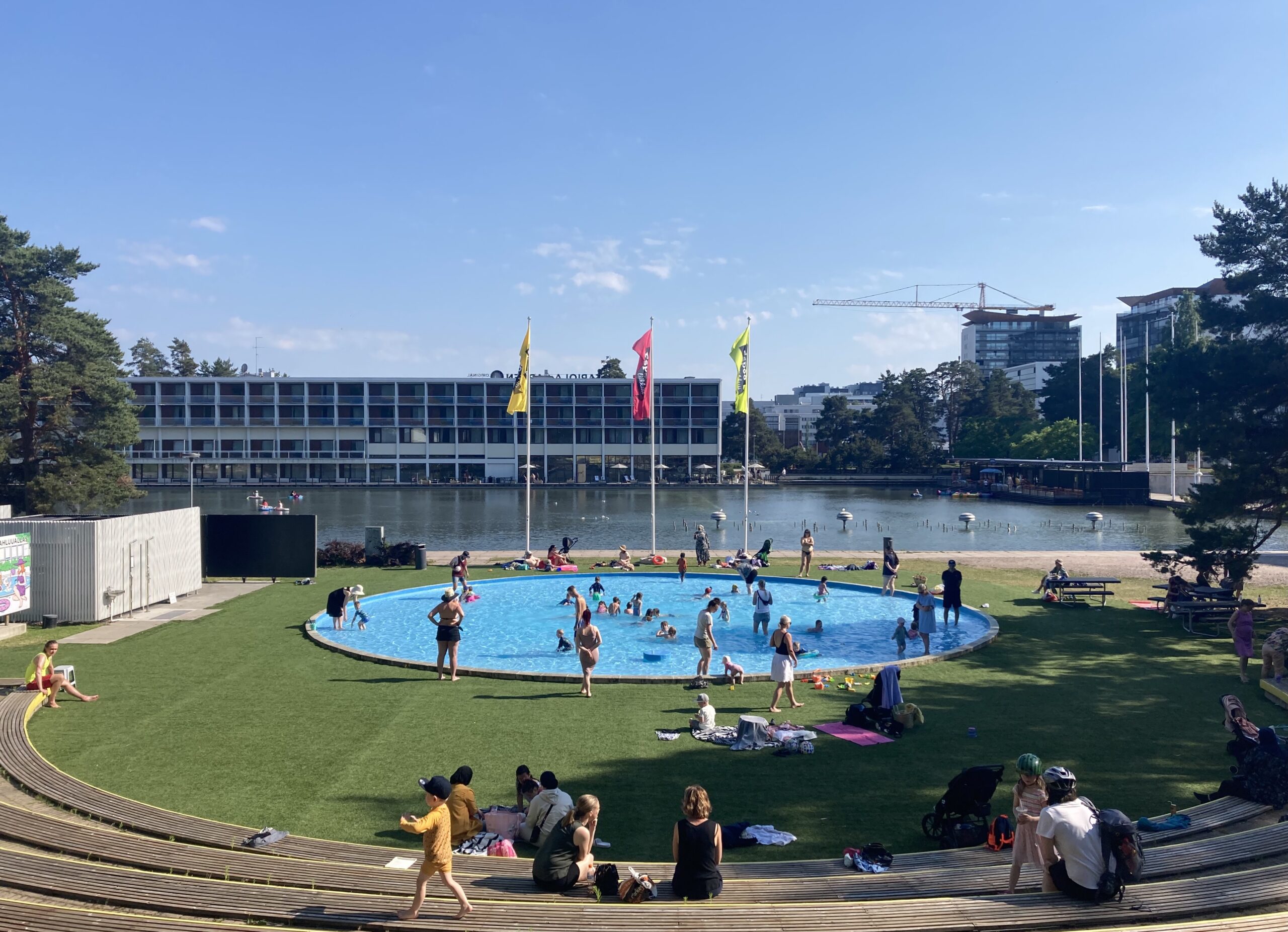
Frédéric Gies & Weld Company agreed, yet again, to show another special version of their piece Tribute. After Tribute – the library version, we have the big pleasure to present the piece as Tribute – the outdoor version in Tapiola Amphitheatre, with all nine dancers.

Sheena McGrandles and her team played around with the idea to place their set, a large wall, in the middle of a park and agreed to present Figured under the given circumstances as an outdoor version. In Ooppera Amphitheatre, two figures re-edit themselves across a wall, back and forth, cut, reverse, re-wind, a constant disruption performed on their bodies along a large wall, situated this time on a stage outside.

For the pieces of Nada & Co and Giuseppe Chico & Barbara Matijević, we have also found new venues, Koko Theatre and Puppet Theatre Sampo. And we are thankful for their last-minute help and collaboration. Both pieces will be presented with a reduced capacity of 10 spectators at a time, in an intimate and hence very special setting.

We are happy to finally bring together the selected participants for the masterclass of Esther Severi Ongoing Moments in Eskus, to work on and discuss dramaturgical concepts.

The Soup Talks will happen in the living room of the Villa, on Tuesday 15th, Friday 18th, Saturday 19thand Sunday 20th, each time at noon. Hosted by Helsinki based artists.

All is set. We are only missing your reservations, and seeing you back in these spaces, to enjoy and discuss the pieces that we have been promising to bring to you since a while.

Welcome!

Kerstin Schroth and the Moving in November team

Soup Talks (June 2021)

Soup Talks is a series of informal conversations with the artists presenting their work during the festival. The talks form a discursive line that goes through the festival and brings people together. We want to welcome the audience and the artists around a big table with a bowl of warm soup. Everybody is invited to join in, to listen, to pose questions and to take part in the discussions. Each of the talks will be hosted by an artist based in the Helsinki area.

15.6.2021
Guest: Sheena McGrandles
Host: Maria Saivosalmi

18.6.2021
Guests: Barbara Matijević & Giuseppe Chico
Host: Jenni-Elina Von Bagh

19.6.2021
Guests: Nada&Co.
Host: Janina Rajakangas

20.6.2021
Guests: WELD Company
Host: Liisa Pentti

The Show

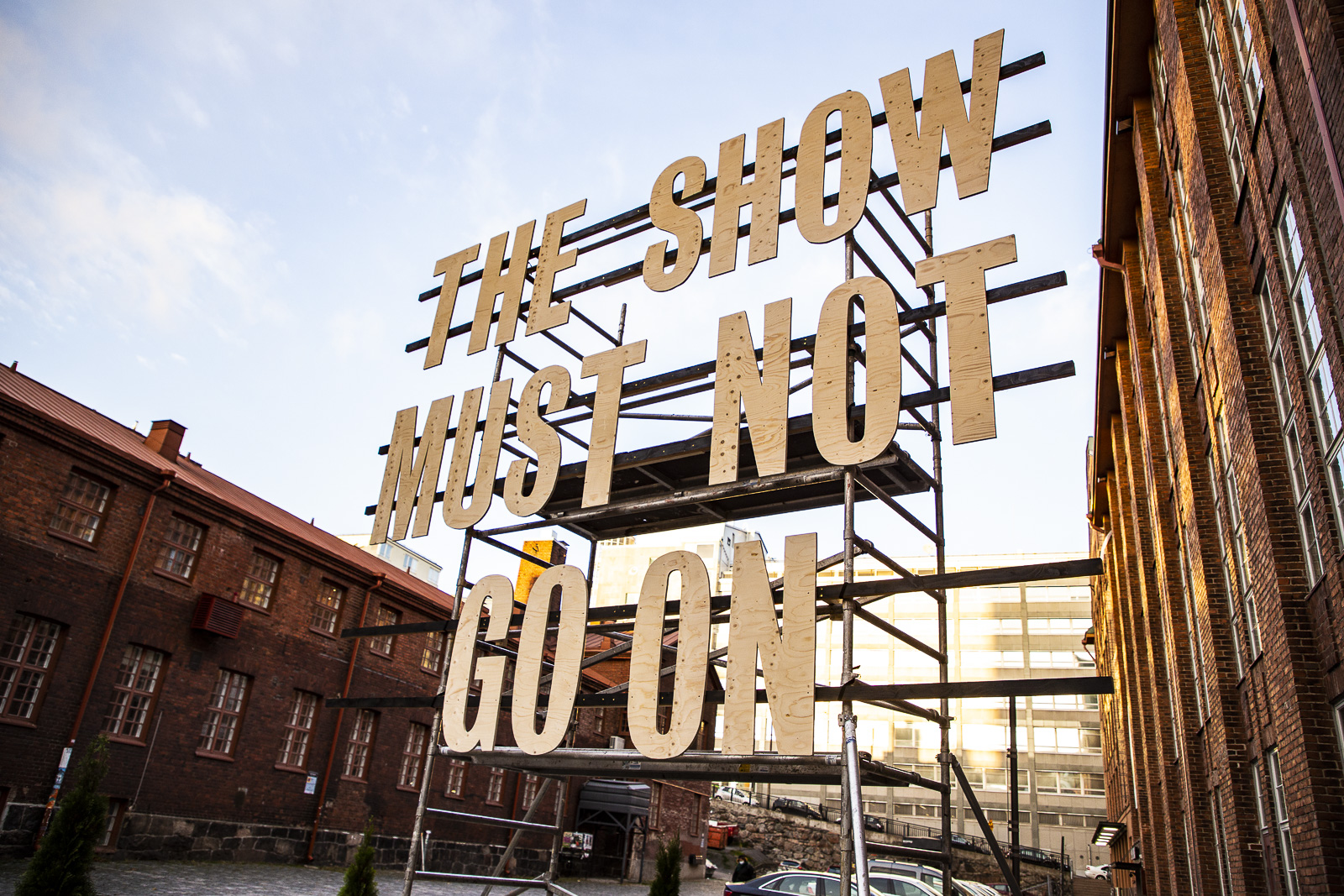
As a joint initiative with the Cultural Centre Caisa Moving in November brings back The Showa large scale installation by British artists Tim Etchells.

The full text of the installation announces, in a bold playful imperative, THE SHOW MUST NOT GO ON. The work is at once a reference to the postponement of live theatre events due to the ongoing Coronavirus pandemic, and at the same time a striking open call for social pause, critical reflection and political change. Etchells’ ambiguous provocative détournement of an upbeat English idiom ‘THE SHOW MUST GO ON’ becomes ‘THE SHOW MUST NOT GO ON’ – a simple linguistic reversal which creates complex new possible meanings.

“Together with Caisa we are reflecting on the ongoing impact that the absence of live art events has on our society. How can we as cultural institutions contribute to finding other ways of moving the live experience of art back into the center of our attention, without occupying only virtual spaces. The restriction of indoor gatherings and closure of performing art spaces does not only have a crucial impact on the artists and their creations themselves but also on the way, we as human beings interact with one another in social spaces and the connective social fabric that’s created while witnessing art works together in a common space.” – Kerstin Schroth, artistic director

“As the pandemic has devastated lives and economies, our models of human interaction, social structures and priorities have been called into question, albeit to different extents, and with different motivations in different international contexts. Such limited, temporary changes as there have been in these last months though, only serve to underscore the need for deeper, more permanent change. (…) The hasty return to ‘business as usual’ after periods of Corona lockdown, already affected across many countries, suits vested interests, whilst the possibilities of a pause, with its much-needed revaluation of habitual thinking and practice, represents an opportunity we should not be afraid to embrace” – Tim Etchells

Tim Etchells

Tim Etchells is an artist and a writer based in the UK. He has worked in a wide variety of contexts, notably as leader of the world-renowned performance group Forced Entertainment and in collaboration with a range of visual artists, choreographers, and photographers. His work spans performance, video, photography, text projects, install      ation and fiction. He is currently Professor of Performance & Writing at Lancaster University.

If you don’t tour internationally, you’re practically non-existent, right?

The text is commissioned by Goethe Institut Finnland and released in September 2020. The link for the original German version you can find below. 

If you don’t tour internationally, you’re practically non-existent, right? I was asked this question on the topic of visibility and ultimately of career opportunities for self-producing artists by a young choreographer at one of the first courses on production and management that I taught at the University of Giessen.

In light of how the performing arts scene has developed since the 80’s and 90’s, the answer to this question is a clear YES. Most notably, the field has expanded, been able to grow and gain an international reputation, because artists have worked, studied, researched across genres and borders and, above all, also because they have been amply invited, presented and funded. This has resulted in a network of collaborating theatres, festivals, production offices and artists.

Thoughtfully browsing through my collection of playbills, theatre programs and festivals pamphlets from the last 10-15 years, I observe the following development:

Far more pieces are now being produced or financially supported by international collaborative networks. The number of pieces performed in theatres and at festivals almost doubled over this period. In addition, more and more artists are trying to perform their pieces (locally, nationally, internationally) and bring them on tour. According to my observations and research, this frequently leads to shorter rehearsal periods. In addition, the pieces tend to have a short lifespan or very limited visibility. Until a piece is really being widely talked about, it has often already run its course, faded away like mist in the sunshine.

International versus local?

If we wish to address the international circulation of productions and the associated issue of supporting artists in the countries in which they live, we must also take a closer look at the urgent question of sustainably producing and performing these works. This also brings up the additional question of: how have we worked in the past, how are we working now and how would we like to work in this community in the future – in a world in which climate change plays an ever increasingly important role and is taking center stage in public perception.

So how can and should the performing arts continue, as a scene in which everything is focused on exchange and international visibility?

It is easy to argue against international travel and to ask how art venues, festivals and theatres today, can sustainably present performances without artists having to get on a plane. But is the solution really to withdraw completely into our local villages? In doing so, we would actually ignore the fact that the scene has grown precisely because of how it has nationally and internationally opened itself, engaging in a global exchange with colleagues and audiences. Nor should we forget that this is also a source of financial security for many artists. Not only does touring secure funding, but it also generates income for choreographers, dancers, technicians, producers, etc. and contributes to the pieces having longer lifespans, something, which is not always the case when artists only operate locally.

International and sustainable, how could that work?

To take a step back now would mean more than just taking a train instead of a plane. Instead it would mean seriously considering whether theatres and festivals could show pieces over longer periods of time, whether pieces could be revived more often, instead of presenting new work, a different artist every other evening.

We could also think about how to use the networks of exchange already in place to make artistic touring more sustainable, to avoid having a group travel from Berlin to Helsinki for only two performances. The same group could travel from Helsinki to other places in Finland, Norway, Sweden, Estonia, surrounding countries and cities. Such forms of collaboration and cooperation would not only ease the pressure on our strained environment, but also reduce and distribute costs, while allowing pieces to be performed more often, run for a longer space of time and thus be more visible.

The sommer.bar as a place of international and local exchange

In 2006, I developed the sommer.bar festival in Berlin (as part of Tanz im August), driven by two main questions:

– Why is it that an international festival like Tanz im August, which brings artists from all over the world to the city of Berlin, a city in itself so vibrant with artists, rarely seeks to engage with the local dance scene?

– Is there a way to promote such exchange, to involve the local scene more strongly in this festival and, as a side effect, to create a framework that allows the international artists to stay longer in Berlin, to show other work, to research, rehearse or to work on something new?

In addition to these thoughts, I was interested in working with a wide variety of spaces, avoiding classical stages, and thus in presenting a wide variety of formats. sommer.bar became a place to work and perform and enter into a dialogue and exchange with others in a place that formed the festival center at the heart of Tanz im August. It was also a place that dealt differently with resources (if I may call artists that for once). Almost all of the artists arriving from outside the city for Tanz im August also did something at the sommer.bar. This extended their stay in the city and gave the audience an opportunity to get to know different facets of their work.

Exchange at Moving in November and questions that remain

I curated the last edition of sommer.bar in 2011. The issues that led to the creation of sommer.bar have continued to occupy me ever since I took over as artistic director of the Moving in November dance festival in Helsinki. What is the role of the festival in a city like Helsinki, surrounded by a small but excellent dance scene? How can we establish an exchange between artists from abroad and the local scene? How can the one be a motor and support for the other?

In general, I always find it important and exciting to involve artists in new ideas and ask them directly: what do you need and how do you want to perform and produce? The answers tend to vary greatly from person to person. Not all of them aspire to an international career, not all of them want to produce and rehearse a new piece every six months. And that is where cultural policies should come in, with funding systems that are more open, offer more leeway, are more tailored to individual career choices and can thus also be applied more freely to specific needs.

What would happen if we agree to produce less pieces in exchange for longer rehearsal periods and more chances to perform?

If creativity, diversity and the personality of each artist were not treated as synonymous, in order to simply implement as many ideas as quickly as possible? If the success of venues and festivals was not measured by how many premieres and different pieces they could accommodate in their program in the shortest possible space of time?

Kerstin Schorth
Artistic director