JEZEBEL

Video Vixens, female models who appeared in hip hop videos in the late 1990s and early 2000s, inspired Cherish Menzo to create the performance JEZEBEL. Also referred to as ’hip hop honeys’ or ’video girls’, these seductive and hypersexualized vixens had a great influence on the aesthetics of hip hop. The repetitive images reinforced negative stereotypes associated in particular with black women. Although Video Vixens were considered strong and empowered by their sexuality, they were also the subject of severe criticism and often typified as ‘Jezebels’, in reference to the biblical temptress and the archetype of the black woman.

In the pre-YouTube era – when MTV still meant Music Television – the Video Vixen model played a central role in the popularity of male artists. Today, she stands for much more than the objectified “ride or die” model in a male-dominated culture.

Jezebel refuses to be defined by others. She navigates the landscape of hip hop culture, looking for ways to reclaim her own image. Can Jezebel deconstruct the controversial stereotype associated with the black hip hop honey? At the intersection of threat and seduction, Menzo’s JEZEBEL forces us to think about how we think in stereotypes. With explosive power, this captivating solo reflects on the way the society stigmatizes, fetishizes and renders invisible certain bodies.

Cherish Menzo

Dancer and choreographer Cherish Menzo is striking for her powerful, controlled, inescapable physical presence. She graduated in 2013 from Amsterdam University of the Arts (Urban Contemporary Dance) and has since appeared in work by Eszter Salamon, Akram Khan, Leo Lerus, Hanzel Nezza, Olivier Dubois, Benjamin Kahn, Lisbeth Gruwez, Jan Martens, and Nicole Beutler. Next to her work as a dancer and. performer, she has been creating her own work since 2016. Menzo questions the apparent norms and creates universes in which the black body stands central. JEZEBEL is her first solo work, created in 2019. It has received an Amsterdam Fringe Award and an International Bursary Award.

Soup Talks

Soup Talks is a series of informal conversations with the artists presenting their work during the festival. The talks form a discursive line that goes through the festival and brings people together. We want to welcome the audience and the artists around a big table with a bowl of warm soup. Everybody is invited to join in, to listen, to pose questions and to take part in the discussions. Each of the talks will be hosted by an artist based in the Helsinki area.

4.11.2022
Guests: Calixto Neto & working group
Host: Antonia Atarah

5.11.2022
Guest: Meg Stuart
Host: Karolina Ginman

6.11.2022
Guests: Angela Schubot & Jared Gradinger & working group
Host: Anna Talasniemi

7.11.2022 NB! @Publics
Guests: Mette Edvardsen & working group
Host: Paul O’Neill

9.11.2022
Guest: Eisa Jocson
Host: Vincent Roumagnac

10.11.2022
Guests: Sheena McGrandles & working group
Host: Maija Mustonen

11.11.2022
Guest: Tuomas Laitinen
Host: Anna Kozonina

12.11.2022
Guest: Cherish Menzo
Host: River Lin

13.11.2022 
Guests: Veli Lehtovaara & working group
Host: Otso Lähdeoja

Antonia Atarah

Antonia Atarah is a Ghanian-Finnish actor and performer who is currently finishing her Master’s degree at the Uniarts Theatre Academy acting program, along with music theatre studies. In her work she has curiously varied between different performing art forms, practices and groups in Finland, Germany and Ghana. Atarah believes in collective work and aims to broaden the perception and task of “the actor” by finding diversity within that role.

Karolina Ginman

Karolina Ginman is a Helsinki-based dancer and choreographer. Through her artistic practice she tempts the multi-temperamented poetic body to speak beyond reason and everyday logics, opening gateways for alternative universes to bloom from the subjective and collective preconscious. Her latest works include Fluvial (Zodiak – Centre for New Dance, 2022) and a Human Ensemble (Cirko – Centre for New Cirkus, 2020). Ginman currently works as a performer with choreographers Mikko Niemistö, Elina Pirinen, Margrét Sara Guđjónsdottir among others, and is engaged in a long-term collaboration centered around breathing with actor Rasmus Slätis since 2019. She is a visiting teacher and supervisor at Uniart’s Theatre Academy in Helsinki. Parallel to her artistic work, Ginman has studied psychology at the University of Helsinki and completed her Master’s Thesis as part of the multidisciplinary ArtsEqual research initiative in 2019. During 2023-25 she works with the 3-year state grant for artists.

Anna Talasniemi

MA Anna Talasniemi has worked in the field of arts and culture for nearly 20 years. Until recently, she served as the Executive Director at Kone Foundation, one of the major private arts and research funders in Finland. Currently, she is completing a Master’s program in cultural environment research with a specialization in arts education at the University of Jyväskylä. She has also written two cookbooks and is a saunaphile.

Paul O’Neill

Dr. Paul O’Neill is an Irish curator, artist, writer and educator. He is the artistic director of a Helsinki-based curatorial agency and event space PUBLICS, since 2017. Paul is widely regarded as one of the foremost research-oriented curators, and a leading scholar of curatorial practice, public art and exhibition histories. Paul has held numerous curatorial and research positions over the last twenty years and he has taught in many curatorial and visual arts programs in Europe, The USA, Asia, and the UK. Paul’s writing has been published in many books, catalogs, journals and magazines. He is the author of the critically acclaimed book The Culture of Curating and the Curating of Culture(s) which has been translated into many languages. Paul has recently completed artist books with Maryam Jafri and is working on books with artists Kathrin Bohm, and Dave McKenzie, as well as two new books of curatorial texts called CURED and CURIOUS.

Vincent Roumagnac

Vincent Roumagnac (DA) is a Helsinki-based Basque-French discipline-fluid artist and researcher. Initially trained as an actor and a director, Roumagnac drifted away from “straight theatre”’s infrastructures and regimes of production to look at how the notion and practice of the “stage” transform through contemporary climate-morphing, techno-ecological conditioning, and media-hybridizing. He has proposed and had been implementing with, the tentative eco-dramaturgical notions of “redirecting/deepening/reacclimating” the stage, and “reecologizing” theatre. He is also involved in investigative and transdisciplinary processes that implement the connections between art and research. In 2020, Roumagnac completes a Doctorate in Arts at the Performing Arts Research Centre of the University of the Arts of Helsinki based on the artistic research project ‘Reacclimating the Stage’. Thereafter, he initiated a four-year post-doctoral artistic research project titled DATA OCEAN THEATRE (D.O.T.). His work is currently supported by the Arts Promotion Centre Finland.

Maija Mustonen

Maija Mustonen (she/her, born 1979) is a multidisciplinary artist from Helsinki. She is interested in long-term practices of support and sharing. The themes of Mustonen’s works are especially encounter, touch, contact and questions of sensuality. She has a master’s degree in fine arts and a bachelor’s degree in dance & choreography. Mustonen is currently working with the support of the Kone Foundation.

Anna Kozonina

Anna Kozonina is a dance critic, researcher and curator based in Helsinki. As well as obtaining an MA in Political Science and Linguistics, she has studied dance history, performance theory, visual cultures, curating and contemporary art. Since 2017 she has been reviewing pieces by emerging and established European choreographers as well as doing research on the new post-soviet dance scene (a book on the topic was published in 2021) and diving into somatic discourse in contemporary dance which she observes from critical and political perspectives. She currently gives lectures on dance and performance theory, curates educational programs and conducts research projects. She is also a regular contributor at Springback Magazine where she analyses contemporary dance in the Nordics.

River Lin

River Lin is a performance artist working across the contexts of visual art, dance and queer culture through making, researching, and curating. He stages live works in gallery settings as choreography, installations, encounters or situations to speculate notions of heteronormative construction, social engagement and performativity of mediums. Born in 1984 in Taiwan, River lives and works between Paris and Taipei. He is a shortlisted artist of Live Art Prize 2022.

Otso Lähdeoja

Otso Lähdeoja is a professor of artistic research at the University of the Arts Helsinki, composer, electronic musician and researcher in digital arts. He holds a doctorate in music from Paris 8 University and has led a myriad of crossover artistic projects over the past years. He has lived and worked in Finland, Canada, Belgium and France. His works include musical ensembles, solo and group albums, multimedia projects, music-poetry, installation art and music for dance performances.

Conversation between Matilda Aaltonen, Veli Lehtovaara and Kerstin Schroth about Performing Animalities – A Praxis

In your work, you have been occupied for a while with the movement of animals, by studying the relation between humans and animals. Can you tell more about your interest and the research behind it?

Matilda: Yes, the relationship between humans and other animals has been my major interest for quite a long time now. In 2020, I began working on the research project – “Can animals be expressed? The challenges of conceptualising animals in science and art” – which combines artistic and scientific research. Since then, I have been writing and performing artistic work with these questions in mind.

I have noticed, that by researching their movements, I am able to learn a great deal from an individual animal. Because we have no common spoken language between us and other species, the language of the body and movements may be the answer to interspecies encounters and interactions. My work is grounded in embodied empathy, through which I can experience our shared bodily existence with other beings. When working with embodied empathy, I don’t imitate the other but acknowledge that they are subjects with their own perspectives and try to connect with them. Like humans, other animals express themselves with moving bodies. So, I study the movement, respond to them, and try to understand the possibilities that open in this action.

I believe that the question of animal – how we understand other animals and live in relationship with them – is one of the most important societal questions of our time. The ongoing widespread abuse and discrimination must come to an end. Society, as well as art, could work towards the well-being of all animals.

Performing Animalities – A Praxis you describe as an “invitation to interspecies dialogue”. You invited choreographer Veli Lehtovaara to share this praxis and dialogue with you. How did you develop this praxis/ dialogue? How did you work together with Veli on it?

Matilda: I realised that we have many shared artistic points of interest with Veli, so I asked him to work with me. We began by sharing past experiences and exercises, and after a time a common practice was forming between us. The performance witnessed today is one phase of our research journey. We want to preserve the feel of an un- resolved question and curiosity because our topic is so extensive that it would be foolish to imagine that it could be contained within a single artwork or performative event. After working with each other for a while, we invited the sound designer Markus Tapio to work with us and bring his own voice to the project.

In the context of this project, “Interspecies dialogue” means that we are asking about our relationship with other animals, willing to let their physicality affect our own.

On the other hand, the practice is also about exploring our own animality. We recall this human animality by tuning ourselves and each other into a certain bodily mode. This happens via specific tasks and exercises which enhance our sentient corporeality. We also use touch as a method of operation: the one who intentionally touches affects the other’s bodily movement and activates their senses. The body becomes highly sensitive – at the same time both impulsive and gentle.

Honestly, I do not think that any characteristics in us are more or less animalistic. We are animals, in every way. But maybe there are some aspects of our physicality, which can be emphasized to reveal the artificiality of a dualistic human-animal divide. So, in our interspecies dialogue, the focus is to re-position ourselves in relationship with other animals – thus enabling the dialogue with others.

With “Performing Animalities – A Praxis” we want to invite our audience to ponder together with us how we unders- tand other animals. What is common between all of us? What might a swan or a cat tell us about corporeality?

Out of curiosity, asking both of you, what are you looking at, when you are observing nature and animals around us in the Helsinki area?

Matilda: In this project and my other works before, I like to observe how our human and non-human lives happen side by side in urban areas. Helsinki is a multispecies city, a home for many different beings. I like to look for encounters and ways to experience co-existence with them.

Veli: I enjoy looking at forms of different kinds of bodies and how these co-create and relate to spaces. These can be bodies of buildings, trees, insects, other humans, clouds, machines, basically any bodies or parts of them. I am particularly interested in perceiving and experiencing the passage of energy and information between and among things, in the natural world as well as human cultivated phenomena. I find it mesmerizing to tune into the diversity of movement and allow myself at times to sink into it – to kind of forget the preconceptions or learned knowledge of what I’m looking at and just wonder about the ongoing poetics of movement and transformation. I guess it is the dance that I am looking to take part in, a form of movement, a choreography.

Conversation between Angela Schubot, Jared Gradinger and Kerstin Schroth about YEW: outside

Your works YEW and YEW: outside are co-created with different plant species. Wherefrom comes to your interest in working and co-creating with plants?

Jared Gradinger: That is such a nice place to begin. First of all, I would like to define my understanding of co-creation within this context. Co-creation is working with Nature as an equal partner on all levels of decision making to create a balanced environment. It is setting primarily human-centric logic aside and trying to work with Nature logic. In this context, balance is the optimal state in which all life systems can flourish. Balance is of course always in flux and recalibrating. This way of thinking seems to point in the direction of humans being separated from Nature. We are of course a part of Nature, but we also live outside of its inherent balance. In fact, we tend to create a lot of imbalance. Balance isn’t a human specialty, but it is one of Nature‘s.

I think as a kid, I was always a friend of plants and Nature even if it wasn’t very conscious. I grew up in a city with incredible trees. I was the child in the outfield during a baseball game who would sit down (while the game was on) and play with the flowers and Grasshoppers because I found them much more compelling to watch and catch than a ball. In my 20s and 30s, I started to buy strange plants and formed a nicely sized family in my flat. Around 2012, I started to become aware of and learn about other layers of reality, other dimensions, and other types of consciousnesses. I started to dig deeper, read a lot, had conversations, and participated in various healing modalities and experiences. I began to understand and even experience Nature in a more expanded way than what I grew up with. It was clear that I needed to find ways to consciously participate with Nature and learn from it. I’ve learned since that Nature is right here ready and willing to work with us whenever we decide we want to. All we need is a kind of intention, which can be almost anything, and then to softly observe and listen.

One of the many intentions of my first garden was to meet, learn from and work with the elemental beings. What better way is there to learn from and work with Nature than to create a garden? Gardens are an optimal place for human/Nature co-creation and can become a real classroom and laboratory for interspecies and more than human communications and learnings. Gardens are radical acts of peace. Gardens are initiated by humans and supported by Nature. Gardens don’t necessarily need to be green spaces, potentially anything can be a garden.

In general, I’m driven to work with Nature as a partner in many aspects of my life: in my home, my body, my artistic practices; expanding my notion of garden and co-creation, and trying to step away as much as I can from my habitual human logic. And in the meantime, have fun learning and creating with creation. I intend to expand the scope of my reality, participate with the beings and phenomena that surround and support us, and try to find ways to share that with other humans in hopes to co-create with them and the more than human world.

Angela Schubot: I am still amazed that it is actually truly possible to do that, working with plant beings as artistic collaborators. I was always interested in leaving the heroic body behind and entering a world of „being moved by other forces “. It is nice to be moved by plants since they have such a different configurations in Time and Space. And total other connectivity with each other and with the world. For me, they seem very wise entities. And they share so much beautiful knowledge with such an abundance.

Could you tell us more about the working process? Concretely, how did you work together with the plants?

Jared Gradinger: That is a very simple and very complex question at the same time.

The simple answer is that we tried to create space to listen to them and then tried to honor what appeared to us while still listening.

We had taken a break from making pieces for a while to have other experiences and learn new things. Angela and I always said we only wanted to make work together when we needed to. When we were interested in learning something or needed to experience something. Angela began to work with and learn from traditional plant medicine, and I began learning from Nature in the garden classroom.

So, we met again in 2017, to make our first group performance YEW, with the plants as our partners. First, we set an intention. We wanted to build a garden with them, a garden on the stage; not a room full of plants but rather a garden that lives in our bodies. We wanted to offer our bodies and the space to the plants and be moved by them. We set the intention to listen, learn, and materialize what our plant partners have to share and what we learned as a result of working with them. We invited them into the theater space, between our bodies, in the music and lights, into our logic and decision making, our rhythms and timings.

We practiced getting quiet and started listening to them and the wisdom they had to share with us. We observed them in form, their shapes, colors, smells, and directions, and also by observing where they grow and with whom. We would practice becoming them. We would invite them into
our bodies, into the room, and move with them. We invited them into our thoughts, our mouths, our lungs. We invited Stefan Rusconi to join us and help to bring their music and sounds into the work as honestly as possible. We listened to their electrical outputs, their rhythms, and their music. And then found the common ground and desires between us and worked to formulate that into a garden and a performance.

For YEW: outside we carried those experiences, inspirations, and encounters back outside and almost stepped back to decentralize ourselves even more. We wanted to offer an expanded perception of the places and beings that we were working with and of course, invite the audience along to encounter and perceive those beings and phenomena in real-time.

Angela Schubot: It was mostly listening and softening the fibers of the body to be moved by their subtle energy.

As a duo, you have worked since 2009 and have created several pieces together. How would you describe your artistic relationship?

Jared Gradinger: In my view, Angela is incredibly radical in thought and movement and completely dedicated to experimentation. She is inspiring. She challenges me and my habits. I never saw someone formulate thoughts and ideas in a body the way she can. Our approaches and ways of thinking are sometimes very different, sometimes not. But when carefully communicated, we create a third, a kind of balance that individually we couldn’t create. Like creating a new consciousness that we’ve had the privilege to grow since 2009.

We worked for a long time to develop new forms of co-existence with each other by letting go, as best we could of our ‚I‘, through an unconditional dedication to the other.

We were always searching to let go of the habitual body and experiment with different ways of being together. Now, by working with Nature, we are inviting and including plant partners. Together, with Nature, we are search- ing for and joining another logic, which exists only when we honestly listen and decentralize ourselves. We practice dedicating unconditionally to each other and the plant beings with their infinite wisdom and multidimensionality.

Angela Schubot: We always shared a vision for trying the impossible and finding what this does in the body.

You are also working with regenerative gardens. You created projects in relation, and you are giving workshops (like for example next week in the frame of Moving in November). Curious to hear more about this, your interest and motives, and also the difference between these gardening projects and your stage work?

Jared Gradinger: I guess it is obvious but working outside allows for a very clear and direct channel to meeting Nature and the plants. Real-time phenomenon. It’s where you can witness, observe, meet, and participate all at the same time.

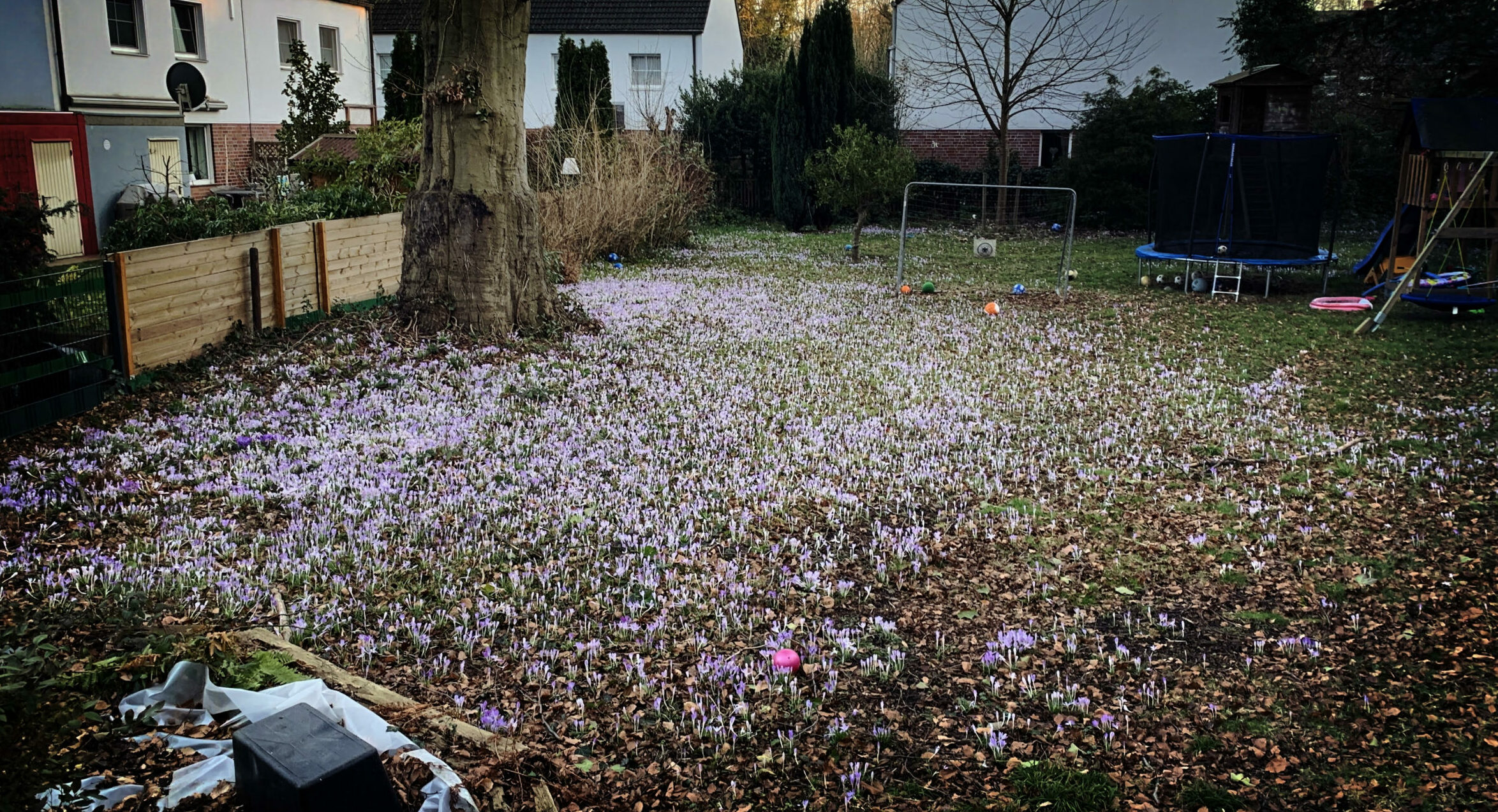
A few years ago we were invited to develop a project for the Martin Gropius Bau and Haus der Berliner Festspiele‘s Down to Earth festival in Berlin. We were inspired to create a garden that takes care of itself and to invite the museum to stop tending the backyard. We intended to allow the garden to find its own way/balance by letting it be. We offered, over the course of a week, a durational performance dancing a garden into existence; consciously planting endemic seeds and bulbs into the ground while in a performative state. The seeds and bulbs regenerate themselves and require little care. A less kempt space also invites other life to occupy the place. The institution agreed to let the new garden be without intervention for at least a few years. It is amazing to visit this little patch of land, growing and finding its new dynamic balance. The grasses are growing high creating habitat for insects and birds and the bulbs are multiplying. A small balsam forest has begun.

In this context, working with the body and the land felt so right and good on so many levels, we decided we wanted to share this performance as a practice to create a workshop that is feeding the land and the human physically and energetically, and at the same time create a space for connection and listening to plants, soil, cycles, sun, weather, etc. The piece was called The opposite of a shadowland, which is a kind of definition of re-wilding.

I must admit that I am doubting my place in the theater. My intention is not as clear as it used to be. The work with Nature has started to point me in (an)other direction(s), and even they are not so clear at the moment. I also feel my responsibility as an artist is changing. Maybe even the purpose is changing. The world is (seemingly) a very different place than it was 10 or even 2 years ago. Responsibility can of course take on many different forms, and there are many people in our field working hard to take on that responsibility to start making fundamental changes. There are people working with and within institutions to create internal change regarding our ecological crisis and regenerative thinking. They are thinking about theater sets and their ecological impact and future. They are thinking about tour structures and habits, about alternative sources of electricity in theater spaces, and about funding structures that are more long-term and not just project-based. There are of course other (smaller) movements and questions being proposed to promote change. Building a public garden in an artistic institution inspired a lot of change. Working with plants and Nature as artistic partners created a lot of change in me and elsewhere. Even creating work for the outside (knowing it’s been done thousands of times before) created change in our way of thinking, doing, and perceiving. I believe it also created small changes in the actual land itself.

The word „sustainable“ has become a challenging word for me. Truly it means to manage and points us in the wrong direction. It has become a capitalistic slogan, and in many ways is one of the reasons we are in our current ecological crisis. I first learned the word „regenerative” when I started looking into different farming/agricultural practices. From my understanding, the basic idea behind regenerative agriculture is not at all a new model, it is indigenous knowledge, and it is also a part of practices such as permaculture, etc. At its most basic it is the mandate to take care of and protect our soil as much as possible. With our current agricultural practices, scientists say we have roughly 50 harvests left before our soil is completely depleted. Healthy soil grows healthy plants and food, which in turn grows healthy environments, ecosystems, healthy bodies, and healthy minds. It is working with the cycles and processes found in Nature. It doesn’t require pesticides and chemicals, tilling, monoculture, etc. In general, regenerative systems create feedback loops that take care of the whole: starting with the foundation, which for everyone everywhere is soil. And as Sateesh Kumar says, “We are soil, temporarily human”. I am not a farmer, so I am wondering how we can integrate those systems and feedback loops into our work, into our living, into everything actually.

To me, the idea and inspiration of „regenerative“ is similar to the co-creative work with/in the garden. I had always wondered if this expanded notion of gardening and co-creation with Nature could be a way to develop artistic works and pieces, and Angela and I explored some of that together. Now I am beginning to ask (as are many others) how can we work with regenerative strategies in general, to better support the ground on which we live; the land, the people, and more than the human beings with whom we are sharing time. How can we better support the various gardens that we co-create, whether they are a green garden, a performance, a long-term project, a body, a partnership, a business, a tour schedule, a waste system, a theater, a festival…

Angela Schubot: The workshop is an attempt to bridge dancing and gardening. A hybrid!
Moving in November’s spring edition has come to an end. Thank you for the shared time!

Traces from November might come across as a pandemic consequence, but actually is an invented format and a possibility to leave the borders of a set festival timeframe. To spill over to other times of the year, with projects that need another temporality, attention, or weather condition than given in November. A format that can take multiple shapes.

The starting point of this edition was the work of Angela Schubot and Jared Gradinger. The way the two artists think, engage, and invite plants and plant knowledge into their performances fascinated me. I was curious to propose their performances YEW: kids and YEW: outside to a Helsinki audience. To find places here, where the intense encounters with plants and trees they are proposing could take place.

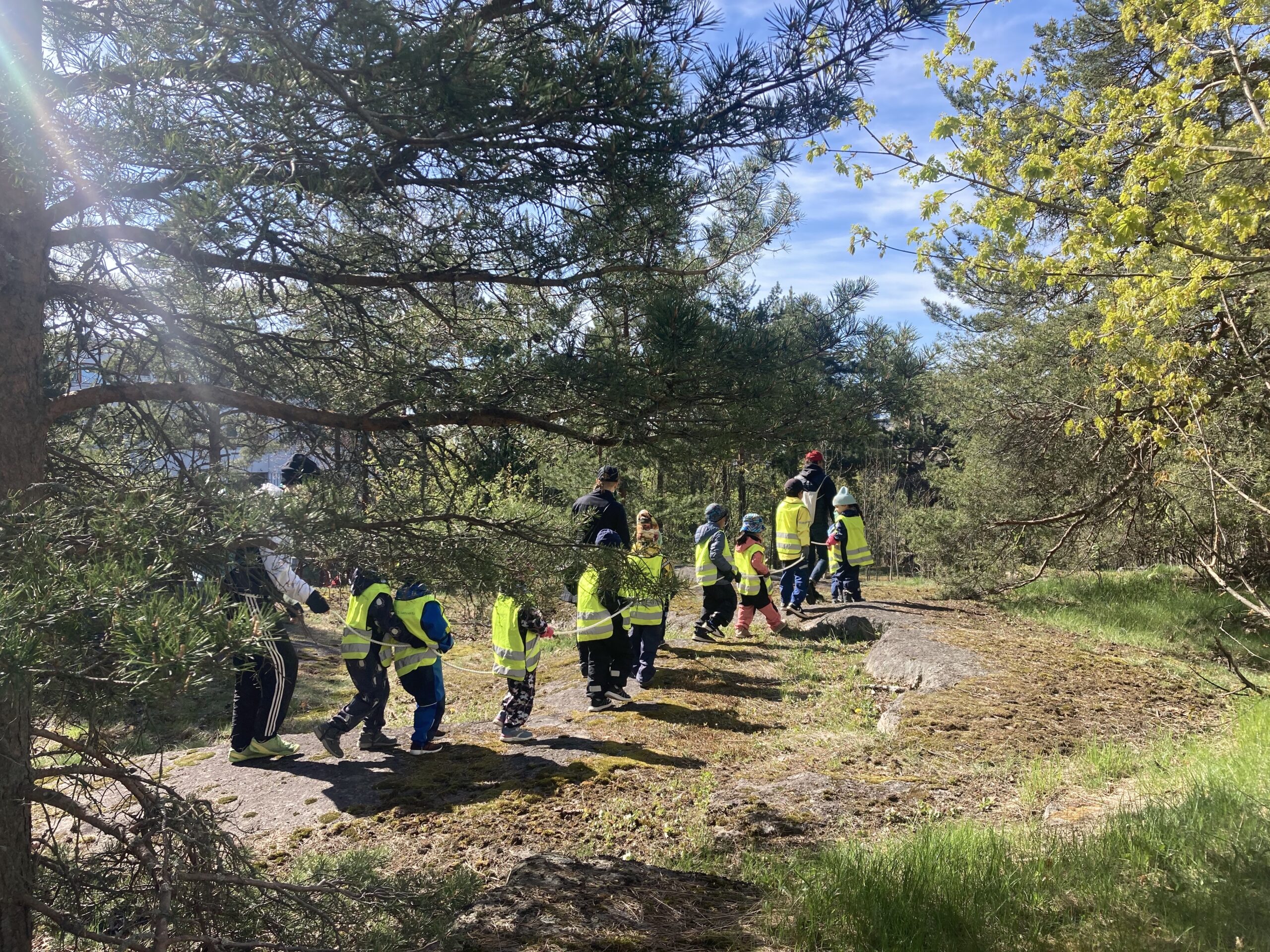
YEW: kids was presented for kindergarten groups in the Pihlajamäki area. An area Moving in November recently started exploring in the frame of the Helsinki model. This specific area has no theater spaces which triggers our thinking towards using other spaces and outside areas for performances. With Pihlajamäki, Moving in November adds another area on its map to spill over to and be included in our general festival activities.

For one week we were present in Pihlajamäki with Traces from November, also occupying the local Youth Center with a workshop for the local community, a workshop for professionals, and a performative study given and proposed by artists Matilda Aaltonen and Veli Lehtovaara, studying and working around animal movements.

Thinking of other performative formats and traces, we brought a performance from last November with us, Fionde by Chiara Bersani with Illaria Lemmo *. A performance in a box, that can be taken and activated at home. By opening it, one becomes the audience and the performer at the same time.

From Pihlajamäki we moved to Helsinki Central Park to experience the performance YEW: outside. Hopefully, a glimpse and a memory of these magical evenings stay with the ones who experienced it, to carry to the November festival. During which another work of the two artists can be encountered in the form of a fungi hut, built in front of the cultural center Stoa.

Together with the participants, the two artists also left some traces behind the Villa Eläintarha, planting bulbs and seeds in the frame of a Gardening -workshop. A choreographic planting action for the future, thinking of regenerative structures of gardens being able to take care of themselves.

Thank you all for the shared time, wish you a good summer!

And hopefully meet you back in the fall for Moving in November, from November 3rd to 13th!

Warmly,
Kerstin

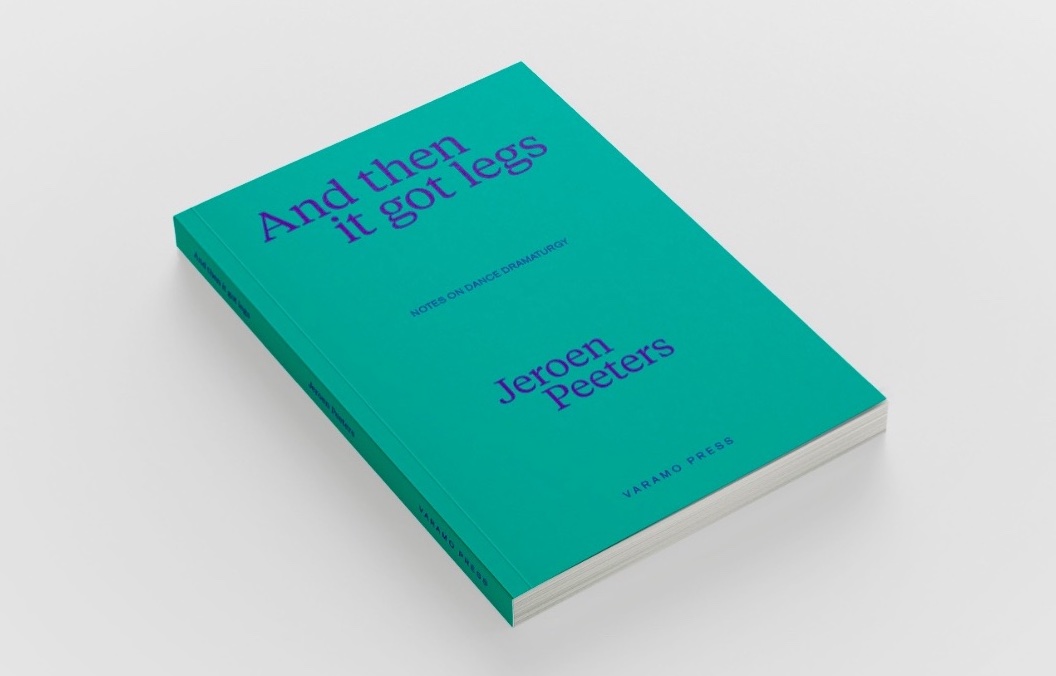
And then it got legs – Notes on dance dramaturgy

Drawing on his experience in the field of contemporary dance, in And then it got legs: Notes on dance dramaturgy Jeroen Peeters discusses principles, methods and practices that contribute to an understanding of dramaturgy as an experimental, collaborative practice and a material form of thinking. How do you set up conditions for the work to come about? How do you create a shared ground for exploring the unfamiliar in pursuit of making sense? The book is written from practice and reflects a particular history of collaboration and conversation with various dance-makers.

In the frame of Moving in November, Jeroen Peeters will be in conversation with artists Maria F. Scaroni and Tuomas Laitinen about his new book. You can purchase the book after the event.

Jeroen Peeters

Jeroen Peeters is an essayist, dramaturg and performer based in Brussels. He has published widely on contemporary dance and on issues such as ecologies of attention, readership, embodied knowledge, material literacy and sustainable development. Publications include a book on Meg Stuart’s work, Are we here yet? (2010), the essay collection on spectatorship in dance Through the Back: Situating Vision between Moving Bodies (2014) and an essay on Mette Edvardsen’s work, Something Some things Something else (2019). Peeters is currently a research fellow at Hasselt University, Faculty of Architecture and Arts, and PXL-MAD School of Arts.

Memory Garden

Memory Garden is a collection of recordings of childhood garden memories. It is an on-growing project initiated by Jared Gradinger and presented in Moving in November. These five minute recordings are available for listening through the link on the right. The project honors personal accounts of the gardens from our childhood reconnecting us to the lands we grew up with. These recordings are accessible anytime.

“I invite you to download or stream one or more memories as you walk down the street to your next appointment, as you sit on the train going home, or while walking through a park on a rainy autumn day. Each memory is a gift: to the rememberer, to you, to me, to Nature.
Love, Jared”

Jared Gradinger

Jared Gradinger is a choreographer, artist, performer, and gardener born in the USA and based in Berlin since 2002. He is an interdisciplinary artist working in the fields of performance, dance, social art, and Nature.

Traces from November May 16th – 27th. Moving in November’s spring edition.

Tickets are on sale, book yours now! Capacity is limited. 

Let’s welcome the spring together. With Traces from November, we invite you to explore the world we share with other beings. We take you to areas in Helsinki, Moving in November has not yet explored. Make sure you book your seats!

With the outdoor performance YEW: outside by Angela Schubot & Jared Gradinger, specifically re-worked for Helsinki’s urban nature, we take you to a familiar place you have crossed probably a thousand times, the Central Park.

The two artists have also crafted a Gardening workshop for you, situated at Tokoinranta. Is there a better way to learn from and work with nature than to create a garden? Thinking of all the neighborhood gardens in the city area, gardens are an optimal place to meet and experience plants and other species.

Matilda Aaltonen & Veli Lehtovaara invite to a dance-oriented study Performing Animalities – A Praxis, and to two workshops exploring our relation to other living beings. My multispecies neighbors – open workshop and I and Other Animals -workshop for professionals in Pihlajamäki–Pihlajisto area.

Last but not least, Jared Gradinger is also collecting your childhood garden memories. You can record your memories and send them via email to us. Instructions on our website.

Looking much forward to seeing you in Helsinki Central Park, Tokoinranta, and Pihlajamäki–Pihlajisto for a special edition of Traces from November.

Warm wishes,
Moving in November team

Herbarium

It all started with a mushroom glowing in the dark and the most tender touches. A desire arose to encounter the more-than-human world through becoming a living, embodied herbarium.

The project Herbarium is overarching, branching and bridging between several places: the Finnish forest, the Colombian rainforest, and the urban nature of Berlin. Through this, mycelium has opened a network that reaches towards ways of making, sharing, and activating through a multiplicity of forms. How can humans host and embody nonhuman knowledge? How do we carry the assemblage of our encounters? How can those be expressed and shared?

The project is initiated by choreographers Angela Schubot and Jared Gradinger who, for over a decade, have been searching for new forms of co-existence through symbiotic practices that deconstruct the dominant notion of self. Parts of the project were developed during several residencies in the frame of Moving in November.

In Helsinki, Angela Schubot and Jared Gradinger together with their working group share three parts of Herbarium: The Hut, Memory Garden, and the solo SAMMAL/MOSS.