Tune into the festival mode through the Pre-note!

Have you already read the Pre-note witten by Artistic Director Kerstin Schroth? We invite you to tune into the festival mode through these notes on the programme. Less than two weeks to go until we open the festival!

Pre-note Moving in November 2025

Dear public, friends, and colleagues,

By now, it has become a tradition to write a pre-note to you before the festival program is officially released. As I write this, it’s the end of July. While I am looking forward to a summer break, my mind is still spinning, revolving around this year’s festival program.

In a text by Claudia La Rocco* I came across a phrase by Sakyong Mipham that caught my attention, particularly the second half: Planting a Flower on a Rock. I could not stop thinking about it and was wondering, if: Planting Trees in Sand would be a more accurate metaphor for today’s world. Both images carry an almost utopian impossibility–and yet, they speak about resistance, patience, and making the impossible happen; as growing something delicate and fragile under hard circumstances or something large and enduring in an unstable environment.

I have been also thinking again about the Finnish title of the festival: Liikkeellä marraskuussa. When run through automatic translation, it does not translate as Moving in November–instead, it gives On the move in November. In German: Unterwegs im November or Aufbruch im November; in French: En route en novembre. A subtle but significant shift. These variations suggest not simply motion, but departure, transition–a state of being in-between. We are not merely “moving” in November; we are setting out, closing our jackets and going, leaving something behind, heading towards the unknown. The whereto is not defined yet–but we are on the move.

I am intrigued by this. Movement stands in opposition to stagnation; it implies change–a shift, a becoming. It makes me think of the persistence of water: how, over time, it carves holes through stone. The movement quality of water carries within it a profound sense of resistance and endurance but also rest.
There is, quite literally, “die Ruhe vor dem Sturm”; the German saying for “the calm before the storm”, describing the peaceful, fleeting moment of stillness before something shifts, before the chaos arrives.
But what if the storm is constant? How do we find a calm phase–a moment of rest–within ongoing turbulences?

All these evoked images–the atmospheres and qualities–I find reflected in this year’s Moving in November program, through the invited artistic works. Rest, resistance, endurance and the ability to invite contemplation and reflection into the spaces, they have imagined for us. Spaces that hold us and bring us together for a while.

Rest can be a form of resistance–a conscious stepping aside, a pause to observe. Not to stand paralysed, but to continue moving differently. It takes resilience not to be constantly thrown around by the spinning, speeding world around us, but to take the time to reflect, to rest amidst the ongoing noise. With this in mind, I invite a collective moment of digestion–a shared pause–as we dive into this year’s Moving in November program.

In November, you will experience an international program alongside our Focus on the Local Landscape and we warmly invite you again to participate in our Soup Talks series and the Audience Club.

Yours,
Kerstin Schroth & the Moving in November team


*(Claudia La Rocco: “Certain Things”, Afternoon Editions N°4)
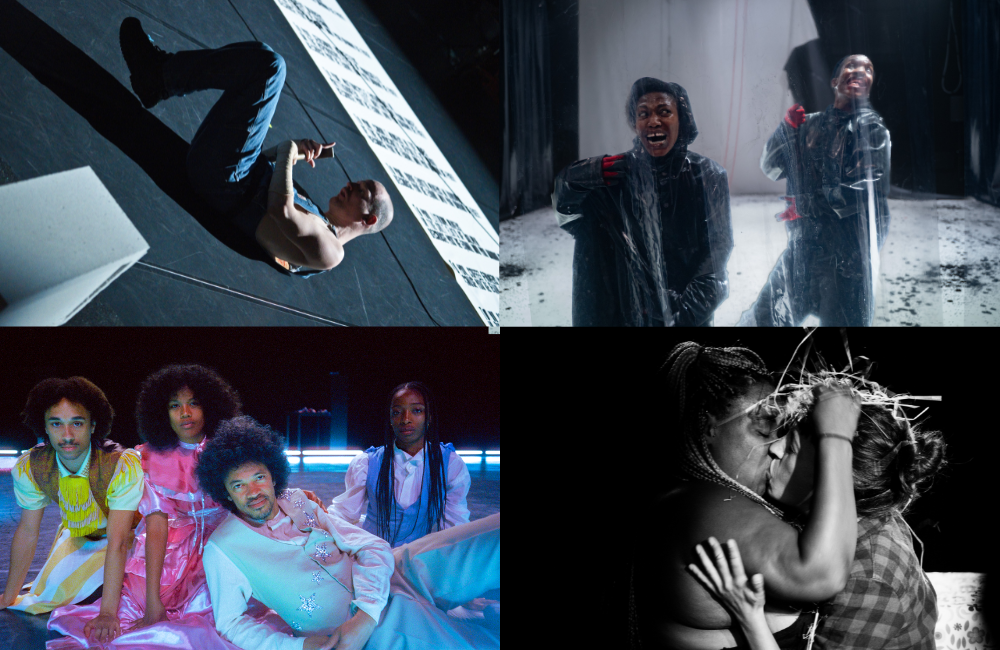
Photo: Mariangela Pluchino

Last chance! Get your festival pass by October 31st

Dear festival audience! We are getting ready, November is getting closer and closer, and our festival passes are nearly sold out: this is your reminder! There’s still a chance to buy your pass and see more shows for a more affordable price – 55€/pass. Passes are being sold until the end of October, so act fast.

For pass holders, the following performances are still available:

  • Work Body by Michael Turinsky in Stoa November 6th at 19.00 (festival opening) or November 7th at 18.00.
  • FRANK by Cherish Menzo in Stoa November 10th or 11th at 20.00
  • La Gouineraie by Rébecca Chaillon & Sandra Calderan in Kiasma Theatre November 12th or 13th at 18.00
  • Fampitaha, fampita, fampitàna by Soa Ratsifandrihana in Stoa November 16th at 17.00 (festival closing)

Buy your pass through this link!

Please note that as a pass holder you’re warmly welcome to check for last minute available tickets at the door — not only for the four performances listed above, but also for any other shows where there are currently no pass tickets left to reserve.

We would like to remind you, that single tickets for all of our performances are still available, even if there are no pass tickets left. Single ticket prices range from 8€ to 33€, and there are discount tickets available for students, unemployed, pensioners and theatre professionals. In addition to the performances above, you have the chance to experience the following works during Moving in November:

  • Maze by Marie Topp & Julia Giertz
  • Mother Tongue by Lucía García Pullés 
  • This resting, patience by Ewa Dziarnowska
  • MANUAL by Adam Kinner & Christopher Willes 
  • DOWN BEAT by Mean Time Between Failures  *🔎
  • Quattro Stagioni by Elina Pirinen, Tom Rejström & Jenni-Elina von Bagh *🔎
  • Conversations with Ants evening by Sanna Kekäläinen, Kari Hukkila & Heli Keskikallio (guest) *🔎
  • Mabel Revival by Liisa Pentti +Co *🔎
  • We’s and Us’s by Karolina Kucia *🔎

Additionally, we warmly remind you that there are also performances and events with free admission:

  • Don’t thank for the food by Antonia Atarah (no pre-registration)
  • Sketch Evenings by Emmi Max Pennanen & Sonjis Laine (pre-registration needed)*🔎
  • Exercise on empathy [a score for performing a human] by Alina Sakko (no pre-registration) *🔎
  • Soup Talk discussion series
  • Soup Talk: Focus on the Local Landscape *🔎
  • Soup Talk Panel *🔎

See the full festival schedule on our website and get your festival pass, tickets, and festival plans fixed! We are looking so much forward to seeing you – already in less than two weeks.

Warmly welcome to Moving in November! 🌀💗

Moving in November team

*🔎Focus on the Local Landscape

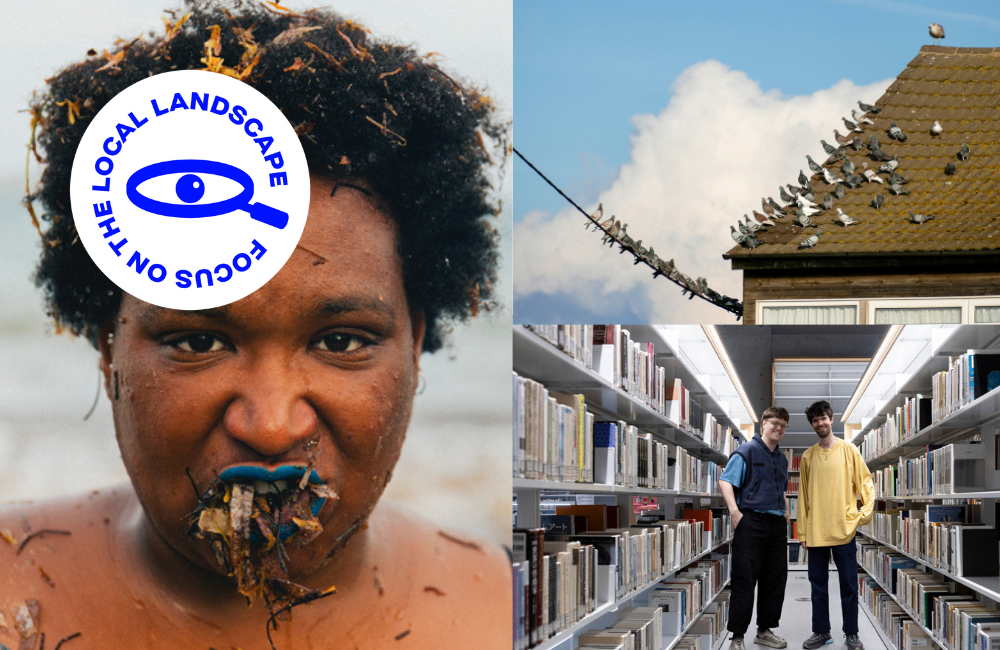
Photos: (up, left) Michael Loizenbauer, Bas de Brouwer, (down, left) Harilay Rabenjamina & Marikel Lahana

Focus on the Local Landscape 2025

Together with the artists, we are proud to once again present Focus on the Local Landscape – a rich program that meanders with a large variety of works through the ten days of Moving in November.

In the face of current funding cuts to the arts in Finland and under the threat of further reductions, it feels crucial to shed light once again on this vivid and inspiring local scene. Focus on the Local Landscape responds to this urgency, embedding the local artistic voices within an international contemporary dance festival. By combining local and international perspectives fostering exchange and inspiration, the program shows the richness of the Finnish performing arts but also builds a bridge for collaboration and visibility in a wider context.

Focus on the Local Landscape is both a collaborative artistic program and the continuation of a conversation, addressing the local culture-political situation that is increasingly complicated and hostile for the arts scene. With this program, we embrace artistic proposals from the local performing arts scene that came towards us by chance.*

We are excited to introduce these artists and share a small glimpse into the vibrant local scene they represent. This is just a taste of what the local scene has to offer.

Focus on the Local Landscape opens with three compelling works: in DOWN BEAT by Mean Time Between Failures, full of pessimistic ambivalence and following the beat, two performers chew gum and invite the audience to join them in this everyday act.

Conversation with Ants evening is a collaborative project led by choreographer Sanna Kekäläinen. The concept of the work centres on the idea of visiting. Local performers will visit the work and continue the performance event with their own presentations. Local guest in Helsinki is Heli Keskikallio.

And there is also Liisa Pentti +Co’s performance Mabel Revival, a joyous and shameless mixture of dance, performance, and DIY cabaret. A solo, revisited, that first premiered in 2008.

The impatiently awaited Quattro Stagioni is a four-part theatrical pizza baked by dance artist Elina Pirinen, theatre artist Tom Rejström and dance artist Jenni-Elina von Bagh. It brings together vivacious and refined flavours, the troubling swings of the seasons – and way much more! Join us for this crusty world premiere!

With Exercise on empathy [a score for performing a human]Alina Sakko continues her endeavour, begun last year, to recall two works from Moving in November 2022 without having witnessed them. Posing the pertinent question: is it possible to remember a performance without having experienced it?

Sketch evenings, initiated by Emmi Max Pennanen & Sonjis Laine, creates dialogue and exchange around performance concepts, thoughts and ideas that are still in the making. It’s a beautiful space of encounter and conversation and opens up a window into the practices and researches of the local artistic scene. Sign up here, to witness or share.

Karolina Kucia’s We’s and Us’s, is a training session in parasitic tactics and monstrous strategies for the formation of collectivity. Join us on Kiasma Theatre’s stage for this unique proposal! The session includes a series of instructive mini-performances, score-led collective exercises, interacting with performing objects, and the screening of the film We Bites Us.

During the festival you can also partake in two workshops, organised in collaboration with Tanssille ryRébecca Chaillon & Sandra Calderan’s Performing Intimacy and MANUAL with Adam Kinner & Christopher Willes.

Last but not least, we are pleased that Audience Cluba concept by Anna Kozonina, goes already in its second round. What better can there be, than to visit the festival with others and discuss the seen performances together? Note that the last day to sign up for the Audience Club is today, Sunday 12th October! Sign up through this link.

Thinking of conversations and encounters – through our Soup Talks series you will have the opportunity to engage in a Soup Talk Panel hosted by Simo Kellokumpu, in conversation with master students in dance from Helsinki, Oslo and Vilnius. We are also excited to present, for the first time in collaboration with EskusSoup Talk: Focus on the Local Landscape. A unique chance to meet and converse with the presenting artists around a bowl of soup. The conversation is hosted by Anna Kozonina and the Audience Club.

Welcome to Focus on the Local Landscape a collaboration between Anna Kozonina, Alina Sakko & Reality Research Center, Elina Pirinen & Tom Rejström & Jenni-Elina von Bagh, Karolina Kucia, Liisa Pentti +Co, Mean Time Between Failures: Dash Che & Suvi Tuominen & Oula Rytkönen, Sanna Kekäläinen & Kari Hukkila & Heli Keskikallio, Sketch evenings: Emmi Max Pennanen & Sonjis Laine, Tanssille ry, Eskus, Kiasma Theatre, Stoa, Teak, Theatre Museum, TSC studio, Viirus, and Moving in November.

Welcome to Focus on the Local Landscape, welcome to Moving in November!

Kerstin Schroth & the Moving in November team.

*If you would like to read more about Focus on the Local Landscape, follow this link.

Logo: Jaakko Pietiläinen

Focus on the Local Landscape: Tanssille ry Workshops and Audience Club by Anna Kozonina

This year, as part of the Focus on the Local Landscape and in collaboration with Tanssille ry, we are offering two opportunities to engage with international artists and dive deeper into their work: MANUAL, a workshop by Adam Kinner & Christopher Willes and Performing intimacy, a workshop by Rébecca Chaillon.

Additionally, we are excited, that Audience Club by Anna Kozonina returns to Moving in November.

Tanssille ry Workshops: Adam Kinner & Christopher Willes and Rébecca Chaillon

MANUAL workshop by Adam Kinner & Christopher Willes
Stoa, Turunlinnantie, 00900 Helsinki
8.11. at 13.00–16.00

In the workshop by Adam Kinner and Christopher Willes, participants will be introduced to the content and artistic strategies of MANUAL, a one-on one performance that turns a public library into a space of sensory encounter and heightened awareness. Led by the Montreal-based artists Kinner and Willes, the day will involve working in pairs, taking turns devising and experiencing one-on-one guided performance proposals related to the piece. These quiet, experimental exercises draw on somatic practices and on the specific materials of the library: its sounds, books, and spaces.

25€ Tanssille ry members
35€ Normal price

Register to workshop

Performing intimacy workshop by Rébecca Chaillon
Eskus, Kaasutehtaankatu 1/33, 00540 Helsinki
10.11. at 14.00–17.00

In Rébecca Chaillon’s workshop, writing is approached through the personal. Participants work with listographies of oneself and with mapping one’s feelings and commitments. The workshop draws on the realities of participants’ own bodies and lives, using the intimate as a means to engage with the world. As a continuation of working together, participants write an individual or group play.

25€ Tanssille ry members
35€ Normal price

Register to workshop

The workshops are organized within the frame of European Network Project Life Long Burning – Futures Lost and Found, funded by Creative Europe 2023-2026.

Audience Club by Anna Kozonina returns to Moving in November

Moving in November and Anna Kozonina invite art lovers, theatregoers, and dance professionals to join the Audience Club–a space to deepen your engagement with contemporary dance and performance.

Want to discuss shows, share reactions, meet artists, and find a community to explore contemporary dance and performance with? The Audience Club offers vocabulary, frameworks, and lively discussions to help you articulate your thoughts and bounce back ideas in a safe but bold space.

What is the Audience Club?

Audience Club is a guided group of up to 15 people, led by dance researcher Anna Kozonina. The group will watch festival performances together, explore dance theories through mini-lectures and other educational formats, and discuss pieces in fun, engaging, and meaningful ways. The Audience Club helps participants connect dance and performance to questions of personal and social life while building confidence in expressing their perspectives.

The Audience Club welcomes dance, theatre and art lovers of all ages over 18 years old. Artists, culture professionals as well as people with no previous background in performing arts can take part on equal terms. The course is created individually for the festival’s programme and takes into consideration the unique group composition.

2025 Audience Club Theme: Signs, Vibes, and Turning Points–How We Make Sense of Dance

This year’s festival features a bold mix of performances–ideal for exploring how dance creates meaning. Together, we’ll unpack movement, symbolism, and emotion: from clear gestures to hidden vibes, from cultural identities to raw physical expression. We’ll see how different dance styles collide, analyze creative choices, and discover how dance dramaturgies shape time, space, and the very landscape of interpretation.

How to take part?

To sign up for the Audience Club, please fill in the Google Form 12th of October, 2025. You will receive instructions by email after registration, how to book and secure your spot.

See you soon at Moving in November!
Your festival team

Photos: Rébecca Chaillon © Adeline Rapon (left), Adam Kinner & Christopher Willes © Kazuki Yoshimoto (right, under), Audience Club © Ioann-Mark Kuznietsov (right, above)

Moving in November 6th to 16th of November. Festival program release!

Moving in November’s festival program is published! We warmly invite you to discover this year’s edition! In case you have not yet read the pre-note in relation to the program, you find it here.

We are excited to open the festival with Michael Turinsky’s latest performance, Work Body, which blurs the boundaries between choreographic intervention, concert, and political agitation. Challenging the capitalist division of labour, Work Body creates a space of resonance – between the ‘disabled’ and the ‘working’ body and puts into our focus physicalities that are often pushed to the edges of representation.

Antonia Atarah, together with her working group, warmly invites us to Don’t thank for the food, a performative installation – a polycentric living room – a dinner party celebrating the BIPOC community and radical joy, while exploring questions of narrative and identity through the themes of home, food, nurture, and rest. We are proud that the artists have agreed to re-create this work for the festival in Caisa’s theater hall and gallery.

With Maze, long-term collaborators Julia Giertz and Marie Topp show a work in the intersection between choreography and sound art – a space of resonators. While sitting in waves of sounds we will encounter the archetype of an oracle. Through the performer’s gaze the experience of time becomes something recurring, circular, repetitive, and non-linear. This rare pearl and intimate encounter is presented in the mornings at Kunsthalle Helsinki.

Returning to Moving in November for the third time, Cherish Menzo has become a celebrated and dear guest. This time she brings her latest work, FRANK – short for Frankenstein – which situates itself somewhere between ritual, apocalypse, and carnival. The piece explores the monstrous as an embodiment of beliefs and narratives that both terrify and horrify, and yet also exert an attraction.

How does language manifest itself in our bodies? What happens when our mother tongue becomes overlayered by another language? Lucía García Pullés brings with Mother Tongue a poetic and physically intensive solo to Helsinki. A struggle to be heard, a need for survival, a fear of disappearance, resistance – and yet the tongue itself is a strong muscle.

MANUAL reflects on the act of listening and the intimacy of reading with another person in a public space. Adam Kinner and Christopher Willes have created a one-on-one performance that turns Itäkeskus Library into a space of sensory encounter and heightened awareness.

After last year’s memorable and tearful success with WhitewashingRébecca Chaillon is back with La Gouineraie. Together with her partner on and off stage, Sandra Calderan, they explore what it means to ‘form a family’. In a playful and intimate performance, we witness their attempts to recreate the ‘perfect family’ – moving between moments of celebration, loneliness, fantasies and failure, with a lot of love, humour and food.

This resting, patience is a part ghostly repository of unconsumed sensuality, part kinetic fadeout, part somatic (strip)tease – addressing attraction, voluntary objectification, proximity, and the aesthetics of bareness. In the three-hour long performance, Ewa Dziarnowska proposes sensuousness and dancing as timeless and democratically available technologies of undoing the world and projecting the continuous present into a future that lasts, quintessentially tender, infatuated, attentive.

We are closing the festival with Fampitaha, fampita, fampitàna. Soa Ratsifrandrihana, together with her team – guitarist Joël Rabesolo and performers Audrey Merilus and Stanley Ollivier – constructs a joyous, radiant performance, a new otherness in which bodies emerge from their muteness, offering themselves the possibility of language. The work is presented as a line of rediscovered dialogue between the children of diasporas and their places of origin.

After last year’s pilot, we decided to continue with our Focus on the Local Landscape, that meanders again with a large variety of works through the ten days of the festival. Focus on the Local Landscape is both a collaborative artistic program and the continuation of a conversation, addressing the local culture-political situation that is increasingly complicated and hostile for the performing arts scene. With this program, we embrace artistic proposals from the local performing arts scene that came towards us by chance. We are aware that these are only a few artists from the local scene, a small window to a far bigger picture.
You can experience and partake in works and proposals by: Anna Kozonina, Elina Pirinen & Tom Rejström & Jenni-Elina von Bagh, Karolina Kucia, Liisa Pentti, Mean Time Between Failures: Dash Che, Suvi Tuominen & Oula Rytkönen, Reality Research Center with Alina Sakko & Sketch evenings, Sanna Kekäläinen, Tanssille ry and TeaK.

Last but not least, there will be our discursive formats, such as: Soup Talks, Soup Talk Panel, and for the first time Soup Talk: Focus on the Local Landscape, as well as the Audience Club.

Gathering the resources for this year’s program was truly a balancing act. The final funding decision, which came in the end of the summer, determined that we can present nearly all the works we had selected for this year’s edition.

We are thrilled that it turned out this way and are now eagerly looking forward to experience all these artistic works together with you.

Welcome to Moving in November!

Kerstin Schroth & the Moving in November team 

Photo: Soa Ratsifandrihana – Fampitaha, fampita, fampitàna © Harilay Rabenjamina

Don’t thank for the food: Open Call for Young BIPOC Visual Artists

The artists have been announced! Read more here!

As part of the performative installation Don’t thank for the food, Antonia Atarah and working group would love to invite young BIPOC visual artists to present their work in Caisa Gallery, Helsinki in the frame of Moving in November.

The installation is a utopic living room made by and for BIPOC communities. A space of home, dreams, joy, nurture and rest.

Your work will enter in dialogue with this setting, expanding its meanings.

✨ What you’ll get:

  • Your work will be part of the installation 7.-8.11.2025.
  • Guidance and support from the working group and the festival and cultural center with displaying your work.
  • A chance to connect with other artists and audiences in a space that celebrates BIPOC creativity.

🎨 Who can apply:

  • BIPOC artists between 18–30 years old.
  • Any medium is welcome (painting, photography, sculpture, video, textile, mixed media and performative works that can be showcased in gallery context is also welcomed!)
  • You don’t need previous exhibition experience – just curiosity and a wish to share your work.

💌 How to apply:

Form a document that includes:

  • A short introduction of yourself and your artistic work.
  • A few lines on why you’d like to be part of this installation.
  • Please tell us what your needs are in terms of displaying the work. What kind of assistance would you like us to provide?
  • Some images or links to your works/the work you’d like to present.
  • Please write your application in English, Finnish, or Swedish.

Send the document to  by 30.9.

The decisions will be made by Antonia Atarah in dialogue with Moving in November and Caisa (in relation to technical realisation) by mid-October.

Feel free to ask any questions you may have by email.

We can’t wait to see your visions❤️

Read more about Don’t thank for the food here.


Kuva: Emma Reijonen

Work Body

Building, singing, speaking, dancing–across and against the capitalist division of labour–Michael Turinsky subverts not only the separation of mental and manual labour, but also the boundaries between choreographic intervention, concert and political agitation. Work Body is inspired by the poem The Ashes of Gramsci, which Pier Pasolini dedicated to the Italian communist thinker Antonio Gramsci, who was also physically disabled. Turinsky uses Pasolini’s sensual and intellectual homage to the Marxist thinker to find in Work Body an answer to the general shift to the right in the working-class milieu, which is permeated by fantasies of masculinity. Looking at the ‘authentic core’ of the proletarian experience, as emphasised by Gramsci; what about the dormant longing to socialise autonomously, and with those one identifies with? What about the erotic, but also narcissistic undertones of camaraderie and brotherhood? And how does communist desire relate to sexual desire?

Work Body creates a space for resonances between the ‘disabled’ and ‘working’ body. Turinsky thus shifts the physicalities that are pushed to the margins of representation to the centre of our attention.

Michael Turinsky is a Vienna-based physically disabled artist. As choreographer, theorist and curator, he is one of the most important disabled movement thinkers in the German-speaking world. Academically trained as a philosopher at the University of Vienna, Michael began immersing himself in the world of inclusive dance in 2006. He later questioned the term inclusion and coined his own term ‘Crip Choreography’ to describe his unique artistic practice, which deals with the specific, resistant materiality of the body in processes of subversion, de-organisation and re-organisation of dominant movement forms and qualities. His solo work Precarious Moves was awarded the prestigious Nestroy Prize for Best Off-Production in 2021. In 2023 he was honoured as ‘Outstanding Artist’ by the Austrian Ministry of Culture.

Don’t thank for the food

“Inspired by the northern Ghanaian saying, ‘don’t thank for the food, food is food, and everyone has to eat’, meaning that in a home or community, you don’t have to say thank you for the food that is given to you. Food is a necessity, and it is a given that you are fed at home.”

Don’t thank for the food is a performative installation facilitated by Antonia Atarah and working group, a polycentric living room that focuses on questions regarding narrative and identity through the themes home, food, nurture and rest. It is a dinner party celebrating the BIPOC community and radical joy, where art, like food, is a necessity and should be accessible for everyone.

The space is curated through artistic partnerships where the main goal is to provide narratives and inspiration to BIPOC audiences. The work invites everyone to experience this blend of art forms and artists, and to join the discussion about our art spaces and what stories are told, and by whom.

Antonia Atarah is a Ghanaian-Finnish actor with a Master’s degree from the Theatre Academy’s acting program, along with additional studies in musical theatre, drama pedagogy and practical training in Accra, Ghana. In addition to her debut leading role in Ronja at Svenska Teatern Atarah has worked across diverse performing art forms, methods, and collectives in Finland, Germany, Ghana and Tanzania. She has explored decolonial and feministic performing approaches in pieces such as Armageddon (Sara Melleri, Sonya Lindfors, Elina Pirinen) and ONE DROP (Sonya Lindfors). Atarah believes in the collective and making art accessible. In her work she aims to broaden the perception and task of “the actor” by finding diversity within that role.

Mirjam Yeboah is a Finnish-Ghanaian costume designer, fiber artist, and owner of the lingerie brand Tekelepekele. Their works often approach themes of identity, corporality, sustainability, and decolonisation. Yeboah graduated with a BA in Fashion Design and Global Education from the University of Lapland in 2016 and has since worked with various projects including costumes for Svenska Teatern in Helsinki and UMK for Yle. Currently Yeboah splits their time between Early Childhood Education and textile design work.

Linus Atarah graduated in Mass Communication and Sociology from the University of Tampere in 1988 and earned a postgraduate degree in Adult Education at Haaga-Helia Ammattikorkeakoulu. Atarah has worked mainly as a journalist and development policy advocate for over 30 years and is the founder of Suomi-Ghana seura ry, now retired.

Nana Thomson worked as an information officer at the Social Security and National Insurance Trust (SSNIT) for 13 years and has master’s degree in communication at the University of Helsinki in 2023. Thomson worked as a chef in the World in the Village festival for 15 years on behalf of the Suomi-Ghana seura ry and as a chef at Cafe Au Lait (first African kitchen in Finland). Thomson is now retired and works with events where African cuisine is required, and as the coordinator of Suomi-Ghana seura ry.

Katinka Ebbe is a Helsinki-based lighting designer who is fascinated by the interaction between light, space, and bodies. Her approach is based on dramaturgical principles, and she draws on her dual background in dramaturgy and lighting design to create immersive visual narratives. Ebbe seeks to explore and stretch the boundaries of light’s potential in shaping spaces and stories, creating performances in which light and shadow become central characters. She is trained as a dramaturg (BA, Aarhus University) and lighting designer (BA and MA, University of the Arts Helsinki).

Edit Williams is a Finnish-Guinean student in her final year of the master’s degree in the Swedish acting program at the Theatre Academy of Helsinki. She has been actively involved in multilingual theatre productions both within and outside the academy. As she approaches the end of her studies, Williams hopes to contribute to and create meaningful productions that elevate important perspectives from the BIPOC community, as well as reflect diverse artistic influences and political views. She also wants to encourage others from the BIPOC community to take space in a room that has not originally been designed for them, particularly in the theatre and film industry, and especially for the younger generation.

äffä is a Helsinki-based rapper, bringing you verses from the back row of the night bus. Nothing fancy, just real life on a beat.

Julian Owusu is a multifaceted freelance dance artist and dance educator who has community building, hip hop, pedagogy, decolonialism, and transformation at the core of his work. In addition to hip hop, Owusu has also worked as a choreographer, dancer, and actor for Jojo – Oulu Dance Center, Oulu Theatre and Zodiak – Center for New Dance, among others. Owusu has taught at the Uniarts Helsinki’s Theatre Academy, Oulu University of Applied Sciences, and several commercial dance schools. He has been involved in planning and facilitating the international CROWD residency program implemented by the Goethe-Institut since 2021. Currently, he is working on several works, including the youth hip hop educational initiative Each One Teach OneXulu2026 as part of the Oulu2026 European Capital of Culture program, and the hip hop works minimal/maximal/group effort.

Soila Shah is an actress who graduated from Petrozavodsk State Conservatory in Russia in June 2022 as Specialist of Drama Theater. She is currently based in Helsinki and finishing her studies as Theatre Pedagogue in Novia University of Applied sciences in Finland. She has also studied dance, yoga, and physical theatre in various programs in Finland and Sweden.

Good Hair Day is a collective of AfroFinns. With their annual event, GHD aims to increase knowledge in afro haircare, broaden representations, and promote the creation of safer spaces.

Muudi organization’s target group is young people aged 13-29 who are interested in knowing more about the mental health effects of racism and hope to receive peer support from other young people in dealing with racism experiences.

Pehmee Collective focuses on amplifying the fullest presence of marginalized bodies and creating space for them in media, art, fashion, and culture. The collective strives for liberation through intersectional feminist, anti-fascist, collective responsibility, and anti-racist approaches. Rooted in activism, Pehmee pushes beyond representation and challenges societal norms to promote self-expression and radical Joy.

POC-lukupiiri is a large literary project initiated by Aracelis Correa and Téri Zambrano. The primary purpose of the POC reading circle is to increase the visibility of the works of POC authors and to offer peer support and better representation for POC in Finland.

Don’t thank for the food – Words from the facilitator

The process

In creating this work at the Uniarts Helsinki’s Theatre Academy in November 2022, I wanted to delve into the archives and representation of BIPOC narratives, which are lacking in the institutions. As a BIPOC student, I have found it difficult to be creative and diverse in a university where the source of creativity and art is white. Bringing my identity as a whole into my studies is crucial but challenging in this school. I have also found it important to witness work in my school that, as a BIPOC person, I can relate to, not just readjust to. I was inspired by the diversity of joy and relatable narratives.

The questions of joy and what I relate to brought me to the concept of “home”. What things make me feel at home? What are the elements? What do I hear or smell? What am I surrounded by? What am I doing there? What would my dream home look like? I was also inspired by stories. Stories I love to tell, stories I love to hear, videos from a childhood and elements that give a sensation of a specific experience.

In a demo of this installation, I formed a living room filled with my archived dreams, memories, and stories that represented my Afro-Finnishness that I felt didn’t have space at the art university. Inspired by Professor Akwugo Emejulu’s talk about “surviving whitespaces: a woman of color activists and the dilemma of solidarity”, I wanted to create a space that should be provided for BIPOCs in a white space such as an art academy.
After that, I took the work further, and with a new working group started to create a reincarnation of the spacefeeding it through new artists, new premises, and with a new white dominated art facility and festival, Hangö Teaterträff.

The work has now gotten a third reincarnation at Moving in November, where we took the topics even further: expanding the concept of identity, home, and joy through a more utopian and futuristic approach. What do we really dream of when we have the platform to do so?

A dinner party

I wanted to create a “dream home” including all its functional elements. In this home, I visualized a dinner party where I cook for others. I wanted to learn something practical while the installation took place that would be connected to something from my heritage. I decided to invite my father and our family friend into the space to gradually pass on the skill of cooking Ghanaian food and sharing it with the audience. Gradually, through the installation, they teach me until I can finally cook on my own.

The invited artists: archiving and taking space.

It is very important to me that this space is shared with a community. That is why I wanted to invite BIPOC artists to share the space with me. To rest, eat, create art, or not create art. The only thing I expect from the artists is to attend this dinner and be together as they please. The importance lies in that the artist is invited to a dinner and a space to be together, not expected to do anything. I am also working with the concept of leaving a trace. What traces are we leaving, and in what spaces? I invite the artist and also the audience to consider that they too are leaving a trace.
This space will be created for BIPOC participants but open to anyone to attend. Through this I hope that we all can together discuss: For whom are we creating? What are the stories? Whose mouth does it come from? Who is gaining from it? Who is present? Who can rest in which spaces?

Rest

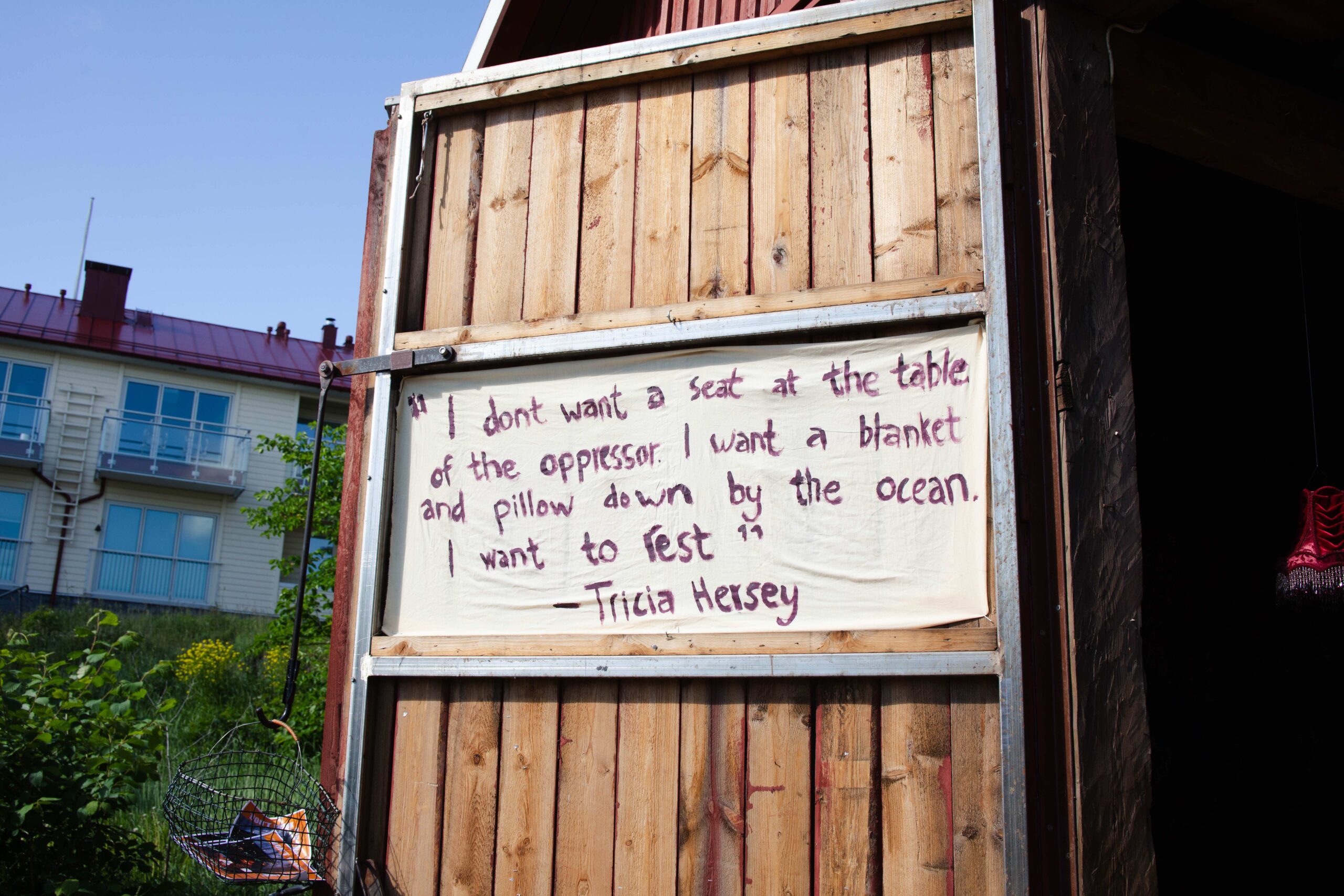
Last and not least, the topic of rest and nurture framed my work ethics. Challenging my capitalistic method of producing art that I’m used to. Inspired by the project black powernaps founded by artists Navild Acosta and Sosa, which tackles the so-called “sleep-gap” issue where statistics show that Black people in the United States are likely to get less sleep than their white counterparts: “How can we dream if we don’t sleep?” If we can experience art and create art when rested/resting, how would you do it? What would you do? Therefore, I invite my guests to also rest during and after their stay.
In this piece, joy is also an important part of rest. To find a space where you can, for a moment, leave burdens behind. A space where you can embrace joy, connect with people, and find joy in movement and sensory elements.

An encouragement

I encourage not to make these topics and this space a temporary alternative, but a part of longer strategies in our art institutions. I want to emphasize that through my work I do not wish to find any answers, nor search for any “correct” ways to work with intersectionality within art. Through this process I hope to find a variety of tools for myself and for other BIPOC artists.

This space welcomes all <3. However, this piece is created through a BIPOC experience. Let’s all take collective responsibility and give space to the marginalized group this piece celebrates. Please ensure that they get to participate in the installation.

Pay attention to how your actions can affect our space with these guidelines:

  • Assume responsibility for your own actions and be mindful of what you ask or comment, regardless of your good intentions. This space’s priority is to give the participants a break from the racism in our daily lives and give space for rest.
  • Actively create an atmosphere where safety and wellbeing are priorities. Get to know the focus and theme of the installation and aim to approach the space with those in mind.
  • Be aware of your own privileges.
  • Respect everyone’s physical and emotional space, listen to others and adapt your behavior if someone indicates that your behavior or words make them feel uncomfortable.
  • Respect and don’t make assumptions about other people’s sexuality, gender, body, nationality, ethnicity, religion, values, socio-economic background, ability, or health. Respect pronouns and names.
  • Respect people’s opinions, beliefs, conditions, and points of view.
  • All forms of harassment, including verbal and non-verbal, are prohibited. Don’t mock, ridicule, disparage, sideline, or humiliate anyone with your words, behavior, or actions.
  • No racism, homophobia, transphobia, ableism, or fatphobia.
  • Intervene if you witness any offensive or harassing behavior. There are two harassment liaison contacts present at all times in the space whom you can talk to if something should occur. Ask the person who was harassed whether they would like help or support.
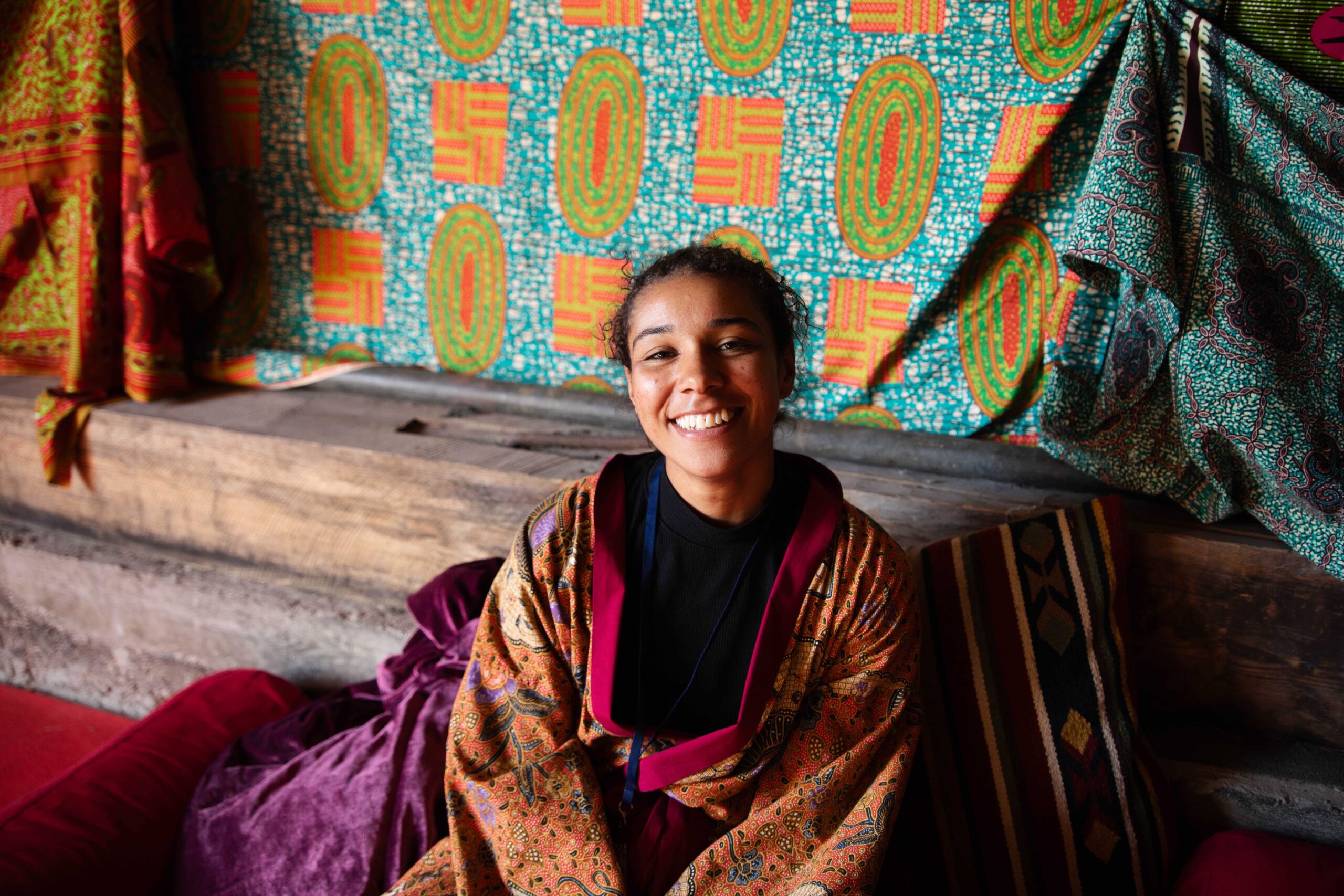
Photo: Emma Reijonen