Thinking about Audience

A Village is not a Village without a Café

“Der Wirt ist sein bester Kunde”, is a humorous German saying meaning that the bar owner is his own best customer.

It is not enough that I know how important contemporary dance and performing arts in general are, and what impact performances can have on people. The basic questions many working in the field today have: how do we deliver this message to a potential audience? Who is this unknown audience we have not reached yet, or that disappeared from theatres, and where can they be found?

Closely connected to this stands the question: are we, the performing arts professionals, our own best customers? And if so, is this really problematic?

I am writing from the perspective of someone curating an annually international festival in a European context. We think that we have built a strong audience over time. We are working in collaboration with theatres, cultural centres, museums and other venues and we are as much as possible spreading over the whole city area. Working across neighbourhoods is not just a logistical choice but a principal: to bring the festival closer to where people live, to meet them on familiar ground.

We know that our audience consists of students and performing art professionals, but we also know that we have reached the so called “normal” audience or “wider crowd”–consisting of art lovers and each year first timers. And still, there is always uncertainty. Will they come back? Do we really know who makes up our audience–and who does not?

When traveling and seeing works in other countries, I see full and partly empty houses, festivals packed with professionals as best spectators, but also festivals and theatres filled up with “normal” audience. I hear conversations about the audience that disappeared after the pandemia, gradually went down already before, never came back, reserves tickets way later than before, buys tickets and does not show up, about audience outreach and engagement programs. But I also hear about theatres and festivals that have a very faithful crowd filling the seats.

So why do we speak again so much about “audience”, the wider crowd that is not from our field? One answer is obvious. Lived experience is difficult to quantify; numbers are not. Cultural institutions today operate under constant pressure to translate their work into numbers–ticket sales, attendance figures, demographic reach. And since most public arts institutions in Europe receive public funding, the question inevitably arises: who is this art for? Who benefits from it–especially in societies that are becoming increasingly diverse while states gradually retreat from social responsibility?

Contemporary dance festivals and venues are seeking so much more actively for spectators, also because people today have endless entertainment options: streaming platforms, gaming, social media, and so on. Performing arts venues have no other choice than to actively make the case for why live performance actually matters.
Contemporary societies have become more culturally plural and socially conscious. Many people do not see themselves reflected anymore in traditional repertoires or the proposed narratives. The traditional performing arts audience that still does, is aging and shrinking. If organisations rely on these long-standing audiences, they face a slow decline.

Engaging younger people, culturally diverse communities and first-time attendees actively, forces institutions to rethink–to connect the performing arts to the realities of contemporary life–to not become completely marginal.

But there is something else I have been reflecting on: arriving in Helsinki in 2020 and beginning my work with Moving in November, I repeatedly heard–especially from older generations of performing arts professionals–that the audiences attending festivals such as Moving in November consist mostly of people from within our own professional circle. This persistent and recurring claim is something I frequently question when I see our venues filling up with both familiar and unfamiliar faces, and when I read our audience surveys.

I can, of course, trace where this way of thinking comes from. Contemporary dance has traditionally been a marginalized art form, and in many countries, it is still chronically underfunded in comparison to contemporary theatre and even more so in relation to classical theatre and dance. However, it seems neither smart nor supportive when members of our own inner circle repeat this claim. Such statement can easily be read as implying that contemporary dance is not relevant or accessible to people who are not already informed–an idea I firmly oppose. I see it as our responsibility to build bridges and create access—and I strongly believe that how we invite people in shapes whether they feel addressed, welcomed, and included.

The question for me, then, is not whether there is an audience, but how we build bridges and extend invitations that truly open our venues and welcome a diverse audience, as many people as possible into the festival experience? What strategies make such invitations to be meaningful and lasting? Questions that continue to guide my work, since I began working with Moving in November and started rethinking the festival–its programming and its relationship to spectators.

Audiences and spectators matter: who they are, the backgrounds they come from, how they found their way to us. It matters with whom we share theatres and with whom we form a temporary community during the festival.

This is why hosting is fundamental to our approach at Moving in November. For us, hosting is not merely a logistical role but a practice–one that actively cultivates personal and social connections within the festival context. It means reimagining the host-guest relations as a dynamic exchange between artists, audiences, and us organizers. Hosting becomes a conscious stance: how we welcome people and how we communicate.

One of my main interests and strategies for addressing a potentially diverse audience has been to continuously ask: whose stories are told on stage, by whom and for whom? Closely connected to this is the question of what bodies are shown on stage. How can I create references and present role models in the festival that, for example, might support teenagers who experience racism in a school context?
The way I curate the programme and develop the festival’s conversational formats grows directly out of these questions: they continue to guide my curatorial practice.

Speaking out invitations, to be in conversation, is prominent everywhere in the festival. It is an essential part and visible in all formats we create, but also in the way I communicate to our audience via our newsletters for example. I try to speak out invitations that make clear that audiences are important to us and that I genuinely look forward to experiencing the festival together with them. This approach challenges the traditional hierarchy between curator and audience. I am not interested in presenting a programme from a distance and then observing how it is received. But I am eager to experience the programme and festival together with the audience and my colleagues–as everyone else, for the very first time. When making the programme, I imagine it as a whole. Seeing all works alongside each other live, is for me also a first time and an experience. Each year I enter the festival alongside the audience, with curiosity and at the same time with the thought, that something might not work out as I have imagined it.

The essence of a festival lies in the notion of the ‘festive’, the act of ‘coming together’ to share an experience. That is also why we emphasize the festival’s social aspect.

To develop this aspect of the festival, to foster conversation and to invite in, I deliberately chose to treat each evening as a premier–recognizing that, for some spectators, it might be their first evening attending the festival. We erased the classical “premiere drink” for a few invited guests from the festival and replaced it with the After-Soup addressing everyone in the audience. We have deliberately chosen soup as a gesture, to also acknowledge that serving alcohol is not always inviting for everyone.
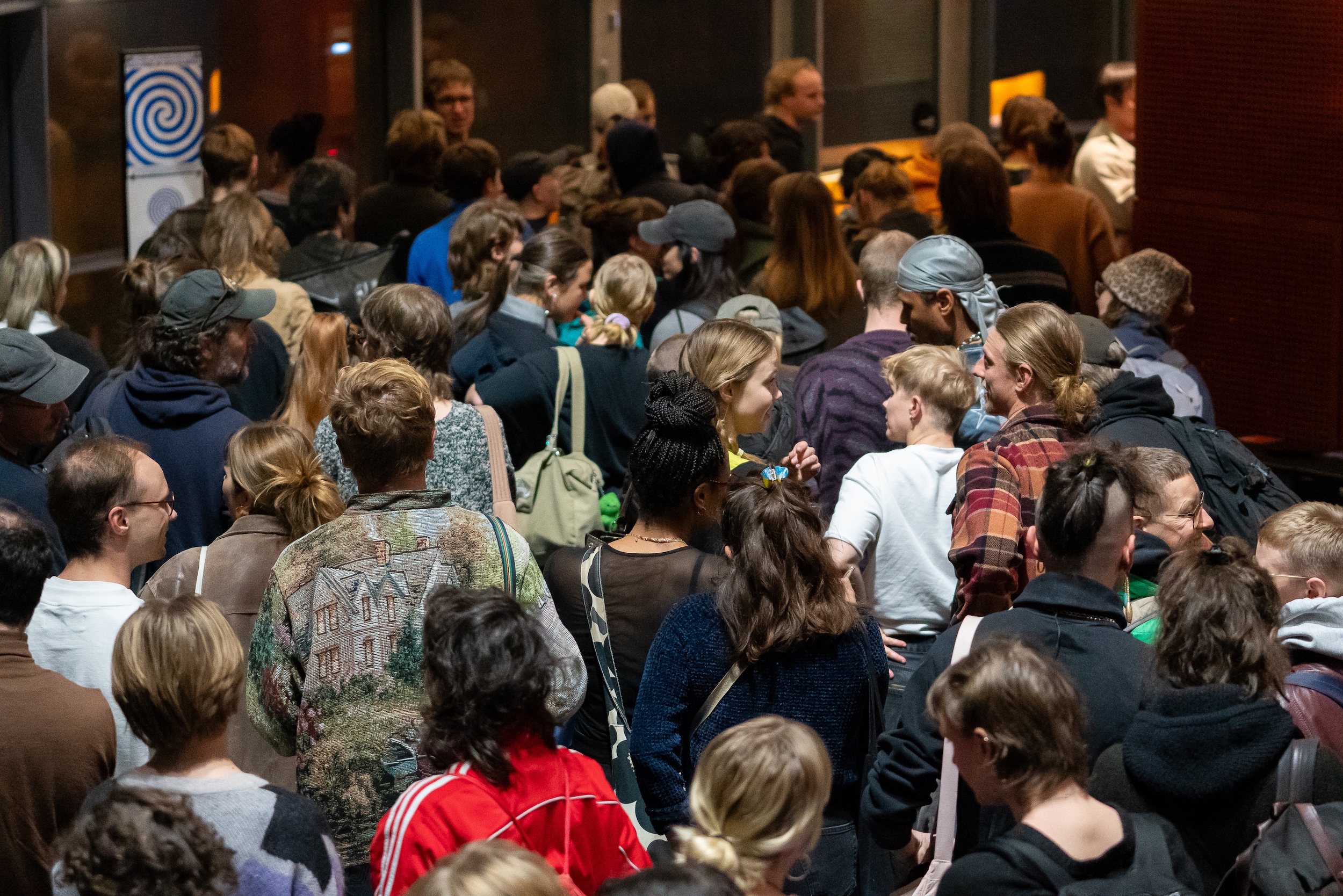
So, after each performance, we serve soup to everyone who wants, extending an open invitation to stay, to not rush home. The soup sets the ground for people to come together, maybe start a conversation, exchange thoughts, and engage in a dialogue. At first, people were surprised–sometimes even sceptical (and some still are)–about this invitation to stay and share a soup. But over time, it has become an integral part of the festival. Spectators now anticipate it, incorporate it into their plans, and discuss the different soups as vividly as the performances.

One of our main formats are the discursive Soup Talks, a series of informal conversations with the artists presenting their work in the festival. Each Soup Talk is hosted by an artist or dramaturg from the local scene, who chooses, based on their artistic interest, with whom they would like to converse. These talks take place each day during the festival at midday for 1.5 hours. Soup is offered for everyone. One can join into the conversations or just eat soup and listen in.

At each Soup Talk, I see the impact this space can have: how much people value hearing artists share their thoughts, how meaningful the conversations are, and how inspired they feel. The discussions often continue afterwards in the foyer. The invited artists highlight how much they value the informal format of the Soup Talks–the opportunity to speak profoundly about their work over 1.5 hours, hosted by a local artist on an eye-to-eye level. I think that this non-hierarchical setting, the extended timeframe, combined with the simple act of eating together, creates a different ground for a conversation.

I would like to also come back to our strategy to span the festival over several neighbourhoods in Helsinki. As we do not have an own venue, collaboration is at the core of how we operate. Rather than simply renting spaces, we aim to build close, long-term relationships with the venues we work with. We bring our audience to our partner venues, and the venues highlight the festival to their own audiences as well–a mutual exchange that requires time, trust, and commitment.

Expanding the festival into different neighbourhoods is also a way of reflecting on who has access to art and cultural institutions. By bringing the programme to areas that lack theatres, we aim to diversify our audience and lower the threshold for participation. Even though November in Finland is cold, we intentionally include outdoor, site-specific works–often free of charge. By being present and visible in public space, we hope to reach people who might not feel comfortable entering a theatre, trusting that curiosity can be sparked simply by encountering a performance unexpectedly.

Between 2020 and 2022, we collaborated with choreographers Jared Gradinger and Angela Schubot on the The Hut, a project developed within a two-year working residency as part of Moving in November. In summer 2022, first parts of a wooden hut—including its fundament (earth and seeds), parts of its walls, and an old piano—was installed in front of one of our main partner venues, leaving it there until November and making the structure part of the neighbourhood’s everyday life. Throughout the summer and autumn flowers flourished inside. When The Hut was finalised in late October and performances began during the festival, several local residents shared how they had interacted with the hut and the piano over the summer. The project became a living example of how sustained presence in public space can foster connection, curiosity, and a sense of shared ownership long before a performance formally begins.

There is an outreach format that I encountered in Paris, that draw my attention and that I think could be also adapted to performing arts. The format has been running in parallel to Festival d’Automne for many years. Each year, it engages several schools, children and teens of almost all ages, with regular exhibitions presented as part of the festival. During the festival, the school classes visit the exhibitions together with a mediator, who approaches each visit by letting the children/teens tell what they see.
After the visit, they work with their teachers on re-creating or re-enacting the experienced exhibition–this can take various forms (handcrafted, performed, storytelling). In a second step, they transmit what they have seen and worked on to another school and class, normally of different age. The teachers love this program and so do the youngsters and their parents. What I find interesting about this format, is the given agency, the profound work on the seen exhibition and the transmission to others. In my opinion this creates a proximity to the seen art and lowers the barrier to experience also complex art works. At the same time, it plays with the imagination and creativity of the youngsters.

I strongly believe in fostering interest in art and culture through formats that engage people in a personal and inviting way and create a sensibility for art by involving and including. As a hopeless optimist I also deeply believe in the seeds we plant through these projects and in the impact they have and that can ripple outward.

I would like to point at another important aspect regarding addressing a diverse audience. A well thought ticket price policy that acknowledges class and income discrepancies can also be key. At Moving in November, we offer affordable tickets, as well as a festival pass. With the pass one can see almost everything in the festival for a low prize.

I understand the pressure nowadays to generate income from ticket sales, also as  publicly funded performing arts institutions. But I do not believe in raising ticket prices to astronomical hights, nor copying marketing strategies from venues that organise commercial events and sell one-time experiences. I would argue that this is not the best way to build a stable and committed audience that is eager to discover and follow several events in a festival. In my opinion, people pay high ticket prizes for known names, foreseeable experiences, for must-see and I-need-to-be-seen events, but not to discover and engage with the unknown, nor with communities one does not already know. To make people commit to a festival or a venue one needs careful mediation, a personal and welcoming invitation, a coherent programme and affordable ticket prizes that allow people to discover.

I would like to jump back to the beginning of this essay and challenge the bar metaphor with: “A village is not a village without a café. Where too would you invite a friend or a stranger to have a coffee and a conversation”. A phrase from a movie that makes me think about our contemporary world. Places to gather and meet are declining in western societies. We live in increasingly impersonal societies, that come with an enhancement of polarization and solitude. Where are people brought together nowadays that don’t necessarily know each other? Where can people connect to one another, talk, discuss and be recognised and seen, outside of a friends-and-family context? Where can people reflect and think together?

Maybe this is why the question of audience feels so urgent again. Not because we need better marketing, but because we need more cafés, more soups, more places to gather and linger. More reasons not to leave immediately after the lights go up.

Kerstin Schroth, 12.02.2026

Originally written for Dance Magazine nr. 8/2026, published by Brain Store Project and Nomad Dance – Bulgaria, in the frame of Life Long Burning – Futures Lost and Found, funded by the Creative Europe program of the EU.
Photo: Petri Summanen
Whose Battle Are We Fighting? Moving in November in the Face of Funding Cuts

One week ago, we learned that the Finnish state cut its funding for this year’s Moving in November by 10% — yes, this year, for the festival already in the making. At the same time, our multiannual grant was not renewed. No explanation, no dialogue, just a decision that landed without warning.

For an organisation that is already fragile, this creates a hole we cannot ignore — and an even greater insecurity about the future. This is more than a setback: not renewing the multiannual grant destabilises the foundations that allow us to plan, collaborate internationally, and bring the festival to life each year. The 10% cut means, very concretely, fewer international works in this year’s program. A program meant to celebrate Moving in November’s 40th anniversary, yet instead of a gift or recognition, we receive a funding cut from the Finnish state. It also means letting down artists we have already engaged with and a fairly big amount of added administrative and curatorial work.

These cuts expose a deeper structural failure. In Finland sustainability and stability in the cultural sector are not guaranteed. We are constantly expected to work with speculation, even though everyone knows that you cannot curate an international festival by starting the work in April. These conversations begin about a year earlier. Development requires time, stability and continuity, not sudden withdrawal.

Since 2020, Moving in November has grown substantially with the support and in open dialogue with Kone Foundation, the city of Helsinki and, the state (previously Taike, currently Kuvi). The development work we were doing has been appreciated and recognized, and our need for structural stability for that acknowledged. Yet, while the city has maintained its transparent dialogue and timely grant processes – with preliminary operational grant decisions already in December for the following year, giving us at least some predictability for the upcoming festival – the state’s once vibrant dialogue with us has fallen silent.

Moving in November is not a private endeavour.

The festival is not a fun dance party for close friends. It is a professional contemporary dance festival — connected internationally, rooted locally, and carried by a diverse and loyal audience who eagerly wait for the program release and the start of ticket sales each year. It is a public cultural service. We host an average of 3500 visitors each year. We offer cultural education, artistic experiences, and a meeting place for people from Helsinki, from Finland, and from abroad. We create work opportunities for around 85 artists and people working in the field each year, foster international exchange, and contribute to Helsinki as a vibrant cultural destination.

This is not something that can be brought to life in a couple of months. It requires continuous development work and years of strategic thinking, as well as building a network of trust and dialogue among partner institutions, colleagues, artists and companies. It also demands ongoing audience outreach and engagement. But this is only possible when Moving in November has the resources to develop its work continuously. When the promise of continuity and stability in funding disappears, we are forced to start from scratch again every year.

Looking at The Cultural Policy Report from the Finnish Government, which outlines the long-term objectives and action plan until 2040s, four objectives are stated:

  1. Culture is a driving force for change.
  2. Cultural practitioners and content play a key role.
  3. Culture is everyone’s right.
  4. Cultural field drives global impact.

If we understand this correctly and take these four points literally, the state sees culture and the work of artists as essential for societal development and progress. Culture is not just seen as entertainment or heritage, but as something that can influence society. Supporting art and artistic projects can inspire new ideas, strengthen communities, and shape public discourse. Accessibility and inclusivity are also highlighted: everyone, regardless of background should have the opportunity to engage with culture and participate in artistic activities. And lastly, the state aims to share Finland’s culture internationally, making it influential beyond its borders.

After reading this, the funding cuts we are currently facing—and the existential crisis and instability they create—become even harder to comprehend, especially as we lose the multiannual support we have relied on for the past three years. Structural funding from the state has a fundamental impact on Moving in November’s operational and curatorial practices. There will be a major clash between our attempts to continue developing sustainable encounters in and through art – for the artists we present, the local performing arts field, and our audiences – and the lack of stable funding. We do value-based work that has shaped how the festival is perceived and welcomed within the contemporary dance-ecosystem in Helsinki and across Europe, and the current cuts stand in contradiction to the very objectives outlined in the government’s cultural strategy.

Is this really a battle we must fight alone? How can a state that recognizes the importance of art and culture fail to sustain a festival like Moving in November and not look actively after and support the structural stability of a healthy ecosystem of cultural organizations that coexist, nourish and complement one another with different roles, approaches, and responsibilities, that are ultimately in service of a diverse modern, contemporary society with very different needs and tastes?

Whose battle are we fighting?

Because this isn’t only our struggle.

It concerns every audience member who attends Moving in November.

Every artist who creates.

Every organisation and institution that are part of and cares about the cultural ecosystem of Finland and in Europe.

And ultimately, it concerns the city and country that decide what kind of cultural future they want to stand for.


Kerstin Schroth & Isabel González


Photo/graphic design: Jaakko Pietiläinen

OPEN CALL Life Long Burning – Artistic Exchange Residency in Montpellier, France – application deadline: 01.02.2026

In the frame of the EU project Life Long BurningMoving in November in Helsinki and Agora Cité Internationale de la Danse in Montpellier are offering a residency for an individual professional artist or a small team (max. 3 persons) from the field of choreography and dance, based in Finland. The residency is ideal for small projects or a research period. Application deadline is 1st of February, 2026!

What’s the offer?

  • 2 weeks residency for 1-3 persons
  • Accommodation for 1-3 persons in an apartment
  • A production fee of 4.000€ (including fee, travel costs and per diems)
  • 3 technical shifts (12 hours for the set up or technical support, depending on your needs)

Agora Cité Internationale de la Danse offers a studio for the residency period, 1st to 16th of October, 2026. Possibility of end-of-residency presentation.

How to apply?

Please send your bio and a brief motivation letter (max. 1 A4 page) in English, describing what you would like to work on and how you envision the residency, as well as how your stay in Montpellier would help to develop your project. Send your application to: 

Applicants must be available during the whole duration of the mentioned period.

Who we are

Moving in November is a contemporary dance festival organised yearly in the Helsinki area. The festival is an invitation to come together. To experience artistic works from the local scene and abroad. Artists voicing their critical thinking, their visions, their experiences, their dreams, opening small windows to the world we are living in. www.movinginnovember.fi

Agora Cité Internationale de la Danse is the only Choreographic Centre in the newly established region Occitanie/Pyrénées-Méditerranée – there are 19 Choreographic Centres in France. They are the cross-roads between a wide-reaching artistic movement and a cultural policy for spatial planning, between the French government and local authorities.
Since autumn 2025, CCN Occitanie and the Festival Montpellier Danse are merged to form Agora – Cité Internationale de la Danse.

We are looking forward to your applications and wishing you a lovely end of the year!

Your Moving in November team

Photo © Agora – Denise Oliver

Ravel at Moving in November 2025

Ravel, an online publication for choreographic reviews, took part in this year’s Moving in November. In collaboration, three artists were invited to write alongside one or more works, or to trace relations across the festival – and so emerged the collection of four beautiful texts: Chen Amor Nadler’s reflections upon her festival experience, Kaarne Fredriksson’s review of Cherish Menzo’s FRANK, and Ella Skoikka’s reviews of MANUAL by Adam Kinner & Christopher Willes and Ordinary Matters by Heli Keskikallio. Find the reviews here.

Ravel is an online publication for choreographic reviews initiated by artist Amalia Kasakove.

Ravel has sprung from a wish to gather within the field of dance and choreography around writing next to and with works, as ways of accompanying them and their makers. The project reflects on the fixity offered by traditions of (e)valuation in review writing. And in turn considers it an artistic, or choreographic, format in itself. Ravel traces, tails and inches closer to the processes of languaging that occur alongside dance. It dives into thinking what the gesture of writing with dance might convey or make present, and how the act of writing can extend the thinking that the work is already doing.

The word “ravel” is a contronym, meaning it always holds two opposing definitions: to knit together or to unknit, to entangle or untangle, to unravel, involve, puzzle out, confuse, complicate, cluster, and knot. This can be seen as a starting point for Ravel, a platform that accompanies, follows, thinks through, and engages with a work and/or its process. The publication is an ode to how we are alongside and with choreographic work.

The choreographic reviews, or reviews on choreography, could take the form of letters, poems, recipes, fan fiction, short stories, scores, fantasy, fables, footnotes, epilogues, essays, toasts, maps, voice memos and beyond!

For now, Ravel invites three people from the field of dance and choreography to respond to a specific work and/or its processes. The aim is that the curatorial process will take multitudes of shapes and forms, include others, mobilize questions, fluctuate and continuously position processes of co-thinking. This project hopes to continually attach and collaborate with various venues, sites, festivals and events!

Ravel is initiated by Amalia Kasakove, a Helsinki based artist working in the gutter between choreography, textual practices and curatorial projects.

Ravel website

Thank you for the shared time!

11 days of festival is a wild ride – gathering so many people together in these times – creating spaces around performing arts to come together feels very special, crucial, important – like a large bowl of Soup with many ingredients that are added to create a whole festival.

Thank you for the shared time. Thank you for your overwhelming presence at this year’s Moving in November. Thank you for your precious feedback, your enthusiasm, your laughter, and all the vivid conversations.

It was a pleasure to see full theatres – you were so many to enjoy the performances, the workshops, the Soup Talks and the after-soups in the foyer – familiar faces, colleagues, friends and new visitors from close and far to the festival.

This year’s program presented again artist from abroad and from Helsinki. For now, a warm and big thank you to the artist and their lovely working groups, that presented their performances during this year’s festival! Namely: Michael Turinsky, Antonia Atarah, Julia Giertz & Marie Topp, Liisa Pentti +Co, Mean Time Between Failures: Dash Che & Suvi Tuominen & Oula Rytkönen, Sanna Kekäläinen & Kari Hukkila & Heli Keskikallio, Cherish Menzo, Lucía García Pullés, Adam Kinner & Christopher Willes, Rébecca Chaillon & Sandra Calderan, Elina Pirinen & Tom Rejström & Jenni Elina von Bagh, Alina Sakko & Reality Research Center, Ewa Dziarnowska, Emmi Max Pennanen & Sonjis Laine, Soa Ratsifandrihana, Karolina Kucia, Anna Kozonina, Bianca Hisse & Laura Cemin and also a warm thank you to the hosts of Soup Talks and participants in the Soup Talk Panel for the conversation: Riina Hannuksela, Ghyslaine Gau, Patricia Scalco, Janne Saarakkala, Vishnu Vardhani Rajan, Elias Girod, Tangmo Ladapha Sophonkunkit & Olga Spyropoulou, Lin Martikainen & Lätsä (Lauri Antti Mattila) and Esete Sutinen, Simo Kellokumpu, Benjamin Pholig, Eeva Muilu, Laura Linna, Maia Means, Martyna Grinevskė, Miklós Ambrózy, Torunn Helene Ronstad.

An equally warm and big thank you to our partner venues for the collaboration and thinking along and to our funders for their important support!

We feel enriched by all the memories and encounters, and we hope they will carry you through the coming winter as well!

Kerstin Schroth & the Moving in November team

We greatly appreciate you taking the time to answer our visitor survey. It’s quick and easy, taking only a few minutes of your time. Among those who participate, we will raffle A Book of Dances by Anne Naukkarinen and other surprises!

Answer the survey here.

P.S. Having a hard time that Moving in November is over? Here you can read the interviews with all invited artists and allow the festival after-glow to linger!

Michael TurinskyWork Body

Antonia Atarah: Don’t thank fort the food

Julia Giertz & Marie Topp: Maze

Liisa Pentti +Co: Mabel Revival

Mean Time Between Failures: DOWN BEAT

Sanna Kekäläinen, Kari Hukkila & Heli Keskikallio (guest): Conversations with Ants evening

Cherish Menzo: FRANK

Lucía García Pullés: Mother Tongue

Adam Kinner & Christopher Willes: MANUAL

Rébecca Chaillon & Sandra Calderan: La Gouineraie

Elina Pirinen, Tom Rejström & Jenni-Elina von Bagh: Quattro Stagioni

Alina Sakko: Excercise on empathy [a score for performing a human]

Ewa Dziarnowska: This resting, patience

Emmi Max Pennanen & Sonjis Laine: Sketch evenings

Soa Ratsifandrihana: Fampitaha, fampita, fampitàna

Karolina Kucia: We’s and Us’s

Anna Kozonina: Audience Club

Bianca Hisse & Laura Cemin: Their Eyes Will Sear Holes In The Night Sky

Photo © Kerstin Schroth // from Work Body by Michael Turinsky

Move with us into the last weekend of the festival

Dear festival audience,

We are moving into the last festival weekend, and feeling very excited for what is still to come! Full Saturday and Sunday are ahead of us, filled with beautiful performances that not only take over but also propose to us various, multifaceted spaces for coming together. Additionally, there are of course the final Soup Talks.

Here’s a little overview of the coming weekend:

Saturday November 15th

MANUAL by Adam Kinner & Christopher Willes
10:00-16:00 Stoa, Itäkeskus Library

Soup Talk with Ewa Dziarnowska
12:00 Goethe-Institut Finnland

Quattro Stagioni by Elina Pirinen, Tom Rejström & Jenni-Elina von Bagh
14:00 Brage

This resting, patience by Ewa Dziarnowska
16:00 Stoa

Exercise on empathy [a score for performing a human] by Alina Sakko
19:00 Stoa

Fampitaha, fampita, fampitàna by Soa Ratsifandrihana
20:00 Stoa

Sunday November 16th

We’s and Us’s by Karolina Kucia
10:00 & 14:00 Kiasma Theatre

Soup Talk with Soa Ratsifandrihana
11:00 Eskus

Soup Talk: Focus on the Local Landscape
13:00 Eskus

Fampitaha, fampita, fampitàna by Soa Ratsifandrihana
17:00 Stoa

Quattro Stagioni by Elina Pirinen, Tom Rejström & Jenni-Elina von Bagh
19:30 Brage

In case of sold out performances, we warmly remind that you can come to the door to see if there are any cancellations – only exception is MANUAL, for which all individual spots are now fully booked.

We are looking forward to seeing you this weekend!

With warmest regards,
Your Moving in November team

Photo © Harilay Rabenjamina

Experience MANUAL – a unique one-on-one performance in the heart of Itäkeskus Library

MANUAL, created by Canadian artists Adam Kinner and Christopher Willes, is a one-on-one performance that turns a public library into a space of sensory encounter and heightened awareness. Intermingling with the daily life of the library, the performance reflects on the act of listening and the intimacy of reading with another person in a public space.

As part of Moving in November, MANUAL takes place in Itäkeskus Library during 12.-15.11.2025.

Reserve your slot now and make sure you get to experience this unique, one-of-a-kind work.

Tickets 10 €

Read more about MANUAL here, and read the conversation between Adam Kinner & Christopher Willes and Kerstin Schroth here.

Please note: Each performance experience is approximately 45 minutes long. You will receive further information after booking your ticket.

With warmest regards,
Your Moving in November team

Photo © Manuel Vason

Conversation between Anna Kozonina and Kerstin Schroth about Audience Club

Now that the Audience Club enters the second year, I am curious what has shifted in your perspective since the project first began?

Since the beginning of the project, Audience Club has been held five times, with the current edition at Moving in November being the sixth. Much has changed in how I understand the project.

First of all, I have come to recognise its limitations, and at the same time the opportunities that arise within them. At the very beginning, the formats of interventions into festivals and ways of working with their audiences were still unclear to me. But the deeper I dug into the infrastructures, production realities, and working styles of different festivals, the more precise the role of my project became. I have decided to concentrate on the Audience Club as its central format, developing it across Nordic festivals in a sustainable way rather than relying on one-off “pop-up” versions as I initially imagined. So far, the project has taken place at STHLM DANS in Sweden, Moving in November in Finland, and CODA in Norway – with the intention to extend towards Denmark and Iceland in the future. Within this format, my aim is to make the Club resonate with each festival’s long-term audience development goals, while preserving its value as an “outside eye” – sometimes a critical one.

The Audience Club has become a space for discussion, learning, and mediation. We see shows together, reflect through the lens of art and dance theories, create our own dramaturgies, and, most importantly, search for ways to articulate emotions and ideas around the curatorial proposal as a whole. These then connect to broader, more “universal” topics such as our values, expectations and societal needs. Together with the festival curators, we share a conviction that theatre remains one of the rare social places where people can step out of their media bubbles and echo chambers, encountering other lifestyles and perspectives. Yet the existing social protocols around performances rarely allow true conversation to happen. Audience Club provides a safe but bold space where such conversations are possible.

At the same time, we have noticed that the Club tends to operate as “a festival within a festival,” with its group dynamics not always visible to those outside. This has led us to seek ways of connecting its activities more directly with the general public. At the latest edition of STHLM DANS in May, for example, we began posting collective reviews on social media, sharing how performances resonated in the group and what kinds of discussions they provoked, and we are developing this approach in this year’s Moving in November edition. Since one of the Club’s main intentions is to trace the processes, tensions, and even conflicts that performances spark in a collective dynamic, these reviews not only increase visibility but also leave behind a record of “productive disturbances.” They also provide an alternative to the single-expert review model, offering instead the voice of a group resonance.

So far, the groups have been culturally diverse, allowing the Club to work as a kind of social thermometer, revealing how performances resonate within a broader societal fabric. Looking forward, we are exploring ways for the Club to become more immersed in the social life of festivals – with participants engaging in artist talks, meeting festival teams, and connecting with other visitors, and this will be more present in the current Moving in November edition.

Another, more technical, comment would be that the format has proven itself to be recognisable (it has begun to shape its own identity and atmosphere), while remaining flexible enough to host various viewpoints. It has also become my personal laboratory for testing different mediation tools, prompts, conversational structures, games, and tasks—elements that I am confident will be of value to performing arts organisations interested in mediation, once published as a methodological brochure.

A year has passed, since I last asked you the same question: how do you currently situate your artistic work within the Finnish performing arts landscape? Has something changed?

I think the main incentive has stayed the same. As I told you last year, Audience Club is a mediation project that grows out of a desperate need for discussion, communication, and translation – both within professional communities (in Finland as well as in other Nordic countries) and between the art field and wider audiences who don’t necessarily belong to “art bubbles.” It also stems from the conviction that theatre remains a vital “third place,” where local social dynamics can be revealed through the audience’s reflection on what is on stage—provided that the venue’s or festival’s working style allows for a genuine meeting between the artistic work and its audience. Wherever I work, I am interested in this process!

But while the project was born in Finland and remains rooted here, its scope is expanding into a cross-Nordic dimension. With three countries – Finland, Sweden, and Norway – already involved, Audience Club is beginning to form a regional ecology of its own.

This expansion brings both questions and consequences:

  • How can the Club preserve sensitivity to local contexts while expanding into a transnational format? And how can I, as a mediator entering new environments, refine the discussion tools that would allow both locals and local expats to engage authentically in our conversations?
  • What does it mean for audience work when discussions begin to circulate across borders?
  • Can a project that started as a local mediation tool grow into a network of collective reflection, contributing to how we understand audiences, communities, and values across the region?

I believe these questions will guide the next steps, as the project continues to negotiate its position between the local and the transnational, the intimate and the structural.

Photo: Vera Kavaleuskaya

Conversation between Karolina Kucia and Kerstin Schroth about We’s and Us’s

Could you tell us about the background and starting point of your project?

I have always wondered what an event is. What happens? What do we see happening. What else happens? How does it happen? As a performance artist I have always doubted whether it actually is possibly to provoke or ‘create’ an event? An actual event, I think is not made. But perhaps art and performance art can be a place of collective processing of an event, or a preparation for it.

There are two themes and life forms, I am fascinated with and that are also a subject in this project: parasites and monsters, or more particularly: parasitic relations and monstrous narratives as that is what parasites and monsters engage with. By that I mean the ability to create and inhabit deep interdependencies and to negotiate terms that coexist regardless of considerable differences, in size and dimension, or even in a form of communication. Parasites and monsters share an imaginative form of survival, an ability to redefine, or even abandon a sense of self and an ability to shift power asymmetry in a complex and paradigmatic way. When I talk about monstrous I talk about embracing all what human is not, I mean those who are discarded from the human logic and yet on which humanity defines itself. The stories we tell to gain power over others.

It took me a while to arrive to these terms. I do not particularly like them, but I believe they carry an answer to certain particular intersections of economic, social and political questions that we cannot reach from a only human perspective. It is a layer of sub-, super- and non-humanity, which is casted away and which could possibly hold answers. For me they hide in actual strategies, protocols, and methods which are employed by those accused as parasitic or monstrous. When you have a closer look they become actually something quite different. This could provide a ground for conversations that aren’t easy, nor smooth, or clean, but I believe that these are the conversations to have right now. Hence I propose a training session or a ridicament . What is that? Ridicament is a made-up word, a mixture of ridiculousness and predicament, for a made-up situation that holds elements of a performance, a gathering and a training, and perhaps the potentiality for an event. In other words, with: “We’s and Us’s” I propose to form tactics and strategies for collective organization.

How do you situate your artistic work within the Finnish performing arts landscape? 

I am Polish. It is not a particularly attractive but tolerated form of foreign-hood in this country. I am born in 1978, which means being born in an economic structure that doesn’t exist anymore. This combined with everyone having some projection over what that life might have been, me included, and the return of the far right sentiments riding on the back of the old anti-communist sentiments not only in my home country, but also around the world, has shaped me without much of my choice. So, I embrace the foreign-hood, the communist past with its uneasiness, and that is how I situate myself. Then, being a performance artist with the background in visual arts, working in the intersections with live art, performance studies and artistic research, all that together in times of austerity politics spreading over the entire public sector, it is another level of uneasiness.

For over 10 years I have been active in groups advocating for art workers working conditions, pointing out the paradoxes of this profession: to make a living, looking for solutions to face the demands of labour and market. As artist I have worked against the myth of the ‘artist-genius’ but also against the stereotype of the ‘starving artist’, actively trying to understand the form of artistic production and logic of capital both historically and right now. I have been collaborating with economists and scholars, artists and art workers in many collective endeavours. Questioning together the immateriality of labour, digital capitalism and organisation. I have been working on the fringe of experimental art/activism/and ‘something from completely different’. I was part of Robin Hood Minor Asset Management (the counter-investment cooperative of precariat), Future Art Base, Economic Arts – the research department at Aalto University, Night Schoolers – a self-organised study curriculum on artist labour conditions and Arts Against Cuts, to mention just a few. And it has been too much, too demanding to work out the form of expression between discourses of art, political theory and economy, between issues of precarity and neo-liberalisation of art institutions, decolonial practice and new materialist feminism – collectively. I got lost in the collective dynamics, other people’s visions, and the extent of the question.

I have found for myself these concepts and methods of parasites and monsters as a two-headed strategy to tackle the multi-headed, the shapeshifting problematics I have been invested in and I partially withdrew from. For a few years, I have been working on a doctorate to work more systematically on the articulation and a method. We’s and Us’s is sharing some of the results of that work. It is also my love letter to all those I have been working with, to our grand plans and troubles we couldn’t solve… and to everyone else who ever failed working collectively . It is surely weird to formulate a love letter in parasitic and monstrous terms. But there is a life in it.


Karolina Kucia: We’s and Us’s

Kiasma Theatre 16.11.2025 10.00 & 14.00


Concept, form and facilitation: Karolina Kucia

In collaboration with: Kiasma Theatre, The Performing Arts Research Centre Tutke and Uniarts Helsinki

Photo: Janina Witkowski (still frame from the film We Bites Us)


Film credits We Bites Us (2023):

Script and direction: Karolina Kucia

Producer: Danai Anagnostou

Cast: Vishnu Vardhani Rajan, Esete Sutinen, Oo Condit, Roxana Sadvokassova, Fjolla Hoxha, Marié Grace Iradukunda

Editor: Smaro Papaevangelou

Cinematographer: Janina Witkowski

Sound designer: Lou Strömberg

Composers: Elvin Brandhi, L T Leif, Robyn Anne Dawson, Air Max ‘97

Intimacy coordinator: Marit Östberg

Creative technologists: Gregoire Rousseau, Angelina Barbonelova, Alain Ryckelynck

Animation: MASCISTA

Makeup artist: Siham Sheikh

Costume designer: Marié Grace Iradukunda

Set designers: Maria Mastola, Karolina Kucia

Supported by: Kone Foundation, Finnish Cultural Foundation, Saastamoinen Foundation, The Promotion Centre for Audiovisual Culture (AVEK), Omron Electronics Oy, Performing Arts Research Centre – TUTKE, Kenno Film Osk