A Village is not a Village without a Café
“Der Wirt ist sein bester Kunde”, is a humorous German saying meaning that the bar owner is his own best customer.
It is not enough that I know how important contemporary dance and performing arts in general are, and what impact performances can have on people. The basic questions many working in the field today have: how do we deliver this message to a potential audience? Who is this unknown audience we have not reached yet, or that disappeared from theatres, and where can they be found?
Closely connected to this stands the question: are we, the performing arts professionals, our own best customers? And if so, is this really problematic?
I am writing from the perspective of someone curating an annually international festival in a European context. We think that we have built a strong audience over time. We are working in collaboration with theatres, cultural centres, museums and other venues and we are as much as possible spreading over the whole city area. Working across neighbourhoods is not just a logistical choice but a principal: to bring the festival closer to where people live, to meet them on familiar ground.
We know that our audience consists of students and performing art professionals, but we also know that we have reached the so called “normal” audience or “wider crowd”–consisting of art lovers and each year first timers. And still, there is always uncertainty. Will they come back? Do we really know who makes up our audience–and who does not?
When traveling and seeing works in other countries, I see full and partly empty houses, festivals packed with professionals as best spectators, but also festivals and theatres filled up with “normal” audience. I hear conversations about the audience that disappeared after the pandemia, gradually went down already before, never came back, reserves tickets way later than before, buys tickets and does not show up, about audience outreach and engagement programs. But I also hear about theatres and festivals that have a very faithful crowd filling the seats.
So why do we speak again so much about “audience”, the wider crowd that is not from our field? One answer is obvious. Lived experience is difficult to quantify; numbers are not. Cultural institutions today operate under constant pressure to translate their work into numbers–ticket sales, attendance figures, demographic reach. And since most public arts institutions in Europe receive public funding, the question inevitably arises: who is this art for? Who benefits from it–especially in societies that are becoming increasingly diverse while states gradually retreat from social responsibility?
Contemporary dance festivals and venues are seeking so much more actively for spectators, also because people today have endless entertainment options: streaming platforms, gaming, social media, and so on. Performing arts venues have no other choice than to actively make the case for why live performance actually matters.
Contemporary societies have become more culturally plural and socially conscious. Many people do not see themselves reflected anymore in traditional repertoires or the proposed narratives. The traditional performing arts audience that still does, is aging and shrinking. If organisations rely on these long-standing audiences, they face a slow decline.
Engaging younger people, culturally diverse communities and first-time attendees actively, forces institutions to rethink–to connect the performing arts to the realities of contemporary life–to not become completely marginal.
But there is something else I have been reflecting on: arriving in Helsinki in 2020 and beginning my work with Moving in November, I repeatedly heard–especially from older generations of performing arts professionals–that the audiences attending festivals such as Moving in November consist mostly of people from within our own professional circle. This persistent and recurring claim is something I frequently question when I see our venues filling up with both familiar and unfamiliar faces, and when I read our audience surveys.
I can, of course, trace where this way of thinking comes from. Contemporary dance has traditionally been a marginalized art form, and in many countries, it is still chronically underfunded in comparison to contemporary theatre and even more so in relation to classical theatre and dance. However, it seems neither smart nor supportive when members of our own inner circle repeat this claim. Such statement can easily be read as implying that contemporary dance is not relevant or accessible to people who are not already informed–an idea I firmly oppose. I see it as our responsibility to build bridges and create access—and I strongly believe that how we invite people in shapes whether they feel addressed, welcomed, and included.
The question for me, then, is not whether there is an audience, but how we build bridges and extend invitations that truly open our venues and welcome a diverse audience, as many people as possible into the festival experience? What strategies make such invitations to be meaningful and lasting? Questions that continue to guide my work, since I began working with Moving in November and started rethinking the festival–its programming and its relationship to spectators.
Audiences and spectators matter: who they are, the backgrounds they come from, how they found their way to us. It matters with whom we share theatres and with whom we form a temporary community during the festival.
This is why hosting is fundamental to our approach at Moving in November. For us, hosting is not merely a logistical role but a practice–one that actively cultivates personal and social connections within the festival context. It means reimagining the host-guest relations as a dynamic exchange between artists, audiences, and us organizers. Hosting becomes a conscious stance: how we welcome people and how we communicate.
One of my main interests and strategies for addressing a potentially diverse audience has been to continuously ask: whose stories are told on stage, by whom and for whom? Closely connected to this is the question of what bodies are shown on stage. How can I create references and present role models in the festival that, for example, might support teenagers who experience racism in a school context?
The way I curate the programme and develop the festival’s conversational formats grows directly out of these questions: they continue to guide my curatorial practice.
Speaking out invitations, to be in conversation, is prominent everywhere in the festival. It is an essential part and visible in all formats we create, but also in the way I communicate to our audience via our newsletters for example. I try to speak out invitations that make clear that audiences are important to us and that I genuinely look forward to experiencing the festival together with them. This approach challenges the traditional hierarchy between curator and audience. I am not interested in presenting a programme from a distance and then observing how it is received. But I am eager to experience the programme and festival together with the audience and my colleagues–as everyone else, for the very first time. When making the programme, I imagine it as a whole. Seeing all works alongside each other live, is for me also a first time and an experience. Each year I enter the festival alongside the audience, with curiosity and at the same time with the thought, that something might not work out as I have imagined it.
The essence of a festival lies in the notion of the ‘festive’, the act of ‘coming together’ to share an experience. That is also why we emphasize the festival’s social aspect.
To develop this aspect of the festival, to foster conversation and to invite in, I deliberately chose to treat each evening as a premier–recognizing that, for some spectators, it might be their first evening attending the festival. We erased the classical “premiere drink” for a few invited guests from the festival and replaced it with the After-Soup addressing everyone in the audience. We have deliberately chosen soup as a gesture, to also acknowledge that serving alcohol is not always inviting for everyone.
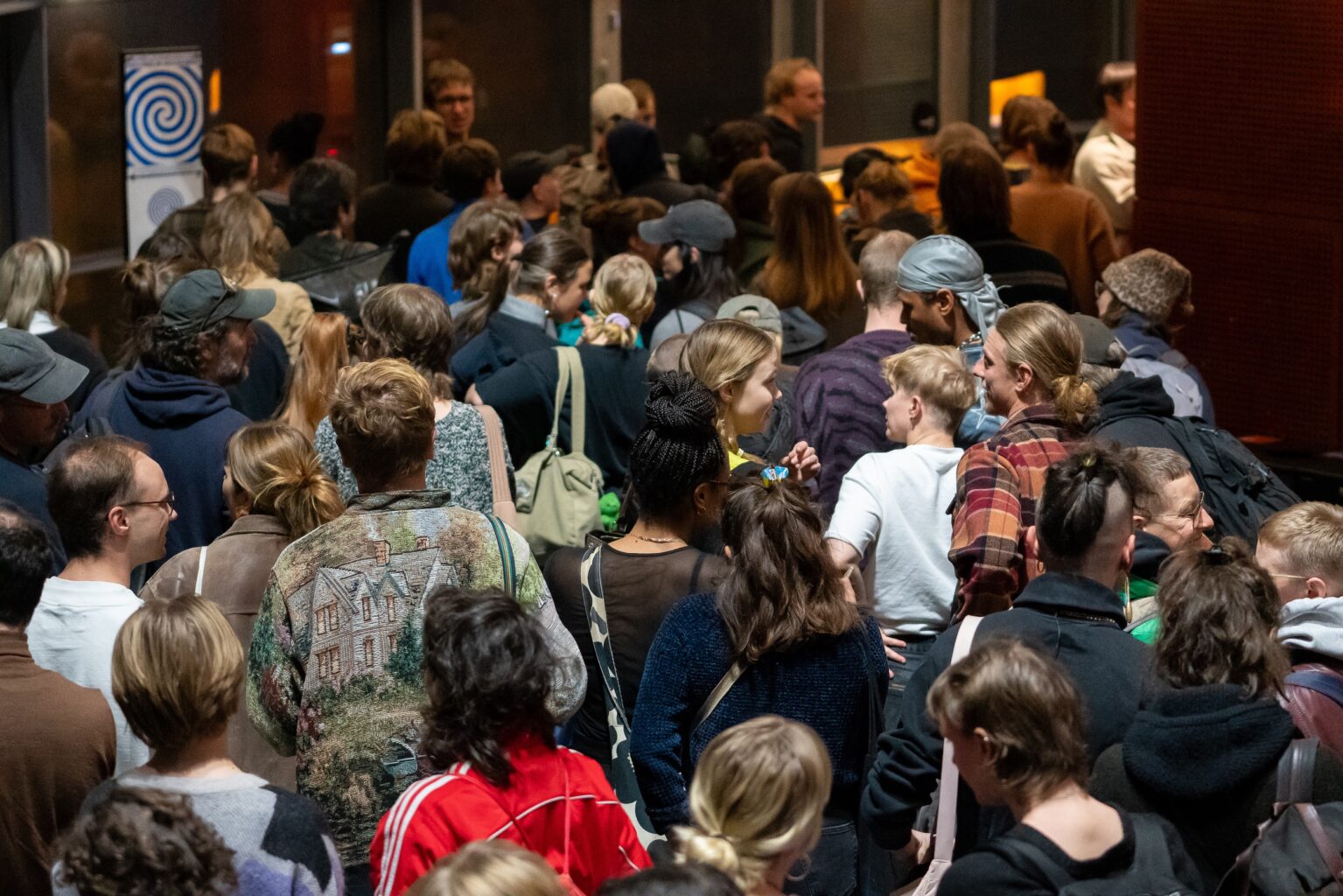
So, after each performance, we serve soup to everyone who wants, extending an open invitation to stay, to not rush home. The soup sets the ground for people to come together, maybe start a conversation, exchange thoughts, and engage in a dialogue. At first, people were surprised–sometimes even sceptical (and some still are)–about this invitation to stay and share a soup. But over time, it has become an integral part of the festival. Spectators now anticipate it, incorporate it into their plans, and discuss the different soups as vividly as the performances.
One of our main formats are the discursive Soup Talks, a series of informal conversations with the artists presenting their work in the festival. Each Soup Talk is hosted by an artist or dramaturg from the local scene, who chooses, based on their artistic interest, with whom they would like to converse. These talks take place each day during the festival at midday for 1.5 hours. Soup is offered for everyone. One can join into the conversations or just eat soup and listen in.
At each Soup Talk, I see the impact this space can have: how much people value hearing artists share their thoughts, how meaningful the conversations are, and how inspired they feel. The discussions often continue afterwards in the foyer. The invited artists highlight how much they value the informal format of the Soup Talks–the opportunity to speak profoundly about their work over 1.5 hours, hosted by a local artist on an eye-to-eye level. I think that this non-hierarchical setting, the extended timeframe, combined with the simple act of eating together, creates a different ground for a conversation.
I would like to also come back to our strategy to span the festival over several neighbourhoods in Helsinki. As we do not have an own venue, collaboration is at the core of how we operate. Rather than simply renting spaces, we aim to build close, long-term relationships with the venues we work with. We bring our audience to our partner venues, and the venues highlight the festival to their own audiences as well–a mutual exchange that requires time, trust, and commitment.
Expanding the festival into different neighbourhoods is also a way of reflecting on who has access to art and cultural institutions. By bringing the programme to areas that lack theatres, we aim to diversify our audience and lower the threshold for participation. Even though November in Finland is cold, we intentionally include outdoor, site-specific works–often free of charge. By being present and visible in public space, we hope to reach people who might not feel comfortable entering a theatre, trusting that curiosity can be sparked simply by encountering a performance unexpectedly.
Between 2020 and 2022, we collaborated with choreographers Jared Gradinger and Angela Schubot on the The Hut, a project developed within a two-year working residency as part of Moving in November. In summer 2022, first parts of a wooden hut—including its fundament (earth and seeds), parts of its walls, and an old piano—was installed in front of one of our main partner venues, leaving it there until November and making the structure part of the neighbourhood’s everyday life. Throughout the summer and autumn flowers flourished inside. When The Hut was finalised in late October and performances began during the festival, several local residents shared how they had interacted with the hut and the piano over the summer. The project became a living example of how sustained presence in public space can foster connection, curiosity, and a sense of shared ownership long before a performance formally begins.
There is an outreach format that I encountered in Paris, that draw my attention and that I think could be also adapted to performing arts. The format has been running in parallel to Festival d’Automne for many years. Each year, it engages several schools, children and teens of almost all ages, with regular exhibitions presented as part of the festival. During the festival, the school classes visit the exhibitions together with a mediator, who approaches each visit by letting the children/teens tell what they see.
After the visit, they work with their teachers on re-creating or re-enacting the experienced exhibition–this can take various forms (handcrafted, performed, storytelling). In a second step, they transmit what they have seen and worked on to another school and class, normally of different age. The teachers love this program and so do the youngsters and their parents. What I find interesting about this format, is the given agency, the profound work on the seen exhibition and the transmission to others. In my opinion this creates a proximity to the seen art and lowers the barrier to experience also complex art works. At the same time, it plays with the imagination and creativity of the youngsters.
I strongly believe in fostering interest in art and culture through formats that engage people in a personal and inviting way and create a sensibility for art by involving and including. As a hopeless optimist I also deeply believe in the seeds we plant through these projects and in the impact they have and that can ripple outward.
I would like to point at another important aspect regarding addressing a diverse audience. A well thought ticket price policy that acknowledges class and income discrepancies can also be key. At Moving in November, we offer affordable tickets, as well as a festival pass. With the pass one can see almost everything in the festival for a low prize.
I understand the pressure nowadays to generate income from ticket sales, also as publicly funded performing arts institutions. But I do not believe in raising ticket prices to astronomical hights, nor copying marketing strategies from venues that organise commercial events and sell one-time experiences. I would argue that this is not the best way to build a stable and committed audience that is eager to discover and follow several events in a festival. In my opinion, people pay high ticket prizes for known names, foreseeable experiences, for must-see and I-need-to-be-seen events, but not to discover and engage with the unknown, nor with communities one does not already know. To make people commit to a festival or a venue one needs careful mediation, a personal and welcoming invitation, a coherent programme and affordable ticket prizes that allow people to discover.
I would like to jump back to the beginning of this essay and challenge the bar metaphor with: “A village is not a village without a café. Where too would you invite a friend or a stranger to have a coffee and a conversation”. A phrase from a movie that makes me think about our contemporary world. Places to gather and meet are declining in western societies. We live in increasingly impersonal societies, that come with an enhancement of polarization and solitude. Where are people brought together nowadays that don’t necessarily know each other? Where can people connect to one another, talk, discuss and be recognised and seen, outside of a friends-and-family context? Where can people reflect and think together?
Maybe this is why the question of audience feels so urgent again. Not because we need better marketing, but because we need more cafés, more soups, more places to gather and linger. More reasons not to leave immediately after the lights go up.
Kerstin Schroth, 12.02.2026