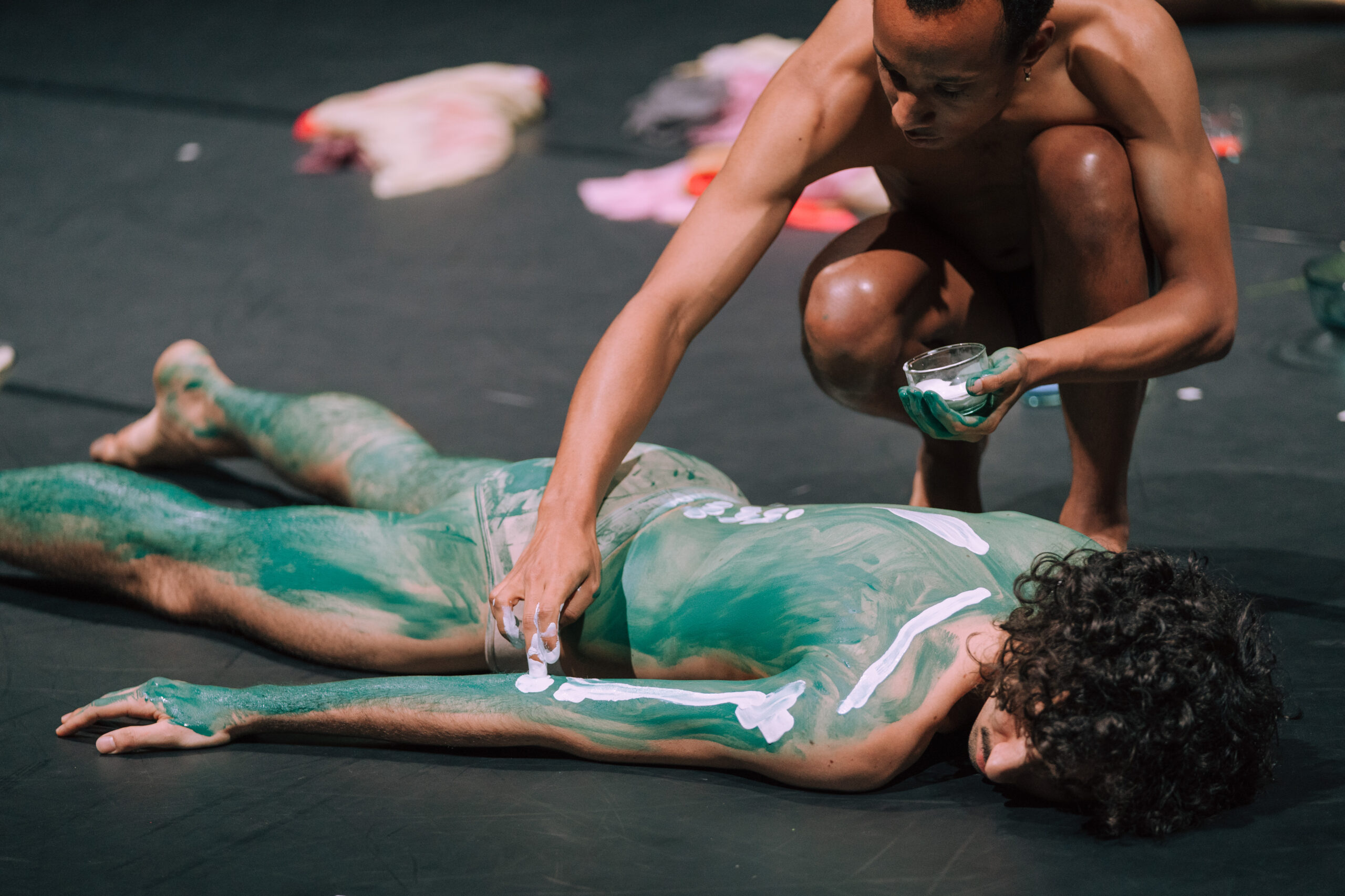
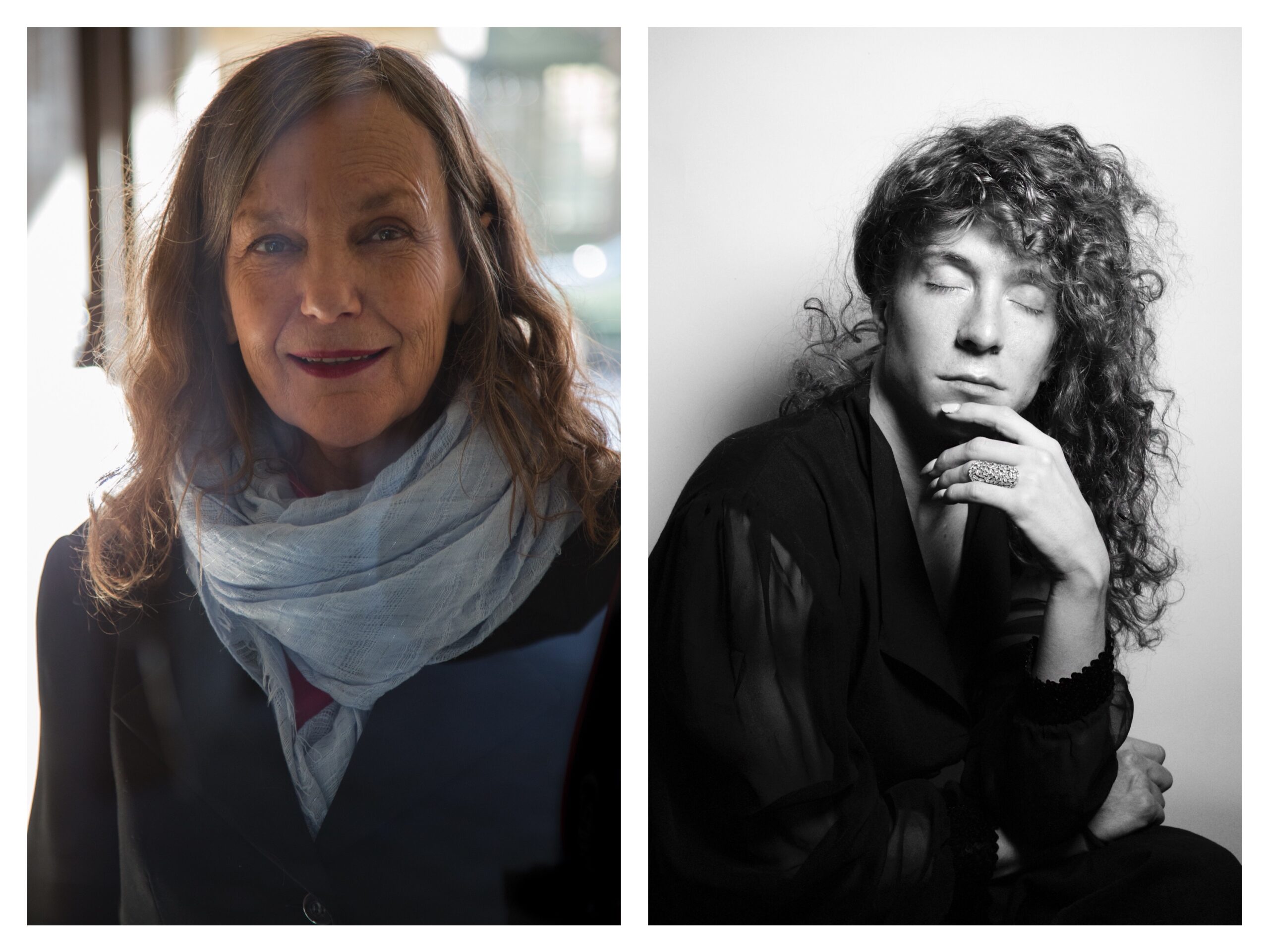
SOCIAL SOIL – the traces we leave

SOCIAL SOIL is produced from bio waste collected from the events of Moving in November in 2020 and June 2021. The main ingredients of the biomass are compostable soup cups, lids and fallen leaves. But also, biodegradable traces of the artist’s and team’s backstage catering, written notes from Soup Talks and rehearsals, evening programs and compostable props.

With SOCIAL SOIL and the continuous composting process artist Pie Kär examines together with Moving in November the traces we leave. Digesting the festival’s activities and thinking about a regenerative way of working.

You might have encountered the festival’s social choreographer Pie Kär and SOCIAL SOIL in one or the other of our venues during the festival this November. Maybe you had a conversation with Pie Kär or you got a bag of SOCIAL SOIL to take home and to nourish your plants.

We would like to give you more insights about this project and share the video made during Pie Kär’s process of composting (see below).

Collecting the festival’s traces has continued during this year’s edition. The compost will conclude into a work presented in November 2022 by artists Angela Schubot and Jared Gradinger.

Now we want to wish you happy holidays, see you in 2022!
Your Moving in November team

Conversation between Mikko Niemistö and Kerstin Schroth about Odd Meters

Your stream of dreams is entering the theater space through Odd Meters, could you reveal more about the initial idea and research for this piece?

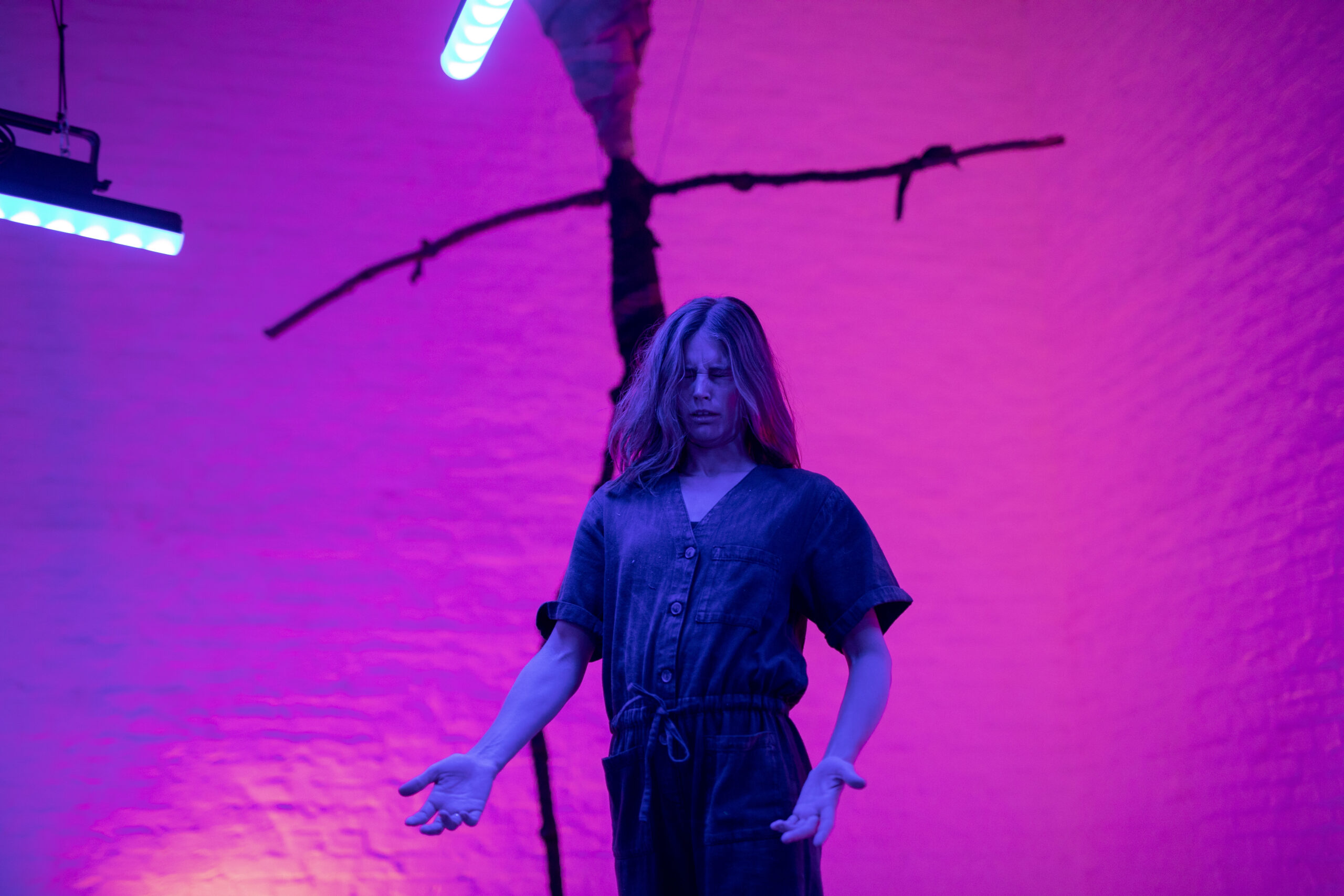
Dreams became a focus for me when I was interested in the throughout technologized western world that is getting increasingly detached from the day-night cycle of living and the nature. I was inspired by the book 24/7 –Late Capitalism and the Ends of Sleep by Jonathan Crary, in which he paints almost a dystopian picture of our contemporary society as a place where night and rest is seen as an unnecessary interference from production.

The topic itself felt hard to approach since I was never interested in making a statement. I instead wanted to approach the unnamed feelings and the background noise of a lifestyle that is powered by electricity and increasingly lacking true connection to human and non-human beings. I started recording my own dreams by having an alarm clock at 4 AM and then speaking whatever. I found a subjective approach to these thoughts. My dreams seemed to reflect a lot of my own daily fears and anxieties about the contemporary world, but they were also layered, containing my whole lived history. It was through often unexplained and illogical dream events and excerpts of my nightly recordings that I started mapping a landscape for the piece.

In the piece you are working from a non-linear understanding of time, would you like to tell more about this, about your notion of time?

When I engage in my physical practice, that frequently has to do with intuition and repetition, I often end up in ritualistic scores where the sense of time feels circular or gets occasionally stuck in loops. Also, while working with my dreams, I noticed their tendency to not constantly wander to new places but also to linger timelessly in the same situations and often return back in time to certain images and places, that are slightly altered from the original.

Since the process of Odd Meters started from my reflection on the high speed and growth centered contemporary life, that feels like a linear diagram of accomplishments, I wanted to situate the piece in a place where the concept of time is a mystery. Revealing itself differently in waking life, dreams and the nature.

Odd Meters is a physically very intense solo that you choreographed for yourself. Could you reveal more about the working process in the studio, finding the movement and working with this high intensity?

While the process focused heavily on the dream material, I wanted to bring the body forth as intensely present in the live event. Also, after spending a lot of time with fuzzy dreams recorded at four in the morning, I just felt the urge to move forcefully.

Animating the dreams, or staging them, never felt relevant, but most interesting for me was to bring side by side different corporeal states and landscapes. I was working a lot with and against rhythms to move through body memories and to enter controlled but semi-improvisational scores. Through this practice I started to approach the movement material that forms the foundation of Odd Meters. Also, exhaustion plays a big part since for me it is something that makes the body move from the inside towards the outside, provoking associations and revealing different bodies within the body.

A lot of the movement and physical work in the piece has grown from my method of ”staying with it”. I was stubborn in dwelling in the same material even though I sometimes wasn’t sure what it was about or grew momentarily tired of it. And even though in the piece the rhythm and ambience changes occasionally, it is as if throughout the whole performance there is something pulling me back towards the foundational and obsessive repetitions that started it.

Conversation between Mikko Niemistö and Kerstin Schroth about Astral Projections

You situate Astral Projections between dream and fiction. What is your understanding of dreams and fiction (and sleep)?

This thought came to me when I realized how the immersiveness of the entertainment I consumed through streaming services and gaming consoles was so pervasive that it started affecting the logic in which I dreamed during nighttime. The way in how today’s games and tv-series are based on getting the consumer so hooked in the worlds that they create, makes it possible to spend hours and hours engaged in these fictional universes, while the physical body is sitting or lying passively on a couch. For me it feels hard to relax without a digital device and it creates a strange paradox where one spends most of their waking life either working or taking it easy in front of a screen. As many people working in front of screens know, this also often causes insomnia.

It was a time of my life, I was almost addicted to digital entertainment in order to relax, among work and personal troubles, I started to keep a dream diary. I soon realized that versions of these game and tv-show characters were appearing in my sleep, entangled with ambiguous feelings and sensations often present in dreams. It felt as if my body was being abducted by fictional people and places that some other person had made up. Since I think dreams are some sort of subconscious reflection on what one experiences during the day, I couldn’t help to think how much our worldview has changed trough these digital realms that keep our eyes locked to the blue light.

The idea of body abduction, or other bodies being present in dreams, was one of our interests from which we started the process Astral Projections. While creating the movement material with Sanna Blennow, we were taking references from play-station games but also being strongly affected by the deeply personal material inhabiting our dreams. In the performance, we decided that we want to keep the fictional references as a backdrop, or something that might appear and reappear in the body rather than depicting them as such.

Could you tell more about your decision to work with the format of a performance-installation?

The work was originally made for Forum Box gallery, following the opening hours of an art exhibition. The process of documenting dreams was a long-term accumulation of inner material and was in itself proposing a temporality that wasn’t tied to a regular 45 min to 1-hour black box time frame. I was also interested in experimenting with different materials, lights and sound and creating with the space in mind. The movement material that came up from our experiments, was about slowly entering different states through meditative scores and it became clear quite fast that it called for duration. So, we wanted to put ourselves in the situation of really spending time at the gallery, letting our bodies go through long lasting and phased transformations. The first version of Astral Projections was an installation containing objects and sound where the space was activated for 2-3 hours each day by the performance. The version that we present in Moving in November is focused on the performance part, but still leaves an openness for the participants to experience the space and the bodies populating it at their own pace.

Astral Projections premiered shortly before the first lockdown in 2020. How was it for you to show the work in this moment and how is it for you to take it back now?

It was absurd. We opened Astral Projections at Forum Box gallery on Friday the 13th of March 2020. The exact date when the news broke about growing infections in Finland and everyone started realizing that the seriousness of the situation. The gallery was still full of people then but the remaining two performances before lockdown were really empty. People were too scared to go anywhere. It felt as if the whole world around us had shut down and we were just dancing by ourselves in an empty gallery. There was something comforting and therapeutic in it though, as if it was the last dance before the apocalypse or something.

To get back to it, feels like doing an old and a new piece at the same time, since the piece premiered a long time ago but never really finished the process of going through the performances and in a way growing through them. It feels like the 1,5 years in between happened in another reality and there’s a weird sense of nostalgia in doing the piece again. Maybe because the whole process of Astral Projections happened when we had no idea that a world changing pandemic is going to happen. At the same time, because of the unfortunate timing of its premiere, to our working group Astral Projectionswill probably for a long time be associated with the beginning of Covid-19.

Conversation between Boglárka Börcsök and Kerstin Schroth

Figuring Age is a performance, that has its origin in a documentary film you made with three exceptional women, who have been part of the early development of modern dance in Hungary. Could you tell more about your interest to work with these women and the research to this documentary?

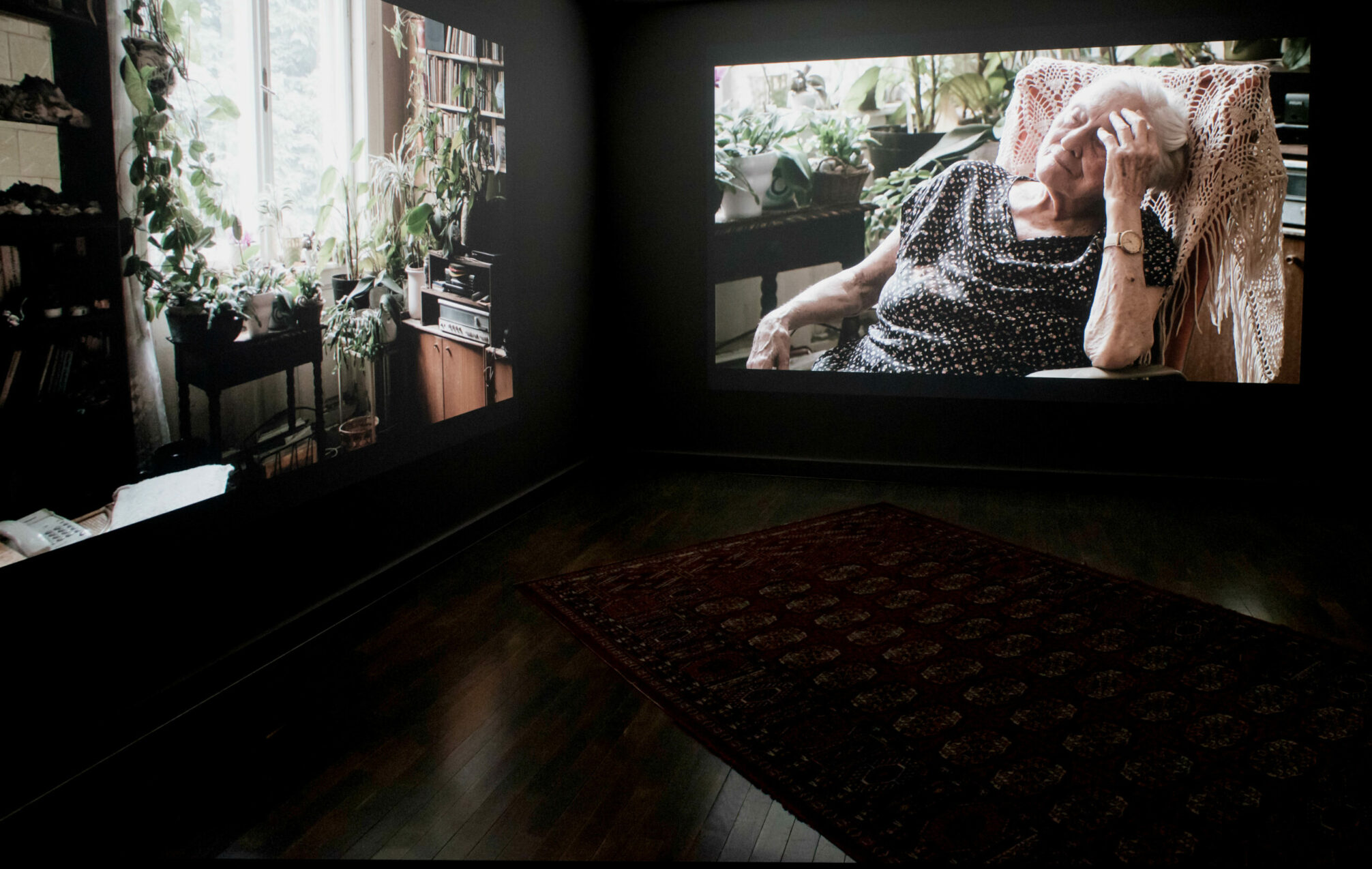
Figuring Age would not exist without the filmmaking process we went through beforehand. Which is wonderful because I’m inclined towards non-lineal ways of making performance. At first, it was not at all obvious for me to make a documentary, but due to the deadline and urgency of working with those elderly women, the process of filming became a necessary step. Irén, Éva and Ágnes were all above 90 years old when we started working with them in Budapest.

The initial research began in 2014, which was centered around questions like: how I situate myself as a young female dancer in the context of where I work in relation to where I come from. What kind of histories do I choose to interrogate and from whose perspective? I left Hungary when I was 18 to study dance in Austria and Belgium, and by then I’ve been living and working in Western Europe for years. During this research, I became aware of my complete lack of knowledge about Hungarian dance history, and I asked myself where does this gap come from and how can I address it artistically?

In the meantime, nursing my grandmother who was battling with Alzheimer made a lasting impression on me. I was confronted with her memory loss, the changes in her aging body, and eventually her death. When I met the elderly dancers, this experience supported me to enter into dialogue with them and build a close relationship.

From the beginning, I wanted to propose an inter-generational exchange as a way to address the silences, traumas and ruptures in the life trajectories of the dancers in relation to some of the main social and political transformations of the past century. I was fascinated by the physicality of the elderly dancers, but I was even more intrigued by how their experiences, their resilience, or their silences were inscribed in their bodies and movements.

Irén, Éva and Ágnes were once part of a heterogeneous movement, which was partly dance, but also gymnastics and a life-reform movement. All of them lived through several prohibitions: Before the war, as Jews, they were forbidden to perform on stage, while some of the modern dance schools were also banned because of their leftist views and links to the workers’ movement. After a brief period of revival at the end of the war, the entire modern dance movement was again banned by the socialist regime. It seems that the freedom of movement, of society and of women, is regarded as a threat by different political regimes and their ideological systems.

Engaging with the history of the three women, also became a way for us to deal with the current rise of nationalism within the post-socialist context. It has been challenging for me to try to understand, how people living in Hungary relate to communism/socialism today and to the period of the right-wing Horthy regime between the two world wars. Many people suppress the fascistic face of the Horthy era and regard it as the good old times. We asked ourselves how people’s sentiments towards those periods are navigated and instrumentalized by the populist discourse of the current government.

Would you like to speak about the transformation of your own body regarding the movements you start to inhabit by the embodiment of the three dancers on stage?

Figuring Age is about physical transmission of knowledge. During the filming process, I offered myself as a dance student to the elderly women and asked them to teach me choreographies and techniques that they learned or created themselves. Contemporary choreographers often address the question of transmitting such dance heritage via re-construction or re-enactment in order to be able to share this knowledge with future generations. In this work, we do not aim to reconstruct original choreographies, much rather I strive to embody the women themselves, very much in the age that we encountered them. Here lies the performative-political core of this work. The audience is confronted simultaneously with my young body and the physicality of the elderly dancers. The result is a fugitive body, a body that attempts to escape a rigid representation.

Let me describe some of the methods we developed for this performance. Firstly, we located each elderly woman in my body. This corporality is partly based on our personal memories of their physicality. For example, remembering the sensation of their weight while holding their hands and recreating their slowness from the experience of accompanying them through the apartment. But also witnessing their transformation when they began to teach or perform. And of course, we have been watching the filmed footages during the editing and subtitling process countless times. Gradually, the film-work itself became our choreographic score, a physical partition that enabled us to sculpt each of the women’s embodiment.

We meticulously recreated and enhanced their postures and gestures with the pull of gravity and heaviness. Listening to their distinct tonalities and rhythm, it was crucial to find the right speaking voice for each woman. Sustaining the sensation of old age during the performance, requires an immense physical effort. Finally, the work demands me to be present right there in the room, without letting go of the fiction for the whole time, otherwise it all just collapses into my biological age. So, if everything works out, the audience might feel that they’ve actually met three different women during the performance. A bit like encountering a ghost through the body of a medium. In our case, the séance is happening between the medium of film and performance.

When you look back at the encounters you had with these women, what stays for you, after having worked so long on the film and the performance, looking/observing them, their movements, listening to their stories and embodying them on stage?

Due to the long creation process, Andreas and I have been involved with Irén, Éva and Ágnes for many years. In consequence, our relations to them grew beyond just a concept or the project itself. Even though they have all already passed away at different phases of the working process, it happened to me only recently, that I’ve noticed they are actually gone now. Referring back to what stays for me: I’ve said a few times that I would like to do Figuring Age also when I get older, in 30 or even in 40 years’ time, so that the performance grows old with me and my body. I see it as a political act to take the histories of these women and carry them and their stories forward.

Conversation between Ofelia Jarl Ortega and Kerstin Schroth

StM is the latest piece in a series in which you examine the dramaturgy of the gaze as choreographic material. How was the idea to this piece and to the whole series born?

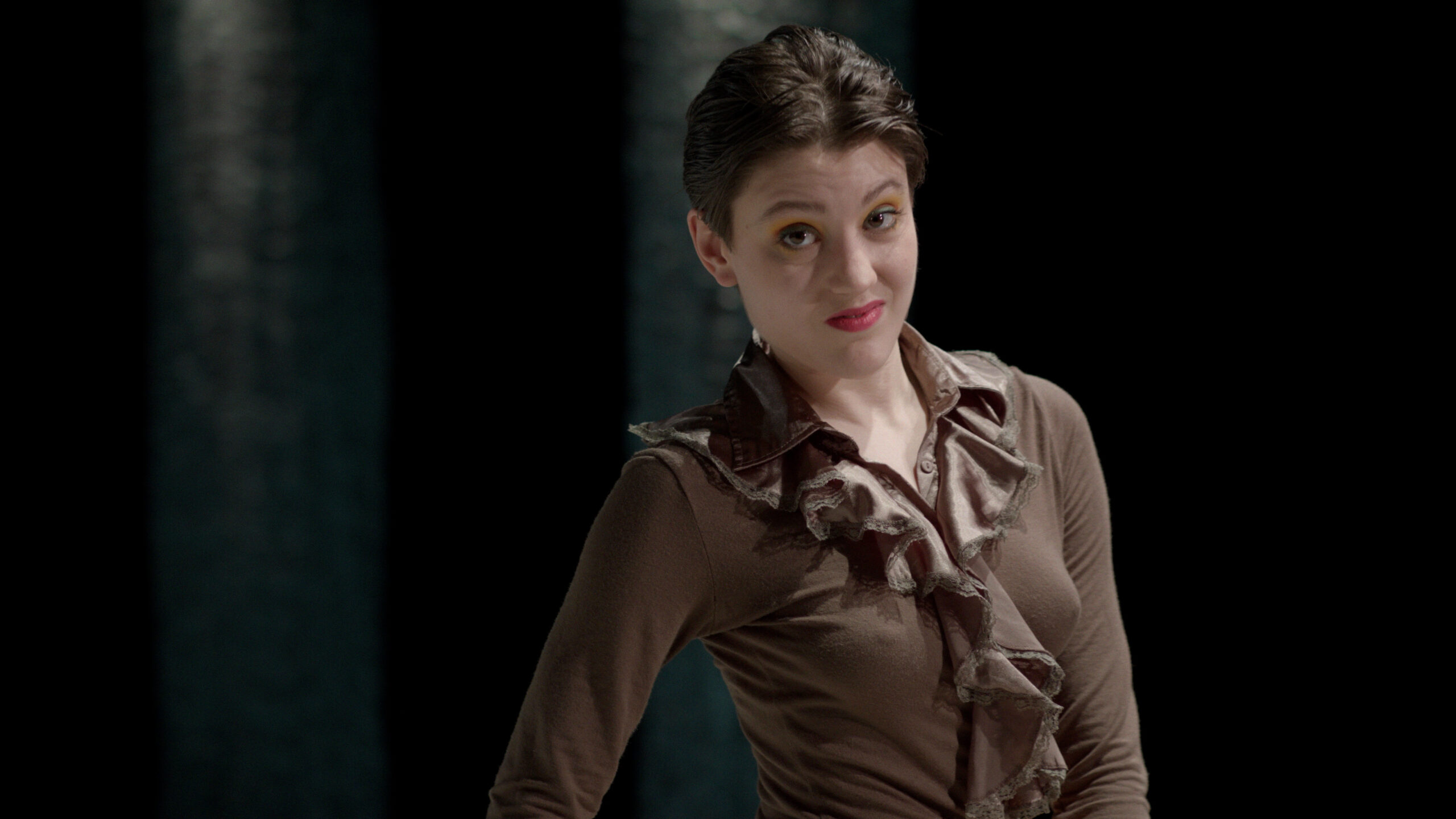
StM was the first solo I made in five years, in which I wanted to play more with performer being exposed to the audience. I was already working on the gaze as choreographic material, where the audience is both victim and perpetrator. In StM I wanted to see how I could manipulate the audience and let them manipulate me and the work, create an interactive piece where they could still be seated and not have to do anything but watch, which is quite a lot already…

I think first time I realized it was a series, was when I started to work on StM. I saw previous works appear and knowledge from previous research took shape again. I wasn’t done with some of those topics, the side material that didn’t fit in earlier works had matured.

You are creating your own music, or soundscape for your performances. Could you tell us more about this process and your interest?

Music has an important role in my work. It’s always made specifically for each piece, and if I haven’t made it myself, I’ve collaborated closely with a composer. For StM I knew I wanted to work with drums and saxophones. I found a great MIDI-orchestra, brass and woodwind instruments, and some basic 4/4 drumbeats that I composed. Music and choreography were then created in parallel, informing each other. The music helps bridging the gap between performer and audience, it has almost two voices that sometimes collide but are still in conversation. It’s also something that I can rely on throughout the performance, that’s slightly different depending on the interaction with the audience. I know every little part and detail of the music, which I as a performer can always play with and lean on.

You also made a short movie based on StM. How was it to exchange the spectator’s gaze with the one of the camera lenses? Not being able to work with the direct gaze of the spectator anymore, like in the live performance?

It was fantastic. I’ve always been a fan of film and have been inspired by classic films from the 50s and 60s: the close ups, narrative made from framing, suspense, postures and angles. I wanted to move the audience in the same way I try in my performances, despite it being pre-recorded and through a screen. In a way it’s scary since I don’t know how it’s received, in that sense it’s much more vulnerable. It’s perhaps the ultimate piece for masturbation, where the subject has become mute and cannot confront you. On the other hand, I can have perfect control over what I show, how I frame things, what I decide you to look at. New things were also possible. There’s a power play between me and the camera that becomes a one-sided communication between the film and the viewer. It made the play with assumptions stronger, where I ascribe identity on to the spectator, since I cannot know their experience and they cannot tell or show me.

Conversation between Maria Saivosalmi, Vytautas Puidokas and Kerstin Schroth

How was the idea for this project, that evolves around the topic of generational chains and the interest to work with amateurs born? Could you also reveal something about the research you did and the decision to work with film as medium?

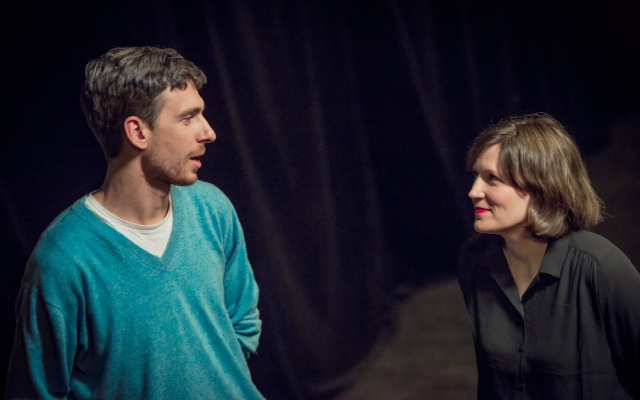
Maria: Year 2018, I was living in Vilnius with my family when I got the idea for this project. The polarization concerning the refugee situation in the world had been getting bigger and bigger. Related to this, I really wanted to create something that would show we all have the same needs for security, love, touch, and seal of approval. From this ancle, I got to thinking of families as a unit with whom to work with. What if to meet and work with families from different backgrounds. I had thought that this is a topic I won’t deal within my artistic work, maybe because it comes so close by me being a mother of four myself. That has felt somehow fare for me in the artistic discourse. But I’m happy I did, because this process was one of the most complex and disarming projects, I have been part of.

It was clear, that I don’t want to use stage as a medium for this project. Somehow film / video as medium was the first choice, I could see the work being executed in. It was also clear, that I want to work with a collaborator for who video is the main tool. I started to look for people in Vilnius and that’s how I invited Vytautas Puidokas to take part to the project.

In the beginning I imagined the work to be sort of a living painting where the emotions are stretched in time. From this initial idea we started to frame it together.

I have been working with amateurs in several contexts and with very different groups, for example seniors, torture survivors in Finland, no fixed abode organization and mostly with people from substance abuse rehabilitation etc. Mainly I have chosen to do this work in a very grassroot level, without heading towards outcomes unless the process has led to it naturally.

So, in this sense this work comes from a different angle of working for me. I needed the families for this idea of work to get complied. It was very important, that our proposal would make sense to the people, to keep it very transparent and two-way.

Vytautas: Video wise it was a very minimalistic work. Priority was always the movement, so we tried to adapt to it, sometimes deliberately avoiding cinematic language. We also chose black background, so the viewers gaze would be on the people, the movement, and the intimacy it creates. The frame of the video basically became our stage, that people would enter and go out from.

Could you tell us more about the encounters and conversations you had with the different families we see in the film? And tell who these families are, from which backgrounds they are coming?

Maria: During the first part of the project, we were meeting a lot of families and having discussions with them. Not all felt they wanted to participate, and some couldn’t take part in the end. For example, most of the families from the refugee center couldn’t take part to the actual outcome for their own security. I feel that this first part of the project was very important and had a lot of beautiful encounters of sharing and speaking about the topic of generational chains and what people are carrying with themselves. The working process for From Mother to Daughtermade me realize that in the future I would want to continue working like this. Taking really time for encounters to deepen, for things to happen.

Vytautas: We started visiting Rukla refugee center and I went to 40+ adult dances outside of Vilnius center. Also, my own family participated because we just had a small baby and it felt fascinating how it got all the family and different generations together.

In some ways, I could say that we were striving for some sort of dynamics. Every family would bring some unique element, be it a strong emotional bond, special circumstances that the family went through or even a talent that they share. On the other hand, I think the same could be done with any family, as in every case we try to dig deeper, and find the invisible bond that lies deep within any family.

Maria: During the talks we spoke about the family structures, generational chains, and family life in general. It wasn’t so easy to get to name the connecting links in each family. Many are connected to such everyday life, that it was difficult for people to grasp them. Habits that have always been in certain way.

And of course, with this project we got to deal with just some layers of each family, since families are such complex networks of individuals, several relationships that are crossing each other’s and so on. From the beginning it was clear, that we consider family as broad concept. Everyone defines themselves, what family is for them.

How was the working process with the families in the studio? How did you come to each of the families’ narrative, working with them on intimacies and closeness and how did you translate this together into movement?

Vytautas: I remember we first tried to arrange meetings at people’s houses, but somehow it didn’t work. We had to create distance, so the families could reflect themselves, and for this, meeting in the studio was way better. First meeting was always just to speak, see how the families feel together. During this phase, certain abstract keywords or ideas about what defines each family would pop up, and later we tried to convert this into movements.

Maria: Yes, we took some keywords from the discussions, and I started to imagine different kinds of movement proposals based on them. Then we started to try out/ to embody them in the studio with the families. Working in the studio was very intense and beautiful. Such a big trust was present, and all the families really surrendered to the movement tryouts.

About the narratives, for example for one family the connecting link was nature. They loved to spend time together in the nature and these were the things/ knowledge, that grandparents wanted to share with their children and grandchildren. We started the movement tryouts through this topic and little by little got into layers of closeness and intimacy, that lay inside/ around this topic.

Most important was to have conversations about: does these movement proposals represent your family and do they correspond with your feelings? Our aim was, that the family would watch the ready work and feel, that it is truly something that they could relate to. So, it was crucial to open the context and possible outcome during the tryouts.

After the project we interviewed some of the families and here is one answer: “The biggest benefit for me is probably the unique experience. An opportunity to contemplate about my family, to see it in different perspective… thus it was strange, almost some kind of ritual, to meet them all in movement, in art…”

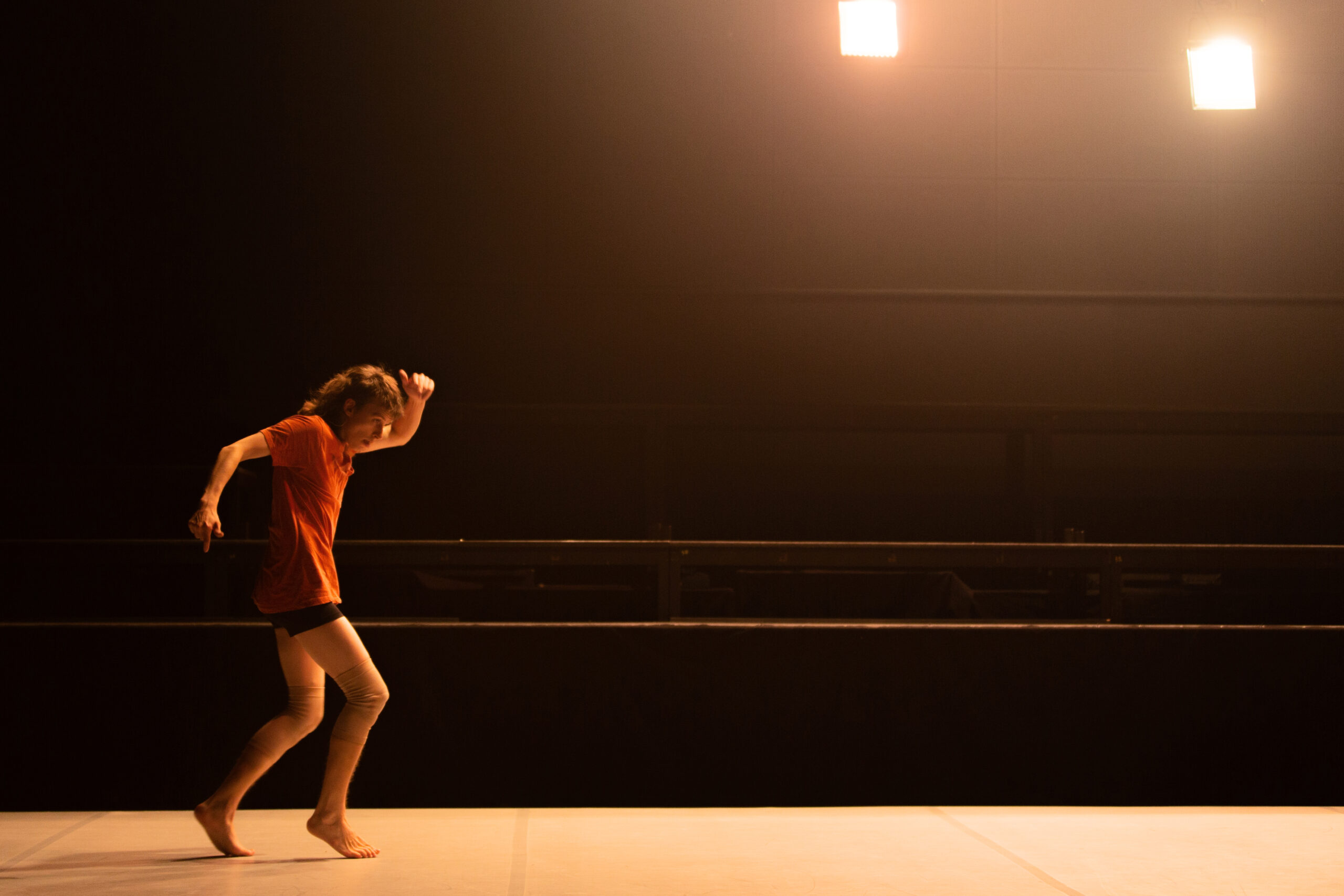
Conversation between Michiel Vandevelde and Kerstin Schroth

In your piece Dances of Death, you examine rituals and dances from different historical areas in relation to death. Could you tell about your starting point and the research for this piece?

Dances of Death departs from personal material. In 2019, my mother died of cancer. At one time she had the ambition to become a dancer, but that was thwarted by her parents. She had to study something ‘serious’. However, three short 16 mm films have survived. In the films, she is between 17 and 18 years old, during the glory days of her early dance career.

For a long time, I wanted to do something with this video material. That’s how the idea for Dances of Death came about. A dance performance that takes the motif of the ‘danse macabre’ or ‘dance of death’ as its starting point. Since the 14th century, this has been a motif that has been used again and again in the art of dance within European traditions. Dances of death have often been passed on in the form of paintings, drawings, narrative music, written sources and more recently, in the 20th century, through photographs and video.

The dancers learned the materials from the videos of my mother. And we choreographed those materials in a circle dance.

For the spatial structuring of the choreography, I was inspired by the two forms: the circle and the procession. The circle has a spiritual meaning of eternal movement, beginning and endings transform into each other continuously. In dance throughout centuries, this form has been continuously explored, from witch-dances in the Middle Ages to now. Also, the procession is a very common figure. It inspired the choreography in the last part of the piece, where possessed dancers are following up on each other, as if it were a procession of past narratives, figures, memories, trauma’s, persons that come into being.

Besides the dance materials inspired on the videos of my mother, we also looked through different sources throughout European dance history. These sources go from pagan European traditions to the modern and contemporary Euro-American dance tradition today. For the last part of the piece, the dancers mixed these sources with personal (physical) memories.

Also, for the costumes, masks, light and music I looked into past European traditions. The embroidery techniques in Christian garments for example, the emotional and therapeutic effects of colors in the lightning, the ghostlike textures of the garment, etc.

With Dances of Death, my aim was to create a journey through time to connect the past with the present in a contemporary staging. All this underlined by the question: how would a dance of death be danced today?

You invited a singer alongside with the dancers on stage. I am curious to hear more about this invitation and the working process you had together.

Kara Leva, the vocalist, entered the process in a later stage. My original plan was to work only with the voices of the dancers. But not all of them have an extensive singing experience, and I lacked the knowledge of creating something interesting out of their voices. So, after the first rehearsal period I dropped the idea, and we continued working with recorded sound. In fact, for quite a large part of the process I choreographed everything in relation the Eliane Radigue’s composition Trilogie de la Mort. But this more minimalist approach to the sound for the piece proved to be insufficient for me. As I worked with the history of the danse macabre, I also wanted to work with a European musical tradition in relation to death. While making another performance at Theater Neumarkt in Zürich, I met Kara, because she recorded something for the show. In our talk, I discovered that she has both experience with western contemporary music, and western folkloristic vocal traditions. That’s how the cooperation started, Kara joined the rehearsal, and we exchanged a lot of songs that have to do with death. Out of this long list we started to select songs that represent different European vocal/music traditions, and that’s how the final score came about. We go from Hildegard Von Bingen to John Dowland, from Italian Tarantella to the Greek Dance of Zalongo, from a completely altered composition of Morton Feldman to Henry Purcell, etc.

What is your relation and thinking towards rituals, both from the past, present and new ones we could invent as a society?

Working on Dances of Death was a way for me to connect to the spiritual again. As a teenager, spirituality in the form of religiosity made up a large part of my life, both in negative and positive ways. As a young adolescent I started to completely dismiss my relation to the spiritual.

Being confronted with some people dear to me that died, not only my mother, but also other people of a younger age, I started to reflect ways of sharing memories, of dealing collectively with emotions. In short, I started to be interested in the power of the spiritual again. This time one could say more from a critically informed position, and with a lot of carefulness.

Living and growing up in a West-European context, it was interesting to me to discover the European pagan traditions that have been whipped away by the Christian tradition. The physicality of those rituals inspired me. I think physically coping with death, we overcome the dichotomy between body and mind that for some part was brought by dominant strands in Christianity and later by modernism. The emphasis on physicality is important for me because of its connection with the body. Through the physical, we can give way to deep emotions and traumas. And by ourselves, we can rehearse the cycle between life and death.

Yet, the present time brings along a fundamental problem, which is also at the core of the song that acts as a sort of prologue and epilogue. The concept of synchronicity is central to the concept of a ritual. In a ritual you synchronize with something beyond yourself (be it a memory, spirit, God, etc.). In our present time, through the emergence of the virtual and increasingly digitized world, one could say that we are in continues synchronicity with ourselves. We are at once present here (in the physical world) and there (in the virtual world). Synchronicity, once central and unique to the concept of ritual, is now rendered meaningless. We have become ourselves infinite beings, always in tune with the non-physical world.

With Dances of Death, I do not have an answer to that central problem. And therefore, one could say the piece as whole becomes potentially a confusing question. Which is a state I very much appreciate because it is the state of not knowing where one needs to experientially find out things anew.

Conversation between Dominique Brun and Kerstin Schroth

Un Bolero departs from the work of Nijinska, the first and only female choreographer of the Ballets Russes. How was the idea to work on her oeuvre born?

In the beginning I did not plan to work on Bronislava Nijinska’s oeuvre in the same exhaustive way as I was able to do with the work of her brother, Vaslav Nijinsky. But to approach only one of her characteristic pieces from her repertoire Les Noces (1923) (The Wedding). Emmanuel Hondré, suggested that I realize this project with the Les Siècles orchestra at the Paris Philharmonic. I was very excited to work on Nijinska’s Les Noces because Bronislava linked her work to the Sacre by her brother Nijinsky. Les Noces has been re-edited many times, the first time in 1966 by Nijinska herself. Since then, this work has been seen regularly in major houses dedicated to the preservation of heritage (Royal Ballet, Paris Opera, etc.) or even more simply as video registration on the internet. The fact that this work can be widely seen and is reproduced often, allowed me to re-examine it by going back to the archives of its creation in 1923, also to add a kind of dramaturgy to Nijinska’s dance. For me, it was important to introduce living tableaux between the Noces‘ tableaux that could problematize the Nocesdance through the prism of its immobility.

The idea to collaborate with François Chaignaud on Nijinska’s Bolero (1928) came later. It was first and foremost a question of repairing a certain form of injustice: that the image of the round table is attributed to the Boléro of Maurice Béjart, although it was Nijinska who invented this scenography for her Boléro. Both works are however a reactivation and interpretation of Nijinska’s dance in two different ways:

  • The reconstruction of Le Noces is based on the archives of the time in relation to Nijinska’s work: notations of the choreographer, photographs, drawings, press reviews and testimonies.
  • For Un Bolero I developed a creative process, that is more freely and poetically inspired by drawings, photographs from 1928, but also other documents and stories related to the piece.

For this piece you are working with choreographer and dancer François Chaignaud. Could you tell more about the choice to work with him and about the process of working together regarding the creation of this piece?

I knew right away that I wanted to work differently with the Bolero than only digging into the archives. I wished to counter the idea of a Bolero danced by a woman, object of desire for men (Nijinska), or danced by a man, object of desire for women and men (Béjart). I wanted to detract the Bolero, the imperious yoke of the music. With François Chaignaud I had already worked, and I admired his research on voice, chant and Spanish dances. At first, I invited him as dancer and after I proposed to him, that we co-sign the choreography.

Our Bolero derives from the very first Bolero, that was co-signed by Nijinska, Maurice Ravel and Alexandre Benois. We borrow the table and the Spanish dress seen on photographs and drawings which belong to the “Nijinska” collection in the Library of Congress in Washington. But our Bolero also brings out other figures than the ones of Nijinska: La Argentinia, Spanish flamenco dancer, as well as Japanese Butoh choreographers Kazuo Ono and Tatsumi Hijikata. Since La Argentina came to dance in Paris in the 1920s, she might have been a source of inspiration to Nijinska for her Bolero from 1928. Kazuo Ohno and Tatsumi Hijikata for example recognize La Argentina in the 60s through a vibrant choreographic tribute.

Through La Argentina, a contiguous link between Nijinskas work (she belongs to the avant-garde of the 1920s) and Butoh dance is established, which emerges in Japan in the 60s, after the Second World War. In Flamenco as in Butoh, gender is mixed up. Hijika says it very well: “when I dance, it’s my sister who rises in me”.

Flamenco gives the bodies of women and men a similar status: one body embodies both the masculine energy through the strikes of the feet and the feminine energy through the volutes of the upper body and the hands. François Chaignaud cultivates this multiplicity, he is at the same time a man and a woman rejoined in the same body. When we worked in the studio with François, I brought documents that represented these four choreographic figures, allowing him to improvise starting from their gestures and postures. Little by little, thanks to the photographs and images, texts and films, François Chaignaud’s improvisation became clearer and more shaped, as material eligible to be composed. François improvised in a pastel green and bronze tulle dress he had brought to dance in. The dance was more and more structured by letting these four figures appear through a spectral and diffuse way, as the colors of the dress. The dance became more and more structured, allowing these four figures and sources of inspiration (Nijinska, La Argentina, Kazuo Ohno and Tatsumi Hijikata) to shine through in a spectral and diffuse way.

In your work as a choreographer the reconstruction of historical choreographies and dances and the heritage of other choreographers is very present. What are your thoughts and interest in working with this heritage, reconstructing works from the past, keeping the memory and to translate the pieces into our nowadays?

My interest in the rediscovery of our choreographic and musical heritage, does not come from a museum point of view but is driven by finding a connection between the material available in the archives and the performers from today. This is what interests me above all.

I am looking for different approaches that allow me to untie the dances from the past from their historical oral tradition where they are normally locked into. I look at these works from the past with a contemporary gaze and bring them to the light through a work of interpretation, without seeking to “reconstruct” (original temptation) them, but rather “reinvent” them. I question the diversity of the historical sources that documented the works. Also trying to free them from the illusion of authenticity that dominate the discourses around reconstruction in dance. I propose different models – recreation, reconstruction and invention – within the same program to allow the development of tension between the creation of a new work and the reproduction from the past. My intention is to remind, that the link between history and creation should be alive, mobile and constantly updated. To also lay a cornerstone for the future, for those oeuvres where the dances have disappeared.

Conversation between Stefan Kaegi, Judith Zagury, Nathalie Küttel and Kerstin Schroth

An octopus stands in the center of this piece (presented in Moving in November as a film), how was the idea to this piece born?

Stefan Kaegi: In fact, for several years now, I have been very interested in using the theatre stage as a space to try to understand animals and also our relationship with them. I find the non-artificiality of what an animal does on stage fascinating. I think that’s why theatre professionals always say that you should never put children or animals on stage, because they are ‘stronger’ than the actors. And it’s true. So, with animals in the theatre, we are somewhat breaking a taboo, and at the same time opening a window into reality. Moreover, for me, the animal on the stage is also a kind of mirror, which I love to hold up to the audience. I had already directed shows with grasshoppers (Heuschreckenin Zurich), ants (Staat in Mannheim) and guinea pigs (Europa tanzt. 48 Stunden Wiener Kongressin Vienna). All these shows were about our perspective on the nonhuman. Perhaps it was after working for a whole year on a project where there was a robot on stage (Uncanny Valley) — a machine that performs actions because human programs it — that the idea was born. I wanted to try to understand something, someone, an animal, that could perhaps have a more anarchic impact on me, outside of my control, and that would also confront me with another form of intelligence. One day I met Judith Zagury, who has this amazing place where a lot of animals live, not so far from Lausanne. And she introduced me to Nathalie Küttel.

Nathalie Küttel: I’m an actress originally, and I’ve always had a connection with animals. In 2015 me and Judith, we watched a documentary, and there were these two professors. It was amazing what they were doing with octopuses. We realized how intelligent these animals are, and how they can learn without negative reinforcement. We said: we should work with octopuses. We wrote to Professor Graziano Fiorito, and his reply was: “When are you coming?” So, I went to work there for several months. After a while, I was in charge of twelve octopuses. It’s funny because I was never afraid, I never felt lonely, yet I was spending eight hours a day in a basement, sometimes all alone with the octopuses. I was in another world. I don’t know, octopuses have always fascinated me, because of their beauty, but also because of their strange nature. It’s as if they are beings that I have always known.

Can you tell more about the working process with this highly intelligent animal and the developed strategies to work together?

Judith Zagury: There are a lot of things that we were not aware of, especially the commitment that you have to have in terms of monitoring the animals’ living environment, the work that this implies and the knowledge that you have to acquire in order to be able to keep octopuses. We found ourselves faced with a universe. Octopuses live in salt water, so we must recreate this environment. You have to be there all the time to ensure their wellbeing, to play with them, to stimulate them. And then it becomes addictive, you don’t want to leave them. We realized that water must be considered as a true living organism. So, yes, the infrastructure and installations we have set up in Gimel are ultraefficient and sophisticated. But that doesn’t solve everything, we have to keep on learning. We thought that machines could solve a lot of things, but it’s never like that with living beings.

Would you like to talk more about your impression of the developed relation between the animal body and the human body on stage?

Judith Zagury: What is disconcerting about these two creatures, which we have been working with, is that we observe them, but they pierce us in return. You feel like they are always one step ahead of you. You don’t ever know how long it will take you to do something. Either they steal the net when you want to clean the aquarium, or they grab your hand and take the probe when you want to analyze the water parameters. Another day, they spit tons of water in your face before you can do anything. It’s a surprise. You don’t think in advance about what you’re going to do because it’s screwed anyway. The two octopuses are very different. Sète is thoughtful, delicate. Agde is full of energy, she’s always looking to make contact with us.

Stefan Kaegi: That agility and curiosity, I wasn’t expecting that. When Judith, Nathalie and I went to Paris to see the octopus in the aquarium, we saw an animal that hardly moved at all, until the very last moment when its keeper arrived and fed it. There is an enormous difference between an animal that is observed by, let’s say, ten children every five minutes spending perhaps half a minute looking at the octopus without producing any special reaction in it. Compared to the quality of the relationships that the octopuses develop, particularly with Judith and Nathalie, but also with me when I go to see them. It seems to me that, in scientific research, we often want to avoid too many interactions to not disturb the analysis. On the other hand, during the months of rehearsals, I think I saw relationships develop with two singular individuals. And during most of the rehearsals, the octopuses were very active and curious. For me, as a director, it’s a catastrophe to work with a protagonist that is not at all predictable. And at the same time, it’s a tremendous gift. In theatre, unlike in film, every performance is different, it plays out differently every night. With the octopus, this is taken to the extreme, because in this show, it is the animal that decides what it wants or doesn’t want to do. The octopuses are not trained. They define much of the action, interaction and dramaturgy of this show and it is new every night. The theatre and the performers will have to adapt to that. But it must be said, and I didn’t expect this either, that these two octopuses seem to be aware of the state of concentration of rehearsal. I have the impression that it’s really something different when you’re there in the afternoon, even when you put the lights on as if it were really the show. It’s a different concentration than in the evening, when there’s audio, when everyone is in the space and the eight people who are there during the rehearsals are focused on that. It seems that there are certain parameters, certain behaviors that are repeated in this situation. Is this comparable to the situation we will have with an audience?

Nathalie Küttel: For me, it’s something that’s been going on for five years and that I just can’t shake. When you meet an octopus, there is such beauty there, but not only beauty: intelligence, something strange too, even a connection The fact that they surpass you, that they surprise you. I wanted to be able to make this known, to make it visible.