a report by Ilse Ghekiere
1. CONTEXT: How do we work together (with conflict)
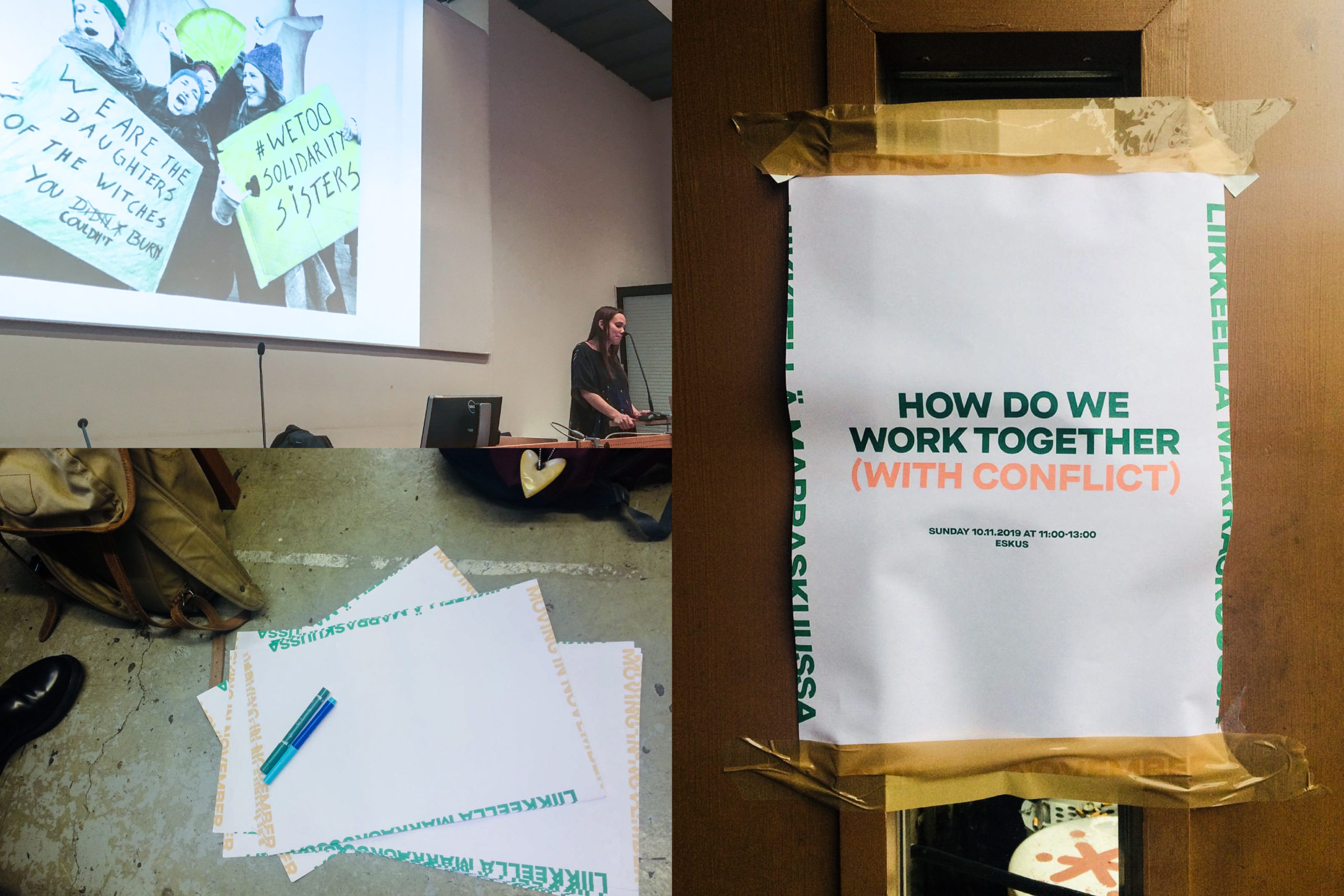
This report is the result of a lecture and a series of encounters which took place during the Moving in November festival in Helsinki 2019. The idea for these events came about in the aftermath of the publication of open letters concerning problematic working conditions and abuse of power in the Finnish dance field.
Having been involved in a lot of #metoo-related work in the Belgian dance field, I was invited by Kerstin Schroth to facilitate a four-day meeting we decided to call How do we work together (with conflict), a title inspired by experiences from the fieldwork done beforehand. The event was proposed as an open invitation to the performing arts field in Finland to come and speak about working conditions in an increasingly scattered industry.
The invitation posed the following questions:
Can we think together about how to better precarious working conditions? How do we create a respectful and productive working environment in a field where time, money, rehearsal space and touring opportunities are constantly limited? How can we voice and react towards incidents of abuse of power within productions? What kind of tools can we develop together?
2. LECTURE
How to address structural issues?
I first gave a lecture in which I introduced the work of Engagement, an artist-led movement tackling sexual harassment, sexism and power abuse in the Belgian arts field. The movement was shaped in the wake of the #metoo-movement and my lecture used the phenomena of sexual harassment to exemplify other professional issues in the field of the performing arts. When approaching any issue in our field, we need to take into account the structural level of the issue and ask ourselves: What are the (local/specific) conditions that allow these problems, often repeatedly, to occur?
In the case of #metoo and sexual harassment, the structural issue could be labeled ‘sexism’. When we want to analyse a structural problem, we need to analyse it on all levels: this includes listening to different voices and approaching the issues from different angles. Solutions are never singular and a plan of action will need to be implied on different levels in order for change to happen. Often this includes a much-needed shift in mentality or norms; a reconsidering of what is seen as ‘normal’.
In the context of Engagement this meant that the movement had to reach out to many different groups, such as artists, institutions, art schools and audiences as well as people who might have “crossed the line”. Addressing a structural issue is always complex work and might open larger questions that are not immediately related to the problem at hand. Addressing sexual harassment, for example, will often lead to questions about (local) art canons and what “artistic freedom” can be; about representation and lack of (gender) diversity; about power relationships within working environments and the field at large; about art education, etc.
We need languages and terminologies
Language is an important factor when we want to address structural challenges in our field. People might have a different understanding of what words mean and definitions are not always clear cut. How we define words and how we use them will also affect their meaning over time. It is important that we keep on discussing these terms and try to understand how they might relate to one another. In the case of #metoo-related incidents, we learnt that sexual harassment is related to sexism, but also to a larger force which we can call “abuse of power”
Below is a visual representation on how some of these terminologies can interrelate:

Make a risk analysis
To map issues in the field, we need to look at the general risk factors and psycho-social hazards specific to the performing arts. A list of some examples may look something like this:
- Small community: ‘everyone knows everyone’, rumours can have a great impact on someone’s career (importance of reputation), information is often passed informally (‘public secrets’)…
- Small organisations: family atmosphere, colleagues are often also friends, the boundaries between work and private life are not always clearly defined, informal moments in which agreements are made, not all artistic leaders are ‘people managers’
- Few alternatives: few jobs, limited subsidies, high competitively
- International scene: nomadic lifestyle, touring, affinities with the culture and language of the country you work in are helpful, resident status will affect precarity (issues with working permits, visa, etc…)
- Economic reality: short contracts, low wages, unfair (sometimes unofficial) payment, instability & insecurity, exploitation, artistic precarity
- Aura of art: subjective world, other rules apply, a field seen as ‘progressive’ (which is not always the case), a world of fame and prestige, ideas around ‘artistic genius’
- World of gatekeepers: the career of artists often relies on the support of certain people who are seen as ‘powerful’ in the field. The people in power sometimes subjectively pick up an artist (‘being the chosen one’). These (often random) dynamics might create strange forms of loyalty and dependency in the field.
- Professional bodies: transgression of physical/mental boundaries is seen as part of the job. As a performer you are expected to be passionate and dedicated, and trust the choreographer.
How do we recognize a toxic working environment?
If risk-factors such as the ones listed above are not taken into consideration (by employers or other people in charge) it can often lead to a toxic working environment. A working environment which has become, or is at risk of becoming toxic is often recognized by the presence of one or more of the following factors:
- General lack of transparency
- Informal communications (often spread as rumour)
- Strong hierarchy
- ‘Charismatic leader’ (e.g. the genius artist)
- Bystanders culture (colleagues notice issues, but no one speaks up)
- Lack of appreciation & favoritism (colleagues are treated differently and it is not clear why)
- Conflict, fear & tension (fights, screaming, not wanting to go to work, no trust in other colleagues)
- No transparency about fees
- Demanding work (can be both physically and psychologically)
- Absence of situations where collective discussion or agreement is possible
- No open environment in which people dare to raise questions (culture of silence)
- Lack of procedures or the existing procedures fail
- …
What can we do when problems, conflicts, or abusive behaviour occur in a working context?
- The options of how you can act depends entirely on the position you have within a professional context (company, institution, project, field). The more power you have, the more agency. However, people in power might not consider themselves as powerful.
- A problem can only be discussed if there is a context where one can talk openly. Ideally, an individual (or group of individuals) feels confident to put the problem on the table, then there needs to be a moment where all parties can express their position. Finally you come to a solution that addressed all parties. This is ‘conflict resolution’ at its best. However, situations are often much more complex and solutions might need an entire restructuring of an organisation and deep changes in patterns of behaviour. Such processes demand time, but also the willingness of all parties to go through this transformation.
- We discuss how a culture of silence might result in a call-out culture when situations have gone too far (which means that the problem is publicly shared). If people who are lower in the hierarchy have felt silenced for too long, this extreme approach might be their only option to voice their position. However, we need to be careful to not confuse ‘abuse’ with ‘conflict’. Call-out culture should remain the last option. If calling-out becomes an approach commonly used in the field, this is a sign that official structures (such as unions) are not in tune with the needs of artists.
Conflict is not abuse: why call-out culture can be counterproductive:
- Backpack of ‘freelance-frustrations
=> the precarity of the field might be a reason why people overreact
- Harm: doing harm is different than feeling harm:
=> everyone has the right to express how they feel, but this doesn’t mean that what the other person did was intentionally.
- People perceive situations differently and will react to them differently
=> you cannot compare people in how they perceive certain behaviour.
- Co-dependent relations can involuntary turn toxic
=> sometimes people don’t know that a situation is harming them when they are still in the situation.
- Unfairness is not injustice
=> always try to be precise. It is not ok if you are treated in a way that doesn’t feel fair, but maybe translating it to injustice might be an overreaction.
=> people might react more strongly due to past traumas.
=> a problem/conflict should be analysed as precise as possible, preferably with the help of an outsider (neutral person).
- How to be constructive with all parties involved?
=> sometimes the person who calls out the problem doesn’t want to talk. When there is no space for talking, it is difficult to find a solution. In some cases, there is no solution. The most constructive answer then might be that people stop working together.
- Focus on collective actions, solidarity, pleasure of activism
=> how do we shift the focus from an individual case to a larger action that addresses similar problems structurally? Maybe a problem can be solved by being part of a community? Artist communities become stronger if there is a collective agency.
Tools for organisations
There are many tools that organisations can employ, but a plan of action should always work on several levels.

The “Prevention Triangle” can be a helpful visualisation. As an organisation, the priority is your “quality governance”. This means that you create an environment where people feel seen, where they dare to speak up when problems arise, where they feel part of the work and motivated, etc.
The second layer is about prevention. This includes the actions and tools that you have set in place, so that certain behaviour or dynamics can be avoided. Set up a code of conduct, give the people you work with as much information as possible on paper (about who is who, their rights, clear agreements, etc), you can train one of your full-time employees to become a mediator, organise workshops that might benefit the work (e.g. non-violent communication, horizontal working methods, etc.)
At the top of the triangle you find the word “reaction”. If your governance in terms of quality and prevention is strong, you may never get to this point. But even if you don’t have the feeling that you need clear rules to be in place, it is good to make general decisions on how you will react when a problem occurs. You can for example decide that there is a zero-tolerance towards violence, or have a plan (or procedure) for when someone shares a complaint. Who is the person who will listen? Will it be written down in a report? Will you involve a mediator? How much time do you leave between these steps? How do you plan to follow up on the situation?
To recap:
- Create an open & transparent working environment
- Work on supportive group dynamics
- Encourage solidarity in group
- Code of conduct (agreements)
- Write a work statement
- Install fixed evaluation moments (all parties should be able to give feedback on working context)
- Be self-critical: educate yourself (e.g. ‘Non-violent communication’, Ethical/feminist leadership,..)
- Make space for apology. If needed invest in a mediator.
- Know your rights and provide info to the people you work with so that they also know theirs
3. INPUT FROM CONVERSATIONS
Conversation with performers
The day after my lecture we organised a conversation between performers and tried to position the questions from the lecture in their individual and professional lives.
About fifteen artists were present during this conversation. All of them had worked as performers, while some also had other professional roles. One person describes herself as ‘dancer, artistic director, editor, choreographer, producer and board member union’ and added ‘this becomes complicated’.
Many spoke about the stress they felt as freelancers. The constant insecurity makes dance a precarious career path, even in Finland, which has a good grant system (in comparison to other countries). People are aware that there are labour laws but find it hard to think about safety in the context of the performing arts. Someone asks: ‘What are are unsafe working conditions in our field?’
There is a feeling that the field of the performing arts operates according to other logics, with hidden networks and informal rules.
A couple of performers shared very personal stories. One gave an example of body shaming during her dance education and spoke about how in society she feels looked down upon when mentioning that she is a dancer, because she doesn’t have a normative dance body. Some performers mention how being hard on yourself and on your body is something that feels like it just comes with the profession, and how this relation to one’s own body actually opens the door for other people (sometimes choreographers) to treat them badly. One dancer asked, “How do I explore my boundaries without hurting myself?”
Performers talk about witnessing situations in which their colleagues are treated badly. It is hard to intervene when you are low on the hierarchical ladder, so you become a bystander who doesn’t intervene. Sometimes this might be because you that you are not allowed (or that it is not your place) to speak up. There is often no transparency or introduction at the beginning of a project that gives you guidelines to understand your position. One performer says that it is also a matter of energy: you need emotional energy to dare to address the problem as a bystander. Sometimes projects can turn into emotional and explosive dramas and this is draining.
For many performers it is not clear where they can go to when they encounter psychological hazards in the field. Someone asks: ‘Where to go when you become the target of bullying in a company?’
There is a willingness to change certain behavioural patterns in the field. Someone says: ‘We need tools for dealing with conflict respectfully. How do we listen to different voices?’. Someone else says that even having this kind of peer-to-peer conversation is rare, but needed. It helps to listen to each other, to listen to people in similar situations, even if you don’t directly work with one another. Someone says: ‘How can we feel empowered instead of building up walls in order to survive?’
A structural problem that everyone agrees on is how to handle the life/work balance in the artistic field. Are there tools for this? Workshops?
Conversation with makers/people in charge
The second day, makers and people in charge were invited. About 25 people attended this meeting. Some worked in institutions, others in collectives, and some had mixed roles being both choreographers and performers. Many artists working in the freelance field are also their own producers.
One choreographer said: ‘When you are leading a creative process, it is hard to also be busy with how each individual feels.’ A returning question revolved around “priority”, especially when there is never enough time. What is given priority in an artistic project: artistic process or group dynamic?’ People expressed a collective need for tools to distinguish the social versus the professional aspects of the artistic work.
‘I used to be afraid of conflict, but it’s inevitable in an artistic creation’, said one younger choreographer. Questions that are formulated by the group were: How to be together in disagreement? How to build a code of conduct? What could guidelines for co-production look like? How do you reach everyone inside a project? What are tools for dialogue during a creative process?
One issue that was extensively discussed was alcohol and drugs abuse in a professional context. According to Finnish law it is illegal to be drunk when you work, but people mentioned several situations where their colleagues were either drunk or hungover. Someone said: ‘It is hard to bring it up, because often you are close to the person or you know that this person is going through something and you don’t want to make it worse. There also seems to be an image of “the romantic destructive artist” (often male) that is more often accepted rather than questioned.’
Several freelancers pointed towards a wide gap between people who work in institutions and people who struggle with finding their own funding for small projects. Agreements around co-productions for freelancers creates tension and competition in the field. People who work in the institutions were listening, but admitted that it is really difficult to be transparent about all facets of things like budgets, because different projects are not always so easy to compare. There was critique of the bigger institutions not always taking up responsibility for issues in the field. Someone said: ‘Many institutions say “we are open for dialogue”, but in reality they are not. Then they are surprised when they hear about problems in the field and wonder: why did no one say anything?’
Someone who works with production said: ‘I end up in the position as mediator when issues arrive in the freelance field, but I have never been trained for it.’ There seems to be a lack of competence to deal with complicated interpersonal dynamics.
One artistic director mentioned that since the 80’s, the Finnish dance scene always needed to fight for national agency (a higher dance education was not established until 1983). Women had to fight hard to build up structures. This generation often works differently from the younger generation. There are intergenerational challenges when it comes to working models (hierarchical vs democratic models).
Conversation with everyone
On the last day, everyone was invited, and around 10 people came. Most had attended the lecture or one of the other conversations.
Someone said: ‘Because of (unspoken) hierarchies in the field, abuse of power happens easily. We need to understand how we all contribute to bad working conditions. Everyone needs to be committed to change. How to empower everyone in the field?’
There seems to be a lack of clarity about who is responsible when: What is the responsibility of the employer versus the employee? How to balance this responsibility?
Some admitted that they might not have enough tools or even experience to face issues of accountability. We spoke about taking responsibility versus outsourcing responsibility. In many contexts there seems to be no clear protocol about procedures. Many expressed a need for outside structures to support people who want to speak up.
One person who teaches dance in a school mentioned that specific tools are also needed for an educational context.
Issues of group dynamics were raised again. Someone pointed out that different individuals (in an artistic project) have different needs: ‘How can we be supportive towards these differences without drowning in “emotional labour”? How to set boundaries when you are the type of person who easily takes up the caretaking role?’
We spoke about different economic statuses, resources and roles versus the efforts put into projects. Some said: ‘We should not take the financial status of people or even the institutional status for granted. Money seems to be a taboo-topic, while solidarity is needed. Where do we find support from colleagues?’
Working conditions for freelancers in the institutional context need to be drastically improved. A director of a festival wanted to think about the role of festivals they are organising. Especially bigger institutions should be an example of putting standards higher.
How do we nourish the relations between institutions and the freelance field? How do we redefine professional ethics in the performing arts?
There was an idea to adapt tools from the commercial field (e.g. tools for startups) to the art field.
4. PROPOSALS FOR PLAN OF ACTION
The performing arts exist largely out of freelancers experiencing their professional field as precarious, uncertain and stressful. Surveys could further document and map this particular aspect of the field, providing data and goal-oriented solutions. Workshops could be provided by unions/institutions to improve the work/life balance. On a structural level, measurements need to be taken to address the causes of this imbalance (see next point).
-
- It is important that different types of funding are available for different kinds of artists, organisations and institutions. A diverse subsidised field will be economically stronger, which will lead to further professionalisation.
- Bigger institutions could join forces by setting up a Fair Practice Payment Code in which correct payments are encouraged (e.g. Charter for Stage Artists in Flanders/BE)
- Workshops could be provided by unions, bigger institutions or festivals discussing ‘entrepreneurship’ and its specifics in the performing arts.
- Socio-psychological hazards
-
- Every working situation should have a version of a “code of conduct” in place. Workshops on how to design such written documents could be helpful.
- Peer-to-peer support groups can empower freelancers to speak up collectively, so that collaborations with institutions and unions can be strengthened.
- Workshops on consent & boundaries for performers/choreographers (e.g. Intimacy Coaching) might provide new tools for negotiation.
- Mentor programs for young artists can help to exchange professional strategies.
- Regular conversations on working ethics will ensure that the topic is not only “alive on paper”, but put into practice.
- Develop (collectively) tools for conflict resolution and how to balance group dynamics.
- Everyone in the field, especially freelancers should be informed about their rights. Procedures relating to the labour law that already exist should be common knowledge. Any person should know where to go when their rights are not respected. The basis of this information could be provided by the institutions (e.g. hanging up informative posters in dressing rooms).
- The field needs a couple of trained mediators who can be consulted for free. These mediators could be linked to an institution or the union, so that a legal frame is in place.
- Dialogue with unions concerning their role in the field is needed.
-
- The role of boards, especially in bigger companies, is not clear to performers. We need guidelines to improve the governance of boards and its communication with the organisation.
- Not all artistic leaders are people managers. Workshops on ethical leadership and competence are needed. They can be helpful to both artistic directors and artists who independently lead projects.
- Workshops on alternative or horizontal working structures while including the specific needs for an artistic process.
- Moderated conversation about generational differences might clarify existing tensions.
- Institutions and especially festivals can find ways of combining the artistic program with workshops and lectures, informing and inspiring the field on aspects that are more related to the professional side of the work.
Ilse Ghekiere is a performer, writer and activist. She studied dance at the Conservatory of Antwerp and art history at The Free University of Brussels. In 2017, she received a grant from the Flemish government to research sexism in the Belgian dance scene. Since the publication of her article #Wetoo: What Dancers Talk About When They Talk About Sexism in the fall of 2017, Ghekiere has continued to work with projects related to issues around abuse of power in the arts. She is also the initiator of ENGAGEMENT, an artist-led movement tackling sexual harassment, sexism and power abuse in the Belgian arts field. Ghekiere lives and works in Oslo and Brussels.