Conversation between Rébecca Chaillon and Kerstin Schroth about Whitewashing

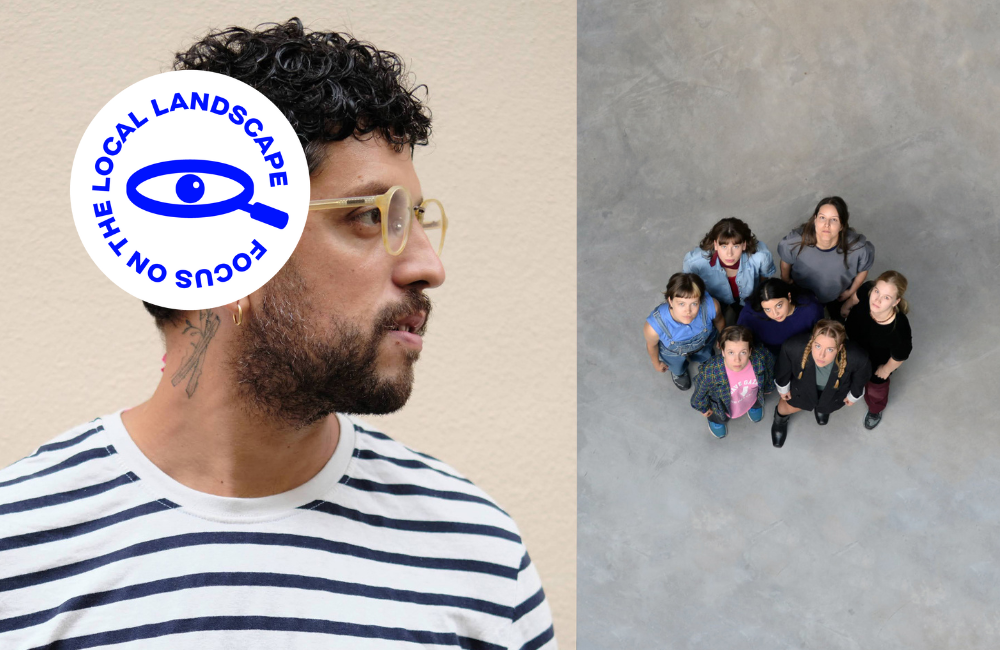
Rébecca, Whitewashing is a duo created in 2018 in Paris that later took on different formats. I am curious about your way of working and thinking. Could you tell me about where the idea for the piece came from, the research and working process, and how you situate this performance within your body of work?

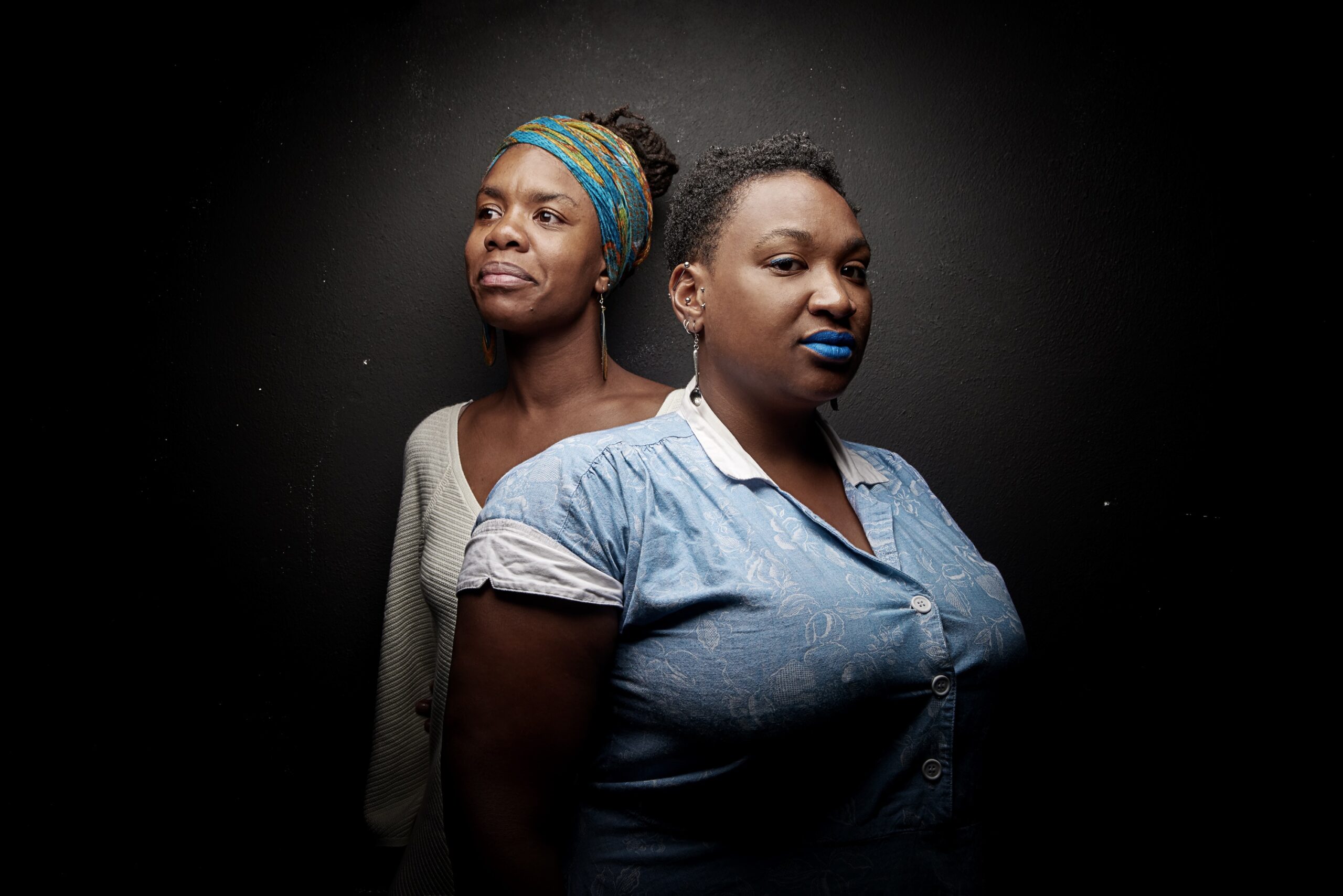
In 2016, I took part in a militant event organized by anti-racist groups fighting against racial profiling and police killings, ‘the decolonial summer camp’. It was a three-day open seminar where I learnt and understood a lot that really empowered me. The following year, I did a solo performance that I started to call Whitewashing, and I invited Aurore Déon to take part. I knew I wanted to do a show with only black women on stage to avenge all those years of my life as a director when I didn’t want to pay attention to the issue of diversity on stage. I wanted to build a team of powerful people, performers who excelled in disciplines where black people are rarely seen (ceramics, circus, fakir, opera singing, harp…). I wanted to create a Carte Noire, a kind of geography of black people in France or close by.

Personally, it was a time in my life when I hadn’t been to Martinique for twelve years. I didn’t understand my place, I was an ‘exiled chimera stammering out its identity’.

I spent several weeks there, and tried to write down what I was feeling from this place of diaspora. I decided to change my writing style, to move from a very intimate ‘I’ style to one that was closer to ‘we’.

I decided not to hesitate to pirate a major work, Alice in Wonderland. I wanted to write a grand narrative that didn’t stick to the present, to reject the documentary aspect often invoked when we talk about discrimination.

Then we started to work together, interviewing each other, proposing improvisations, challenges… watching Spike Lee films, sniffing coffee… and doing public performances.

And I decided to create Carte Noire with 7 other artists on stage, a big set design, a technical team and everything, but also to keep a light, raw, performative form to take abroad, to alternative places too, Whitewashing.

Your performances often imagine another world by strongly pointing out the defaults of the society we are living in, giving space to stories that stayed long untold, creating community, and bringing people together. How do you work on these subjects, which are still underrepresented in theaters? And how do terms like ‘invisible bodies’, ‘bodies in danger’ and ‘at risk’ relate to your work?

I love fiction but I never felt capable of writing it, because it wasn’t the genre I was expected to work in. I was destined to act, to direct, to copy major texts, validated works of text from the dominant white hetero culture. And I loved those texts, those stories. But then I had to ask myself what kind of story I wanted to tell on stage. And then I had these collective activist adventures, around the struggles for women’s rights, queer people, non-white people, fat people… I wanted powerful communities on stage, to tell the story of difference and violence in a different way, and also to give complexity, and therefore a less ‘Benetton’ version of otherness.

I work on this with the different teams, whom I choose very carefully. I need to know that they are politically aware and that they want to put their physical and intimate commitment on the line to talk about social issues. And then we try to make sure that we have space to talk about anything that might be complicated in terms of representing the issues of violence that concern us.

When creating the performance Carte Noire, for example, we work with a mediator who specializes in these issues.

In your performances, your body and the way you use nakedness are strong and you have a fascination for food and references to it. Can you elaborate on both?

I’m afraid that my answers will be philosophically disappointing… I started putting my body into play because I had the feeling that working with text, embodying texts and characters wasn’t for me. That I would always be inferior to my white fellow students at the Conservatoire.

I loved the work of Romeo Castellucci and Rodrigo Garcia and I enjoyed the possibility of already being very significant with just my body. And mine was really full of signs that French theatre didn’t know what to do with. Fat, female, lesbian, black–just looking at my body in space communicated already a lot of history.

When I was researching performance and my way of doing performances, I realized that I was so obsessed with food that I wanted to show myself in that relationship. To challenge the public to look at what is not on show. The obscene. The intimate. It’s an organic, sensual, intense, contradictory relationship. A relationship that transforms me physically, and creates a strong empathy with the people watching. Disgust, desire, hunger…

I’d been facepainting and bodypainting my body for years, and it reminded me of the colors and textures of food. At first, I mixed the two. Then, as I dug deeper, I realized that I could talk about devouring, lack and therefore power relationships. Talk about class, gender and race with this tool. And that it was universal. Everyone has a close relationship with food.
Conversation between Maija Hirvanen and Kerstin Schroth about Mycoscores / Choreospores

Could you tell us about the background and starting point of the publication?

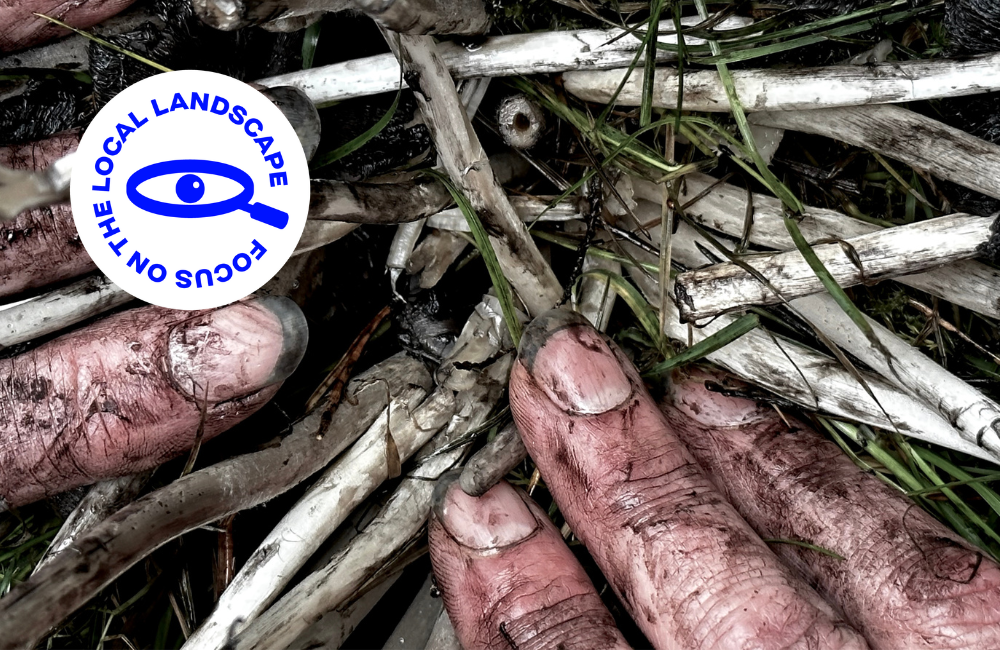
About a decade ago I started to consciously search for connections in between my choreographic processes and foraging mushrooms in the woods. I’ve been a mycophile, a fungi lover, since my childhood and an art lover equally long. My foraging trips are pretty extensive and this wandering with a particular focus leads to states of awe, emptying out, getting deliberately lost to go a  further – and getting lost in one’s self-consciousness, knowing and control. The experience of time changes.

When foraging, one finds mushrooms by their and the milieu’s scents, the formation of the forest, the feel under the feet. One starts to look around in a particular way, shifting the eyes in between the forest floor, tree trunks and everything else. Also something else is formed in this process. I call it the fungi feel. This feeling of “something else” is not reducible to the senses or nameable aspect of the search.

And suddenly, you find something. It might be one of the species you’ve been looking for or it might be something completely else. Like a species of fungi unfamiliar to you, or an encounter with another animal, or a most amazing stone or an emerging dance or a meaningful thought.

There’s so much resemblance in all of this process to the making of artistic work. At best one is focused, and simultaneously open to what comes out of the journey. These processes get more sensitive and vivid over experience and time.

So the artistic publication Mycoscores / Choreospores is one articulation of my long ongoing process of searching for connections in between choreographic work and the world of fungi. It comes in a form of 31 scores and an accompanying booklet. The scores form a network of practices which is ever developing and never ready. They can be practiced one or few at the time and in any order. They are movement and dance scores in a form of writing – a framing that I kept for this publication. One could practice them indoors or outdoors in forests, city parks and agoras, wastelands, shores… Each of the publication’s cards contains one score in writing on one side, and the name of the score on the other side. The names set a starting point for the score – an activity that could be both human or fungal. Such as entangling, breathing, connecting, decomposing, sensing, waiting etc. One could practice them as a solo, with a pair or in a group.

How do you situate your artistic work within the Finish performing arts landscape?

My artistic work has changed and keeps changing over time. My work lives, grows, collaborates and takes place in a range of fields within the performing arts and can be experienced in these neighboring contexts – choreographic work, dance, contemporary theatre, live art, contemporary art. I understand my work as expanded choreography, made through my long background and practice in dance, choreography, and performance. The Finnish performing arts field has changed a lot in the 20 + years I’ve been making work.

How my work can be situated is also in movement. In connection Mycoscores / Choreospores I see my work’s growth and position resembling that of the fungal mycelium, the underground body of a fungus, which creates networks that grow outwards in many directions, depending on the food source, moisture, temperature and circumstances, and is aware of gravity.

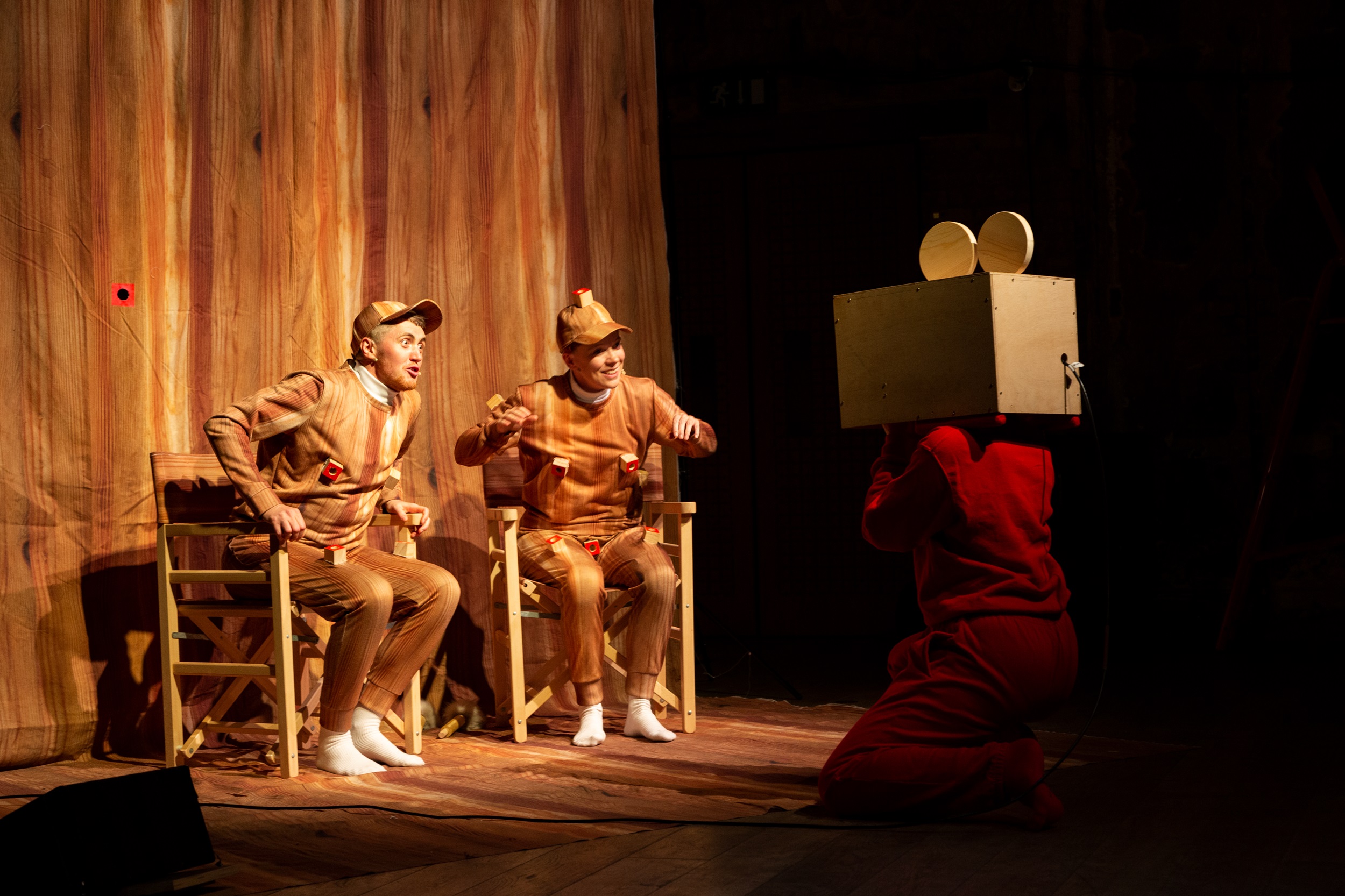
Conversation between Ivor MacAskill and Kerstin Schroth about The Making of Pinocchio

In relation to your piece The Making of Pinocchio, I am curious about the working process. Why did you choose the tale of Pinocchio for this performance, and how did you work on it and build it?

Initially the choice of Pinocchio as inspiration was partly tongue-in-cheek – we enjoyed the sort of joke of using the lying puppet who wants to be a ‘real boy’ as an imperfect metaphor for the trans-masculine experience. We wanted to highlight the difficulty we had finding positive, hopeful representations of couples going through gender transition and found it both comical and somewhat tragic to imagine a scenario where Pinocchio is the best story we could find.

But then we were surprised at how much we could connect with the rich imagery and transformations in the story. It was both fun and fruitful to fit Pinocchio into our lives and our translate our experiences into the world of Pinocchio, represent the story on stage, and also queer it for our own benefit.

The working process of making the performance was very much the process of us living through and coming to understand my gender transition and how it was affecting our lives as individuals and as a couple. Working with Pinocchio as a frame allowed us to revel in the magic of the physical transformation of my body – the voice lowering, the changing shape, the new hairs. Equating these miracles with fairy tale magic helped us appreciate the wonder of what was changing before our very eyes, and then it gave us images to articulate it for an audience.

We were inspired by Judith Butler’s work around fantasy and reality that Butler describes in Undoing Gender. “Fantasy is what allows us to imagine ourselves and others otherwise; it establishes the possible in excess of the real; it points elsewhere, and when it is embodied, it brings the elsewhere home.”

The work sits in this liminal space between fantasy and reality. The process of gender transition for me demanded a lot of creative imagining and fantasising about new ways of embodying my self and being seen by others. Similarly of course, the act of creating a performance is a shared fantasy – trying to conjure up new images and worlds that an audience can connect with – always in a space in between lived reality and willful pretending.

How do you situate The Making of Pinocchio within your artistic evolution?

This is certainly our most ambitious work to date. Much of our work expresses our identities as queer, trans, gender expansive, neurodivergent lovers. In the past this has often been shared in smaller, experimental and queer festivals and clubs for knowing audiences. This work has Intentionally been made to reach and be appreciated by a wider and more mainstream audience. It’s by no means a Trans101, but it welcomes cis and straight allies (or potential allies) who want to understand more about trans experiences.

But it’s also still vitally important to us that we are connecting with other trans and queer people in a way that retains the intimacy of our earlier work.

The scale and richness of the theatrical and technical production is way beyond anything we have created before, although it still holds something of the DIY aesthetic we’ve always worked with. We of course owe this to the collaboration with our amazing creative team who brought the work together and continue to work on the piece: including Yas Clarke (sound/AV), Tim Spooner (design/costume), Kirsten McMahon & Jo Hellier (cinematography/camera), Jo Palmer (lighting/AV), Mary Osborne (Original Producer), Nora Laraki (Touring Producer) and Sorcha Stott-Strzała (Production Manager).

This dream team of collaborators allowed us to situate and elevate our personal material and performance within this rich, sumptuously-crafted world. This staging creates a stable container (even as it shifts and transforms) in which we can be vulnerable and feel safe to invite the audience in.

Would you like to speak about the socio-political dimension of this work, its high relevance, and your role as passionate advocates for LGBTQIA+ rights and culture? 

Additionally, could you address the underrepresentation of these subjects in theaters?

In the performance we reference the toxic environment in the UK for trans people. Sadly as we’ve moved forward with this project the situation has in some ways gotten worse. The waiting lists for support and healthcare have increased and trans people are used as a political football which increases discrimination. The work has reached thousands of people internationally, but it has been difficult to tour in the UK – although this may say more about the woeful arts funding situation, rather than only a ‘low risk appetite’ for queer work.

We know we are in a privileged position – financially the support we’ve received to make this piece has allowed me to keep paying my medical bills privately – and there is little actual risk for us, particularly now we see that the work is in demand and sought after on the international circuit. The other side of this success is a question of potential exploitation – to what extent are we falling into a trap of visibility?

But we currently feel willing and able to put ourselves and our lives (or a performative version of our lives) on stage with the hope that this visibility is powerful for people like us who rarely see themselves represented positively. And for non-trans or queer audiences, we offer an alternative narrative that goes against much of the problematic discourse and so-called debates around trans lives.

We know that this work is unlikely to reach and change the minds of staunch transphobes and bigots. But we also know that our embodiment of an ever-evolving love story offers a gift of possibility for those who might need it.

What’s also important to us is how touring a performance might influence change in terms of breaking down barriers around access and disability. We try to address this within the material of the performance, but also through the wraparound activity and the conversations we have with venues and festivals that present the work.

For example we send both a trans rider and an access rider along with our technical rider that gives information about the different identities and needs on the team, and suggest offering gender-neutral toilets to make the venue more welcoming for gender-expansive visitors.

Every performance is a relaxed performance meaning that audience members can do what they need to feel welcome and comfortable in the space, and a wellbeing practitioner is on hand to support anyone who has a strong emotional response to the work.

It takes a lot of work and ongoing consideration to craft the artistic work and material, and also foster a context which allows audiences the best possible overall experience and can change the theatre infrastructure from the inside.

Conversation between Stina Nyberg and Kerstin Schroth about Skvallret (The Gossip)

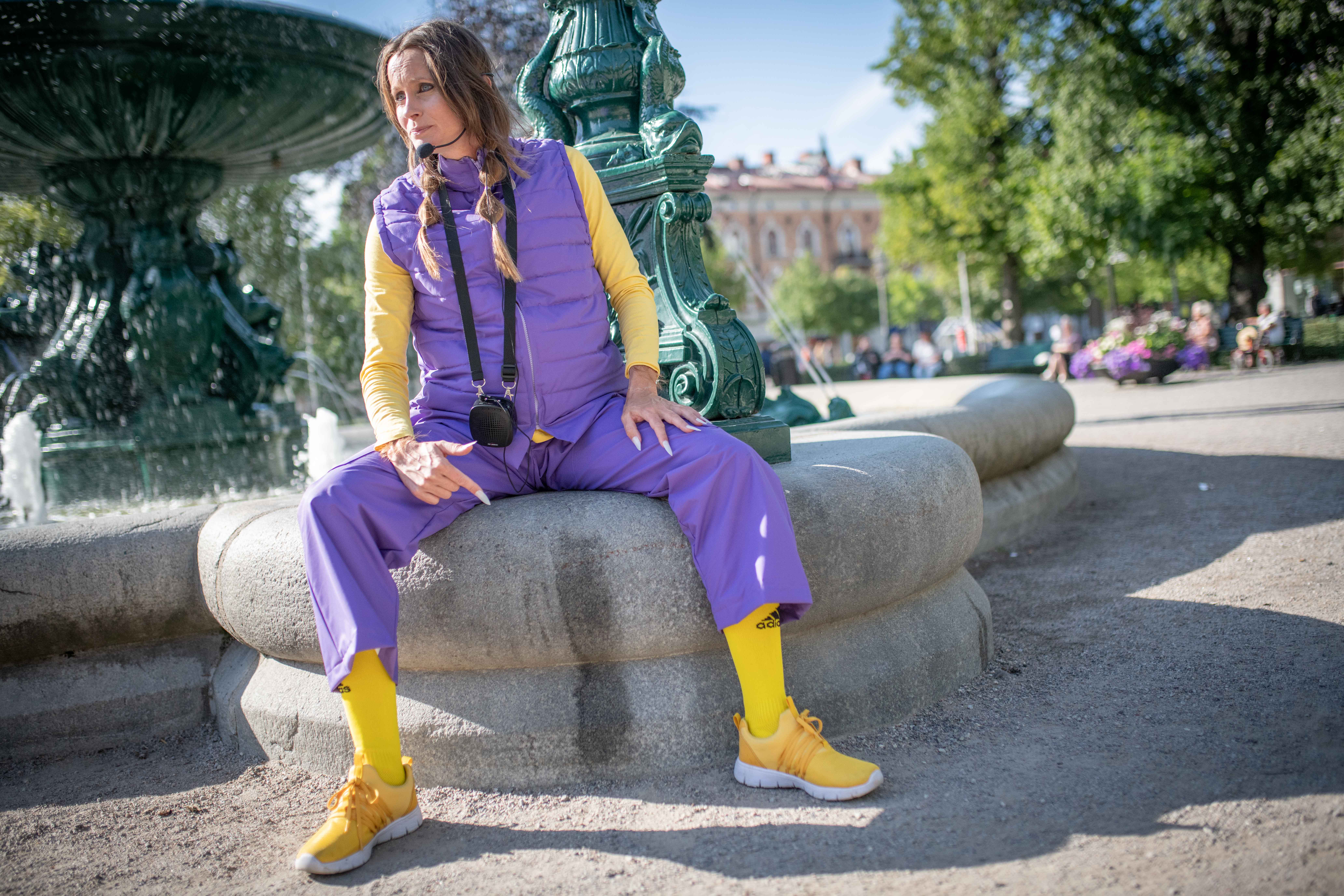
Skvallret is a hybrid between a performance and a guided tour. You yourself take on the roles of performer and tour guide and you also slip into the role of a dog. Can you tell us where the idea for this performance originated?

In 2019 I was asked by the Public Art Agency Sweden to create a site specific work for the city of Sundsvall – a (for Sweden) mid-sized city in the middle of the country, close to where I was born and grew up. The commission was to create something that could take place in the city centre. A space which was about to be remade when the bus station of the city was moved from one place to another. A space made out of gravel which mainly harboured night time drug business, kids out and about and people passing by on the way to the bus. A space which for a year would be left as it was, waiting for the big remake of the square.

The same year my dog Pablo was turning 3, and was a complete mess. His fur curled into felt balls, he barked at newborns and bit old men in their heels. As I walked with him in the city, I was on the constant look out for food scraps (no, don’t eat), toddlers (no, don’t bark), skateboarders (no, don’t chase), dogs (no, don’t hump), cats (no, don’t attack) and animal hides (don’t worry, they are not dangerous). At the same time, he made me notice leaves ruffling, made me stop for unusual smells and showed me how to take time to understand the true nature of a black plastic bag stuck on a road sign.

I had for a while been interested in ways of emphasizing the role of the senses in how we as humans understand the world. In various ways I was trying to steer away from the dominance of the gaze towards an interest in listening, with all of the body’s senses. I was influenced by some of the thoughts expressed by Donna Haraway (who herself has developed a close intellectual relationship with and about her dog). I was further interested in the practices of sense perception that are developed within dance, both theoretized and practiced by dancers such as Chrysa Parkinson and as experienced through my personal dancing history. Somehow, I was thinking that this practice based knowledge of sense perception, as present in the dancer, could have a conversation with the more theoretical approaches.

At the same time, I was curious about dog training and social behaviours. The domestication of animals comes with a bouquet of norms of what is considered wanted and unwanted behaviour for a dog among humans. Somehow, these reflect the norms for human social behaviour, but in dog training they are allowed to be shamelessly outspoken. And the conflict lines are big between different kinds of dog training, dog domestication, dog companionship, dogs in relation to their humans. I have used the lingo of the shaping of dog behaviours to think about the social choreography of humans, and other living beings, in public space.

As I started to spend time in Sundsvall, I read up on the official history of the city as well as started to talk to strangers about their stories of the city. I especially spent time with dogs and their owners, accompanying them on their walks around town. In combining these two perspectives, I tried to apply the attention of a dog. To ignore the big buildings in favour of the pee spots, ignore the big picture in favour of the details, ignore the grand narratives in favour of the gossip. With this oscillation between the very far and the very close I started to build a story about the city, and a storyteller that could simultaneously be a city guide, a dog trainer, a dancer, and a dog.

The version we are seeing in Helsinki is specifically recreated for the area of Pihlajamäki as part of Moving in November. How do you develop each new version of this piece? And how does the concept of gossip come into play?

This new version will be developed with the departure point of reflecting both the official and unofficial stories of Pihlajamäki. Especially about how it is to be a dog in Pihlajamäki. I will spend time in Pihlajamäki and hope to meet other dogs who live there. I also will meet people, and when you meet people, you have to really listen. Listen with all the senses. This is the starting point, but as with any gossip it brings you to places you did not already know about. I will try to spend time listening to whatever gossip people and creatures are willing to share. Often, one story leads to a person, who tells a different story, leading to another person, leading to a dog, to a place, to a memory. The concept of gossip comes into play as this collective trail of thoughts and stories, which in its turn is the major part of what constitutes a place. Gossip is subjective, oral and ephemeral, it borders the true and the fantastic, and it is often community building.

In dog training, there is a common practice of “tattling training” (“skvallerträning” in Swedish). This refers to making the dog “tattle” or “gossip” to their human about any potential dangers, attractions or actions that calls their attention. To tell their human first, often through finding eye contact, before they act – giving the human an opportunity to intervene. The concept of gossip thus also refers to this kind of human oriented dog training, with a wink to other dog companions.

How do you situate this work in relation to your choreographic practice, artistic development and in relation to your other performances?

The focus on sense perception as a possibility of looking at the world differently is a theme that has been running through several of my works over the last years. It has taken the shape of the organisation of a series of symposiums on collective learning processes and practice based thinking (as in the case of A Thinking Practice, a collaboration with the researcher in Urban studies Sofia Wiberg), as well as infiltrated my dance works.

Similarly, I have continued moving between the very far and very close perspectives, honing in on personal stories as well as the timeline of humanity at large (as in the solo Sweet from 2022). The practice of storytelling, and of using choreographic means to create a storytelling character, is an ongoing practice which moves in and out of my choreographic works.

However, Skvallret holds a very special position for me as it exists on the silly end of choreography. It does not shy away from the embarrassing, the too close and the intimately filthy. It is created anew for each place, and performed very close to its audience, in public space, and thus needs to be flexible and humble enough to work with its circumstances. In this way, it is a work which is both very demanding and a lot of fun to perform.

Conversation between Renan Martins and Kerstin Schroth about Teak Open Studio

Could you tell us about your practice as a choreographer and how you will be working with the students?

From the start of my choreographic journey, I have explored various forms of tension. This tension has manifested differently in each piece—through intense or subtle contact, text, or direct interaction with soundscapes. My aim now is to share this practice with the students, incorporating their desires into their final project. Additionally, I want to foster a space that emphasizes both physical reflection and engagement. What kind of collaborative work can we create that allows them to pursue personal goals while remaining interconnected, even if their individual expressions differ? Can we build a sense of community while preserving their unique voices?

How do you situate your artistic work within an International performing arts landscape? 

Over the past few years, I’ve been focusing on integrating my positionality into my work. Navigating my cultural background has posed challenges in understanding contemporary dance definitions and positioning my work within the European landscape. Recently, this perspective has evolved as the scene seems to be striving for a more diverse body of artistic voices. My work has been generating curiosity as I’ve been exploring alternative dance forms, references, and staging techniques to challenge conventional norms, utilizing provocation, humour, and joy as tools of resistance

Currently, I balance smaller-scale independent projects that curate social and political elements from both my background and that of the performers, alongside commissions from established dance companies such as Dance Theatre Heidelberg, Unusual Symptoms/ Theater Bremen, Danish Dance Theatre, and Cullberg. These institutions have shown particular interest in innovative creative processes that challenge traditional studio hierarchies in a decolonial manner. This approach has become a crucial aspect of my choreographic practice.

Conversation between Tiran Willemse and Kerstin Schroth about blackmilk

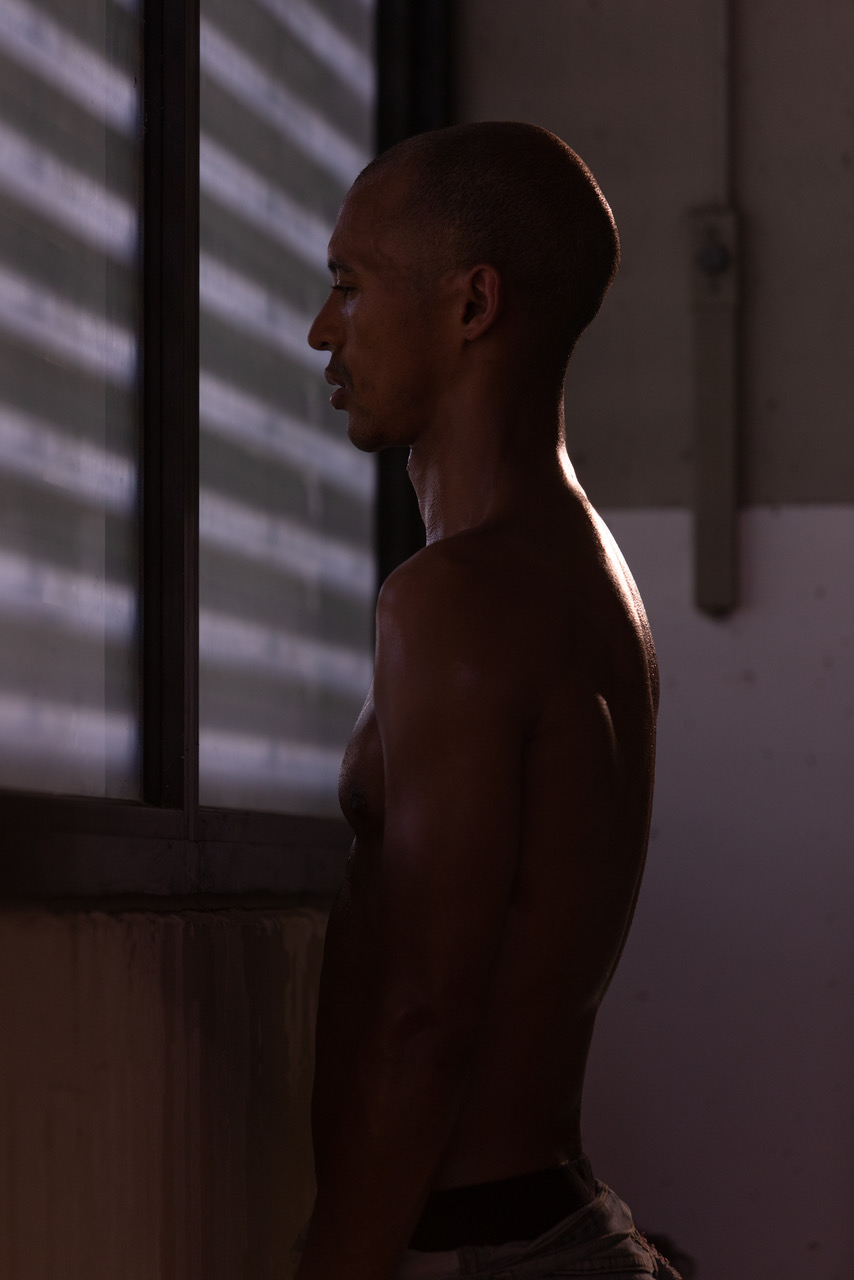
Tiran, to start, it would be great if you could share the starting point, research, and process behind blackmilk. Could you also explain where the title comes from?

I am curious in Absence and presence as a concept of performance. The two keeps propelling me through the process of making. Looking at identity within that and the concept of where is the source of your identity and how do we curate that and how do we change that. The Idea that masculinity and femininity is very fluid in what it means.

The title is looking at the idea of race and the fallacy of race. The question is what is black and what is white, as they really construct ideas that’s historical and political. What is underlying that and who are you beyond that.

I experienced an extreme sense of loneliness, melancholy, but also rage in blackmilk. Throughout much of the piece, your face and gaze are covered or internalized. Would you like to share your thoughts on these aspects?

There is a rebellious side to it but it’s also quite strong as a self-expression and pushing boundaries of fighting against or dealing with our unpredictable and instinctual minds. It helps me to manipulate, be highly individual and to have a personality.

I think of complete darkness as a strangely comforting sense of loneliness. Loneliness as delicate as possible without breaking. Breaking in relation to examining the question on violence. Within dance there is a physicality and it could be aggressive but it’s removed from Violence. Another layer of intimacy inside aggression as it decelerate.

How do you situate this piece in relation to your second work, that just came out in January? And how does it relate to your role as a performer in the works of other choreographers?

The accumulation within both works is a gathering of energy. I’m very curious what the body does when the mind let go, in a state of transcendence. The idea of how the body can speak for itself and tell you things without you directing it. I am interested in something that changes its personality over the course of time. React to the environment, I make work that functions within a system in relationship to one another and the space that they’re in.

Space location is very important to me and usually the starting point. There is a type of soul in all spaces and I’m curious of that and how to connect to that to lead me and hopefully encounter things.

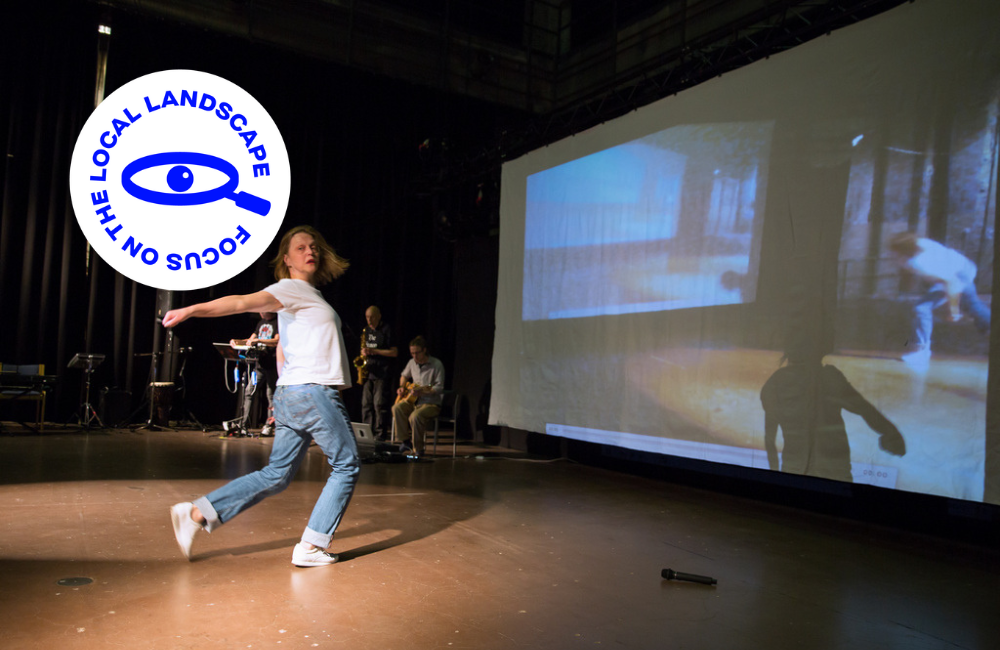
Conversation Between Liisa Pentti and Kerstin Schroth about Dance-improooo!

Could you tell us about the background and starting point of this project?

Improvising (in life and) in dance is a core practice of mine that reveals where I am situated in at a present moment. It is the joy of finding myself making moves and decisions which are surfacing in that specific moment, and in relation to what is going on elsewhere. Like in the room or in the music or with the audience. It is like being a transmitter in motion and focusing on being tuned in with what is happening in the midst of it all. It is a challenge to be creating a stream and sequences of bodily communication during each performance without stating the obvious. Or at least being aware of stating the obvious – and that makes me feel sometimes embarrassed even though it is also fun to play with personal obviosities. I am extending my awareness into listening to the space and to the music and the audience and finding a dialogue with them through dance.

I have been making quite large scale works in the past couple of years. Last autumn my colleague choreographer Ulla Koivisto asked me to give an improvised performance with a musician in the retirement home where she lives, and so Troels Strange Lorenzen and myself did our first gig together. It was so very nice to get back to my dancing through improvising, and I thought that there is not so much of it happening at the moment, dance and music impro performances. So we started to plan a season for it and invited these great dancers and musicians to perform in the events.

There is actually a long tradition in improvising in Finland. In Oodi we will have a whole day of performances around the theme. Also there will be workshops open for everybody.

As I understand it in the music scene it is common for musicians to improvise, especially in jazz. Dance improvisation can take so many forms and shapes but there is always a thrill of the unknown. You just have to get going.

How do you situate your artistic work within the Finish performing arts landscape?

This is a very difficult question for me to answer. I can say that I have been part of the landscape for a long time and my work and interests have changed somewhat. The landscape here in Finland is also very variable. My work follows my curiosity in relation to the new questions that arise and inspire my dancing. At the moment I’m intrigued by how the dancer’s thinking process is reflected in the dance, by where the concentration is and how the body is working in tandem with the mind.

I work a lot with questions and tasks and usually my work is related to the material that comes out of these questions. Very process-like. Lately I have asked many questions about the different relations between dance and music. I’ve also taken a dive in the archives of contemporary dance and found questions relating to the ghosts of dance theater. Next year I will be doing a solo, so I’m curious about it and what will appear in the process. I will continue with the ghosts and the bodies. And with an electric guitar  played very loud.

Conversation between Olga Spyropoulou and Kerstin Schroth about A Cloud and it’s Shadow

Could you tell us about the background and starting point of this project?

Things form through encounters. A cloud begins to form when warm, moist air rises to meet lower temperatures. A shadow forms when rays of light meet an opaque object placed in their path. A cloud and its shadow began with a meeting between Reality Research Center (RRC) and Moving in November. 

Things change relative to one another. This isn’t the first time that Reality Research Center and Moving in November meet. In previous years, performances from RRC’s members have been presented in the festival, e.g. Tuomas Laitinen’s Audience Body and Matilda Aaltonen’s and Veli Lehtovaara’s Performing Animalities – A Praxis in 2022.

Things find each other in memory time when there are no memories. A cloud and its shadow challenges one of the elementary structures of reality, time. RRC’s members artists Emma Fält and Alina Sakko are invited to review the RRC’s members performances from 2022 without having experienced them. 

“Things are transformed one into another according to necessity”.1 Clouds appear when there is too much water vapour for the air to hold. A shadow appears to make the light visible to one’s eye. Getting resources for local artists becomes harder and harder for international festivals. Getting resources for Finnish artists becomes harder and harder due to the current government policies. “Remember the light and believe the light”.2

As though conjured

by conditions;

as though constellations

fretted something

to existence; as though

larger arrangements […]

produced brief real things

in real places.

– Kay Ryan, “Brief real things” 

Things experience time according to their altitude. This year, Reality Research Center introduced a new series of seminars under the title How do I research reality?. The series is a way for Reality Research members to encounter and learn from each other’s research on reality and to think forward on how reality research could be developed and with it, how RRC can respond to this development. This year, Moving in November introduces the Focus on the Local Landscape program, as a political initiative to shed light to the local scene. These relative times gravitate towards each other on the 16th of November. 

_______________________________________

1. Anaximander in Carlo Rovelli, The Order of Time, Riverhead book, New York, 2018. 

2. Tindersticks, “4.48 Psychosis” based on Sarah Kane’s play, on the album “Waiting for the Moon”.


Brief real things persist. This program aims to bring together artworks, artists, a collective, and a festival to express admiration, gratitude, and respect to all the individuals, communities, and forces that, through their generosity and dedication, make creating and experiencing art possible.

“Tell me, what else should I have done?

Doesn’t everything die at last, and too soon?

Tell me, what is it you plan to do

with your one wild and precious life?”

– Mary Oliver, “Poem 133: The Summer Day”

How do you situate your artistic work within the Finish performing arts landscape? 

For over 20 years, Reality Research Center (RRC) has played a pivotal role in establishing Performance and Live Art within the Finnish cultural landscape, and has carried out more than 100 performance projects. As a collective of performing arts professionals, we are driven by a shared passion for the study of reality—observing, questioning, and renewing it. Performance is both our method of research and the outcome. We believe that art expands the spectrum of reality.

Most of our performances unfold beyond traditional art spaces, taking place in diverse settings such as forests, offices, streets, boxing rings, virtual reality, parliament, and even people’s homes. These unconventional environments demand exceptional care for our audience, and over the years, we have developed various effective strategies for audience engagement. The audiences and their experience are central to our work, which is why we often refer to them not just as spectators, but as experiencers, participants, or even co-authors.

In addition to performances, our activities include publishing (Esitys Magazine, the online publication Ice Hole – The Live Art Journal, and Taiteen paikka which is published in collaboration with Voima magazine), projects in cooperation with local residents and communities, and course activities such as the Queer Dance Group. 

In Reality Research Center, we are committed to exploring the boundaries of Live Art and rethinking how to diversify the field, especially in the Finnish context. We aim to develop new forms that address and challenge the inaccessibility of Live Art, broaden our member base and audiences, and inform our working structures in terms of equity. In the current political climate, this is a necessary, daring move and an almost impossible performance, consistent with the collective’s long history of challenging reality and experimenting with emancipatory art practices. 


Conversation between Calixto Neto and Kerstin Schroth about IL FAUX

Calixto, welcome back to Moving in November with you latest work Il Faux. In 2022 we opened the festival with your performance Feijoada and in 2020 we saw you in Luiz Abreu’s piece O Samba do Crioulo Doido. How do you situate Il Faux in relation to these two pieces?

First of all, thanks for having me back. It’s been a pleasure to develop this connection with Moving in November and get to know a bit more of Helsinki every year.

From a chronological point of view, Il Faux is a piece that began to be dreamed of and even worked on long ago, back in 2019, even before the invitation to reenact O Samba do Crioulo Doido. At that point, I was thinking about what to do next after oh!rage (2018) when a friend introduced me to Ta-Nehisi Coates and his amazing work, Between the World and Me.

This plan was interrupted by the invitation to reenact O Samba (2020). Right after that, in 2021, I was invited to create a piece in collaboration with choreographer Lia Rodrigues for Kunstenfestivaldesarts in Brussels, and then to be part of Lia’s portrait at Festival d’Automne in Paris, where I created Feijoada (2021). Especially for Feijoada, which was created during the COVID time, I didn’t want to invest in a solo project again; I needed to be surrounded by people.

Everything went kind of fast and hectic during those couple of years. After this period of agitation, going back to the idea of creating Il Faux seemed coherent to me: the questions that animated me at that point resonated with the questions raised in the preceding pieces.

However, in 2019, I would have certainly created a different piece, especially because of the working conditions I could bring to the project in 2022/23, having experienced three other projects in between. In this sense, I had the pleasure of having a bigger team with me. I could invite Luiz de Abreu to be an artistic advisor in the project (which is a luxury!) and I had the time to establish a nice collaboration with Rachel, Clay, and Eduardo to think together about the space, sound, and lights. All that meant a lot to me.

It’s also nice to think that in O Samba, the audience saw me in a very vulnerable position, naked and playing with the Brazilian flag in a way that might even be considered dangerous. In Feijoada, I felt that I could start an actual conversation with the audience in a very simple and informal way, which explored another layer of vulnerability for me.

We could never know how the piece could have been if it was created in 2019, but having done it after experiencing so many things in three years gave me some confidence, comfort, and desire to explore other possibilities and other vulnerabilities.

Your performance is inspired by the book Between the World and Me by African-American writer Ta-Nehisi Coates. How did you move further from this source creating Il Faux and working with subjects like invisible bodies, bodies at risk and bodies in danger?

The experience of reading Ta-Nehisi Coates was a delightful surprise! This book was recommended to me by my friend and inspirational artist Ghyslaine Gau. She thought I would connect with his writing, which has a Baldwin-like mood—kind of melancholic in my opinion. But it is also vividly wise and consistently accurate in its point of view on North American society. I read it as though I was revisiting a perspective on the history of a country that is, in a way, part of my life because we are very influenced by North American culture in Brazil.

What is also interesting is that he is a Black man talking about his experiences and those of his community, so the book offers much about the United States from a Black perspective. There is a Brazilian photographer and activist who once wrote, “There is a history of Black people without Brazil. What doesn’t exist is a history of Brazil without Black people.” It seems we can say the same about the United States.

This Black perspective is where I connected with him, especially because he comes from a precarious background, where poverty and violence were very close to him—and the fear. This fear was transmitted to him, and he, in turn, transmitted it to his son (even when he is talking about courage and empowerment). The fear that his kid could, at any moment, lose his body.

This is the point where the book resonated with me. I could connect with that experience, that transmission, that fear, because I lived that at home. This is printed on my skin.

For me, it was never a matter of reproducing the book itself but of allowing it to give me a ground on which to build some reflections and some delirious suppositions. I thought that out of fear, one could build capes, masks, other personas—a character we invent to cope with the dangers of the world. All those ideas of doubling oneself, mask games, and creating a persona became interesting notions to explore in creating the piece. Practices of dissociation, manipulation, isolation of parts, and ventriloquism seemed like fertile ground to explore.

Finally, throughout the creation process, I realized that Il Faux is not about fear, just as Ta-Nehisi’s book is not about fear. It is about what we create out of fear and oppression, and the act of creation—in a book, in dance—is already a rebellion against that.

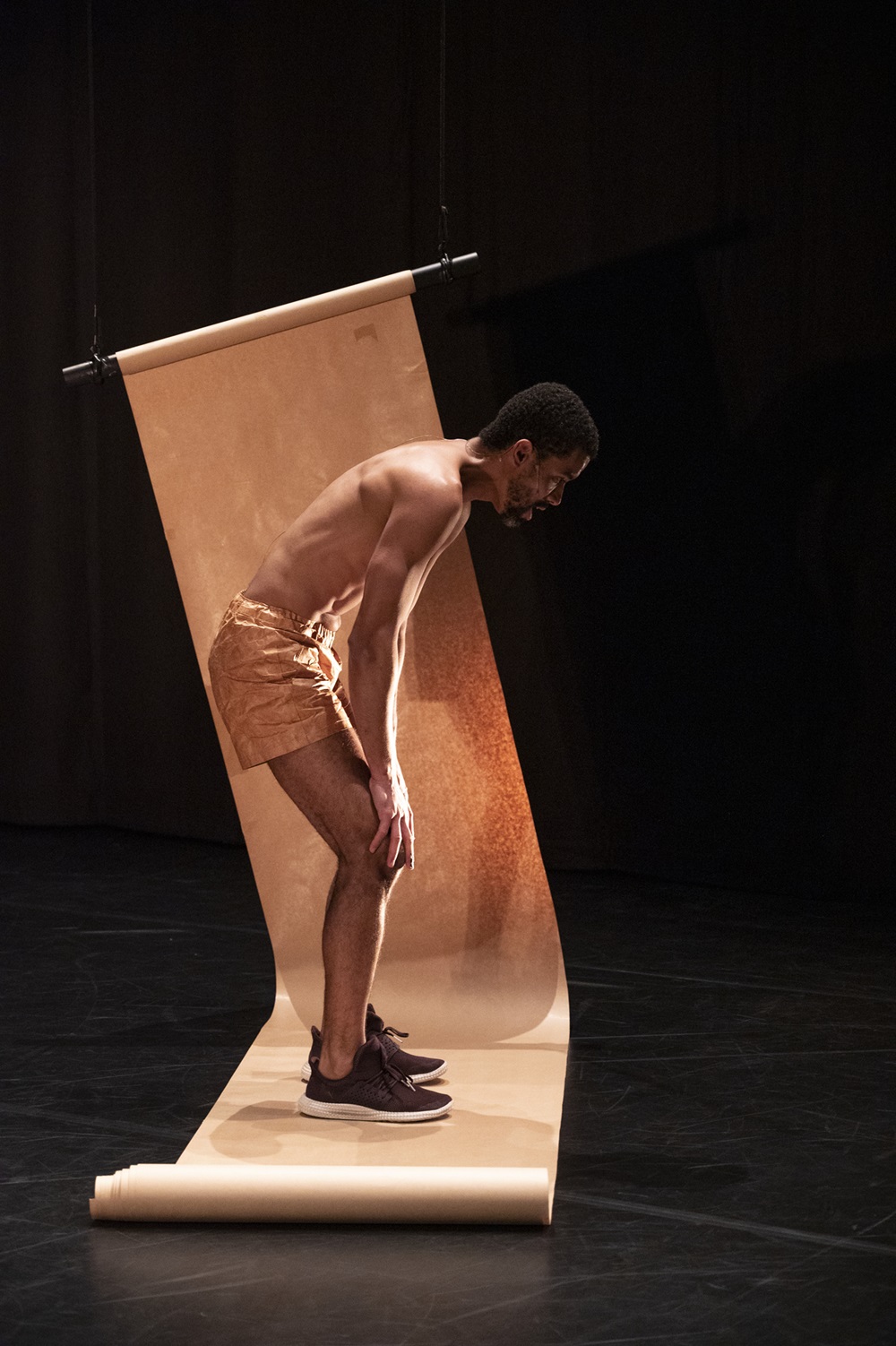
Could you speak a little more about the paper ‘kraft’ that you are using in this performance and the puppets that you are building with it?

The “Kraft” element that I use in the piece—and which holds a quite central place in it—is an amalgamation of many references that are integral to the work. At the beginning of each new creation, I create a universe of references—photos, films, quotations, etc. This helps me build a dialogue with works that inspire me and influence my thinking. It aids in considering body practices and the imagistic universe of the work. These references come from diverse sources, and this collection follows an intuitive logic. At some point, I stumbled upon an image of a man “talking” to a human-sized puppet made out of what we call in Europe “kraft paper.” That intrigued me, I wanted to invest on that strange situation.

Another reference for me in Il Faux is the Brazilian visual artist Maxwell Alexandre and his series of paintings called “Pardo é papel” (an approximate translation would be “kraft is paper”). Pardo, besides being a type of ordinary paper used as a support for Alexandre’s paintings, is also an ethno-racial classification according to the Brazilian Institute of Geography and Statistics. The term is used to describe a large portion of the Brazilian population that is not white or black but is between the two. Of course, as we all know, this has a direct impact on how close one is to privileges: the darker your skin color, the further away you are from them. Alexandre comes from the largest favela in Rio de Janeiro, Rocinha, where around 70% of the population is considered Black.

In Portuguese, you can translate “black” in two different ways: preto and negro (equivalent to “black” and “negro” in English, though in French it is impossible to differentiate). So, in a very smart political move, the Black movement back in the nineties included the pardo population in the negro classification, which makes the negro population (Blacks and Pardos) the largest demographic in Brazil. The violence rates against the negro population in Brazil are akin to war statistics. So, all this idea of miscegenation in my country is about violence, from the colonial period to the present day.

It seems like a harsh story, but I soften it by sharing this information in a very informal atmosphere, exploring the confusions that translations between languages can create, but also using it as material to provoke the audience and invite them to come with me on my trip. The Kraft/Pardo paper is also the material I use to make the puppet, which plays an important role in the piece, as it is all about transmission and manipulation. The dance for me becomes this strange situation where I talk to the audience, sharing some harmless (or not) information, while building a puppet from the paper on the floor. There is an identification between me and the puppet(s). The Kraft paper is also present as the element that gives shape and depth to the space. It’s an “overkraft” space. Thus, Kraft paper is both a scenographic and dramaturgical element in Il Faux.