During Moving in November, you open your doctoral research to the audience, and invite us to a choreographic installation that you activate four times during the festival. How do you work and prepare for this?
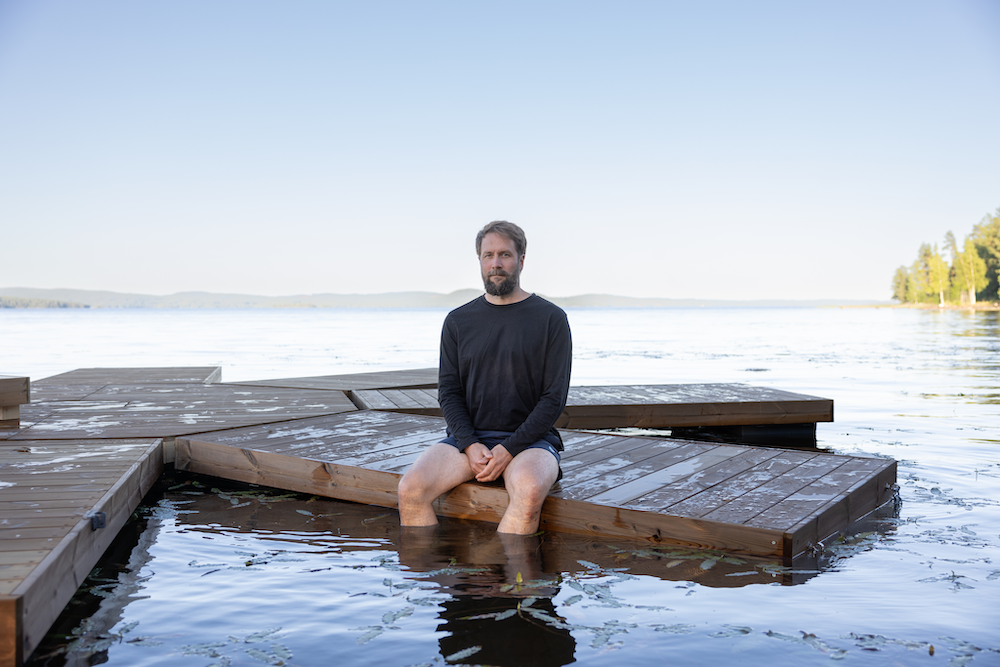
During the past year and a half, I designed and built this choreographic and architectural object, the research pier. Over the summer months I conducted artistic fieldwork with this instrument on two bodies of water, Lake Päijänne in Central-Finland and on a remote Ypykänlampi Pond in Kainuu region.
I explored physically its possibilities and affordances in relation to these specific environments, floating on the water surface. In addition to my own practice, I invited people to work with me as well as organized public events on weekends. I shared information about the research with visitors, performed dances for them on the pier, and took them on a journey to drift on the body of water. I use a small electric motor to drive the pier around. I found that the pier functioned exceptionally well as a meeting place, a structure for dance practice and choreographic work on site, a theatre (a place to see), a stage, and a sculpture connecting bodies with the natural environment.
Based on these embodied experiments and encounters with human and more-than-human, I have been preparing an installation setting to continue the work indoors and on solid ground. I documented the field work through writing, sound recordings, photography and film. I work with two artist-designers Jani Hietanen and Jani-Matti Salo towards a composition presenting the essential aspects of the research. This will happen through different media (light, sound and image) organised in relation to the object of the Pier itself occupying the central stage.
I have invited musician Pauliina Syrjälä to play Finnish zither, specifically Saarijärven Kantele during the events. We have sessions together, me dancing and Pauliina playing. We explore the potential resonance – and the communication between that which Pauliina’s music carries within and my approach to the dancing body as an ecologically orientated instrument.
There will be two guests present on different days, philosopher and researcher Maria Villa Largacha (TAU) and curator and writer Taru Elfving (CAA – Contemporary Art Archipelago). I am meeting with Maria and Taru to prepare these conversations as moments of exchange, focusing on different aspects of the research and thematics around it.
I’m also preparing simple tasks based on my long term choreographic work to be shared with the audiences through speech and imagination in the installation space. The focus will be on tuning attention into relations between sensing-feeling bodies and architecture as choreography.
Your doctoral research project aims to cultivate embodied ecological awareness through the poetic practice of dance and choreography, in relation to specific environments and their physical circumstances. Would you like to share more about this?
I perceive my own body or corporality as the closest and most intimate relation to the concept of “nature”. In old Finnish “nature” was not used as a generalizing concept, but always connected into a specificity of a certain being or place. Through this place that my body is, I can listen and connect with the surrounding environment and encounter with curiosity and empathy the other beings, forces and “natures” at play. More generally, I think of human bodies as a temporary and transforming constellation of and embedded in a more-than-human world(s).
For me dance is a practice of sense making, in an experiential way, of the entanglements and dynamic relations that sustain us as a life form, and create meaningfulness. I see choreography as a poetic practice cultivating the forms of communication through movement and with the embodied. Through artistic practice I can investigate the poetic nature of reality, so to speak. Physical reality is not only logically organised or mathematically measurable, but it is also fundamentally poetic. That is why embodied artistic research does matter.
I have been transforming my artistic practice for the past ten years to understand better how approaches to dancing and choreography change when those are taken from their contemporary environment (studios, theatres) into different kinds of places. The ecologies of site sensitive and responsive work has become the main interest. Within the field of experimental dance there is a lot of knowledge and craft on how to cultivate embodied relations with specific environments and more-than-human phenomena. My long term wish is to find pathways for that information to flow into different segments of society at large.
Thinking of the pier as such – a place that evokes beautiful summer images of hanging out there with your feet in the water, jumping into the cold blue – why did you choose this space?
The choice was influenced by my work at the ecologically oriented Mustarinda residency on Paljakanvaara in Kainuu—undertaken intermittently since 2016 and annually as part of the Rindamus collective since 2021. Mustarinda Association is a key organisation in the Vaara-Kainuu Art National Park initiative. As part of my research, I posed the question: what kind of choreographic artwork could be situated in the landscape of the future Art National Park? A pivotal insight came to me on the Lake Päijänne, when I realized that my family cottage pier—a simple, self-built structure—was a site that had for years supported my embodied and choreographic praxis in relation to the surrounding nature, its elements, and the changing conditions across the seasons. I decided to incorporate the concept of this everyday object into my research and artistic practice by reimagining its form and purpose.
Veli Lehtovaara: The Pier ~ An Amphibious Dance Vessel
Uniarts Helsinki’s Academy of Fine Arts 7.11.2026 10.00 & 14.00 / 14.11.2026 16.00 / 15.11.2026 16.00
Soup Talk 15.11.2026 12.00 @Eskus
Research, choreography, concept and design: Veli Lehtovaara
Sound: Jani Hietanen
Light: Jani-Matti Salo
Kantele, Zither music: Pauliina Syrjälä
Production: Lisa Kalkowski & Entirely Moved |Kaikki Liikkuu ry
Texts: Veli Lehtovaara, if not mentioned otherwise
Woodwork: Saku Koistinen, Veli Lehtovaara
Metalwork: Jussi Niemelä
Technical drawings: Juho Lindström, Heikki Rosti (1st version)
Collaborators: Moving in November, University of the Arts Helsinki, Theatre Academy and Research Institute (6th Research Pavilion, Idiorrhythmic Imaginaries exhibition)
Support: City of Helsinki, Finnish Arts and Culture Agency, Research Institute of the Uniarts Helsinki
Residencies: Bioart Society / Ars Bioarctica – Kilpisjärvi Biological Station / University of Helsinki and Mustarinda residency
Photo: Matti Häyrynen