Could you tell us about the starting point of this performance and the working process behind it?
Antonia Atarah: Funny enough, for me, it all started with the name. Alen Nsambu, Johanna Karlberg and I first met through working together on Sonya Lindfors’ performance ONE DROP. Johanna and I instantly bonded over being both Fennoswedes. We would often laugh about how, during morning warm-ups, we somehow always ended up working together and how, whenever we were told to “pick a pair”, we would inevitably find each other. It felt like such a classic Fennoswedish thing.
During the rehearsals for ONE DROP, our warm-ups often included house dance moves, one of which was the “Spanish Hustle”. One morning, while we were dancing house, Alen suddenly asked, “Hey, what was that dance move called again? Swedish Asshole?”
It immediately became an inside joke for us three. From that moment on, the “Spanish Hustle” was always performed with an exaggerated, forced “Swedish” smile. The joke stayed with Johanna. Not long after, she contacted me and said: “We should make a Swedish Asshole performance.” She then presented me with a performance idea exploring the liminal world of the Fennoswedes, with the Swedish Hollywood Wives as its royalty.
Alen Nsambu: As Antonia mentioned, I misheard the ”Spanish Hustle” -house dance move at the rehearsals of ONE DROP. In my chaotic head it was Swedish Asshole. Who knew it would grow into an inside joke and from there evolve into a performance. I think sometimes the best things start out as a joke or as a random occurrence. For me in the process one of the most fruitful things was the desire to co-create and work together with Antonia and Johanna. It for sure wasn’t always smooth sailing with three performance makers from different artistic backgrounds and strong personalities. But I think there can be something so beautiful in co-creation. There’s the potential to giving birth to something completely different and new when it’s multiple directors rather than one person setting the course for the boat. In the rehearsals we had different methods of co-creating. We brought different references and entry points to the table while trying to figure out the landscape of the work together. With an emphasis on trying to figure out. I think the three of us still see the piece from different points of view, but I think that also brings volume and dimension to our individual characters and materials on stage.
Johanna Karlberg: Yes, the Swedish Asshole joke stayed with me and started to grow into an idea for a performance. We also sent a lot of reels and memes with Swedish Hollywood Wives (a reality tv-show that ended in 2019) and were laughing about the ignorance and drama in the show. The idea that took shape was on one hand “wouldn’t it be fun to make a performance that kind of is a joke in itself about the Swedish Hollywood Wives and use that material as an allegory for the Fennoswedish culture and social code”. On the other hand, the idea was anchored in the politics of the body and questions about perceived neutrality. What dynamics and hierarchies are born on stage and how do the performers’ bodies and perceived identities impact how it is seen? This work is very much inspired by all the work I’ve done together with choreographer Sonya Lindfors; by her thinking and practices that stretch so much further than the stage.
The common denominator between the Hollywood Wives and the Fennoswedes is the unawareness of their own privileges and status – us Fennoswedes even tend to see ourselves as victims and as being oppressed when we don’t get customer service in Swedish. However, statistically we live longer, are happier, wealthier and more educated than the Finnish speaking population. On the surface we play with the Fennoswedish stereotypes and Hollywood Wives, but the work is dealing with themes of competition, belonging, power play, social dynamics and hierarchies.
Another starting point for the work was what I heard the former professor of the Swedish acting programme at the Theatre Academy used to say “art is easy, anything can be art”. And I thought, that’s such a Swedish Asshole thing to say – and it turned into the motto of this artist genius character – an artist who just is inspired by anything, makes art about it and is super convinced of the value in and the importance of their own art.
You describe the performance as a mindset, as a practice. Could you tell us more about this?
Johanna: Swedish Asshole, the character, is an antagonist who has both an inferiority complex and delusions of grandeur; a daunting and inspiring contradictory limbo. The character is caught in the liminal space between identities – not really Finnish, not really Swedish and constantly shapeshifting to fit in and trying to find the ultimate Swedish-ness. The practice is like an ongoing method acting—LARP, with the mindset “art is easy, anything can be art” and just embracing the delusion. The mindset is to be delusional – drink the champagne and have the caviar and tomorrow is another day! I work with this höpö-höpö practice (nonsense or blah blah) which is a practice of tapping into nonsense and silliness, kind of fooling oneself out of the rational, logical doing and thinking, and opening the portal to the nonsense.
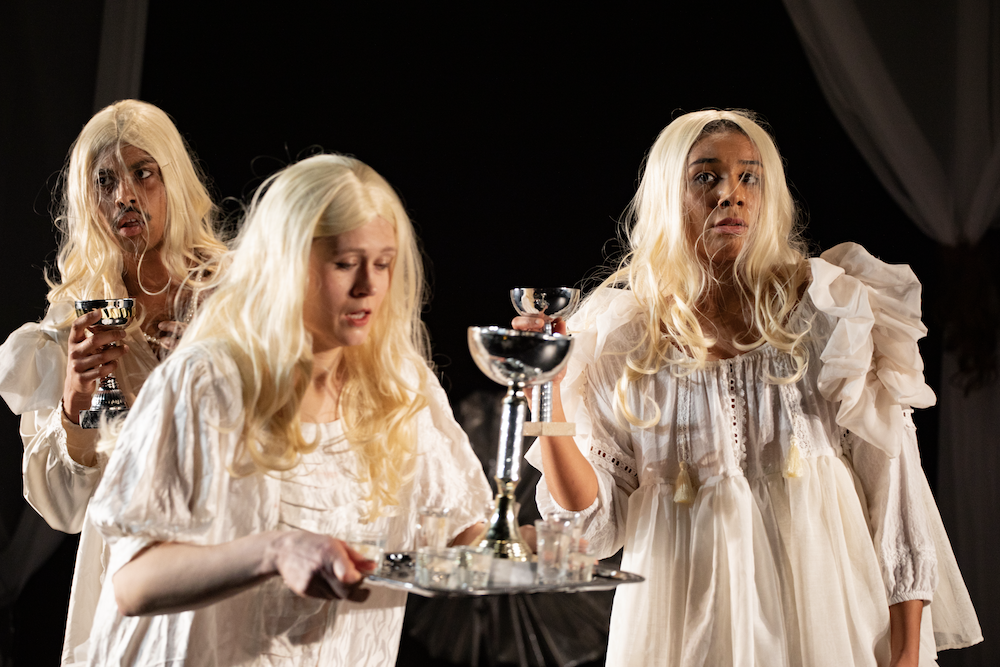
Most of the material in the work is based on improvisational scores and just playing together as the Hollywood Wives and artist geniuses, with the wigs, talking about shopping, champagne and our made up artistic practices, and like this creating our own antagonist characters. We worked a lot with audacity and testing boundaries with ourselves and each other as performers. How to be the antagonist? We practiced not being so nice and likeable all the time, to be ful och äcklig (ugly and disgusting) to work with this monstrous, jester-like, ignorant, audacious mindset.
Antonia: It is difficult, there are so many mindsets or practices that could describe this performance: “delusion”, “enfant terrible” etc., etc. But I maybe have to pick one that has stayed with me because there is something about it that resonates with me and my interest in what we see as artistically valuable. It all came from a bad review that we got from HBL. The headline said : “Swedish Asshole är mer fjantig än provocerande” roughly translated, “Swedish Asshole is more silly/foolish than it is provocative.”
And this idea of silliness/foolishness as an active practice really stayed with me. There is ongoing research about memes and how this culture that we see as simple or silly can actually carry broader social and cultural discourses and gives new information on how we process issues in our world today. I find that using this “silliness” and the things that we as artists find funny and enjoyable is a way to investigate the different layers and absurdities of our topics. My friend actually said it well after they saw our performance: “This was so great, the world is such a fucked-up place.”
Alen: For me performance as a practice as a mindset is very evident as a non-Fennoswedish person in this working group. Last spring when the performance was published and Teater Viirus was the place for premiere, many people suddenly thought that I am Finlandsvensk. However, I am not. In a way I’d love to be, because there are way more arts funding and resources that would be available for me to apply from. But then we started joking that what if I just pretend that I am Fennoswedish. Give in to the delusion. Be the Gunilla of your own life. Let people be confused. Take space. The audacity.
For me it’s like a long improvisation where you say yes with a big not-always-so-genuine-smile and just go for it thinking you are really good at it. And that became a practice of mine to navigate the process as well as the performance. In the performance my character is trying to find the long lost swedishness or, as I like to put it, the Swede deep inside of me. There are all these ideas of what it could be and what is the right way to be Swedish. Achieving the ultimate swedishness is the goal. There are so many traditions, norms, societal codes and hierarchies that I didn’t know before, so being a Swedish Asshole at rehearsals was a method for me not to go crazy and to be able to access the lightness and play in the process. I also don’t speak Swedish, so there were some challenging moments. As Johanna and Antonia point out, there is this huge identity crisis going on with the Swedish Asshole and so many coping mechanics in trying not to reveal the crisis within, you need to be classy while simultaneously things are falling apart in the picture perfect Hollywood-wife set.
For our international guests, could we speak about belonging, specifically about the caricature of the Swedish-speaking Finn you are working with, and its heritage?
SWEDISH ASSHOLE: We are a very happy, linguistic and cultural minority in Finland. Our culture is directly based on the colonial remnants of the Swedish rule over Finland. Traditionally we Fennoswedes are the upper-class, the landowners and the old money. Even though we are a very small minority, only 6% of the population, we Fennoswedes statistically live longer because we have a strong sense of community, and we generally feel happier (sometimes due to generational wealth). But there is also something hidden in this happiness. We are seen as always being “unpartial” and as people who try not to create dålig stämning; a bad atmosphere or vibe. We don’t necessarily want to bring up unsettling or rough subjects. It can become very “I don’t see color.” So it has been interesting to try to create this “bad atmosphere” through the piece and see what lies underneath the surface.
Johanna: Fennoswedes are said to be the most privileged minority in the world. My background is very working class and growing up it became clearer and clearer to me that I don’t “belong” to the (elitist) fennoswedish circles. It is all about the right things – the right contacts, the right summer villa, the right clothes, the right taste in Swedish pop music etc. So it works in the same way as any other exclusive social group. Although, Fennoswedes as a group see themselves as open minded, inclusive and tolerant – even though we are not. For example, racism as an oppressive structure is often denied amongst us because it is considered bad to be racist (and Fennoswedes are good) So, how the values make us look is more important than how we actually act.
Antonia: I feel that the piece uses fennoswedishness as a reference point for our need to belong, our value of traditions, and our blind spots when it comes to solidarity. All of us, in one way or another, bring an outside eye to Fennoswedish culture and its social norms. As an Afro-Fennoswedish person, a term that has only recently become something that we as a community use, I have the complexity of being part of a minority within a minority. And on top of that, one is a privileged minority while the other is an oppressed one. The Fennoswedish minority is very white, and growing up within that can mean that your experiences and networks are very different from those of an Afro-Finnish person. So not quite fitting in has been a big part of my Fennoswedish experience, while at the same time having this weird, almost “patriotic” feeling of being Fennoswedish.
SWEDISH ASSHOLE: But we have also created a beautiful, multidisciplinary bond through Fennoswedish culture in this piece. Our culture has a very strong choir tradition, and our sound designer Leissi brought early on the desire to work with a choir. He reached out to Akademiska Sångföreningen, a male choir which also happens to be the oldest choir in Finland, and they were instantly very interested and engaged to be a part of our piece and said “it’s exactly the kind of collaboration they want to do”. The singers came to one run-through before the premiere and the collaboration worked so well even though our traditions and contexts differ from each other a lot.
Alen: I actually can’t speak Swedish. Like at all.
Johanna Karlberg, Antonia Atarah & Alen Nsambu: Swedish Asshole feat. Akademiska Sångföreningen
Caisa 14.11.2026 20.00 / 15.11.2026 20.00
Soup Talk 10.11.2026 12.00 @Caisa
Concept, artistic idea, and facilitation: Johanna Karlberg
Directing, choreography, and performance: Antonia Atarah, Johanna Karlberg and Alen Nsambu
Sound design and music: Nicolas Leissi Rehn
Choir: Akademiska Sångföreningen
Light design: Kristian Palmu
Spatial design: Mikko Salminen
Costume design: Mirjam Yeboah
Dramaturgy: Even Minn
Production: Johanna Karlberg
Supported by: Kone Foundation, Arts Promotion Center Finland, Svenska Kulturfonden, Konstsamfundet
Residencies: Davvi – Senter for scenekunst, Hammerfest (Svenska Kulturfonden, Finsk-Norsk Kulturinstitutt), Kanuti Gildi SAAL, Tallinn (Suomen Kulttuurirahasto)
Visit with the support of Moving in November
Photo: Venla Helenius
Visit in collaboration with: Caisa