Iver and Marit, I am curious to read how you start working on a new creation?
Marit Sandsmark: Our new creations are often initiated either with proposals consisting of different impulses that speaks to a wide range of practices and threads or with one main topic/idea which gets dissected becoming more complex as the process starts. With an approach that strives to give equal weight to different practices, we start developing scores by improvising, creating dialogues between the elements where the intuitive, playful and in the moment (live) aspects play a big role, are important factors.
Iver Findlay: It’s a little different every time, but for the recent iteration series it’s been unique, as there was a desire to work with material(s) over a longer period of time, and allow ourselves to work with and define the intersection between the choreographic and the visual and audible. Also to investigate and unravel certain ways in which Marit and my artistic practices unfold and relate and build or cooperate with one another. I think this also expands to certain ideas around the curatorial and community project of RIMI and Flørli in some way.
Before the iteration series we started with a strong conceptual framework and premise and then plugged away improvising or working with the live composition of material and relations between artistic actions (movement, sound, visual, light, etc) over and over until we arrived some place, sort of exhausting the possibilities (and ourselves).
Some of these starting points were how to achieve an impossible task such as hypnotize the entire audience as a group, or create a room sized dream machine the audience could exist inside or dissect nostalgia for the present or prove that death does not exist. So, sort of general foolishness to try to start from a beginning point we knew was impossible but believed would instigate an entertaining or rewarding outcome. Rewarding for us, but also eventually in alchemy with the audience in live composition or kinship.
The new project we have just started this summer is a knew direction and amalgamation of the different approaches, utilizing a mobile residency over a couple of weeks in the American west to create a common experiential collectively between the core artists exploring the concept of ‘dead roads’. This also harkens back to some early projects where we used ‘field studies’ as a culling of development material which related thematically or geographically to landscape or place. Also embracing the impossible, working towards the ineffable.
You create your own performances, you run a venue in Stavanger: RIMI SceneKunst, a space for your own creations, a residency place, and also a place where you show performances. You also organise a yearly festival: Outpost Flørli in the Norwegian fjords, bringing together artists to show and share works with and for each other (and an audience).
I perceive all these different activities as deeply connected. Could you share how all this comes together for you, and what the urge is that drives you to engage with all these different aspects?
Iver: Yeah, we sort of imagine the RIMI and Outpost projects as extensions of our artistic work, and a necessary approach to create exchange and meeting places between our local and extended community. And we try to treat the RIMI and Outpost projects as if there were expanded artistic projects. They also act as a survival tactic and experiment, with a strong drive to align with how and where we want to make our work and our experience with community.
When I was growing up in America in the early 80’s there was a health slogan ‘you are what you eat’ which I take now as ‘the work is where you make it’. If you work in a house sponsored by oil companies and corporate capitalist structures then this must also influence the artistic work in some way.
Stavanger can sometimes feel like a void. It’s easy to want to make an ‘outpost’ in New York, or say Oslo…. it’s quite another to create what doesn’t exist and you think you need and is necessary for a liveable society in a place that is provincial like Stavanger or a ghost village like Flørli.
Also when you live in Norway, in Stavanger the nouveau riche part of one of the most nouveau riche countries in the world you understand what tremendous possibility and potential the system can offer to you. And Marit and I both coming from working class backgrounds, we never felt comfortable or satisfied with only making art as a enough.
There is almost a certain self-shame in the complacency or privilege in the cultural field, especially in Norway, and the idea that proliferates in ‘Hygge’ or ‘koselige’ culture that you feel like you should work harder or achieve more. And then when what you feel like is necessary or missing or lacking in the prevailing culture, institutions or society, there is a strong pull to create that space and share the possibility and opportunities that are available. It seems like there is so much other potential and possibility to help create space and community and instigate a counter position to dominate, conformist capitalist viewpoints of artistic institutions, which in the Norwegian context seem to exist to coddle and infantilize people or mostly there to give everyone warm fuzzy hugs. And we love warm fuzzy hugs and taking care but we also feel the need to dream, be compelled to other voices, other experiences and to welcome critique and a conversation a better place for all people as hokey as that may sound.
Marit: We are for sure entertaining many ideas/activities and dreams at the same time and there seems to be a symbiosis between them, where they feed and inspire each other- but sometimes also having the opposite domino effect where it feels overwhelming with questions and doubts about the overloads that tends to come in waves.
Our work is in general very process driven, and some of these initiatives started by grabbing opportunities in the moment- bridging and blurring our personal lives in a way that makes it all become a sort of lifestyle. Our own need as artists to find a space that would allow us to let the work evolve over longer time and also seeing tendencies from institutions moving the other way of shortening periods in the studio,- and also relating to artists in ways we found problematic, was a big motivator for starting the RIMI/IMIR SceneKunst. The desire to create a space where we could feel free naturally made us want to share it with others and also present other artists work based on grounds where conversations, connections and a deep respect for freedom of expression were anchoring points, and important statements in a city where capital and commerce is easy to digest, but not art unless it gets wrapped into some other package that can be sold and consumed.
As for the festival in Flørli, it started in a similar way with a friend and colleague who used to reside there for 15 years and having arranged performance gatherings in a smaller scale and insisting on the presence of art in nature and not only for hiking and the experience of amazing spectacular views from the mountains. When she made it clear she was planning to move we had an urge to share this place and continue her efforts in bringing artists to present work and spend time together and we managed to restore some studios to be offered as residencies.
Again, we started something that felt natural as part of our journey and not something that was first planned on paper – and so, it also speaks to the process guiding our work and not too much the other way with forcing ideas but rather wanting to grow with the idea than growing to fit an idea being placed on top which create more facades than real and honest outcome.
Your performances are often hybrids, existing between several art forms. They create space for dreaming and simply being with the experience beyond the immediate need to interpret it. Can you elaborate on this?
Marit: As a performer, being a body in the space, there is an attraction to the ambiguity that arises in the meeting and dialogue between movement and sound, movement and material, stenographic elements and other bodies. There are often layers that can speak to certain ideas and a desire to create a feeling and understanding of some kind of logic in the work without it being something that needs or is possible to pin down with words. For me the work is a reaction to the journey I experience as a human moving through the world and the constant negotiation that is happening between the body and the material, also to the world consisting of a wide range of emotions that is hard to explain with words.
Iver: Sharing real time and space with people is just about the most valuable thing I can think of at this particular moment. And we are interested in the circulatory system between art forms to create the spiritual, the ineffable, the intangible spaces that cannot exist on their own. I think in broad terms the idea of intersectionality and how things relate is only a positive thing to explore and exist in, instead of mono renderings of what is around us or out there. Somehow moving away from purity and individualism and the traditional.
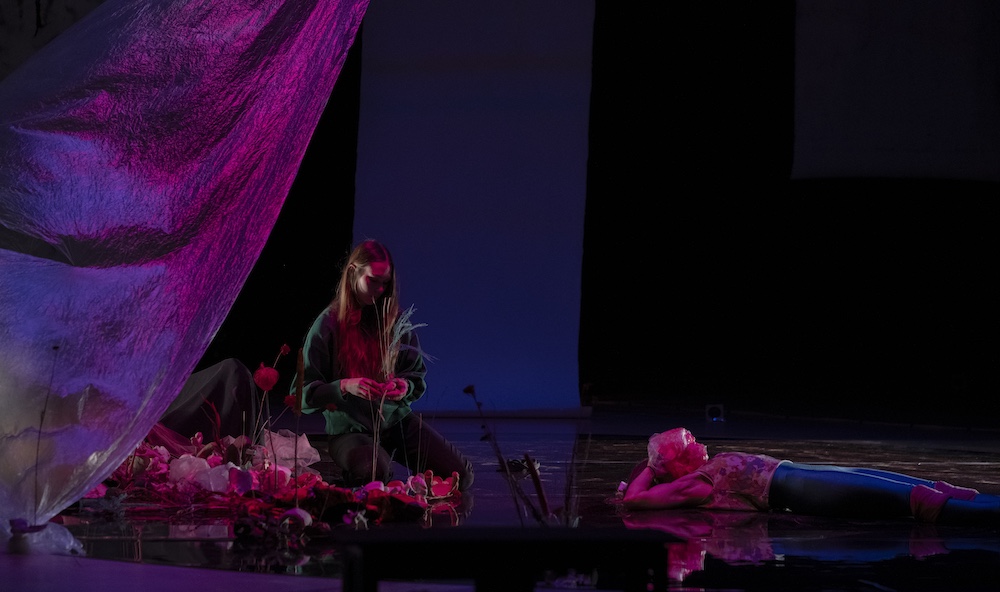
Findlay//Sandsmark: broken (iteration III – for Helsinki)
Mad House & Reality Research Center 13.11.2026 21.00 / 14.11.2026 22.00
Soup Talk 14.11.2026 12.00 @Caisa
The work involves: Marit Sandsmark, Iver Findlay, Fabrice Moinet, Jean-Vincent Kerebel, Greta Jasaite, Peter Warren and Oda Olivia Øverbø Lindegård
Additional programming: Dag Egil Njaa
Co-production: Bergen Internasjonale Teater, Rosendal Teater og RIMI/IMIR Scenekunst
Thanks to Elia and Avery Findlay
Supporters: Norwegian Arts Council, Rogaland County Council, the City of Stavanger
Photo:Oddbjørn Erland Aarstad
Visit supported by: The Finnish-Norwegian Cultural Foundation, PAHN (Performing Arts Hub Norway), Norwegian Ministry of Foreign Affairs
Visit in collaboration with: Mad House Helsinki & Reality Research Center