Chen, how was the idea for this performance born?
The urge to bring this ritual into my artistic life was there for a long, long time. I felt this ritual was drifting away from me, and I wanted to call it back. Living in Finland for a few years, I missed the community I used to feel so strongly through Henna gatherings, celebrations and transitional ceremonies (death rites, holidays…). I wanted to find my way back to that, and thought of a form where I – and others – could experience it from a different perspective. I was driven by the thought of this specific gathering and ritual in this particular context; what it can offer to performance, choreography, today?
The first clear initiation came during my first year of my MA in choreography studies at TeaK in Helsinki, 2023, where the task was to create a solo connected to one’s own roots. The second came when I was invited to facilitate a gathering-workshop connected to this research, a three-day workshop at ImPulsTanz Vienna International Dance Festival, 2024. That experience helped enormously! I had to ask myself what is the core of this ritual for me, how it connects to today’s atmosphere, and what is missing in today’s social, academic, and artistic circles. From there I unpacked and translated its gestures into embodied, dramaturgical tasks around encounter- for duets, for groups, for individuals.
For almost four years now, the solo/gathering has kept evolving – into a duet with two different performers and friends, and back into a solo… At a certain moment I was asking myself; is this a never-ending research? The versions kept changing, as did the audience’s participation and relations. I kept digging, replacing, experimenting while performing and testing it with others. This is the longest research I have been “living” with…
Could you tell us more about the origin of the Moroccan henna ritual you are working with in this performance? And also how you are integrating it in you are my eyes?
The Henna ritual is a social ceremony carrying folk-symbolism and a strong sense of community – a tradition older than any of the religions that later adopted it, shared and reshaped across Jewish, Muslim, and other communities in North Africa, the Levant, and the Mediterranean. Practiced differently across many other cultures too, here I’m referring specifically to the Judeo-Arab version of it, as practiced in Morocco, Algeria, Iran, Iraq, and Yemen. I grew up with it through my father’s and my grandmother’s Moroccan ancestry.
Traditionally for women only, it included live music, dancing, a feast, and embroidered clothing. Guests would alternate between seeing and being seen – dancing, playing music, or simply witnessing and chatting with one another. At its core, it was a meeting: a celebration of a new life beginning, strangers from two different families growing close.
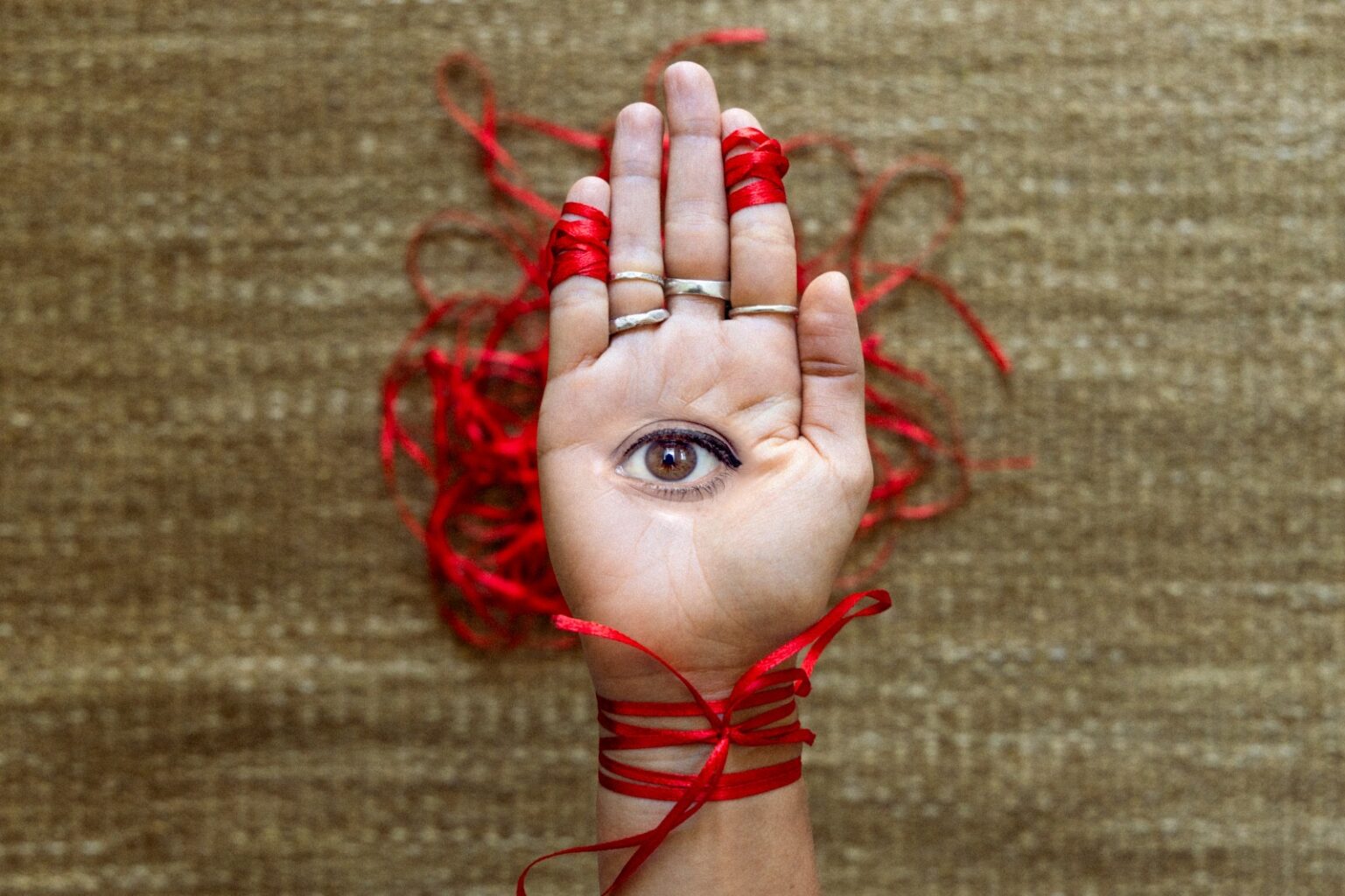
Henna, a vegetable-based paste, is central to it, believed to protect against the evil eye and against djinn, supernatural spirits in Arabic and North African folk belief. The bride’s palms, as well as the palms of all the guests, would be decorated in a circular pattern. At the end of the night, guests took home a small piece of fabric wrapped around their hennaed hand, to be washed off only at home– a mark that can stay for weeks… a physical memory, a blessing carried out of the gathering.
In the research of you are my eyes, I question, deconstruct, and re-create the ritual in connection to who I am today – it is also a real challenge: how do I bring a performance closer to this specific gathering, and let a gathering find its way into a performative space? Dramaturgically, the performance is made from an invitation to witness followed by a participatory part where the audience and I actually experience the Henna ritual in a different setting and frame. Working with this ritual as an embodied knowledge connected to my ancestry, I let my body navigate movements and memories that echo through those rites, engaging with exposure and nudity politics of the body as spectacle versus the body as agent. At the same time, my body holds a mix of multiple practices and lineages: Western dance and somatic techniques, Yemenite dance, social and circle dances, Romanian hora, and Moroccan dances, as well as gestures from gatherings and ceremonies. I let them “visit,” come and go like waves crashing on the shore and pulling back into stillness, transforming my “historical body” as it meets the audience.
As music and dance are so closely related in those traditional gatherings, I worked hand in hand with the percussionist João Luís, who created the sound landscape and music composition influenced by those rituals and Andalusian music. We also work with an original recorded song from those celebrations by Moroccan singer and poet Zohra El Fassia.
Roles in these ceremonies were fluid and interchangeable, but a dancer still carried a distinct kind of responsibility even within that fluidity – channeling the weight of the community’s celebration and grief through their body. My piece plays with unsettling and redistributing that responsibility. I work with the principle of the gaze as a source of connection, invitation, entertainment, or separation, and challenge the “permitted” exposed body of a woman in the Henna Ritual tradition.
You are very interested in encounters with others, working and thinking together, and in collaboration. I am curious to hear more from you about this.
Encounters with others feel both tragic and magical to me. In these catastrophic political, ecological and social times, I keep asking myself: how do we meet? How do we collaborate today? Sometimes it seems impossible. Working with the friction of encounter allows me to connect life to the art and vice versa, and to my own transcultural, geo-political existence. The so-called bubble of art-making isn’t a bubble once I bring these questions into the studio: into the concept, the artists I collaborate with, the way of working. Reflecting and acting from this place is, for me, an ethical commitment I carry at all times.
Having transcultural roots, I live with “many” inside one body. Because of this, I don’t belong, or maybe I belong everywhere… This complex identity means I’m constantly learning (or failing) how to collaborate with all these parts of myself – and that process echoes in the work I create. How to share, what to share, on what terms: these remain fragile questions I keep returning to… My lived experience keeps bringing me back to moments where the encounter didn’t happen. The more I asked questions and tried to meet, the more I was silenced. At their core these are questions of identity, use of power, otherness, diaspora, control over the moving body. The performance sphere lets me sit with them, work through them – engaging with the emotional, energetic, spiritual and political dimensions of human encounters.
There’s always something in the other I can’t fully grasp, and that not-knowing keeps me curious. That tension is present in the space of creation, being examined, being practiced. Meeting another holds a surprise; it’s never what you expected. The performative gesture works in a similar way. There’s something exciting about being exposed, about transforming in front of others’ eyes, about not knowing what each constellation will bring. To fail, to fall, to rebuild, to stay in the in-between – our demanding society rarely gives us room for that. Performance can still.
Chen Amor Nadler: you are my eyes
Theatre Museum 11.11.2026 18.00 / 12.11.2026 18.00 / 14.11.2026 10.00
Soup Talk 7.11.2026 12.00 @Caisa
Choreography, performance: Chen Amor Nadler
Original music composition: João Luís
Recorded live track: “Sidi Habibi,” performed by Zohra El Fassia (original 1950s recording)
Sound design and mixing: Daniel Motola
Set design: Tua Holappa
Lighting design: Katinka Ebbe
Costumes: Chen Amor Nadler, Tua Holappa
Co-production: Moving in November
Thanks to: Kadence Neill, Jacqueline Aylward, Daniel Motola, Family close and far
Photo: Daniel Motola
In collaboration with: Theatre Museum
The work was developed during a residency at Workshop Foundation in Budapest (2025), supported by Moving in November and Life Long Burning – Futures Lost and Found, funded by the European Union, and as part of Dance Legacy Reset Camp, organized by Liisa Pentti +Co in Helsinki (2026).