Could you tell us about the background and starting point of your performance? How did you research and develop the material together with the four performers? How did you choose Emma Tricard, Folly Romain Azaman, Dalila Khatir, and Adélaïde Desseauve, aka Mulunesh?
It all began in 2023 with an invitation from Maïté Rivière, then director of the Quartz Scène Nationale in Brest – where I was an associate artist – to create a project aimed at young audiences. In response, I asked myself the following question: What do I want to pass on to the younger generation? Quite quickly, I decided to approach this project as a continuation of my two previous pieces, Mascarades and Lessons of Darkness, each of which explores colonial history through different lenses. I asked myself: How is colonial history taught in schools today? What relationship do younger generations have with history? I began to look into both educational science and how the teaching of history in schools has evolved over time. I was also inspired by bell hooks’s pedagogical thinking in her book Teaching to Transgress. In this work, she discusses her experience as an activist teacher and the relationship between theory and personal experience. For bell hooks, theoretical thinking must be linked to individual experiences in order to go beyond the mere acquisition of knowledge. In this book, she also discusses the body in the classroom at length; bringing back the personal and the experiential also means restoring a place for the body in a space where it tends to be sidelined in favour of purely theoretical content.
I have known Emma Tricard since I was a child, as she is my ‘white cousin-sister’.
I met Folly Romain Azaman for the first time in 2021 in Cotonou, Benin. At the time, I was on a research residency for my piece Lessons of Darkness. Together, we shared dances, songs and stories linked both to the history of the Kingdom of Dahomey (now Benin) and to the Vodoun faith.
I have known Dalila Khatir for several years and we have already worked together on several occasions, notably on the dramaturgy and vocal work for my two previous shows.
I met Mulunesh in 2023 during the touring of my piece Lessons of Darkness. This encounter led me to continue my exploration of Krump dance, its history, its energy and its ability to turn dance into a form of expression, to transform violence.
I proposed them to create a portrait of them because I love them and because I felt they had a lot to tell through their bodies, voices and singular histories…
We all started the process with a moment of interview that was a starting point for me to write a text for them. I also proposed them different ways of exploring and finding the dances that was inhabiting their bodies in relationship with the stories they were sharing with me.
Originally, the four portraits were made for an educational context, to question how colonial history is taught and approached in French schools. At a certain point, you decided to also create a stage version of the four portraits. I am curious to understand, from your perspective, how did your perception change when staging the four portraits, and perhaps also what changed for the performers?
When I decided to bring the four portraits into the theatre I was thinking of two things: the first one was that I wanted to propose to the audience to see the four portraits in row. Which is not possible in the school context. The second one was that when we started to present the pieces inside schools I quickly felt that these portraits were addressed to young people but not only. I felt that the theatre context could also give the possibility to present the piece in front of people from different generations at the same time. And that could enrich the reading of the pieces.
In the theatre version, the stories echo one another directly. But it is also the audience, as the recipients of these stories, who are led to make the connections between them. Thanks to the dates provided as reference points, the audience is free to draw their own parallels.
When performing these portraits in schools, could you share some of the reactions, feedback and discussions that followed?
When the portraits are presented in school, the discussions are led through an invitation to write a word or a sentence in relationship with what the youngsters saw, felt or imagine during the performance. I will share some of the reactions we received:
FEAR, WORLD, FUNNY, MAP, HISTORY, WEIRD, BEAUTY, JOY, SURPRISED, RESISTANCE, FREE WOMEN, NATIONALITY, KING, MOVING, MELANCOLY, PROXIMITY, MYTH, AUDACE, PRIDE, DIFFERENT, INSPIRING, ALIVE…
Is this your true story?
Do you feel emotional when you’re performing this show, when you’re talking about your family?
Was this our History?
Behind every dance lies a story.
Where has the world gone?
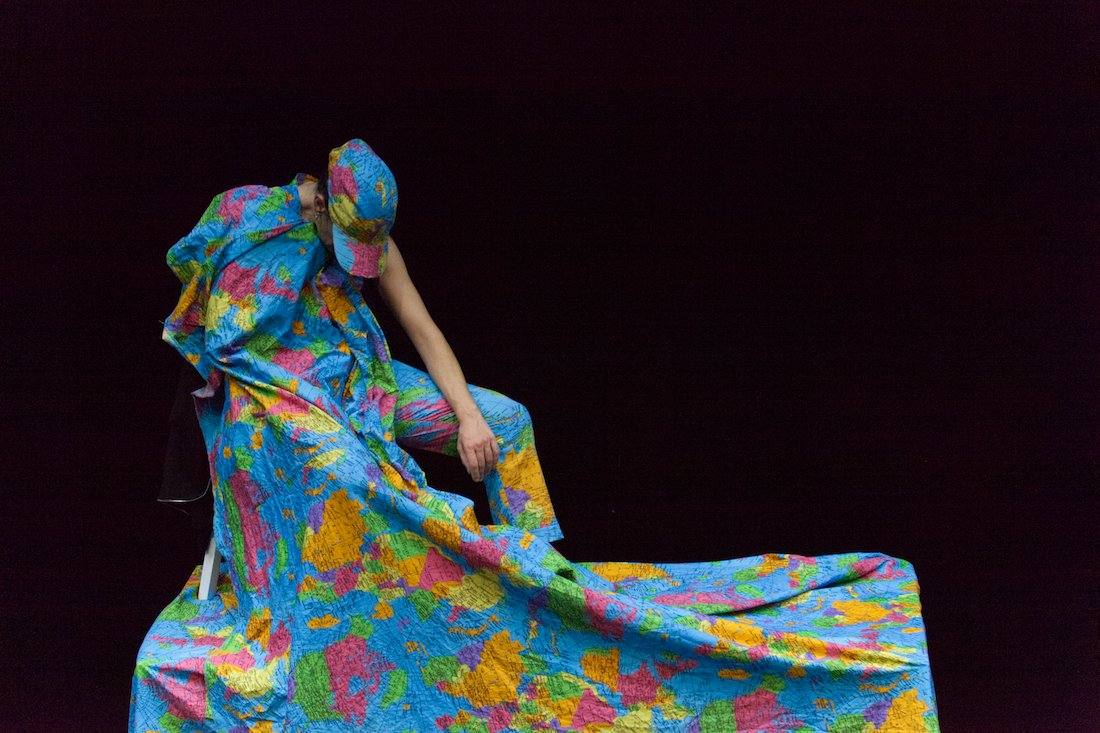
Betty Tchomanga: Decolonial (Hi)stories #Parallel Portraits
Stoa 10.11.2026 18.00 / 11.11.2026 18.00
Soup Talk 11.11.2026 12.00 @Caisa
Directed, choreographed and written by: Betty Tchomanga
Artistic collaboration and performance: Emma Tricard, Folly Romain Azaman, Dalila Khatir, Adélaïde Desseauve aka Mulunesh
Lighting design: Eduardo Abdala
Sound design: Stéphane Monteiro
Set design and props: Eduardo Abdala and Betty Tchomanga in collaboration with Vincent Blouch
Construction: Emilie Godreuil
Costumes: Marino Marchand in collaboration with Betty Tchomanga; Théodore Agbotonou (costume of Folly), and Mariette Niquet-Rioux (mask of Mulunesh)
Stage management: Stéphane Monteiro
Lighting manager (alternating): Eduardo Abdala and Tatiana Carret
Sound engineer (alternating): Stéphane Monteiro and Maëlan Carquet
Trainee assistant director: Ariane Chapelet
Executive director: Marion Cachan
Production manager: Florentine Busson
Administrator: Marion Le Guerroué
Acknowledgements: Bureau Aoza, Maxine Le Tyrant, Anouk Le Cann, Rosalie Olivier and the technical team of Quartz – scène nationale de Brest
Production: GANG
Co-production: Le Quartz Scène nationale Brest, Les Rencontres chorégraphiques internationales de Seine-Saint-Denis, Le Gymnase CDCN – Roubaix, Le Triangle cité de la danse – Rennes, Danse à tous les étages CDCN itinérant en Bretagne, La Maison danse CDCN Uzès Gard Occitanie, CCAM scène nationale de Vandoeuvre, Théâtre de la Bastille – Paris
With the support of: Le Mac Orlan – Brest, CAC Passerelle – Brest, Collège Saint-Pol-Roux – Brest, CN D – Centre national de la danse, European program Choreography Connects
With the financial support of: Ministry of Culture – DRAC Bretagne, Brittany region and the City of Brest
Visit supported by: Institut français / PIDA, R.O.M, Spectacle Vivant en Bretagne, Adami, the Icelandic-Finnish Cultural Foundation
The work is shown at Moving in November and at Reykjavík Dance Festival through a collaborative curation process. First programmed in Helsinki, Moving in November sends the work to Reykjavík to continue the tour.
Visit in collaboration with: Stoa
Photo: Grégoire Perrier